
Enterprise Imaging Solutions Market Report Scope and Overview:
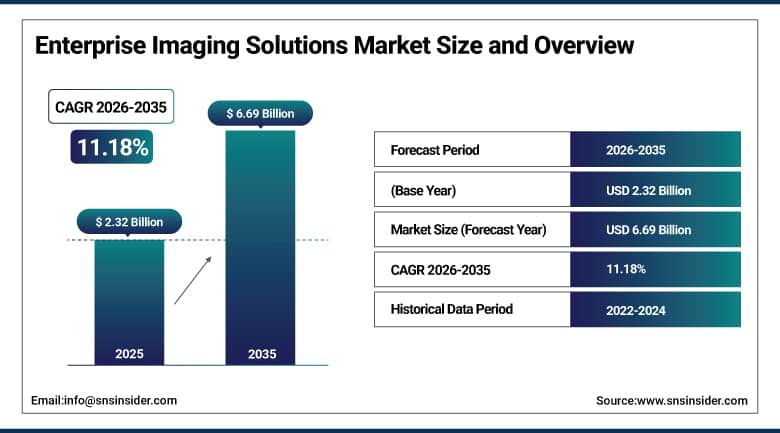
The Enterprise Imaging Solutions Market was valued at USD 2.32 Billion in 2025 and is projected to reach USD 6.69 Billion by 2035, registering a CAGR of 11.18% from 2026 to 2035.
The Enterprise Imaging Solutions Market is revolutionizing the process of capturing, storing, and communicating diagnostic imaging information by integrating diagnostic imaging information from various radiology, cardiology, pathology, and point-of-care imaging silos into one platform interoperable with electronic health record platforms. Enterprise Imaging Solutions Market is typified by the rapid shift from traditional picture archiving platforms to vendor-neutral archiving and cloud-based solutions, incorporation of artificial intelligence in image evaluation processes and workflow automation, and mergers and acquisitions of industry leaders. Growth is observed in hybrid and cloud-native imaging solutions, multi-facility imaging consolidation, and artificial intelligence-based pathology identification modules.
⮞February 2025: Siemens Healthineers introduced Syngo Flexinity ahead of the European Congress of Radiology 2025, offering flexible access to its imaging software portfolio through Syngo Flexinity for CT and MRI and Syngo Carbon Flexinity. The offering supports scalable software deployment and standardization across healthcare imaging environments.
To Get More Information On Enterprise Imaging Solutions Market - Request Free Sample Report
Enterprise Imaging Solutions Market Trends
-
Rapid migration from legacy PACS toward vendor-neutral archives continues consolidating fragmented departmental imaging systems.
-
Growing integration of AI-powered image review continues automating diagnostic workflow and pathology detection tasks.
-
Accelerating cloud-native and hybrid deployment adoption continues replacing traditional on-premise-only imaging infrastructure.
-
Rising vendor consolidation through large-scale acquisitions continues reshaping the competitive enterprise imaging landscape.
-
Expanding multi-site health system imaging consolidation continues supporting population health and specialist collaboration initiatives.
U.S. Enterprise Imaging Solutions Market Outlook
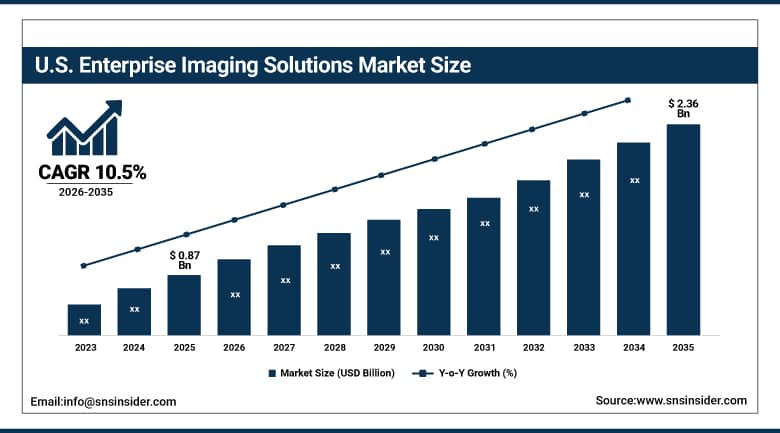
The U.S. Enterprise Imaging Solutions Market was valued at approximately USD 0.87 Billion in 2025 and is projected to reach approximately USD 2.36 Billion by 2035, registering a CAGR of approximately 10.5% from 2026 to 2035.
Demand across the United States continued to be shaped by a dense concentration of large multi-hospital health systems, substantial healthcare IT investment, and strong government initiatives supporting interoperable electronic health record integration. Rising deployment of cloud-native and AI-enabled enterprise imaging platforms by leading academic medical centers and multi-site health systems continued reinforcing the country's position as both the largest and most technologically advanced enterprise imaging market. Growing adoption across diagnostic imaging centers and ambulatory surgical centers added further layers of sustained domestic demand well beyond the technology's traditional hospital-based radiology use case, with expanding cardiology and oncology imaging consolidation increasingly relying on unified enterprise imaging infrastructure.
⮞March 2026: GE HealthCare completed its USD 2.3 billion acquisition of Intelerad, expanding its enterprise imaging software portfolio across hospitals, ambulatory imaging centers, and teleradiology providers. The transaction strengthens GE HealthCare's cloud-first imaging capabilities and recurring software revenue opportunities.
Enterprise Imaging Solutions Market Segment Analysis
-
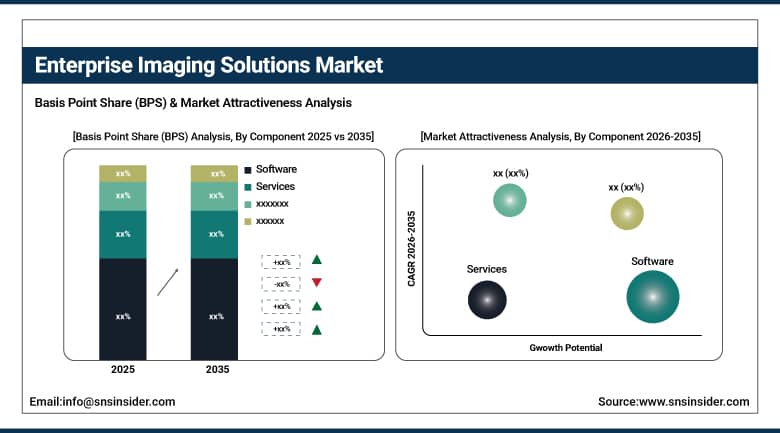
By Component, Software segment dominated the Enterprise Imaging Solutions Market in 2025 with 58% share; Services segment is the fastest growing segment.
-
By Deployment Mode, On-Premises segment dominated the market in 2025 with 61% share; Cloud segment is the fastest growing segment.
-
By End-User, Hospitals segment dominated the market in 2025 with 64% share; Diagnostic Imaging Centers segment is the fastest growing segment.
-
By Application, Radiology segment dominated the market in 2025 with 52% share; Cardiology segment is the fastest growing segment.
By Component: Software Leads, Services Emerge as Fastest-Growing Segment
The Software segment was the largest in terms of share in the Enterprise Imaging Solutions Market in 2025, attributed to the progress that was made in the area of AI-enabled imaging analytics, vendor-neutral archiving solutions, and workflow orchestration tools which serve as the core value offering of enterprise imaging implementations. The popularity of licensing models and developments in features among leading vendors' platforms ensured the predominance of software in the contribution to market spend. Increasing usage of machine learning components for automated pathology detection and workflow prioritization added further to the software lead.
The Services segment is the fastest growing in the Enterprise Imaging Solutions Market owing to rising demand for implementation, data migration, and system integration support as health systems transition from legacy departmental PACS toward unified enterprise imaging platforms. Growing complexity of multi-site health system imaging consolidation projects is driving substantial consulting and managed services engagement alongside core software licensing. Rising vendor emphasis on ongoing training, technical support, and cloud migration services continues extending the value captured from existing software and hardware investments across large, multi-hospital health systems.
⮞October 2025: The U.S. FDA granted 510(k) clearance to AGFA HealthCare Enterprise Imaging under submission K252199, supporting the company's continued commercialization of its radiological image-processing software. The regulatory decision highlights the importance of validated software capabilities within enterprise imaging platforms.
By Deployment Mode: On-Premises Dominates, Cloud Grows Fastest
The On-Premises segment dominated the Enterprise Imaging Solutions Market because large hospital systems with established IT infrastructure and stringent data governance requirements have historically favored maintaining direct control over imaging data storage and security. Established regulatory compliance frameworks and extensive IT staff familiarity with on-premise infrastructure sustained this deployment model's dominant position throughout the base year. Continued reliance on on-premise infrastructure among academic medical centers with substantial existing data center investment reinforced this segment's leading contribution to total market revenue.
The Cloud segment is the fastest growing due to rising adoption of cloud-native and hybrid deployment models that offer substantially improved scalability, cost-effectiveness, and ease of multi-site implementation compared with traditional on-premise infrastructure. Growing evidence that roughly a third of new enterprise imaging contracts are now cloud-first or hybrid continues validating this deployment model's commercial viability. Rising vendor investment in cloud-native platform architecture is accelerating health system migration away from legacy on-premise-only infrastructure across leading multi-site health systems worldwide.
⮞June 2026: Emory Healthcare completed its migration from on-premises enterprise imaging infrastructure to Sectra One Cloud. The transition provides a fully managed imaging environment across a healthcare system comprising 11 hospitals and more than 250 provider locations, illustrating large-scale adoption of cloud-based imaging services.
By End-User: Hospitals Dominate, Diagnostic Imaging Centers Grow Fastest
The Hospitals segment dominated the Enterprise Imaging Solutions Market due to their comprehensive multi-departmental imaging infrastructure spanning radiology, cardiology, pathology, and point-of-care imaging that requires unified enterprise-wide platform consolidation. Large academic and multi-hospital health systems continue generating the highest imaging data volumes, sustaining consistent software and services demand. Continued investment in enterprise-wide imaging consolidation projects, driven by population health and specialist collaboration initiatives, reinforced hospitals' dominant contribution to total market revenue throughout the base year.
The Diagnostic Imaging Centers segment is expected to witness the fastest growth in the Enterprise Imaging Solutions Market as standalone imaging centers increasingly invest in cloud-based enterprise imaging platforms to compete with hospital-affiliated imaging services on interoperability and referring-physician collaboration capability. Growing numbers of independent imaging centers adopting cloud-native PACS and vendor-neutral archive platforms increasingly rely on enterprise imaging vendors to deliver hospital-comparable data management capability without large upfront infrastructure investment. Expanding diagnostic imaging center network consolidation continues attracting a broadening base of cost-conscious independent operators.
⮞November 2025: Fujifilm launched Synapse One in North America, introducing an integrated cloud-based imaging and informatics solution designed specifically for outpatient diagnostic imaging centers. The platform combines RIS, PACS, scheduling, patient engagement, and advanced imaging functionality within a unified AWS-hosted environment.
Regional Analysis
|
Region |
Major Country |
Share within Region, 2025 (%) |
|---|---|---|
|
North America |
United States |
85.00% |
|
Europe |
Germany |
22.00% |
|
Asia Pacific |
China |
27.60% |
|
Middle East and Africa |
Saudi Arabia |
23.20% |
|
Latin America |
Brazil |
32.80% |
North America Enterprise Imaging Solutions Market Insights
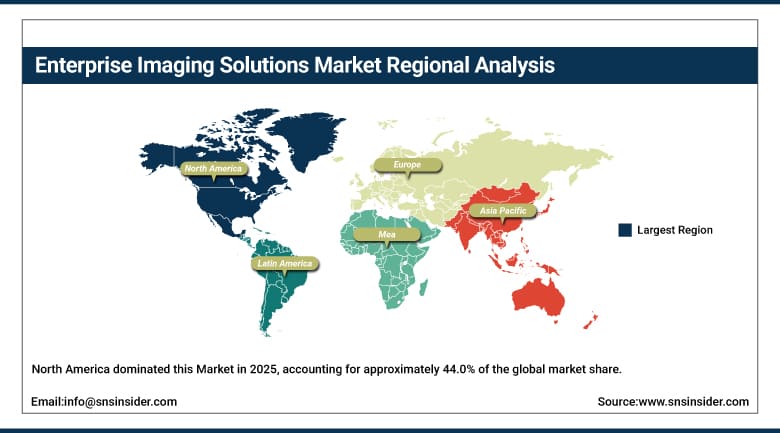
North America dominated the Enterprise Imaging Solutions Market in 2025, accounting for approximately 44.0% of the global market share. A dense concentration of large multi-hospital health systems, substantial healthcare IT investment, and strong government initiatives supporting interoperable electronic health record integration continued reinforcing this dominant regional position. A deep concentration of leading enterprise imaging vendors, academic medical centers, and multi-site health system deployments headquartered across the continent gave regional providers early access to next-generation AI-enabled and cloud-native imaging platforms well ahead of most other regions.
The United States accounted for roughly 85.00% of regional revenue, anchored by a dense cluster of large multi-hospital health systems, rapid vendor consolidation through major acquisitions, and expanding cloud-native platform adoption. Canada added further regional demand through its own growing public health system investment in interoperable imaging infrastructure, and that combined strength kept the continent the largest addressable market for enterprise imaging vendors through the forecast period.
⮞June 2026: Sectra announced that Oak Valley Health in Ontario, Canada, selected Sectra One Cloud for radiology and breast imaging. The five-year agreement covers a healthcare organization serving approximately 480,000 patients annually and supports consolidation of imaging workflows onto a fully managed cloud platform.
Get Customized Report as Per Your Business Requirement - Enquiry Now
Europe Enterprise Imaging Solutions Market Insights
Europe held a meaningful share of global revenue, supported by increasing focus on digital health initiatives, stringent regulations regarding patient data management, and continued growth of interoperable imaging infrastructure across the region's major economies. Regulatory requirements for data storage and patient privacy, combined with rising aging-population healthcare demand, continued lowering historically significant barriers to advanced enterprise imaging technology adoption across the continent.
Germany led demand at roughly 22.00% of European revenue, supported by its substantial hospital infrastructure and strong government initiatives to enhance healthcare IT infrastructure among the region's largest economies. The UK and France contributed substantial additional demand through their own expanding digital health and interoperable imaging programs, and continued European investment in healthcare IT infrastructure should keep regional demand for enterprise imaging technology climbing through the forecast period.
⮞April 2026: Sectra signed a five-year, GBP 15.6 million contract to deliver Sectra One Cloud to six NHS Trusts in north-central London. The project will consolidate seven separate imaging systems into a shared cloud environment supporting radiology and breast imaging services for a population of approximately 1.4 million.
Asia Pacific Enterprise Imaging Solutions Market Insights
Asia Pacific is expected to register the fastest regional growth through 2035, growing at a CAGR of approximately 15.0% from 2026 to 2035, driven by rapidly expanding healthcare digitalization initiatives, rising diagnostic imaging procedure volumes, and growing government-backed investment in interoperable healthcare IT infrastructure across the region's largest economies. That combination of rising imaging volumes and expanding domestic healthcare IT investment kept the region's growth trajectory well ahead of every other region tracked in this report.
China led the pack, supported by substantial government investment in healthcare digitalization and expanding hospital IT infrastructure. Japan and India contributed meaningful additional demand, with India's fast-growing hospital network digitalization and Japan's advanced healthcare IT infrastructure both reinforcing the region's position as the fastest-growing market tracked in this report.
⮞April 2026: China's National Healthcare Security Administration announced the first 305 hospitals selected for its cross-provincial medical imaging cloud retrieval network. The initiative supports secure sharing of diagnostic images between participating institutions, reinforcing demand for interoperable imaging platforms and cross-institutional data access.
MEA and Latin America Enterprise Imaging Solutions Market Insights
The Middle East and Africa and Latin America both showed steady growth, driven by expanding hospital IT infrastructure, rising government investment in healthcare digitalization, and growing demand for interoperable diagnostic imaging capability across both areas. As these markets continued building out modern healthcare IT infrastructure, enterprise imaging solutions proved a genuinely efficient way to establish advanced diagnostic collaboration capability without the decades-long buildout wealthier nations required.
Saudi Arabia led Middle East and Africa demand, supported by the country's substantial healthcare investment under its national healthcare transformation programs. The UAE contributed further demand through its own expanding private hospital network and healthcare IT capability. In Latin America, Brazil accounted for the largest share of regional revenue, with growing hospital digitalization adoption and healthcare IT infrastructure investment continuing to anchor regional demand for enterprise imaging technology.
⮞May 2026: Dubai Health and AGFA HealthCare marked 20 years of collaboration, highlighting the development of an integrated enterprise imaging, analytics, and AI ecosystem across Dubai's healthcare network. The organizations outlined continued work on intelligent workflow orchestration, high-speed imaging access, and AI-enabled clinical operations.
Market Dynamics
Growth Drivers: Rising Imaging Volumes and Growing Interoperability Demand
The industry is driven by rising volumes of diagnostic imaging procedures across radiology, cardiology, and pathology, growing demand for integrated and interoperable healthcare IT systems, expanding adoption of AI-powered image analysis, and increasing multi-site health system consolidation requiring unified imaging infrastructure. As healthcare organizations continue prioritizing centralized data management and specialist collaboration, the need for enterprise-wide, interoperable imaging platforms continues driving adoption of enterprise imaging solutions.
Rising vendor consolidation through large-scale acquisitions continues reinforcing this driver, as acquiring companies combine complementary imaging platform capabilities to offer more comprehensive enterprise-wide solutions. Growing integration of AI-powered diagnostic modules directly into PACS and workflow orchestration tools continues improving clinical efficiency and diagnostic accuracy, and that combination of platform consolidation and AI integration is exactly what keeps demand climbing at such a steady, sustained pace.
⮞May 2026: Ardent Health partnered with Fujifilm to implement Synapse Enterprise Imaging across its acute-care hospitals in six U.S. states. The project integrates radiology and cardiology imaging through a unified diagnostic viewer and vendor-neutral archive, supporting cross-departmental interoperability and clinical workflow consolidation.
Restraints: High Implementation Costs and Legacy System Migration Complexity
The substantial capital and implementation cost of enterprise-wide imaging platform deployment continues posing a genuine restraint on faster market-wide expansion, particularly across smaller hospitals and healthcare systems without the IT budgets that large multi-hospital systems can commit. That cost profile has kept large-scale enterprise imaging consolidation concentrated among a comparatively small number of well-resourced academic and multi-site health systems.
Data migration complexity from legacy departmental PACS systems continues posing a further restraint, as consolidating years of accumulated imaging data across multiple incompatible legacy systems requires substantial technical expertise and carries meaningful project risk. That complexity keeps some smaller health systems reliant on fragmented departmental imaging systems rather than pursuing full enterprise imaging consolidation of their own.
Opportunities: Cloud-Native Platform Expansion and Emerging Market Healthcare IT Investment
Rising investment in cloud-native and AI-enabled enterprise imaging platforms represents a genuinely significant opportunity, as health systems increasingly seek scalable, subscription-based infrastructure that reduces upfront capital investment compared with traditional on-premise deployment. Vendors positioned early in cloud-native architecture and AI integration stand to capture meaningful share as this capability continues expanding from large academic medical centers into mainstream community hospital adoption.
Closing healthcare IT infrastructure gaps across emerging markets offers a second substantial opportunity, as government initiatives aimed at expanding digital health infrastructure continue creating fresh demand for accessible, cost-effective enterprise imaging platforms. Vendors with proven, scalable cloud-based platforms stand to capture meaningful share as developing economies increasingly view interoperable imaging infrastructure as a genuinely practical way to improve diagnostic collaboration and healthcare quality at scale.
⮞May 2026: Grady Health System went live with Sectra Amplifier Services, enabling centralized deployment and management of AI applications within its enterprise imaging environment. The implementation supports an anticipated annual volume exceeding 90,000 radiology examinations and demonstrates opportunities for integrated AI workflow services.
Recent Developments:
-
2025: Siemens Healthineers launched Syngo Flexinity at the European Congress of Radiology 2025 in Vienna, providing hospitals of all sizes with scalable, modular access to its complete enterprise imaging software suite.
-
2025: GE HealthCare completed its acquisition of Intelerad Medical Systems, significantly expanding its enterprise imaging and radiology workflow software portfolio across the diagnostic imaging market.
-
2025: Medicai partnered with Microsoft Azure to embed advanced AI capabilities directly into its cloud-native PACS platform, expanding AI-powered image analysis integration across enterprise imaging workflows.
-
2024: FUJIFILM Healthcare continued expanding its Synapse Enterprise Imaging platform with additional AI-powered diagnostic modules for radiology and cardiology imaging workflows.
-
2024: Agfa HealthCare continued expanding its Enterprise Imaging platform with additional vendor-neutral archive capabilities supporting multi-site health system imaging consolidation.
Enterprise Imaging Solutions Market key players are:
-
Agfa-Gevaert Group (Agfa HealthCare)
-
Merative L.L.C.
-
Change Healthcare (Optum)
-
Koninklijke Philips N.V.
-
Sectra AB
-
Intelerad Medical Systems (GE HealthCare)
-
Hyland Software, Inc.
-
Ambra Health (GE HealthCare)
-
Novarad Corporation
-
Mach7 Technologies Limited
-
Visage Imaging, Inc. (Pro Medicus)
-
Pro Medicus Limited
-
Konica Minolta Healthcare Americas, Inc.
-
Carestream Health, Inc.
-
Medicai
-
Client Outlook Inc.
-
RamSoft Inc.
Enterprise Imaging Solutions Market Report Scope:
| Report Attributes | Details |
|---|---|
| Market Size in 2025 | USD 2.32 Billion |
| Market Size by 2035 | USD 6.69 Billion |
| CAGR | CAGR of 11.18% From 2026 to 2035 |
| Base Year | 2025 |
| Forecast Period | 2026-2035 |
| Historical Data | 2022-2024 |
| Report Scope & Coverage | Market Size, Segments Analysis, Competitive Landscape, Regional Analysis, DROC & SWOT Analysis, Forecast Outlook |
| Key Segments | • By Component (Software, Hardware, Services) • By Deployment Mode (On-Premises, Cloud) • By End-User (Hospitals, Diagnostic Imaging Centers, Ambulatory Surgical Centers, Others) • By Application (Radiology, Cardiology, Orthopedics, Oncology, Others) |
| Regional Analysis/Coverage | North America (US, Canada), Europe (Germany, UK, France, Italy, Spain, Russia, Poland, Rest of Europe), Asia Pacific (China, India, Japan, South Korea, Australia, ASEAN Countries, Rest of Asia Pacific), Middle East & Africa (UAE, Saudi Arabia, Qatar, South Africa, Rest of Middle East & Africa), Latin America (Brazil, Argentina, Mexico, Colombia, Rest of Latin America). |
| Company Profiles | Siemens Healthineers AG, GE HealthCare Technologies Inc., FUJIFILM Holdings Corporation, Agfa-Gevaert Group (Agfa HealthCare), Merative L.L.C., Change Healthcare (Optum), Koninklijke Philips N.V., Sectra AB, Intelerad Medical Systems (GE HealthCare), Hyland Software, Inc., Ambra Health (GE HealthCare), Novarad Corporation, Mach7 Technologies Limited, Visage Imaging, Inc. (Pro Medicus), Pro Medicus Limited, Konica Minolta Healthcare Americas, Inc., Carestream Health, Inc., Medicai, Client Outlook Inc., RamSoft Inc. |

Frequently Asked Questions
Key players in the Enterprise Imaging Solutions Market include Siemens Healthineers AG, GE HealthCare Technologies Inc., FUJIFILM Holdings Corporation, Agfa-Gevaert Group (Agfa HealthCare), Merative L.L.C., Change Healthcare (Optum), Koninklijke Philips N.V., Sectra AB, and Hyland Software, Inc., among others.
Key opportunities in the enterprise imaging solutions market include expansion of cloud-native and AI-enabled imaging platforms and increasing healthcare IT investment in emerging markets.
The market is driven by rising diagnostic imaging volumes, growing demand for interoperable healthcare IT systems, increasing adoption of AI-powered image analysis, and expanding multi-site health system consolidation.
The Software segment dominated the Enterprise Imaging Solutions Market, accounting for approximately 58% market share.
The North America region dominated the Enterprise Imaging Solutions Market in 2025 with a 44.0% share, driven by substantial healthcare IT investment, large multi-hospital health systems, interoperable EHR integration, and strong adoption of AI-enabled and cloud-native imaging platforms.
