
Vendor Neutral Archive and PACS Market Report Scope and Overview:
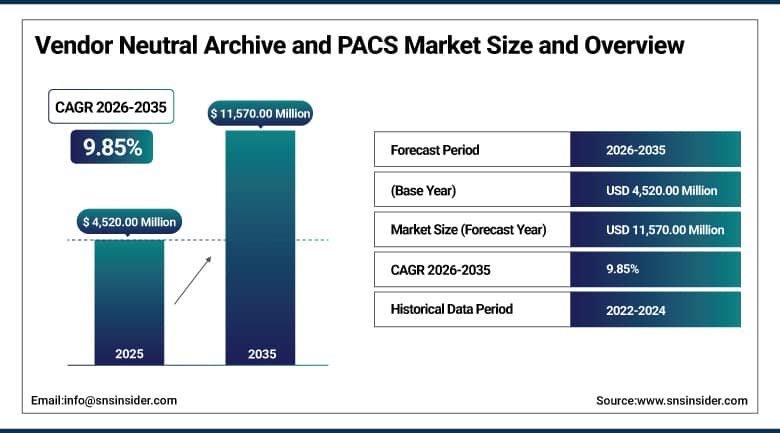
The Vendor Neutral Archive and PACS Market was valued at USD 4,520.00 Million in 2025 and is projected to reach USD 11,570.00 Million by 2035, registering a CAGR of 9.85% from 2026 to 2035.
The Vendor Neutral Archive and PACS Market is revolutionizing the management of medical imaging information with its innovative approach of providing hospital imaging departments and imaging centers the ability to archive, access, and share medical imaging images in an interoperable format. This market is fueled by increasing medical imaging information, growing preference for cloud and hybrid deployments over the on-premise traditional archive systems, and the need for enterprise-level interoperability for radiology, cardiology, pathology, and orthopedic imaging workflows within the integrated system. AI integrated diagnostic workflow, advanced cybersecurity and disaster recovery, and increased image sharing standards across vendor lines have seen tremendous growth in recent years.
⮞In March 2025, GE HealthCare unveiled its Genesis portfolio of cloud-based enterprise imaging solutions, including vendor-neutral archive, storage, edge, and data-migration capabilities. The announcement highlighted the industry's shift toward scalable, cloud-enabled medical imaging infrastructure
To Get More Information On Vendor Neutral Archive and PACS Market - Request Free Sample Report
Vendor Neutral Archive and PACS Market Trends
-
Rising transition from legacy on-premise PACS archives toward cloud-based and hybrid deployment models continues reducing hospital IT infrastructure burden.
-
Growing adoption of AI-enhanced diagnostic workflow tools continues improving radiologist reading efficiency and reducing report turnaround time.
-
Expanding enterprise-wide interoperability standards continue enabling seamless image sharing across cardiology, oncology, and orthopedic departments.
-
Increasing cybersecurity and disaster recovery investment continues strengthening data protection for centralized medical imaging archives.
-
Rising imaging data volumes driven by advanced modalities continue accelerating demand for scalable, vendor-neutral storage infrastructure.
-
Growing hospital consolidation and merger activity continues driving demand for unified enterprise imaging platforms that integrate previously separate archive systems.
U.S. Vendor Neutral Archive and PACS Market Outlook
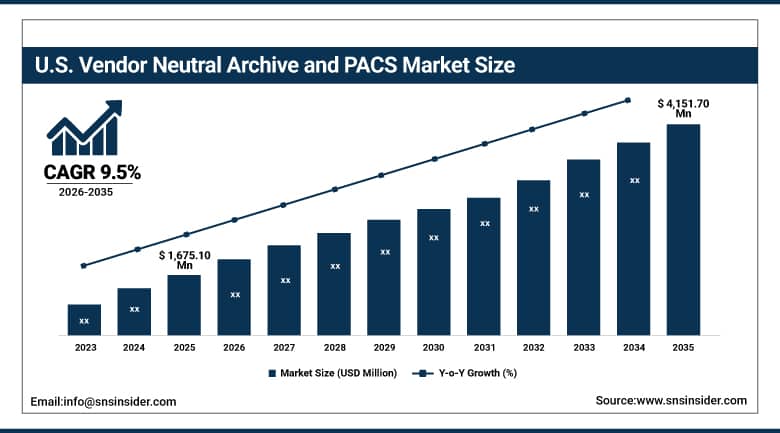
The U.S. Vendor Neutral Archive and PACS Market was valued at approximately USD 1,675.10 Million in 2025 and is projected to reach approximately USD 4,151.70 Million by 2035, registering a CAGR of approximately 9.5% from 2026 to 2035.
Demand across the United States continued to be shaped by the wide acceptance of electronic health records, comprehensive digitalization projects in hospitals’ networks, as well as the presence of a large number of market-leading IT companies specializing in medical imaging. Medical imaging information volumes' growth in the areas of radiology, cardiology, and oncology reinforced the USA’s position as not only the largest but also the most advanced market for vendor neutral archive and PACS technologies. Growing investment in cloud migration, AI-assisted diagnostic tools, and enterprise imaging consolidation added further layers of sustained domestic demand extending well beyond large academic medical centers into community hospital networks nationwide.
⮞In September 2026, Northeast Georgia Medical Center went live with Sectra One Cloud, initially integrating radiology, breast imaging, and cardiology workflows. The deployment enabled clinicians across departments and locations to access and share imaging studies through a unified cloud-based enterprise imaging platform.
Vendor Neutral Archive and PACS Market Segment Analysis
-
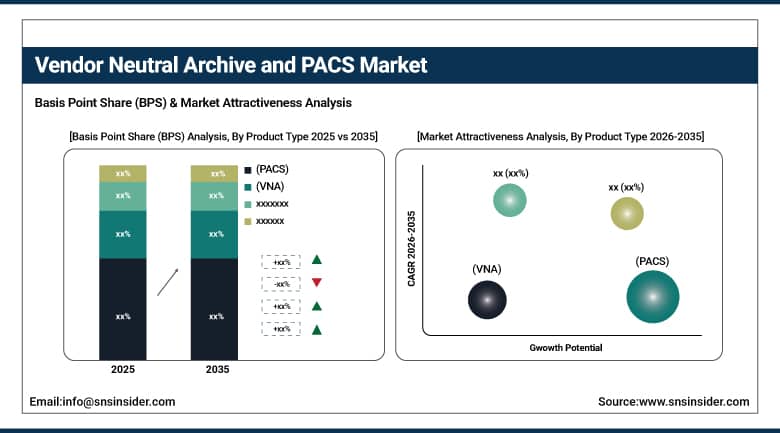
By Product Type, PACS segment dominated the Vendor Neutral Archive and PACS Market in 2025 with 60.40% share; VNA segment is the fastest growing segment.
-
By Deployment Mode, Cloud-Based segment dominated the market in 2025 with 54.60% share; Hybrid segment is the fastest growing segment.
-
By Application, Cardiology segment dominated the market in 2025 with 34.80% share; Oncology segment is the fastest growing segment.
-
By End User, Hospitals segment dominated the market in 2025 with 58.60% share; Diagnostic Imaging Centers segment is the fastest growing segment.
By Product Type, PACS Leads the Market While VNA Posts the Fastest Growth
The PACS segment dominated the Vendor Neutral Archive and PACS Market in 2025, reflecting its established position as the primary system through which hospitals and imaging centers acquire, view, and distribute diagnostic images across radiology and other clinical departments. Decades of accumulated installed base and deep integration with existing hospital information systems reinforced PACS as the default imaging management platform across most healthcare networks. Continued vendor investment in advanced visualization and diagnostic workflow tools further supported this segment's continued revenue leadership. Extensive vendor lock-in across legacy PACS installations, built up over more than two decades of departmental purchasing decisions, has further entrenched this segment's revenue dominance across most hospital imaging budgets.
The VNA segment is the fastest growing in the Vendor Neutral Archive and PACS Market, driven by rising hospital demand for true vendor independence that allows imaging data to migrate freely between different PACS platforms without proprietary lock-in. Growing enterprise imaging consolidation initiatives, particularly among multi-site hospital networks seeking to unify fragmented departmental archives, continues accelerating VNA adoption as the underlying data management layer beneath diverse clinical viewing applications. Rising merger and acquisition activity among hospital systems seeking to unify disparate legacy archives onto a single standardized platform continues reinforcing VNA's strategic importance beyond its current revenue contribution.
⮞In March 2025, Fujifilm Healthcare Americas entered a strategic agreement with Amazon Web Services, which validated its Synapse Radiology PACS, Cardiology PACS, Digital Pathology PACS, and Synapse VNA for cloud readiness. The agreement expanded cloud-hosting options for North American healthcare providers seeking interoperable imaging infrastructure
By Deployment Mode, Cloud-Based Systems Dominate While Hybrid Models Record the Fastest Growth
The Cloud-Based segment dominated the Vendor Neutral Archive and PACS Market in 2025, supported by lower upfront infrastructure costs, simplified IT maintenance, and improved remote accessibility for radiologists and referring physicians working across distributed care settings. Growing hospital preference for subscription-based, scalable storage models over capital-intensive on-premise server infrastructure reinforced cloud deployment as the preferred choice across both large hospital networks and smaller imaging centers. Growing subscription-based pricing models have further lowered the barrier to entry for smaller imaging centers previously unable to justify large upfront capital expenditure on dedicated server infrastructure.
The Hybrid segment is the fastest growing in the Vendor Neutral Archive and PACS Market as healthcare systems undergoing phased migration from legacy on-premise PACS toward full cloud adoption increasingly rely on hybrid architectures that balance local data control with remote accessibility and disaster recovery benefits. Growing hospital interest in this transitional deployment approach continues expanding hybrid adoption ahead of both pure cloud and pure on-premise alternatives on a percentage basis. Vendors offering flexible hybrid architecture with clear migration pathways toward full cloud adoption continue gaining preference among hospital IT departments managing multi-year digital transformation roadmaps.
⮞In February 2026, two NHS trusts in North West London agreed to consolidate their existing imaging environments onto Sectra One Cloud. The shared, fully managed cloud service is intended to strengthen cybersecurity, simplify IT operations, and improve cross-hospital diagnostic collaboration
By Application, Cardiology Dominates While Oncology Emerges as the Fastest-Growing Application
The Cardiology segment dominated the Vendor Neutral Archive and PACS Market in 2025, owing to the fact that the number and variety of imaging procedures, such as echocardiography, angiography, and cardiac CT/MRI, are very large, thus requiring special storage and sharing abilities. An increase in the number of cardiology interventional procedures has been a strong factor contributing to the consistent growth in this market. Established reimbursement pathways for cardiac imaging procedures across most major healthcare systems have further reinforced sustained capital investment in cardiology-specific archiving and viewing infrastructure.
The Oncology segment is the fastest growing in the Vendor Neutral Archive and PACS Market as rising global cancer incidence drives increasing reliance on longitudinal, multi-modality imaging for diagnosis, treatment planning, and response monitoring. Growing adoption of AI-based tumor tracking and radiomics analysis tools that depend on standardized, accessible historical imaging archives continues accelerating this segment's growth ahead of the broader market average. Expanding pharmaceutical and clinical trial demand for standardized oncology imaging endpoints is also contributing meaningful incremental growth to this segment beyond routine clinical diagnostic use alone.
⮞In September 2026, four hospitals in France's Provence-Alpes-Côte d'Azur region went live with Sectra's shared digital pathology solution, representing the first phase of an eight-hospital deployment. The implementation enables cross-site pathology collaboration and supports more coordinated cancer diagnostics.
By End User, Hospitals Dominate While Diagnostic Imaging Centers Post the Fastest Growth
The Hospitals segment dominated the Vendor Neutral Archive and PACS Market in 2025 because of the involvement of imaging volumes from various departments within an organization along with the complexity of their workflow and IT infrastructure deployment for full-fledged image archiving services. Larger hospital networks continued to invest in the consolidation of their enterprise imaging infrastructure, underscoring the role of this sector as the largest end-user group for VNA and PACS technologies. The demands for deep integration into hospital information systems and EHRs have strengthened hospitals’ favoring of total enterprise imaging vendors over point solutions.
The Diagnostic Imaging Centers segment is the fastest growing in the Vendor Neutral Archive and PACS Market as standalone and multi-site imaging center networks increasingly adopt cloud-based archiving to support remote radiologist reading and referring physician access across geographically dispersed locations. Growing outpatient imaging volume, combined with rising demand for cost-efficient, scalable storage infrastructure, continues driving this segment's growth ahead of traditional hospital-based deployment. Growing partnerships between diagnostic imaging center chains and cloud infrastructure providers continue lowering deployment costs and accelerating this segment's adoption curve relative to traditional hospital procurement cycles.
⮞In November 2025, Fujifilm announced Synapse One, an integrated enterprise imaging solution designed specifically for outpatient imaging centers. The AWS-hosted platform combines PACS, radiology information management, scheduling, patient engagement, and advanced visualization within a unified workflow.
Regional Analysis
|
Region |
Major Country |
Share within Region, 2025 (%) |
|---|---|---|
|
North America |
United States |
85.00% |
|
Europe |
Germany |
23.50% |
|
Asia Pacific |
China |
30.20% |
|
Middle East and Africa |
Saudi Arabia |
25.30% |
|
Latin America |
Brazil |
33.40% |
North America Vendor Neutral Archive and PACS Market Insights
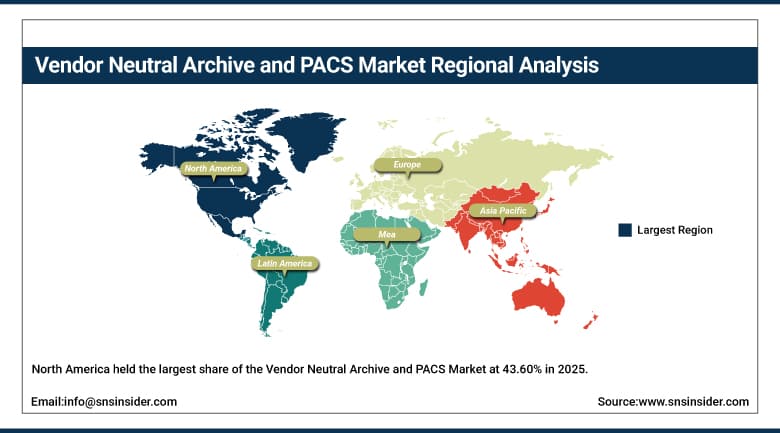
North America held the largest share of the Vendor Neutral Archive and PACS Market at 43.60% in 2025. Extensive hospital network digitization, widespread electronic health record adoption, and a dense concentration of leading imaging IT vendors continued reinforcing this dominant regional position. Strong regulatory emphasis on interoperability standards, combined with substantial healthcare IT capital investment across large hospital systems, further supported sustained regional demand throughout the current forecast period.
The United States accounted for the substantial majority of regional revenue, anchored by its leading position in enterprise imaging consolidation and cloud migration initiatives among large hospital networks. Canada added further regional demand through steady public healthcare system investment in imaging infrastructure modernization, and that combined strength kept the continent the largest addressable market for vendor neutral archive and PACS vendors through the forecast period.
⮞In June 2026, four healthcare providers in Ontario, Canada, announced a coordinated transition to Sectra One Cloud across 16 sites. The deployment is designed to improve radiology and breast imaging workflows while enabling more consistent access to diagnostic images across participating healthcare organizations.
Get Customized Report as Per Your Business Requirement - Enquiry Now
Europe Vendor Neutral Archive and PACS Market Insights
Europe held a meaningful share of global revenue, supported by well-established public healthcare systems, strong national health service investment in digital imaging infrastructure, and growing regulatory support for cross-border health information exchange standards across the European Union. Continued national digitization initiatives and hospital network consolidation efforts reinforced sustained demand for vendor neutral archive and PACS technology across the region's leading healthcare economies.
Germany led demand within the region, supported by its strong manufacturing industry in healthcare IT and excellent statutory health insurance coverage in imaging infrastructure development. UK and France provided significant additional demand owing to the efforts by their respective NHS and public hospitals in consolidating their enterprise imaging systems, and continued growth in Europe's digital health strategy would ensure increasing demand in the forecast period.
⮞In April 2026, Sectra signed a contract to provide its enterprise imaging solution as a fully managed cloud service to six NHS trusts in north central London. The project will consolidate seven separate imaging systems into a shared environment supporting hospitals that collectively serve approximately 1.4 million people.
Asia Pacific Vendor Neutral Archive and PACS Market Insights
Asia Pacific is projected to register the fastest growth, expanding at a CAGR of 12.80% from 2026 to 2035, driven by rapidly expanding hospital infrastructure, rising medical imaging volumes, and growing government investment in healthcare digitization across the region's largest economies. Rising domestic healthcare IT vendor capability and improving hospital access to cloud-based imaging infrastructure kept the region's growth trajectory well ahead of every other region tracked in this report.
China led regional demand, supported by substantial government investment in hospital digitization and rapidly expanding domestic healthcare IT manufacturing and software development capability. Japan and India contributed meaningful additional demand, with India's growing hospital network expansion and Japan's advanced healthcare technology adoption both reinforcing the region's position as the fastest-growing market tracked in this report.
⮞In April 2026, Fujifilm launched SYNAPSE LEAD Cloud in Japan, a cloud-based medical imaging information system for storing, managing, and sharing CT, MRI, and other diagnostic images. The subscription-based solution incorporates a diagnostic viewer and cloud storage architecture designed to improve access and reduce infrastructure requirements.
MEA and Latin America Vendor Neutral Archive and PACS Market Insights
The Middle East and Africa and Latin America both showed steady growth, driven by expanding hospital infrastructure investment, growing government focus on healthcare digitization, and rising demand for modern imaging data management capacity across both areas. As these markets continued building out modern healthcare infrastructure, vendor neutral archive and PACS technology offered a genuinely effective way to consolidate fragmented imaging systems beyond legacy departmental archiving methods alone.
The UAE and Saudi Arabia led Middle East and Africa demand, supported by advanced private hospital infrastructure and substantial government investment in healthcare digitization programs. In Latin America, Brazil accounted for the largest share of regional demand, with growing public and private hospital investment continuing to anchor regional adoption of vendor neutral archive and PACS technology across the broader region.
⮞In September 2026, Sectra entered the Brazilian healthcare market through a partnership with S&S Partners. The agreement initially focuses on introducing Sectra One Cloud to Brazilian hospitals, supporting demand for unified cloud-based imaging platforms and reduced operational complexity.
Market Dynamics
Growth Drivers: Rising Imaging Data Volumes and Cloud Migration Demand
The industry is driven by rising global medical imaging data volumes, growing hospital demand for enterprise-wide interoperability across radiology, cardiology, and other imaging-intensive departments, and expanding regulatory emphasis on health information exchange standards. As diagnostic imaging complexity and file sizes continue increasing across advanced modalities, the need for scalable, standardized archiving infrastructure continues driving adoption of vendor neutral archive and PACS technology over fragmented departmental systems.
Growing hospital transition from legacy on-premise infrastructure toward cloud-based and hybrid deployment models continues reinforcing this driver, as cloud architecture reduces capital expenditure while improving remote accessibility for distributed care teams. Rising integration of AI-assisted diagnostic workflow tools continues improving radiologist efficiency, and that combination of cost efficiency and workflow improvement is exactly what keeps hospital and imaging center demand climbing at such a sustained, steady pace.
⮞In September 2025, GE HealthCare made Genesis Storage, Genesis VNA, and True PACS SaaS available through AWS Marketplace. The move expanded procurement access to cloud-enabled enterprise imaging software and reflected growing demand for scalable archiving, interoperability, and subscription-based imaging infrastructure.
Restraints: High Implementation Costs and Data Migration Complexity
The substantial capital investment required for enterprise-wide VNA and PACS implementation continues posing a genuine restraint on faster market-wide expansion, particularly for smaller hospitals and imaging centers without the capital budgets that large hospital networks can commit. That cost profile has kept advanced enterprise imaging capability concentrated among comparatively well-resourced healthcare systems.
Data migration complexity continues posing a further restraint, as transferring decades of accumulated legacy imaging data from proprietary departmental systems into standardized vendor neutral archives requires extensive validation and carries meaningful downtime risk. That complexity keeps some healthcare systems delaying full migration despite recognizing the long-term operational benefits of vendor-neutral infrastructure.
Opportunities: AI-Driven Diagnostics and Emerging Market Healthcare IT Expansion
Deepening integration between vendor neutral archives and AI-based diagnostic and radiomics analysis tools represents a genuinely significant opportunity, as standardized, easily accessible historical imaging data becomes increasingly valuable for training and deploying machine learning algorithms. Vendors positioned early with strong AI-ready archive architecture stand to capture meaningful share as hospitals seek to future-proof their imaging infrastructure investment.
Expanding hospital infrastructure and healthcare IT investment across emerging markets offers a second substantial opportunity, as government healthcare digitization programs across Asia Pacific, Latin America, and the Middle East continue creating fresh demand for accessible, cost-effective imaging archiving infrastructure. Vendors with proven, cloud-native platforms stand to capture meaningful share as developing healthcare systems build out modern imaging infrastructure from a comparatively low existing base.
⮞In November 2025, GE HealthCare announced an agreement to acquire Intelerad for USD 2.3 billion, combining its enterprise imaging and AI portfolio with Intelerad's cloud PACS, workflow orchestration, and image-sharing capabilities. The proposed transaction highlighted commercial opportunities in connected imaging across hospital, outpatient, and teleradiology settings.
Recent Developments:
-
2025: Agfa HealthCare expanded its Enterprise Imaging platform integration capabilities, adding AI-powered diagnostic workflow tools to its vendor-neutral archive offering for multi-department imaging management.
-
2025: Intelerad Medical Systems advanced commercial rollout of its cloud-native InteleOne XT enterprise viewer, designed to unify PACS and VNA data access across distributed healthcare networks.
-
2024: Fujifilm Healthcare expanded its Synapse VNA platform with enhanced cybersecurity and disaster recovery capabilities, targeting healthcare systems undergoing legacy PACS-to-cloud migration.
-
2025: GE HealthCare integrated its Centricity Enterprise Archive with expanded interoperability standards, streamlining cross-vendor image sharing across multi-site hospital networks.
-
2024: Philips expanded its Enterprise Imaging Informatics platform with enhanced multi-site deployment capability, enabling large hospital networks to consolidate radiology and cardiology archives onto a single vendor neutral infrastructure.
Vendor Neutral Archive and PACS Market key players are:
-
Siemens Healthineers AG
-
FUJIFILM Holdings Corporation
-
Fujifilm Healthcare Americas Corporation
-
IBM Corporation (Merative)
-
McKesson Corporation
-
Dell Technologies Inc.
-
Intelerad Medical Systems Incorporated
-
Novarad Corporation
-
Sectra AB
-
Change Healthcare Inc.
-
Carestream Health, Inc.
-
Konica Minolta Healthcare Americas, Inc.
-
Hyland Software, Inc. (Acuo VNA)
-
Visage Imaging, Inc.
-
Mach7 Technologies Limited
-
Client Outlook, Inc.
-
Infinitt Healthcare Co., Ltd.
Vendor Neutral Archive and PACS Market Report Scope:
| Report Attributes | Details |
|---|---|
| Market Size in 2025 | USD 4,520.00 Million |
| Market Size by 2035 | USD 11,570.00 Million |
| CAGR | CAGR of 9.85% From 2026 to 2035 |
| Base Year | 2025 |
| Forecast Period | 2026-2035 |
| Historical Data | 2022-2024 |
| Report Scope & Coverage | Market Size, Segments Analysis, Competitive Landscape, Regional Analysis, DROC & SWOT Analysis, Forecast Outlook |
| Key Segments | • By Product Type (Picture Archiving and Communication System (PACS), Vendor Neutral Archive (VNA)) • By Deployment Mode (Cloud-Based, On-Premise, Hybrid) • By Application (Cardiology, Oncology, Neurology, Orthopedics, Others) • By End User (Hospitals, Diagnostic Imaging Centers, Ambulatory Surgical Centers, Others) |
| Regional Analysis/Coverage | North America (US, Canada), Europe (Germany, UK, France, Italy, Spain, Russia, Poland, Rest of Europe), Asia Pacific (China, India, Japan, South Korea, Australia, ASEAN Countries, Rest of Asia Pacific), Middle East & Africa (UAE, Saudi Arabia, Qatar, South Africa, Rest of Middle East & Africa), Latin America (Brazil, Argentina, Mexico, Colombia, Rest of Latin America). |
| Company Profiles | Agfa-Gevaert Group (Agfa HealthCare), GE HealthCare Technologies Inc., Koninklijke Philips N.V., Siemens Healthineers AG, FUJIFILM Holdings Corporation, Fujifilm Healthcare Americas Corporation, IBM Corporation (Merative), McKesson Corporation, Dell Technologies Inc., Intelerad Medical Systems Incorporated, Novarad Corporation, Sectra AB, Change Healthcare Inc., Carestream Health, Inc., Konica Minolta Healthcare Americas, Inc., Hyland Software, Inc. (Acuo VNA), Visage Imaging, Inc., Mach7 Technologies Limited, Client Outlook, Inc., Infinitt Healthcare Co., Ltd. |

Frequently Asked Questions
Key players in the Vendor Neutral Archive and PACS Market include Agfa-Gevaert Group (Agfa HealthCare), GE HealthCare Technologies Inc., Koninklijke Philips N.V., Siemens Healthineers AG, and FUJIFILM Holdings Corporation, among others.
Key opportunities in the vendor neutral archive and PACS market include AI-driven diagnostic and radiomics integration, cloud-native imaging infrastructure, and expanding healthcare IT investment across emerging markets.
The market is driven by rising medical imaging data volumes, increasing demand for enterprise-wide interoperability, and the transition from legacy on-premise systems toward cloud-based and hybrid deployment models.
The PACS segment dominated the Vendor Neutral Archive and PACS Market, accounting for approximately 60.40% market share.
The North America region dominated the Vendor Neutral Archive and PACS Market in 2025 with a 43.60% share, driven by extensive hospital network digitization, widespread electronic health record adoption, and strong healthcare IT investment.
