
Fluorine-Free Surfactants Market Report Scope & Overview:
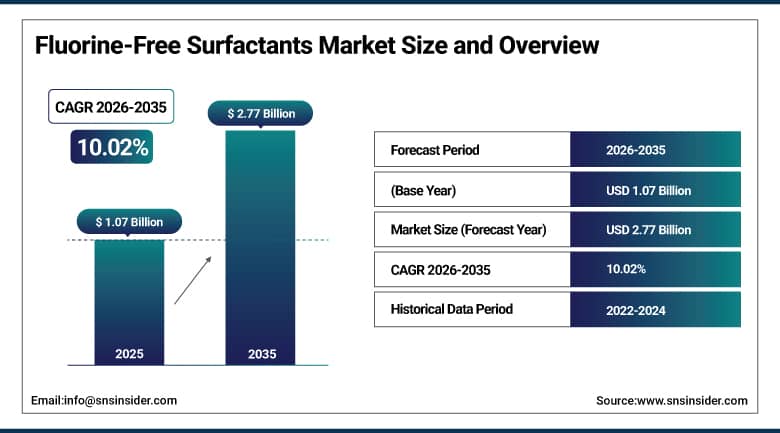
Fluorine-Free Surfactants Market was valued at USD 1.07 Billion in 2025 and is expected to reach USD 2.77 Billion by 2035, growing at a CAGR of 10.02% from 2026–2035.
There is steady growth in the fluorine-free surfactants market due to increasing demand for non-fluorinated surface-active solutions that provide effective performance and improved environmental characteristics. Growing adoption of sustainable chemical formulations is encouraging the use of hydrocarbon-based, biosurfactant, carbohydrate-derived, siloxane-based, and amphoteric surfactants across a wide range of industries.
The growing demand for high-performance alternatives in paints and coatings, industrial and institutional cleaning, firefighting foams, textile processing, agricultural formulations, and specialty applications is driving market expansion. Manufacturers are developing fluorine-free formulations with effective wetting, emulsification, spreading, foaming, dispersion, and surface-modification properties. Ongoing research is focused on improving formulation stability, surface performance, durability, compatibility, and cost efficiency, further expanding the application potential of fluorine-free surfactants across diverse industries.
In 2025, researchers published work on new fluorine-free low-surface-energy surfactants, highlighting hydrocarbon-based surfactants as potential PFAS replacements for coatings, inks, cleaning products, and firefighting foams.
To Get More Information On Fluorine-Free Surfactants Market - Request Free Sample Report
Fluorine-Free Surfactants Market Trends
-
Growing adoption of fluorine-free surfactants is driving demand for effective surface-active solutions across industrial and commercial applications.
-
Rising demand for sustainable cleaning, coatings, textiles, agricultural formulations, and specialty chemicals is supporting the use of fluorine-free surfactant technologies.
-
Increasing need for effective wetting, spreading, emulsification, foaming, and dispersion properties is supporting the development of specialized fluorine-free surfactant formulations.
-
Growing focus on environmental compatibility, biodegradability, formulation efficiency, and regulatory compliance is creating opportunities for fluorine-free surfactant manufacturers.
-
Advancements in hydrocarbon-based, biosurfactant, siloxane-based, carbohydrate-derived, and amphoteric surfactant chemistries are improving performance and expanding market adoption.
The U.S. Fluorine-Free Surfactants Market Outlook
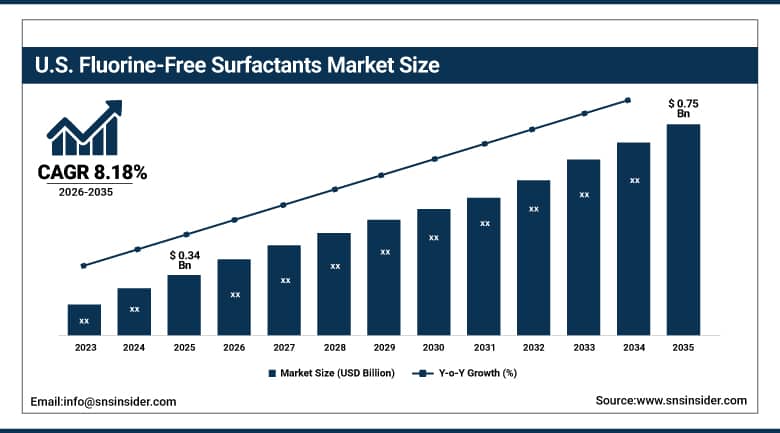
The U.S. Fluorine-Free Surfactants Market was valued at USD 0.34 Billion in 2025 and is expected to reach around USD 0.75 Billion by 2035, growing at a CAGR of 8.18% from 2026–2035.
The U.S. fluorine-free surfactant market is experiencing steady growth because of the rising demand for eco-friendly and high-performance surface-active agents. The increased use of fluorine-free compounds in the fields of coatings and paints, industrial and institutional cleaning, firefighting foam, textile, agrochemicals, and specialty chemical applications will contribute to the market growth. The growing investment in surfactant technology is contributing towards the improvement in the wetting, spreading, emulsifying, foaming, dispersing, and surface-modification properties. Sustainable chemical production and increased demand for environment-friendly formulations will also help drive the growth of the market in the United States.
In 2025, the U.S. National Research Laboratory research community advanced work on silicone-containing surfactants for fluorine-free firefighting foams, with research focused on understanding surfactant structures and properties to improve formulation performance.
Fluorine-Free Surfactants Market Segment Analysis
-
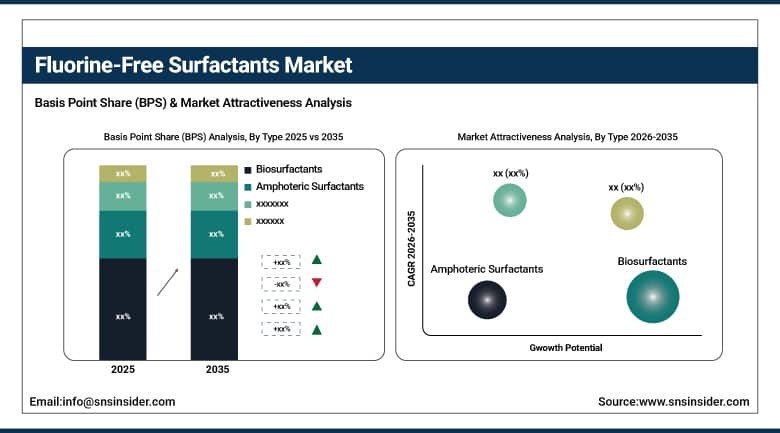
By Type, biosurfactants dominated the fluorine-free surfactants market with a 31.00% share in 2025, while biosurfactants are projected to be the largest segment, registering a 13.22% CAGR during 2026–2035.
-
By Application, firefighting foams dominated the fluorine-free surfactants market with a 40.80% share in 2025, while food packaging foams are projected to be the fastest-growing segment, registering an 11.64% CAGR during 2026–2035.
-
By End-use Industry, industrial manufacturing dominated the fluorine-free surfactants market with a 24.50% share in 2025, while food & beverage is projected to be the fastest-growing segment, registering a 15.61% CAGR during 2026–2035.
By Type, biosurfactants dominated the fluorine-free surfactants market, while biosurfactants are expected to grow fastest.
In the year 2025, biosurfactants would dominate the market because of the increase in their usage as sustainable and high-performance formulations in the cleaning, coatings, agricultural, textiles, and specialty chemicals industries. The increasing need for effective wetting, emulsifying, foaming, and dispersion attributes is promoting the usage of biosurfactants. Developments in fermentation, formulations, and manufacturing techniques may also play a key role in enhancing their usage in various sectors.
The biosurfactants would witness the highest CAGR during the forecast period from 2026 to 2035. The rising need for environmentally friendly and biodegradable surfactant solutions, in addition to increased investment in bio-based chemicals technology, is contributing to the development of better biosurfactants.
By Application, firefighting foams dominated the fluorine-free surfactants market, while food packaging is expected to grow fastest.
Firefighting foams are expected to dominate the market in 2025 due to the increasing adoption of fluorine-free firefighting systems across industrial, aviation, marine, and fire-protection sectors. Rising demand for effective foam generation, spreading, wetting, and fire-suppression performance is driving the adoption of specialized fluorine-free surfactants.
Food packaging is expected to experience the fastest CAGR during 2026–2035. Increasing demand for sustainable and safer packaging materials, growing regulatory pressure to reduce the use of fluorinated chemicals, and the rising adoption of environmentally friendly surfactants in food-contact applications are among the key factors driving growth in this segment.
By End-use Industry, industrial manufacturing dominated the fluorine-free surfactants market, while food & beverage is expected to grow fastest.
In 2025, the segment of industrial manufacturing is expected to hold the largest market share because of the wide application of surfactants for cleaning, surface treatment, coating, processing, and specialty purposes. The growing need for efficient wetting, dispersion, emulsification, and surface modification acts as a driving factor behind the adoption of non-fluorinated surfactants in the manufacturing process.
The fastest-growing segment among all is that of food & beverages. In 2026–2035, the demand for functional and sustainable processing aids, cleaning formulations, packaging, and surface-active formulations in the food & beverage industry is driving the development and adoption of non-fluorinated surfactants.
Regional Insights
|
Region |
Major Country |
Share within Region, 2025(%) |
|---|---|---|
|
North America |
United States |
82.40% |
|
Europe |
Germany |
34.30% |
|
Asia Pacific |
China |
48.54% |
|
Middle East & Africa |
Saudi Arabia |
23.50% |
|
Latin America |
Brazil |
23.00% |
North America Fluorine-Free Surfactants Market Insights
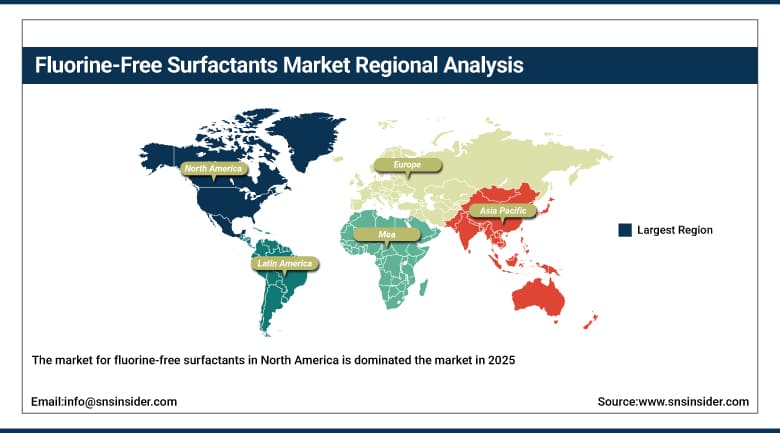
The market for fluorine-free surfactants in North America is dominated the market in 2025, due to the rising demand for sustainable surfactant solutions from different sectors such as industrial manufacturing, coatings and paints, cleaning products, firefighting foam applications, textile processing, and specialty chemicals. North America held a share of 38.50% of the overall market in 2025. The region holds the advantage of well-established chemical manufacturing operations and innovation in formulation in addition to the rising use of high-performance fluorine-free surfactants.
The United States will emerge as the leading player in the market for North America. It will be fueled by its vast industrial manufacturing capacity and coating and chemical industry along with sustainable formulation and surfactant innovations. Canada is also expected to make its contribution towards the regional market growth.
Get Customized Report as Per Your Business Requirement - Enquiry Now
Europe Fluorine-Free Surfactants Market Insights
The market for European fluorine-free surfactants market is anticipated to witness steady growth over the forecast period due to rising demand for sustainable chemical formulations, cleaning formulations, coatings, textile applications, agricultural formulations, and firefighting applications. The robustness of chemical manufacturing base along with rising focus on environment-friendly products is driving the development of fluorine-free surfactants.
Germany is expected to be a significant country-level market in Europe owing to its strong chemical manufacturing industry, automotive, industrial coatings, and specialty chemical sectors. Other European nations such as France, UK, and Italy are also expected to provide significant contributions to regional demand due to rising adoption of advanced and sustainable surfactant formulations.
Asia Pacific Fluorine-Free Surfactants Market Insights
Asia Pacific is projected to be the highest-growing region in the fluorine free surfactants market in the coming years between 2026 and 2035 at a CAGR of 13.99% owing to growing chemical manufacturing, increasing industrialization, increasing sustainable formulations, and applications across the cleaning industry, coatings industry, textile industry, agricultural industry, and specialty chemicals. The region is experiencing growing manufacturing and investments in advanced surfactants.
China is anticipated to remain a major market in the Asia Pacific region owing to its extensive chemical manufacturing industry, manufacturing, and high demand for high performance surfactant formulations. Japan and South Korea will remain major markets in the Asia Pacific region owing to their extensive chemical, electronics, automotive, and specialty materials industry, whereas India will experience increasing demand owing to manufacturing, construction, consumer goods, and industrial chemical applications.
Middle East & Africa and Latin America Fluorine-Free Surfactants Market Insights
Growth is projected in the Middle East & Africa and Latin America fluorine-free surfactants markets over the forecast period of 2026-2035, driven by rising industrial manufacturing, construction, coatings, cleaning product formulations, agriculture, and specialty chemicals. Increased investment in sustainable formulation and industrial process advancements are generating demand for fluorine-free surfactant technologies in these regions.
The Middle East & Africa region will continue to have Saudi Arabia as one of its key markets due to industrial diversification, industrial manufacturing, coatings, cleaning applications, and specialty chemicals. In Latin America, Brazil will continue to be one of the key country-level markets owing to the presence of a large agricultural industry, industrial sector, food and beverage industry, coatings, and consumer goods industries.
Growth Driver: Increasing demand for sustainable and high-performance surfactant solutions is driving market growth
One of the major factors contributing to the growth in the global fluorine-free surfactants market is the rising demand for efficient and environment-friendly surfactant solutions for various industrial and commercial purposes. Use of surfactants in applications such as industrial and institutional cleaning, coatings and paints, firefighting foams, textile processing, agriculture and specialty chemicals is promoting growth in the market. The increasing requirement of effective surfactant solutions in terms of wetting, spreading, emulsifying, foaming, dispersion and surface modification characteristics is prompting industries to employ advanced fluorine-free surfactants.
Furthermore, innovations in hydrocarbon surfactants, biosurfactants, siloxane surfactants, carbohydrate surfactants and amphoteric surfactants are fueling growth in the market.
Restraint: Performance limitations and formulation challenges can limit market adoption
The various performance criteria of the different applications represent a major challenge for the development of fluorine-free surfactants. Variations in the surface tension, wetting properties, foam stability, spreading properties, compatibility of the ingredients, and formulation conditions may influence the performance of individual surfactant technologies in particular applications.
Also, the achievement of performance while ensuring formulation stability, economic viability, biodegradability, and compatibility with current manufacturing processes may involve intensive development and evaluation work. The increased production costs of particular surfactant systems, scarcity of special raw materials, and poor performance in comparison to standard high-performance chemistries may present further challenges.
Opportunity: Growing demand for sustainable formulations creates new market opportunities
The rise in sustainable and high-performance chemical formulations creates several opportunities for manufacturers of fluorine-free surfactants. Opportunities arise due to growing demands in cleaning products, coatings and paints, firefighting foams, textiles treatment, agricultural chemicals and specialty applications where effective wetting, spreading, emulsification, foaming, and dispersion characteristics can be achieved through innovative surfactant technologies.
Moreover, opportunities arise in the development of more efficient formulations for specialized applications due to the rise in bio-based and silicon/siloxane surfactant technologies. Increasing opportunities for sustainable chemical formulation and manufacture technologies are additional opportunities for fluorine-free surfactant manufacturers and technology providers.
Recent Developments
-
March 2026: BASF increased prices across its Home Care, Industrial & Institutional Cleaning, and Industrial Formulators portfolio in Europe, reflecting raw-material, logistics, packaging, and energy-cost pressures affecting surfactant supply.
-
August 2026: Evonik highlighted continued growth in sustainable and advanced surfactant technologies, with increasing demand for environmentally responsible, bio-based, and high-performance formulations across industrial and consumer applications.
-
2026: BASF continued expanding its sustainable chemical portfolio and formulation technologies, supporting the broader shift toward environmentally compatible surfactant solutions across home care, industrial cleaning, coatings, and specialty applications.
-
August 2026: Evonik continued expanding its sustainable surfactant technologies, with recent industry developments highlighting growing demand for bio-based and environmentally compatible surfactant formulations across cleaning, coatings, and specialty chemical applications.
Fluorine-Free Surfactants Companies are:
-
BASF SE
-
Evonik Industries AG
-
Clariant AG
-
Dow Inc.
-
DIC Corporation
-
Croda International Plc
-
Ashland Global Holdings Inc.
-
Huntsman Corporation
-
Kao Corporation
-
Nouryon
-
Stepan Company
-
Pilot Chemical Company
-
Solvay S.A.
-
Sasol Limited
-
Galaxy Surfactants Ltd.
-
Ecolab Inc.
-
Lonza Group AG
-
Indorama Ventures Public Company Limited.
Fluorine-Free Surfactants Market Report Scope:
| Report Attributes | Details |
|---|---|
| Market Size in 2025 | USD 1.07 Billion |
| Market Size by 2035 | USD 2.77 Billion |
| CAGR | CAGR of 10.02% From 2026 to 2035 |
| Base Year | 2025 |
| Forecast Period | 2026-2035 |
| Historical Data | 2022-2024 |
| Report Scope & Coverage | Market Size, Segments Analysis, Competitive Landscape, Regional Analysis, DROC & SWOT Analysis, Forecast Outlook |
| Key Segments | • By Type (Hydrocarbon-based Surfactants, Biosurfactants, Siloxane-Based Surfactants, Carbohydrate-Derived Surfactants, Amphoteric Surfactants) • By Application (Industrial and Institutional Cleaning, Firefighting Foams, Coatings and Paints, Oilfield Chemicals, Textile Processing, Agricultural Formulations, Food Packaging) • By End-use Industry (Industrial Manufacturing, Aerospace and Defense, Oil and Gas, Textile and Leather, Automotive, Healthcare and Pharmaceuticals, Food & Beverage) |
| Regional Analysis/Coverage | North America (US, Canada), Europe (Germany, UK, France, Italy, Spain, Russia, Poland, Rest of Europe), Asia Pacific (China, India, Japan, South Korea, Australia, ASEAN Countries, Rest of Asia Pacific), Middle East & Africa (UAE, Saudi Arabia, Qatar, South Africa, Rest of Middle East & Africa), Latin America (Brazil, Argentina, Mexico, Colombia, Rest of Latin America) |
| Company Profiles | BASF SE, Evonik Industries AG, Clariant AG, Dow Inc., DIC Corporation, Arkema S.A., Croda International Plc, Ashland Global Holdings Inc., Huntsman Corporation, Kao Corporation, Nouryon, Stepan Company, Pilot Chemical Company, Solvay S.A., Innospec Inc., Sasol Limited, Galaxy Surfactants Ltd., Ecolab Inc., Lonza Group AG, Indorama Ventures Public Company Limited |

Frequently Asked Questions
The Fluorine-Free Surfactants Market is expected to grow at a CAGR of approximately 10.02% from 2026 to 2035.
The Fluorine-Free Surfactants Market was valued at approximately USD 1.07 billion in 2025.
The market is driven by sustainable surfactant demand, expanding industrial applications, and advancements in high-performance formulation technologies.
Biosurfactants dominated the Fluorine-Free Surfactants Market in 2025, accounting for a 31.00% share.
North America dominated the Fluorine-Free Surfactants Market in 2025, accounting for a 38.50% share.
