
Glider Aircraft Market Report Scope & Overview:
The Glider Aircraft Market size is valued at USD 4.72 Billion in 2025 and is projected to reach USD 7.53 Billion by 2035, growing at a CAGR of 4.90% during the forecast period 2026–2035.
The analysis report on the Glider Aircraft Market has provided a comprehensive analysis of the market dynamics, technology trends, and aviation applications. The growing interest in recreational flying, increased participation in competitive air sports, composite material usage, and development of aviation infrastructure are some of the key factors propelling the market growth during 2026-2035.
The demand for gliders has surpassed 1.2 million units in 2025, owing to the rise in aviation for leisure, defense training, and eco-friendly tourism.
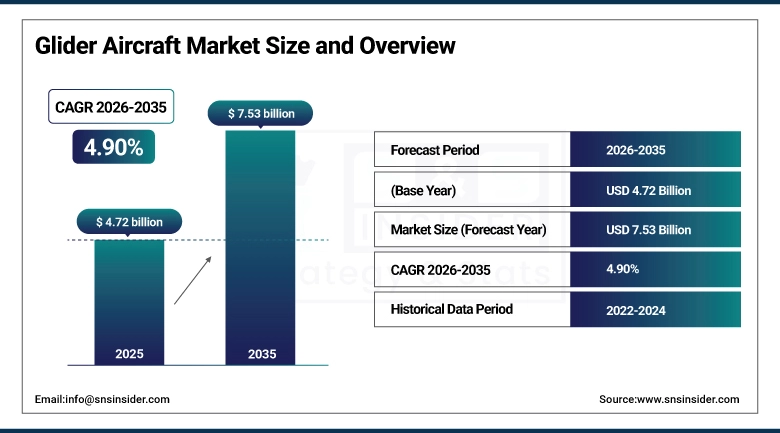
To Get more information on Glider Aircraft Market - Request Free Sample Report
Glider Aircraft Market Trends:
-
Recreational flying is becoming the major force in demand growth, encouraged by increasing interest in eco-friendly aviation.
-
Composite materials are replacing aluminum and wood in the construction of gliders, offering lighter, stronger, and more efficient designs.
-
Self-launching and motor gliders are gaining traction, thanks to the added flexibility and the elimination of the need for tow planes.
-
The Asia-Pacific market is expanding quickly, fueled by investments in aviation sports from China and India.
-
Modern gliders are incorporating digital technology and automation, which are enhancing safety and the overall flying experience.
-
In popular tourist destinations, gliding-related activities are on the rise, suggesting opportunities for niche markets in Latin America and Europe.
-
Gliders continue to be used by defense academies for economical pilot training.
-
Sustainability trends are motivating manufacturers to innovate in electric propulsion and eco-friendly materials.
U.S. Glider Aircraft Market Insights:
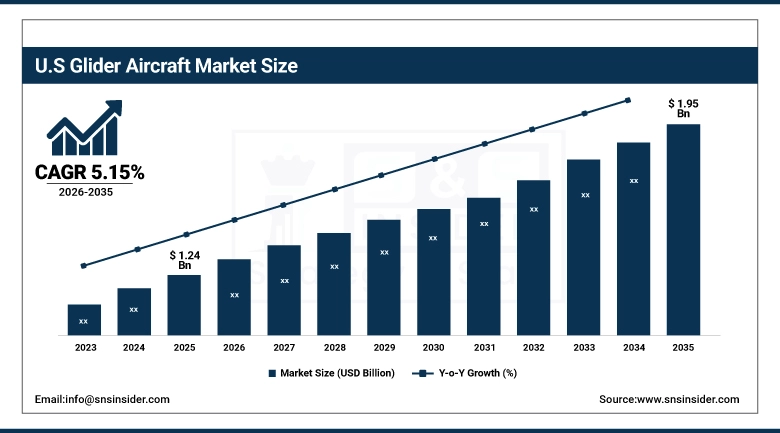
The U.S. Glider Aircraft Market is expected to grow from USD 1.24 billion in 2025 to USD 1.95 billion in 2035 at a CAGR of 5.15%. This can be attributed to the increase in participation in recreational flying activities, demand for competitive air sports, high adoption rates for advanced composite material and self-launch technology applications, and investments in innovative training programs and infrastructure development within clubs, schools, and defense academies.
Glider Aircraft Market Growth Drivers:
-
Rising Participation in Recreational Flying and Competitive Air Sports Is Driving Demand for Advanced Glider Technologies.
The growing interest in leisure aviation and soaring competitions is a major growth driver for the Glider Aircraft Market. Aviation clubs, defense academies, and training schools are increasingly opting for advanced gliders which includes sailplanes, motor gliders, and self-launching gliders for recreational purposes and institutional requirements. Advancements in composite materials, aerodynamic designs, and digital avionics, combined with safety, efficiency, and pilot experiences, are boosting the growth of the market.
More than 58% of aviation clubs, defense academies, and training schools have opted for advanced glider aircraft in 2025 for recreational purposes, pilot training, and sports competitions.
Glider Aircraft Market Restraints:
-
High Acquisition Costs and Seasonal Limitations Are Restraining Wider Adoption of Glider Aircraft.
The high-end gliders made from composite materials and electronic avionics are still expensive for small clubs and private owners. Seasonal dependency on favorable weather conditions also reduces the usage of the equipment. In cold weather, the usage of the equipment is even less. Regulatory issues also pose challenges for introducing new designs. In addition, there are fewer pilots and training schools, which limits the growth of the market.
In 2025, more than 46 percent of aviation clubs and schools faced financial and seasonal issues in expanding the fleet and utilizing the equipment throughout the year.
Glider Aircraft Market Opportunities:
-
Eco-Friendly Aviation and Tourism-Driven Demand are Creating Strong Opportunities for Glider Market Expansion.
The initiatives on sustainability have been promoting the use of gliders as environmentally friendly alternatives in recreational and training aviation. Adventure tourism has been embracing the inclusion of gliding in picturesque spots, while new markets in the Asia-Pacific and Middle East regions have been investing in aviation infrastructure. Digital avionics and semi-autonomous technology have been attracting the younger population and enhancing pilot training.
In 2030, over 52% of new gliders will be equipped with eco-friendly technology and avionics, creating opportunities for long-term growth and new revenue streams in the leisure, tourism, and institutional markets.
Glider Aircraft Market Segmentation Analysis:
-
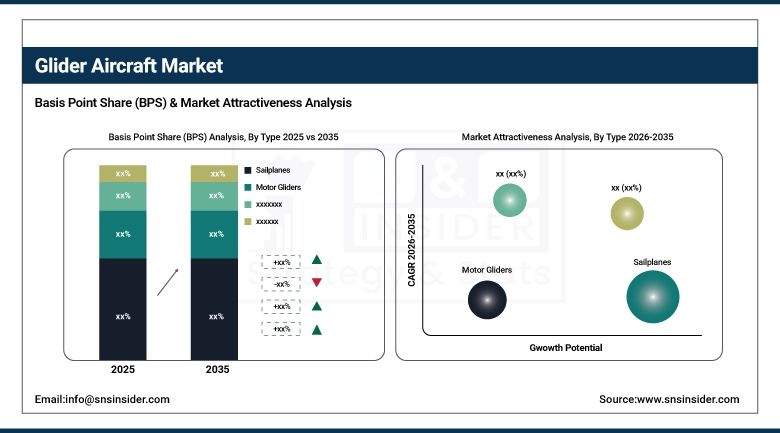
By Type, Sailplanes held the largest market share of 38.58% in 2025, while Self-launching Gliders are expected to grow at the fastest CAGR of 4.71% during 2026–2035.
-
By Application, Recreational dominated with 46.54% market share in 2025, whereas they are also projected to record the fastest CAGR of 4.66% through 2026–2035.
-
By Material, Composite accounted for the highest market share of 51.82% in 2025, while they are also expected to grow at the fastest CAGR of 5.19% during the forecast period.
-
By End User, Clubs & associations held the largest share of 39.61% in 2025, while Defense forces are expected to grow at the fastest CAGR of 4.31% during the forecast period.
By Type, Sailplanes Dominate While Self‑launching Gliders Grow Rapidly:
The Sailplanes segment had the highest domianant share in the market in 2025, owing to their efficiency, aerodynamic capabilities, and popularity in recreational activities and sports competitions. Their reliability and presence in aviation clubs and associations have cemented their position in the market.
Self-launching Gliders is the fastest growing segment, owing to the rising need for independence from tow planes, their versatility in training, and the rising interest in private ownership. This segment is growing at a rapid pace, as pilots are seeking increased flexibility and newer flight experiences.
By Application, Recreational Flying Dominates While Also Growing the Fastest:
The Recreational segment held the largest share of the market, fueled by high demand from aviation clubs, private owners, and enthusiasts. The dominance of this segment is further enhanced by its accessibility, tourism potential, and popularity as an environmentally friendly sport.
The Recreational flying segment is also set to experience the highest growth rate, propelled by an increase in adventure tourism, expansion of aviation infrastructure, and growing popularity among the youth. The twin attributes of largest and fastest-growing segments make Recreational flying the main contributor to growth in the coming decade.
By Material, Composites Dominate While Also Growing the Fastest:
The Composite segment has the highest market share in 2025, owing to its high strength-to-weight ratio, durability, and aerodynamic properties compared to conventional materials which is aluminum and wood. This is due to they are used in almost all types of both recreational and competitive gliders.
The Composite segment is also anticipated to have the highest rowth rate during the forecast period due to ongoing innovations in advanced polymers, sustainability trends, and the need for lightweight designs for better performance and reduced maintenance costs. This proves that composites are the most significant material segment in shaping the future of glider aircraft manufacture.
By End User, Clubs & Associations Dominate While Defense Forces Grow the Fastest:
Clubs & Associations segment has the largest share, as these clubs play an essential role in recreational flying, pilot training, and competitive soaring events. The existing infrastructure, membership, and tradition of promoting gliding activities make this segment dominate the market.
The Defense Forces segment is expected to grow at the highest rate, as there is an increased need for gliders to conduct cost-effective pilot training, skill development, and specialized aviation programs. The increased investments in defense academies and schools will drive this segment, making it an essential contributor to the growth of the market in the coming years.
Glider Aircraft Market Regional Analysis:
Europe Glider Aircraft Market Insights:
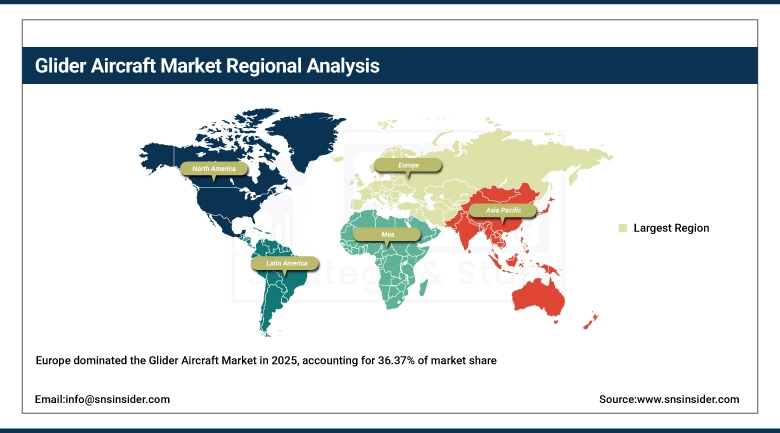
The Europe Glider Aircraft Market is at the forefront, with a 36.37% share in 2025, owing to its tradition of recreational flying, competitive soaring, and well-developed aviation infrastructure in countries such as Germany, France, and Poland. The widespread use of sailplanes and self-launching gliders, combined with advanced composite technologies, has contributed to its leadership. The expansion of aviation clubs, international competitions, and government encouragement for eco-friendly aviation activities add to its leadership. The ongoing innovations in aerodynamic design, digital avionics, and pilot training programs add to its leadership in this mature market.
Get Customized Report as per Your Business Requirement - Enquiry Now
Germany Glider Aircraft Market Insights:
The Germany Glider Aircraft Market is the largest market in Europe due to its history as a center for sailplane construction and competitive gliding. Its position as a market leader can be attributed to high participation rates for recreational flying, high numbers of aviation clubs, and renowned manufacturers based in Germany. Increasing demand for high-performance composite sailplanes, self-launching technology integration, and investments in pilot training facilities are adding to Germany’s market leadership.
Asia‑Pacific Glider Aircraft Market Insights:
Asia Pacific Glider Aircraft market is seen as a growing market and is expected to be the fastest-growing market with a CAGR of 6.46%. This market is expected to grow steadily with the increase in demand for recreational aviation activities in countries such as China, India, and Australia. The market for self-launch gliders is growing fast due to increased investments in aviation infrastructure, growth in adventure tourism activities, and eco-friendly aviation activities. In addition to this, Asia Pacific is expected to increase its market share substantially by 2035.
China Glider Aircraft Market Insights:
The China Glider Aircraft Market is at the forefront in the Asia Pacific region, with investments from the Chinese government in aviation sports, pilot training, and recreational infrastructure. Eco-friendly tourism and competitive aviation sports have increased interest in modern sailplanes and motor gliders. In 2025, China contributed more than 12 percent of the revenues in the Asia Pacific region, and growth is anticipated in the country from 2035 onward.
North America Glider Aircraft Market Insights:
The North America Glider Aircraft Market is at the forefront due to the high aviation infrastructure, high recreational flying activities, and training institutions. This is complemented by the use of advanced composites, digital avionics, and favorable aviation regulations. Ongoing innovation and high usage in the US and Canadian markets have cemented North America’s position in the matured glider aircraft market.
U.S. Glider Aircraft Market Insights:
The U.S. Glider Aircraft Market holds the position of the biggest market in the North American region owing to the high number of aviation clubs, defense academies, and recreational flying. High demand for sailplanes and self-launching gliders, coupled with investments in pilot training and eco-friendly aviation, has further established the U.S. as the biggest market. In 2025, the U.S. accounted for more than 70% of the revenues generated in the North American region.
Latin America Glider Aircraft Market Insights:
The Latin America glider aircraft market is growing steadily, driven by increasing adventure tourism activities in countries such as Brazil, Argentina, and Chile. The scenic locations are providing a fillip to the market for eco-friendly aviation tourism. Although the market for glider aircraft in Latin America is small compared to Europe and North America, increasing tourism demand and activities are expected to drive growth in the market during the forecast period.
Middle East & Africa Glider Aircraft Market Insights:
Middle East & Africa Glider Aircraft Market is growing at a slow pace, led by government investments in aviation infrastructure and increased interest in adventure sports. Countries such as the UAE and South Africa are growing as new aviation hubs, utilizing tourism and training activities to boost the use of glider aircraft. Though the market share is low, favorable government regulations and increased leisure aviation activities are expected to provide fresh opportunities between 2026 and 2035.
Glider Aircraft Market Competitive Landscape:
Schempp-Hirth Flugzeugbau GmbH is a renowned German manufacturer of high-performance sailplanes. The company specializes in innovative designs and composite technology, which have gained worldwide recognition for their efficiency and safety. The products offered by Schempp-Hirth are highly competitive and have found wide applications in international gliding competitions and for leisure purposes. The investments made by the company in innovative designs for aircraft wings and structures have strengthened their position in the market.
-
In April 2025, Schempp-Hirth introduced upgrades to its Ventus series, enhancing glide ratios and pilot comfort, reinforcing its dominance in competitive soaring markets.
The oldest sailplane manufacturer in Germany is Alexander Schleicher GmbH & Co., which was founded in 1927. The company is one of the key players in the market in the supply of glider aircraft. The organization is known for supplying a wide range of sailplanes in the market, which can be used for both recreational and competitive purposes. The organization has established its reputation in the supply of sailplanes with the best craftsmanship, aerodynamic qualities, and safety of the pilots using the aircraft.
-
In June 2025, Alexander Schleicher expanded its ASG series with improved cockpit ergonomics and composite innovations, strengthening its appeal among professional pilots and clubs.
DG Flugzeugbau GmbH, a respected name in Germany, has made a name for itself in the glider world. They're celebrated for their elegant designs and their embrace of the latest tech in composite materials. The company has produced a range of aircraft, from high-performance sailplanes to motor gliders. DG Flugzeugbau GmbH places a strong emphasis on aerodynamic efficiency, pilot well-being, and environmental considerations, dedicating significant resources to research and development in green aviation.
-
In December 2025, DG Flugzeugbau launched enhancements to its DG-1000 series, integrating advanced avionics and improved safety features, boosting its presence in training and leisure segments.
Glider Aircraft Market Key Players:
Some of the Glider Aircraft Market Companies are:
-
Schempp-Hirth
-
Alexander Schleicher
-
DG Flugzeugbau
-
Pipistrel
-
L-13 Blanik
-
HPH
-
Aerospool
-
Bristell
-
Allstar PZL Glider
-
Jonker Sailplanes
-
SZD-Bielsko
-
Rolladen-Schneider
-
Stemme AG
-
Glasflügel
-
Lange Aviation
-
Phoenix Air
-
Alisport
-
HpH Sailplanes
-
Schleicher ASG series
-
ASH Analagen Services
| Report Attributes | Details |
|---|---|
| Market Size in 2025 | USD 4.72 Billion |
| Market Size by 2035 | USD 7.53 Billion |
| CAGR | CAGR of 4.90% From 2026 to 2035 |
| Base Year | 2025 |
| Forecast Period | 2026-2035 |
| Historical Data | 2022-2024 |
| Report Scope & Coverage | Market Size, Segments Analysis, Competitive Landscape, Regional Analysis, DROC & SWOT Analysis, Forecast Outlook |
| Key Segments | • By Type (Sailplanes, Motor Gliders, Self-launching Gliders, Vintage Gliders, Others), • By Application (Recreational, Military Aircraft, Competitive sports, Commercial/aerial photography, Others), • By Material (Composite, Aluminium, Wood, Steel, Others), • By End User (Clubs & associations, Defense forces, Air sports schools, Private owners, Others) |
| Regional Analysis/Coverage | North America (US, Canada), Europe (Germany, UK, France, Italy, Spain, Russia, Poland, Rest of Europe), Asia Pacific (China, India, Japan, South Korea, Australia, ASEAN Countries, Rest of Asia Pacific), Middle East & Africa (UAE, Saudi Arabia, Qatar, South Africa, Rest of Middle East & Africa), Latin America (Brazil, Argentina, Mexico, Colombia, Rest of Latin America). |
| Company Profiles | Schempp-Hirth, Alexander Schleicher, DG Flugzeugbau, Pipistrel, L-13 Blanik, HPH, Aerospool, Bristell, Allstar PZL Glider, Jonker Sailplanes, SZD-Bielsko, Rolladen-Schneider, Stemme AG, Glasflügel, Lange Aviation, Phoenix Air, Alisport, HpH Sailplanes, Schleicher ASG series, ASH Analagen Services |

Frequently Asked Questions
Recreational flying leads 46.54% market share supported by growing interest in leisure aviation, sports clubs, and eco-friendly tourism activities.
Composite materials dominate with 51.82% market share and show the fastest growth of 5.19% CAGR due to their lightweight, durability, and performance advantages over aluminum and wood.
Sailplanes account for the largest share of 38.58% widely used in recreational flying and competitive sports due to their aerodynamic efficiency.
Asia-Pacific is the fastest-growing region with 6.46% CAGR, driven by rising recreational aviation demand in China, India, and Australia, along with eco-friendly aviation initiatives.
Europe holds the largest share 36.37% in 2025, due to its strong gliding tradition, advanced manufacturing, and established clubs and associations.
