
Hydrazine Hydrate Market Report Scope & Overview:
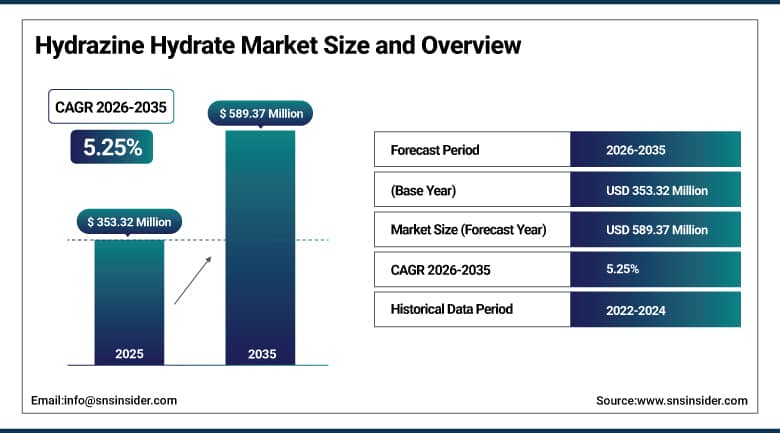
The Hydrazine Hydrate Market was valued at USD 353.32 Million in 2025 and is expected to reach USD 589.37 Million by 2035, growing at a CAGR of 5.25% from 2026–2035.
Hydrazine hydrate is a reactive nitrogen-based chemical used mainly as a blowing agent in polymer foams, a reducing agent in water treatment, and a synthesis intermediate for agrochemicals and pharmaceuticals. Manufacturers produce it in a range of concentrations, from dilute 24% grades used in bulk industrial processes up to anhydrous 100% material used in specialty and aerospace applications. Demand tracks closely with industrial activity in construction, automotive, and agriculture, since foam blowing agents and pesticide intermediates account for a large share of overall consumption. Tighter safety and environmental regulation in North America and Europe has pushed producers toward cleaner synthesis routes and better containment systems, even as Asia Pacific's chemical manufacturing base continues to expand output.
In February 2024, LANXESS launched a high-purity 100% hydrazine hydrate variant designed for aerospace applications, with the new product supporting satellite fuel systems and drawing immediate procurement interest from national space agencies. The launch illustrates how specialty, ultra-high-purity grades are becoming an increasingly important growth avenue for hydrazine hydrate producers as demand from propulsion and defense customers grows alongside the more traditional industrial and agrochemical end uses.
To Get More Information On Hydrazine Hydrate Market - Request Free Sample Report
Hydrazine Hydrate Market Trends
-
Producers are shifting investment toward the 60%-85% concentration range, which offers the best balance of reactivity and handling safety for the widest range of industrial customers.
-
Demand for polymer foam blowing agents is climbing as automakers and builders look for lighter, more insulating materials, particularly in electric vehicle interiors and energy-efficient construction.
-
Pharmaceutical customers are placing more orders for high-purity hydrazine hydrate intermediates used in oncology and tuberculosis drug synthesis, a segment that commands premium pricing over bulk industrial grades.
-
Tightening environmental regulation in the EU and US is pushing manufacturers toward closed-loop production systems and safer, lower-emission synthesis routes.
-
Capacity additions are concentrating in Asia, particularly China and India, where lower production costs and government support for domestic chemical manufacturing are attracting new investment.
U.S. Hydrazine Hydrate Market Outlook
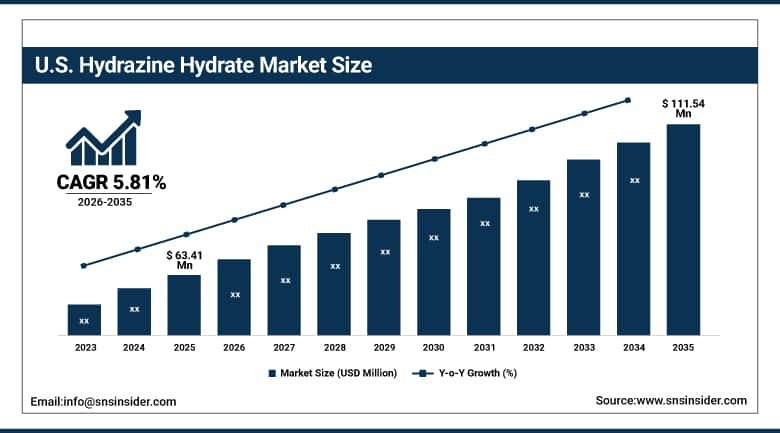
The U.S. Hydrazine Hydrate Market was valued at approximately USD 63.41 Million in 2025 and is expected to reach approximately USD 111.54 Million by 2035, growing at a CAGR of approximately 5.81%.
The United States holds the largest single-country share of the global hydrazine hydrate market, supported by a well-developed chemical manufacturing base, strong demand from the polymer and pharmaceutical industries, and extensive agricultural activity that requires agrochemical intermediates. A cluster of major producers maintains U.S. operations, backed by consistent research and development investment aimed at improving product purity and expanding into new applications. Regulatory support for safer synthesis methods, combined with growing interest in clean energy and fuel cell technologies that use hydrazine derivatives, continues to reinforce the country's leading position.
Between 2024 and 2025, Lonza Group completed an expansion of its Highly Potent API suite in Visp, Switzerland, significantly increasing capacity for hydrazine-based pharmaceutical intermediates used in antibody-drug conjugate payloads and other oncology applications. While the facility itself sits outside the United States, the expansion directly supports U.S. pharmaceutical customers who rely on Lonza's high-purity hydrazine derivatives for advanced cancer treatment manufacturing, underscoring how specialty pharmaceutical-grade material is becoming a larger share of overall demand.
Hydrazine Hydrate Market Segment Analysis
-
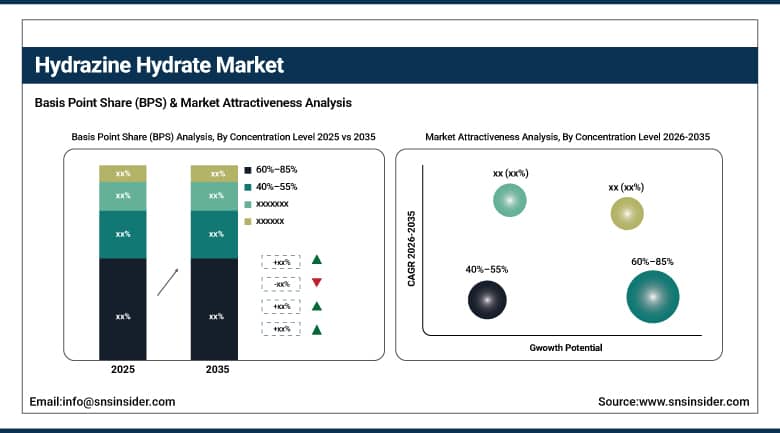
By Concentration Level, the 60%-85% segment dominated the Hydrazine Hydrate Market with approximately 68% share in 2025.
-
By Application, the Polymerization & Blowing Agents segment dominated the Hydrazine Hydrate Market with approximately 42% share in 2025, and is also the fastest growing application.
By Concentration Level, 60%-85% dominates
The 60%-85% concentration range held about 68% of the hydrazine hydrate market in 2025, the largest share of any grade. This range works well across a broad set of industrial processes, including polymerization, blowing agents, agrochemicals, and water treatment, offering a practical middle ground between reactivity and safe handling that suits most commercial applications.
Manufacturers favor this concentration because it minimizes handling risk while still delivering performance comparable to higher-purity grades, and it's widely used in chemical intermediates, pharmaceutical products, and fuel cell applications. Regulatory standards across most industrial markets are built around this concentration range, which further reinforces its position as the default choice for buyers across nearly every end-use category.
By Application, polymerization & blowing agents dominates
Polymerization and blowing agents accounted for roughly 42% of application demand in 2025, the largest share of any use case. Hydrazine hydrate derivatives are essential inputs for foam blowing agents used across construction, automotive, and packaging, where lightweight, insulating materials are in high demand as industries push toward more energy-efficient products.
This segment is also the fastest-growing application, propelled by rising industrialization and urbanization in emerging economies alongside growing consumer preference for lightweight materials in vehicles and buildings. As construction activity and vehicle production climb globally, particularly in fast-growing Asian markets, demand for the blowing agents that depend on hydrazine hydrate is expected to keep outpacing other application categories.
Regional Analysis
|
Region |
Major Country |
Share within Region, 2025 (%) |
|---|---|---|
|
Asia Pacific |
China |
44.0% |
|
North America |
United States |
76.0% |
|
Europe |
Germany |
25.0% |
|
Middle East & Africa |
Saudi Arabia |
29.0% |
|
Latin America |
Brazil |
38.0% |
Asia Pacific Hydrazine Hydrate Market Insights
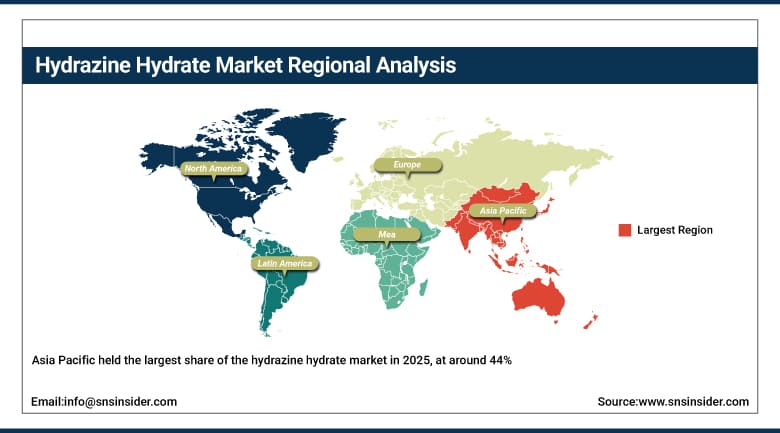
Asia Pacific held the largest share of the hydrazine hydrate market in 2025, at around 44%, supported by a dense concentration of end-use industries including agrochemicals, pharmaceuticals, and polymer manufacturing. Rapid industrialization in China, India, and Japan has driven strong demand for pesticide production, water treatment, and polymer manufacturing, while government policies across the region have encouraged both chemical productivity and agricultural output.
Lower production costs, ready access to raw materials, and the presence of major chemical manufacturers give the region a durable cost advantage over other markets. Rising investment in infrastructure and research and development, particularly in China and India, is expected to keep demand climbing, and the region is also the fastest-growing hydrazine hydrate market as industrial capacity continues to expand.
Get Customized Report as Per Your Business Requirement - Enquiry Now
North America Hydrazine Hydrate Market Insights
North America remains a significant hydrazine hydrate market, anchored by the United States, where advanced manufacturing facilities and steady innovation in chemical processes are driving growing demand for polymerization, pharmaceutical, and fuel cell applications. Strict environmental monitoring policies have pushed producers toward low-pollution, high-efficiency synthesis routes, which has, in turn, encouraged wider use of high-purity hydrazine hydrate grades.
Regulatory bodies including the EPA continue to endorse the applicability of hydrazine-based chemical agents within appropriately controlled industrial settings, providing a stable operating environment for domestic producers. Steady research and development investment aimed at improving product performance and opening new industrial use cases further supports the region's position as a mature, technically sophisticated market.
Europe Hydrazine Hydrate Market Insights
Europe remains a well-established hydrazine hydrate market, shaped by strict chemical safety regulation from bodies including the European Chemicals Agency and a strong base of specialty chemical producers. Germany leads regional demand, supported by its large polymer and industrial manufacturing sectors, which rely on hydrazine hydrate derivatives for foam blowing agents and process chemicals.
Regulatory pressure across the EU has pushed European producers toward safer formulations and greener synthesis alternatives, a shift that's reshaping competitive dynamics across the region. France, the United Kingdom, and Italy round out demand, supported by steady pharmaceutical and agrochemical consumption, and ongoing compliance investment is expected to keep shaping how European manufacturers compete going forward.
MEA & Latin America Hydrazine Hydrate Market Insights
The Middle East and Africa remain a developing hydrazine hydrate market, with demand tied to industrial development and agricultural expansion across the region. Saudi Arabia leads regional consumption, supported by its growing petrochemical sector and ongoing investment in agricultural production that requires agrochemical intermediates, while South Africa contributes through its established industrial base.
Latin America is seeing steady adoption led by Brazil, where large-scale agricultural operations and expanding water treatment infrastructure are driving demand for hydrazine hydrate-based agrochemicals and oxygen scavengers. Rapid industrialization and agricultural expansion across the broader region are creating substantial market entry points for producers looking to grow outside their traditional markets.
Market Dynamics
Growth Drivers: Rising demand for polymerization and blowing agents across industries
One of the biggest drivers behind hydrazine hydrate market growth is its key role in polymerization and as a blowing agent. It's widely used in polymer foams that benefit the automotive, packaging, and construction industries thanks to their lightweight, insulating properties, and its use as a blowing agent in plastic and rubber production is creating strong growth opportunities as industrialization and urbanization continue to expand globally.
As demand builds, particularly from emerging economies, companies are directing more capital toward expanding output. Rising use of polymer foams in energy-efficient building materials is opening further growth avenues, and the polymerization and blowing agents segment is expected to see the fastest demand growth over the forecast period as industrial bases expand and consumers increasingly favor lightweight materials.
Restraints: Stringent environmental and health regulations limiting expansion
The hydrazine hydrate market faces real headwinds from strict environmental and health regulations worldwide. Hydrazine hydrate is classified as a hazardous chemical with serious risks to human health and the environment if not handled properly, and regulatory bodies including the EPA and the European Chemicals Agency have put in place tight guidelines governing its production, transportation, storage, and use.
These regulations increase operational costs for manufacturers, who need advanced safety systems and compliance protocols to stay in business. Frequent inspections and licensing requirements add further complexity, particularly for new entrants, and rising public awareness of the risks is pushing manufacturers to develop safer formulations or seek greener substitutes, which could restrain overall market growth in the years ahead.
Opportunities: Expanding applications in pharmaceuticals and agrochemicals
Growing use of hydrazine hydrate in pharmaceuticals and agrochemicals is opening up substantial opportunities for the market. In pharmaceuticals, it's a critical intermediate in the synthesis of active pharmaceutical ingredients, especially for oncology and tuberculosis treatments, while in agrochemicals it plays an essential role in producing the pesticides and herbicides that global food demand keeps pushing higher.
As governments worldwide focus on improving agricultural productivity and healthcare infrastructure, demand for agrochemicals and pharmaceuticals keeps climbing, which translates directly into growing hydrazine hydrate consumption. Emerging economies in Asia Pacific and Latin America, where rapid industrialization and agricultural expansion are underway, offer substantial entry points that should keep strengthening global demand prospects over the next several years.
Recent Developments:
-
2024: In February 2024, LANXESS launched a high-purity 100% hydrazine hydrate variant for aerospace applications, supporting satellite fuel systems and drawing immediate procurement interest from national space agencies.
-
2024-2025: Lonza Group completed an expansion of its Highly Potent API suite in Visp, Switzerland, significantly increasing capacity for hydrazine-based pharmaceutical intermediates used in oncology drug manufacturing.
-
2025: In early 2025, SS Blowchem commissioned a new 2,800 TPA hydrazine hydrate and azodicarbonamide production facility in Rajasthan, India, addressing rising demand for polymer blowing agents used in automotive and construction foams.
-
2025: In April 2025, LANXESS divested its Urethane Systems business to UBE Corporation, reallocating capital toward its Saltigo division, which uses hydrazine derivatives in high-value agrochemical and pharmaceutical intermediates.
Hydrazine Hydrate Market Key Players
-
Arkema S.A.
-
Lonza Group
-
LANXESS AG
-
Weifang Yaxing Chemical Co., Ltd.
-
Otsuka Chemical Co., Ltd.
-
Nippon Carbide Industries Co., Inc.
-
Yibin Tianyuan Group Co., Ltd.
-
Tianjin Kaihong Chemical Co., Ltd.
-
Japan Finechem Co., Inc.
-
Hunan Zhuzhou Chemical Group Co., Ltd.
-
Gujarat Alkalies and Chemicals Ltd.
-
Chongqing Chemical & Pharmaceutical Holding Co., Ltd.
-
Nanjing Huaguan Chemical Co., Ltd.
-
Anugrah In-Org
-
Weifang Kailong Chemical Industry Co., Ltd.
-
Mitsubishi Gas Chemical Company, Inc.
-
Acuro Organics Limited
-
RX Chemicals
-
Merck KGaA
-
Palm Commodities International, Inc.
Hydrazine Hydrate Market Report Scope:
| Report Attributes | Details |
|---|---|
| Market Size in 2025 | USD 353.32 Million |
| Market Size by 2035 | USD 589.37 Million |
| CAGR | CAGR of 5.25% From 2026 to 2035 |
| Base Year | 2025 |
| Forecast Period | 2026-2035 |
| Historical Data | 2022-2024 |
| Report Scope & Coverage | Market Size, Segments Analysis, Competitive Landscape, Regional Analysis, DROC & SWOT Analysis, Forecast Outlook |
| Key Segments | • By Concentration Level (100%, 60%-85%, 40%-55%, 24%-35%) • By Application (Agrochemicals, Water Treatment, Polymerization & Blowing Agents, Pharmaceuticals, Others) |
| Regional Analysis/Coverage | North America (US, Canada, Mexico), Europe (Eastern Europe [Poland, Romania, Hungary, Turkey, Rest of Eastern Europe] Western Europe] Germany, France, UK, Italy, Spain, Netherlands, Switzerland, Austria, Rest of Western Europe]), Asia Pacific (China, India, Japan, South Korea, Vietnam, Singapore, Australia, Rest of Asia Pacific), Middle East & Africa (Middle East [UAE, Egypt, Saudi Arabia, Qatar, Rest of Middle East], Africa [Nigeria, South Africa, Rest of Africa], Latin America (Brazil, Argentina, Colombia, Rest of Latin America) |
| Company Profiles | Arkema S.A., Lonza Group, LANXESS AG, Weifang Yaxing Chemical Co., Ltd., Otsuka Chemical Co., Ltd., Nippon Carbide Industries Co., Inc., Yibin Tianyuan Group Co., Ltd., Tianjin Kaihong Chemical Co., Ltd., Japan Finechem Co., Inc., Hunan Zhuzhou Chemical Group Co., Ltd., Gujarat Alkalies and Chemicals Ltd., Chongqing Chemical & Pharmaceutical Holding Co., Ltd., Nanjing Huaguan Chemical Co., Ltd., Anugrah In-Org, Weifang Kailong Chemical Industry Co., Ltd., Mitsubishi Gas Chemical Company, Inc., Acuro Organics Limited, RX Chemicals, Merck KGaA, Palm Commodities International, Inc. |
Frequently Asked Questions
The Hydrazine Hydrate Market was valued at USD 353.32 Million in 2025.
Asia Pacific dominated the Hydrazine Hydrate Market in 2025 with approximately 44% market share and is also the fastest-growing region.
Polymerization & Blowing Agents dominated with approximately 42% share in 2025 and is also the fastest growing application segment.
Rising demand for polymerization and blowing agents across the automotive, packaging, and construction industries.
The Hydrazine Hydrate Market is expected to grow at a CAGR of 5.25% from 2026 to 2035.
