
MEO Satellite Market Report Scope & Overview:
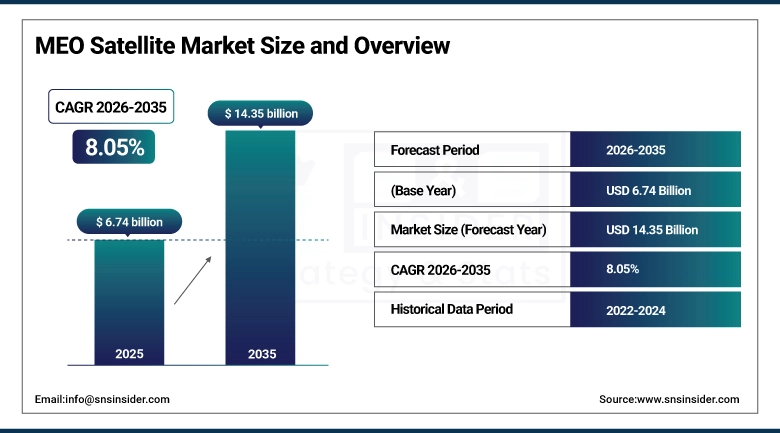
The MEO Satellite Market size is valued at USD 6.74 Billion in 2025 and is projected to reach around USD 14.35 billion by 2035, growing at a CAGR of 8.05% during the forecast period 2026–2035.
The MEO Satellite Market analysis report offers a comprehensive analysis of market dynamics, satellite technology, and application areas. The demand for navigation satellite services (GNSS), satellite communication systems, satellite data relay services, defense and military satellite applications, and satellite technology developments are contributing to the growth of the MEO satellite market between 2026 and 2035.
MEO satellite deployments have exceeded 150 satellites in 2025, mainly driven by navigation satellite constellations, growing communication requirements, and defense-focused satellite infrastructure development.
Market Size and Forecast:
-
Market Size in 2025: USD 6.74 Billion
-
Market Size by 2035: USD 14.35 Billion
-
CAGR: 8.05% from 2026 to 2035
-
Base Year: 2025
-
Forecast Period: 2026–2035
-
Historical Data: 2022–2024
To Get more information on MEO Satellite Market - Request Free Sample Report
MEO Satellite Market Trends:
-
Rising demand for navigation satellite systems (GNSS) is fueling the growth of MEO satellite systems.
-
Rising demand for satellite systems for communication and data relays is fueling the growth of MEO satellite systems.
-
Rising demand for satellite systems for defense and military operations is fueling the growth of MEO satellite systems.
-
Rising demand for satellite systems for payload, propulsion systems, high throughput satellite systems, and high throughput communication systems is fueling the growth of MEO satellite systems.
-
Rising demand for satellite systems from commercial satellite operators is fueling the growth of MEO satellite systems.
-
Rising demand for satellite systems for SSA is fueling the growth of MEO satellite systems.
-
Rising demand for satellite systems for multi-orbit satellite systems (LEO-MEO-GEO) is fueling the growth of MEO satellite systems.
U.S. MEO Satellite Market Insights:
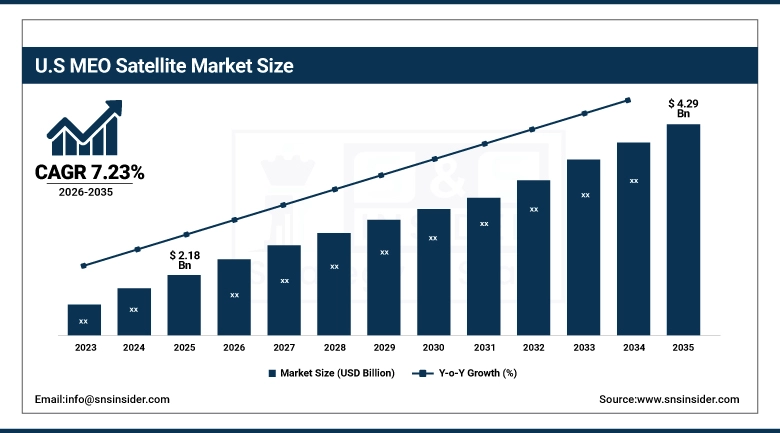
The MEO Satellite Market in the United States is estimated to grow from its current value of USD 2.18 Billion in 2025 to reach USD 4.29 Billion in 2035 at a CAGR of 7.23%. The growth is fueled by the increasing need for satellite navigation systems (GNSS), military satellite communications, support for military ISR systems, expansion of commercial satellite operators, and ongoing investments in advanced satellite payloads, propulsion systems, and integrated multi-orbit (LEO-MEO-GEO) space architectures.
MEO Satellite Market Growth Drivers:
-
Rise In Demand for Navigation (GNSS), Secure Communication, and Defense Satellite Services.
The rise in demand for navigation (GNSS), secure communication, and defense satellite services is a major growth driver for the MEO Satellite Market. In recent years, there has been an increased demand for satellite navigation services, military communication services, ISR services, and space-based data relay services. With the increasing demand for MEO-based satellite navigation services, military communication services, ISR services, and space-based data relay services, the MEO Satellite Market is growing rapidly.
In 2025, More than 60% of defense and commercial satellite operators used MEO-based systems for navigation, communication, and data relay services.
MEO Satellite Market Restraints:
-
High Deployment Costs, Infrastructure Complexities, and Lack of Affordability are the Key Restraining Factors for the Adoption of MEO Satellite Systems.
High capital costs involved in the production of satellites, launch services, infrastructure costs, and deployment of the satellite constellation in the MEO orbit are the key restraining factors for the MEO Satellite Market. The deployment of MEO satellite constellations involves high upfront costs and long gestation periods. Therefore, this technology has been accessible only to large defense agencies, established space agencies, and large commercial players. Moreover, the integration complexities of the MEO satellites with the existing multi-orbit systems would add to the overall complexities. The cost-conscious nature of the emerging markets would be an additional factor acting as a restraint.
MEO Satellite Market Opportunities:
-
There is an Immense Scope for the MEO Satellite Market Due to the Increasing Deployment of Navigation Services, Secure Communication, and Multi-Orbit Satellite Constellations.
The increasing demand for high-precision navigation services, secure defense communication, and high-speed data relay is opening up immense opportunities for the adoption of MEO Satellite. Defense organizations, government space agencies, and commercial entities are increasingly looking to invest in MEO-based constellations to ensure high-quality and efficient services across their operations. Technological developments in satellite payloads, electric propulsion systems, and high-capacity communication platforms have made it easier to deploy MEO Satellite efficiently.
More than 50% of new satellite infrastructure investment in 2025 was dedicated to the enhancement of navigation services, secure communication, and multi-orbit satellite constellations.
MEO Satellite Market Segmentation Analysis:
-
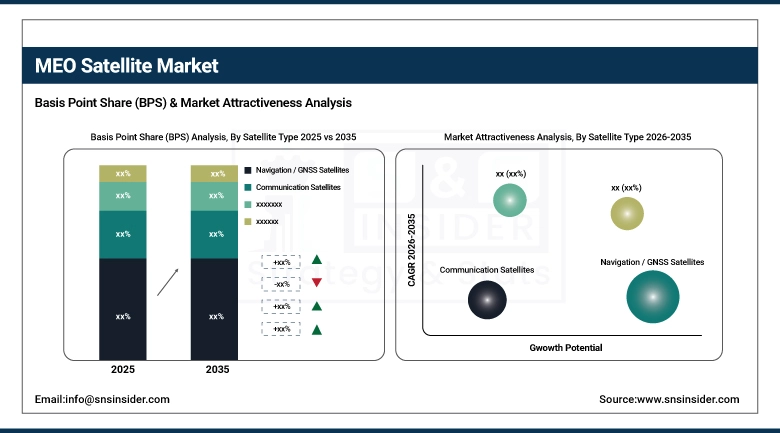
By Satellite Type, Navigation / GNSS Satellites held the largest market share of 60.25% in 2025, while Communication Satellites are expected to grow at the fastest CAGR of 8.85% during 2026–2035.
-
By Application, Navigation & Positioning (PNT Services) dominated with a 55.21% market share in 2025, whereas Military Communication is projected to record the fastest CAGR of 7.74% through 2026–2035.
-
By Component, Payloads accounted for the highest market share of 37.12% in 2025, while Communication Subsystems are expected to grow at the fastest CAGR of 5.98% during the forecast period.
-
By End-User, Commercial Satellite Operators held the largest market share of 50.25% in 2025, while Government Space Agencies are anticipated to expand at the fastest CAGR of 6.65% through 2026–2035.
By Satellite Type, Navigation / GNSS Satellites Dominate While Communication Satellites Grow Rapidly:
The Navigation/GNSS Satellites segment held the highest share in the market due to the importance and necessity of the service in providing positioning, timing, and navigation capabilities to the defense, aviation, maritime, and other industries. There were more than 60 operational GNSS-enabled satellite systems and services in 2025, indicating the high dependency on the service by government and defense organizations.
The "Communication Satellites" segment has been the fastest-growing segment in the market due to the high demand for communication satellites in providing a secure and reliable communication service. The deployment of MEO-based communication capabilities has been high in the recent past, especially in the field of defense and other industries.
By Application, Navigation & Positioning (PNT Services) Dominates While Military Communication Grows Rapidly:
The Navigation & Positioning (PNT Services) segment was the market leader in the past due to the widespread adoption of the service in defense systems, transportation infrastructure, aviation, and other key areas where precise time management is required along with location positioning. Billions of devices and systems around the globe rely on satellite navigation signals, which was the case in the year 2025 as well, thus emphasizing the significance of PNT services.
Military Communication is the fastest-growing segment in the market, which is being fueled by the growing need for defense system modernization programs.
By Component, Payloads Dominate While Communication Subsystems Grow Rapidly:
Payloads segment was the dominant segment of the satellite payload market due to their necessity in facilitating the key satellite operations such as navigation signal generation, communication transmission, etc. In the year 2025, payload systems act as the backbone for most MEO satellite deployments, especially those related to navigation and communication systems.
Communication Subsystems is the fastest-growing segment of the satellite payload market, largely due to the advancements in high-throughput communication systems. Integration of high-end antennas, transponders, signal processing systems, etc., is enhancing the efficiency of satellite connectivity systems.
By End-User, Commercial Satellite Operators Dominate While Government Space Agencies Grow Rapidly:
Commercial Satellite Operators was the largest segment in the market due to the growing trend of the commercialization of satellite services, including navigation augmentation, broadband connectivity, and data relay services. In 2025, key private players and organizations have been at the center of deploying MEO satellites for global services.
Government Space Agencies is the fastest-growing segment of the MEO satellite market due to the growing trend of national investments in space programs, navigation systems, strategic communication systems, and other related applications. Growing involvement in multi-orbit systems, space exploration, and other applications is boosting the use of MEO satellites by government space agencies.
MEO Satellite Market Regional Analysis:
North America MEO Satellite Market Insights:
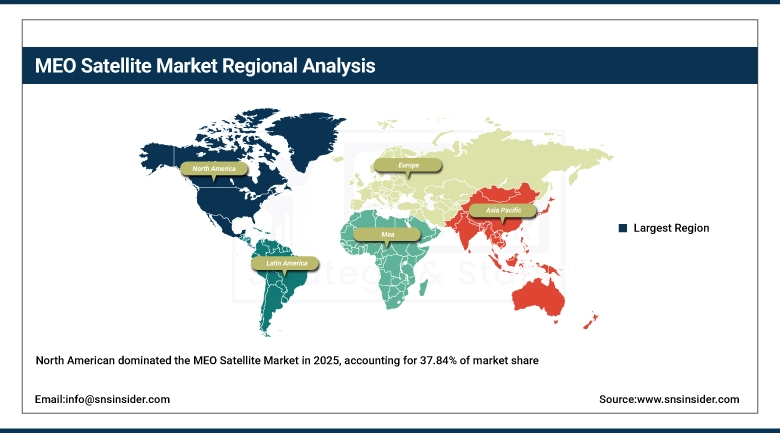
The North America MEO Satellite Market is dominated by this region, with a market share of 37.84% in 2025. This is due to the high demand for secure defense communication, high-end navigation services, and established space infrastructure in the US and Canadian regions. This region is served by major defense organizations, major satellite players, and high-end aerospace and space technology organizations that are actively engaged in the development and implementation of multi-orbit satellites. This is further supported by the growing demand for GNSS services, space situational awareness, and high-end communication services. This is further supported by the high-end developments and advancements in satellite payloads, propulsion systems, and high-end communication technologies.
Get Customized Report as per Your Business Requirement - Enquiry Now
United States MEO Satellite Market Insights:
The United States MEO Satellite market is fueled by significant defense sector modernization initiatives, high satellite navigation and position services reliance, and robust military communication infrastructure investments. The presence of prominent space agencies and satellite operators contributes to faster development and deployment of advanced MEO satellite systems for supporting GNSS augmentation services, ISR services, and connectivity solutions.
Asia-Pacific MEO Satellite Market Insights:
Asia-Pacific MEO Satellite Market: This market is in the growth phase and is expanding at a rate of 10.46% during the forecast period. This is due to increased investments in space programs in countries such as China, India, Japan, and Southeast Asia. The demand for satellite navigation services, defense communication services, and satellite services is contributing to market growth. Governments are investing heavily in satellite technology and navigation systems in countries such as China, India, and Southeast Asia. Private organizations are collaborating with these countries to deploy satellite services.
China MEO Satellite Market Insights:
The China MEO Satellite Market is driven by the growth of national space programs, increased investment in satellite navigation systems, and growing demand for secure communication and data relay. Strong government support through state-backed space initiatives and the continued development of indigenous satellite constellations are driving the China MEO Satellite Market. Increased demand for GNSS services in various sectors, including transportation and defense, and the continued development and improvement of satellite manufacturing and launch capabilities are all supporting China’s growing importance to the Asia-Pacific MEO Satellite Market.
Europe MEO Satellite Market Insights:
The Europe MEO Satellite Market is driven by established space agencies and high participation from commercial satellite operators. Growing demand for secure communication and reliable navigation is driving the Europe MEO Satellite Market. Steady progress is being made through investment in regional GNSS infrastructure, space-based surveillance, and multi-orbit integration. Countries including Germany, France, and the UK are investing heavily in the development and deployment of advanced satellite technologies. This is supporting innovation and development in payload, propulsion, and communication technologies.
Germany MEO Satellite Market Insights:
Germany is an important contributor to the European MEO Satellite Market due to high-end capabilities in aerospace engineering, participation in various European space-related initiatives, and increasing investments in satellite communication and navigation technologies. The country is benefiting from high-end research facilities, industrial partnerships, and associations with renowned space organizations. Increasing demand for defense communication, space observation, and high-end navigation is boosting the demand for MEO satellites. Continuous innovations in satellite-related technologies and integration capabilities are making the country an important contributor to the regional MEO Satellite Market.
Latin America MEO Satellite Market Insights:
Latin America MEO Satellite Market is growing steadily with increasing demand for satellite-based navigation, communication connectivity, and disaster response applications. Countries such as Brazil and Mexico are showing keen interest in improving their space-related capabilities and adopting various satellite-based technologies to enhance transportation, agricultural, and defense-related initiatives. Limited geographical infrastructure is making the region rely heavily on satellite-based solutions. Increasing associations with international space agencies and organizations are making it easier to access high-end MEO Satellite services.
Middle East & Africa MEO Satellite Market Insights:
The Middle East & Africa MEO Satellite Market is developing steadily, driven by rising investments in space programs, defense modernization, and growing demand for reliable communication and navigation services. Countries such as the UAE, Saudi Arabia, and South Africa are actively investing in satellite infrastructure and space initiatives to enhance national capabilities. Increasing use of satellite-based systems for defense operations, oil and gas sector connectivity, and remote area communication is supporting market growth.
MEO Satellite Market Competitive Landscape:
Safran S.A. is a leading aerospace and defense company with a strong presence in the MEO Satellite Market through its advanced propulsion systems, satellite subsystems, and space engineering capabilities. The company contributes to satellite platform performance with high-efficiency propulsion technologies and critical components used in navigation and communication satellite missions. Its long-standing expertise in aerospace engineering, combined with sustained R&D investments and collaborations with space agencies and defense organizations, strengthens its competitive position.
-
In March 2025, Safran advanced its electric propulsion systems for satellite constellations, enhancing fuel efficiency, mission lifespan, and manoeuvrability for medium Earth orbit platforms, supporting next-generation navigation and communication satellite programs.
XVIVO Perfusion AB is primarily known for its life sciences and organ preservation technologies, but its relevance to the MEO Satellite Market is limited compared to core aerospace and defense players. However, its technological expertise in precision systems, fluid dynamics, and controlled environments reflects broader innovation capabilities that can indirectly align with high-precision engineering domains. The company’s focus on advanced preservation solutions demonstrates strong R&D orientation and systems-level integration, which is a common characteristic among high-technology industries including aerospace and satellite systems.
-
In June 2025, XVIVO Perfusion AB advanced its preservation and perfusion technology platforms through continued R&D initiatives and clinical collaborations, strengthening its technological foundation in precision-controlled systems, though without direct commercial involvement in satellite programs.
RTX Corporation (Collins Aerospace) is a major aerospace and defense company with a strong presence in the MEO Satellite Market through its satellite communication systems, avionics, navigation technologies, and space-qualified components. Collins Aerospace, as a subsidiary, provides advanced payload systems, communication subsystems, and navigation solutions that are integral to satellite operations. The company plays a significant role in supporting defense communication networks, space-based navigation systems, and multi-orbit satellite architectures
-
In April 2025, RTX Corporation (Collins Aerospace) expanded its satellite communication and navigation technology portfolio, contributing to next-generation secure defense communication systems and enhancing interoperability across multi-orbit satellite constellations used in GNSS and ISR applications.
MEO Satellite Market Key Players:
Some of the MEO Satellite Market Companies are:
-
Safran S.A.
-
XVIVO Perfusion AB
-
RTX Corporation (Collins Aerospace)
-
Lockheed Martin Corporation
-
Northrop Grumman Corporation
-
Airbus Defence and Space
-
Thales Group
-
L3Harris Technologies, Inc.
-
Leonardo S.p.A.
-
Honeywell Aerospace (Honeywell International Inc.)
-
General Dynamics Corporation
-
BAE Systems plc
-
SES S.A.
-
Intelsat S.A.
-
Telesat Corporation
-
Viasat, Inc.
-
Kratos Defense & Security Solutions, Inc.
-
Maxar Technologies Inc.
-
OHB SE
-
Mitsubishi Electric Corporation
-
Indian Space Research Organisation (ISRO)
| Report Attributes | Details |
|---|---|
| Market Size in 2025 | USD 6.74 Billion |
| Market Size by 2035 | USD 14.35 Billion |
| CAGR | CAGR of 8.05% From 2026 to 2035 |
| Base Year | 2025 |
| Forecast Period | 2026-2035 |
| Historical Data | 2022-2024 |
| Report Scope & Coverage | Market Size, Segments Analysis, Competitive Landscape, Regional Analysis, DROC & SWOT Analysis, Forecast Outlook |
| Key Segments | • By Satellite Type (Navigation / GNSS Satellites, Communication Satellites, Earth Observation Satellites, Scientific / Research Satellites, Others) • By Application (Navigation & Positioning (PNT Services), Military Communications, Secure Data Relay, Intelligence, Surveillance & Reconnaissance (ISR), Missile Guidance & Targeting, Space Situational Awareness (SSA), Others) • By Component (Payloads, Satellite Bus, Communication Subsystems, Navigation Payload Systems, Attitude & Orbit Control Systems (AOCS), Power Systems, Propulsion Systems, Thermal Control Systems, Ground Control Systems, Others) • By End User (Defense & Military Agencies, Government Space Agencies, Commercial Satellite Operators, Defense Contractors / System Integrators, Others) |
| Regional Analysis/Coverage | North America (US, Canada), Europe (Germany, UK, France, Italy, Spain, Russia, Poland, Rest of Europe), Asia Pacific (China, India, Japan, South Korea, Australia, ASEAN Countries, Rest of Asia Pacific), Middle East & Africa (UAE, Saudi Arabia, Qatar, South Africa, Rest of Middle East & Africa), Latin America (Brazil, Argentina, Mexico, Colombia, Rest of Latin America). |
| Company Profiles | Safran S.A., XVIVO Perfusion AB, RTX Corporation (Collins Aerospace), Lockheed Martin Corporation, Northrop Grumman Corporation, Airbus Defence and Space, Thales Group, L3Harris Technologies, Inc., Leonardo S.p.A., Honeywell Aerospace (Honeywell International Inc.), General Dynamics Corporation, BAE Systems plc, SES S.A., Intelsat S.A., Telesat Corporation, Viasat, Inc., Kratos Defense & Security Solutions, Inc., Maxar Technologies Inc., OHB SE, Mitsubishi Electric Corporation, Indian Space Research Organisation (ISRO) |

Frequently Asked Questions
North America dominated with a 37.84% share in 2025, while Asia-Pacific is the fastest-growing region expected to expand at a CAGR of 10.46% during 2026–2035.
Navigation / GNSS Satellites dominated with a 60.25% share in 2025, while Communication Satellites are projected to grow at the fastest CAGR of 8.85% during 2026–2035.
Growth is driven by rising demand for GNSS services, increasing need for secure satellite communications, expanding defense applications, advancements in satellite payload and propulsion technologies, and growing adoption of multi-orbit satellite architectures
The market is valued at USD 6.74 Billion in 2025 and is projected to reach around USD 14.35 Billion by 2035.
The MEO Satellite Market is projected to grow at a CAGR of 8.05% during 2026–2035.
