
Message Queue as a Service (MQaaS) Market Report Scope & Overview:
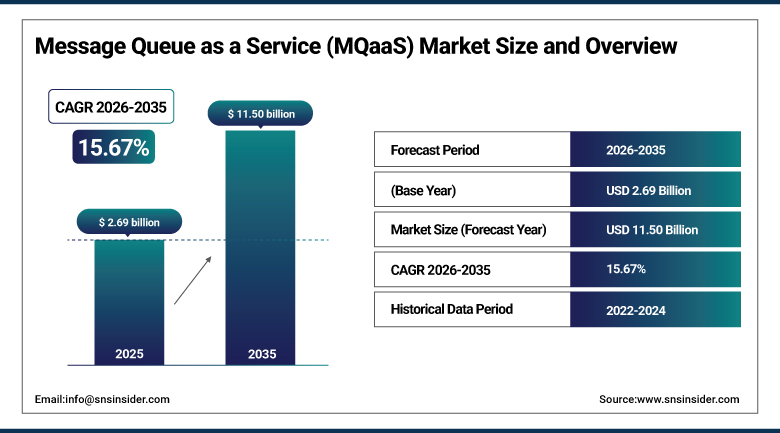
The Message Queue as a Service (MQaaS) Market was valued at USD 2.69 Billion in 2025 and is expected to reach USD 11.50 Billion by 2035, growing at a CAGR of 15.67% from 2026–2035.
The global message queue as a service (MQaaS) market is witnessing rapid growth owing to increasing adoption across IT, telecommunications, BFSI, healthcare, retail, manufacturing, and other industries. Rising investments in cloud computing, microservices architecture, event-driven applications, and distributed systems are boosting market development. Growing deployment of MQaaS solutions for application integration, real-time data streaming, asynchronous communication, and IoT messaging is supporting market expansion. Service providers are focusing on scalable, secure, and highly available messaging platforms to address diverse enterprise requirements. Rising demand for cloud-native applications, digital transformation, and seamless communication between distributed applications is driving product innovation and commercialization. Increasing integration of AI-enabled automation, cloud-native technologies, containerization, APIs, and real-time data processing capabilities is further accelerating market adoption.
In July 2025, Amazon Web Services introduced fair queues for Amazon SQS, helping distribute messages more efficiently across tenants and reduce the impact of high-volume workloads. For the Message Queue as a Service (MQaaS) Market, the update highlights growing demand for scalable message distribution, reliable asynchronous communication, and efficient multi-tenant workload management in cloud environments.
To Get more information Location Message Queue as a Service (MQaaS) Market - Request Free Sample Report
Message Queue as a Service (MQaaS) Market Trends
-
Increasing adoption of microservices and cloud-native applications is driving demand for reliable asynchronous messaging and application communication.
-
Growing complexity of distributed IT environments is encouraging enterprises to adopt managed message queues for efficient message routing, processing, and application integration.
-
Rising adoption of event-driven architectures, real-time data streaming, and IoT applications is increasing demand for scalable and reliable messaging infrastructure.
-
Growing focus on application scalability, operational efficiency, business continuity, and reduced infrastructure management costs is creating opportunities for MQaaS providers.
-
Advancements in artificial intelligence, automation, cloud computing, and distributed application technologies are improving message processing, workload management, scalability, interoperability, and real-time data exchange.
U.S. Message Queue as a Service (MQaaS) Market Outlook
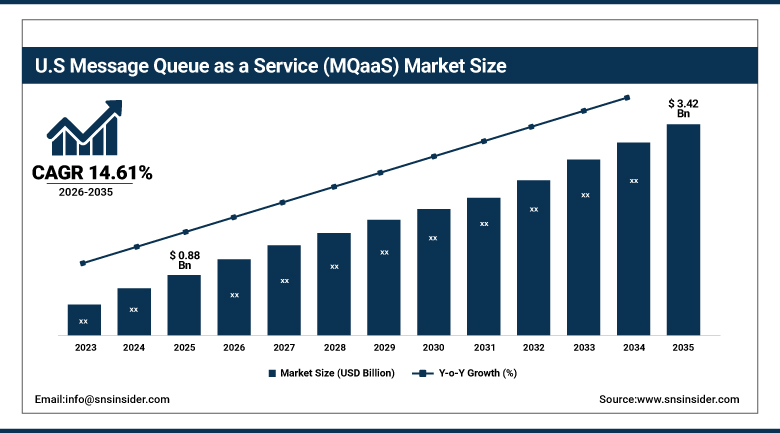
The U.S. Message Queue as a Service (MQaaS) Market was valued at USD 0.88 Billion in 2025 and is expected to reach around USD 3.42 Billion by 2035, growing at a CAGR of 14.61% from 2026–2035.
There are several factors responsible for making the US message queue as a service (MQaaS) market a highly attractive space in the coming years. One such factor is the rising demand for scalable, reliable, and efficient messaging infrastructure to support distributed applications, microservices, and event-driven architectures. The presence of numerous technology companies, banks, healthcare organizations, retailers, manufacturers, government agencies, and other enterprises in the US is driving the adoption of cloud-based messaging services for application integration and real-time data exchange. Increasing investments in cloud computing, artificial intelligence, containerization, microservices, and cloud-native applications are encouraging organizations to adopt MQaaS solutions for asynchronous communication, message routing, data streaming, workload decoupling, and application scalability.
In April 2026, Google Cloud introduced enhancements to its cross-cloud infrastructure capabilities at Google Cloud Next ’26 in Las Vegas, focusing on fluid compute, cross-cloud connectivity, unified data management, and digital sovereignty. For the Message Queue as a Service (MQaaS) Market, these developments highlight the growing need for reliable communication and data exchange across distributed cloud environments. The expansion of cross-cloud infrastructure can support demand for scalable messaging services that enable application integration, event-driven processing, workload decoupling, and consistent data flows across heterogeneous environments.
Message Queue as a Service (MQaaS) Market Segment Analysis
-
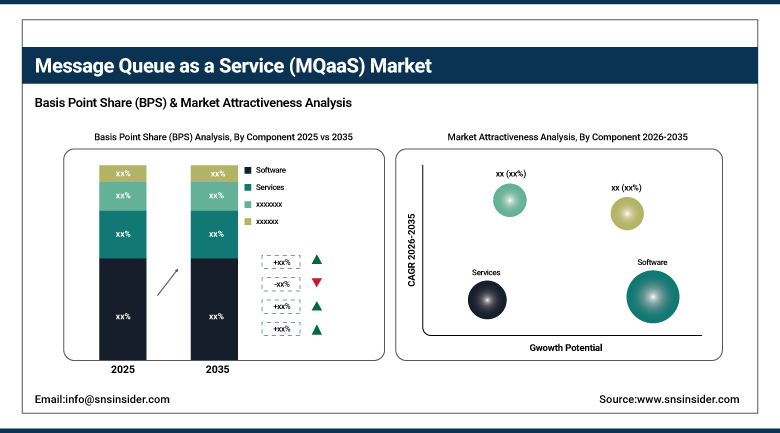
By Component, software dominated the message queue as a service (MQaaS) market with a 68.40% share in 2025, while services is projected to be the fastest-growing segment, registering an 18.89% CAGR during 2026–2035.
-
By Deployment Mode, public cloud dominated the message queue as a service (MQaaS) market with a 61.20% share in 2025, while hybrid cloud is projected to be the fastest-growing segment, registering a 22.67% CAGR during 2026–2035.
-
By Organization Size, large enterprises dominated the message queue as a service (MQaaS) market with a 70.30% share in 2025, while small and medium enterprises is projected to be the fastest-growing segment, registering a 19.42% CAGR during 2026–2035.
-
By Application, microservices integration dominated the message queue as a service (MQaaS) market with a 31.40% share in 2025, while data streaming is projected to be the fastest-growing segment, registering a 21.41% CAGR during 2026–2035.
-
By End User, information and telecom dominated the message queue as a service (MQaaS) market with a 27.80% share in 2025, while banking, financial services, and insurance is projected to be the fastest-growing segment, registering a 19.63% CAGR during 2026–2035.
By Component, software dominated the message queue as a service (MQaaS) market, while services is expected to grow fastest.
The software sub-segment was the market leader in 2025 due to rising usage of managed messaging services, message brokers, queues management software, and event processing software for distributed applications. Companies are leveraging MQaaS software for facilitating asynchronous communications, application integrations, message routing, and secure data exchange across microservices and cloud-native applications. Rising deployment of microservices, event-driven architecture, APIs, containerization, and distributed applications within BFSI, IT and telecoms, healthcare, retail, manufacturing, government, media and entertainment sectors, among others, will drive demand for messaging software.
The services sub-segment is estimated to be the fastest-growing during the forecast period. Companies are requiring implementation, integration, consulting, migration, maintenance, monitoring, and managed services to make the deployment and operation of MQaaS environments easier. With increasing complexities in messaging infrastructure in multi-cloud, hybrid cloud, microservices, and event-driven architectures, businesses need specialized services for optimizing messaging process, integrating applications, managing workloads, and ensuring service reliability.
By Application, microservices integration dominated the message queue as a service (MQaaS) market, while data streaming is expected to grow fastest.
The microservices integration market share was dominated by the segment of MQaaS in 2025, mainly due to the growing adoption of the microservices architecture and the requirement of reliable communication between loosely coupled applications and services. The use of message queues allows organizations to have asynchronous communication, reduced dependency between different parts of applications, and enhanced resilience and scalability of the system. MQaaS allows enterprises to ease communication between microservices while having minimal involvement in the management of their messaging infrastructures.
Data streaming is anticipated to register the fastest growth rate during the forecast period. The rising amount of real-time data generated from different sources, including connected devices, digital applications, financial transactions, enterprise systems, and online platforms is driving the demand for scalable messaging and data streaming. The MQaaS allows transmitting and processing large volumes of data in real-time while ensuring efficient analytics and event processing.
By End User, information and telecom dominated the message queue as a service (MQaaS) market, while banking, financial services, and insurance is expected to grow fastest.
Information and telecom segment held the largest market share in 2025 due to the widespread adoption of distributed applications, cloud services, APIs, network services, and large-scale data processing. Telecommunication and Technology companies need efficient messaging solution to provide application integration, service communication, customer facing portals, network services, and data exchange in real time.
BFSI is estimated to be the fastest-growing segment with the highest CAGR during the forecast period. BFSI Organizations are increasingly deploying event-driven architecture and real-time data processing to facilitate digital banking, payment processing, fraud detection, customer applications, and automated financial services. MQaaS Solution helps BFSI Organizations to develop efficient asynchronous communication channels between applications.
Regional Insights
|
Region |
Major Country |
Share within Region, 2025(%) |
|---|---|---|
|
North America |
United States |
84.63% |
|
Europe |
Germany |
27.38% |
|
Asia Pacific |
China |
45.72% |
|
Middle East & Africa |
Saudi Arabia |
22.84% |
|
Latin America |
Brazil |
21.63% |
North America Message Queue as a Service (MQaaS) Market Insights
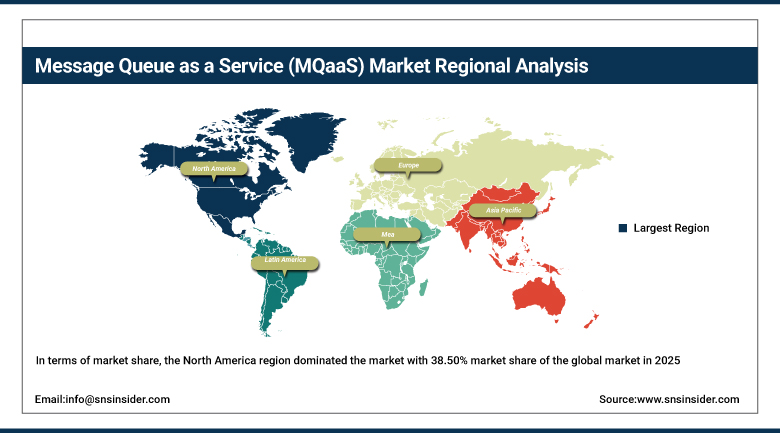
In terms of market share, the North America region dominated the market with 38.50% market share of the global market in 2025. This domination is driven by the presence of advanced cloud infrastructure, the rapid rate of digital transformation, and the availability of technology companies, financial institutions, healthcare organizations, telecom service providers, manufacturing companies, and governmental bodies. The adoption of microservices, cloud-native applications, event-driven architectures, real-time data processing, and distributed enterprise architectures has been increasing the demand for managed message services.
In the region, the US will be the leading country market due to the adoption of cloud computing, microservices, artificial intelligence, containerization, and distributed application architecture. The rising need for scalable asynchronous communication, application integration, real-time data exchange, message routing, and effective event processing has been promoting the adoption of MQaaS services among enterprises
Get Customized Report as per Your Business Requirement - Enquiry Now
Europe Message Queue as a Service (MQaaS) Market Insights
The MQaaS market in Europe is projected to continue growing consistently until 2035, driven by the adoption of cloud solutions, digital transformation initiatives, data-centric apps, and increased IT environment complexity. Germany is considered one of the largest countries markets due to the advanced development of the manufacturing, automotive, engineering, finance services, and industrial technology industries. The adoption of microservices architectures, event-driven apps, and cloud-native solutions creates the need for robust messaging platforms.
Organizations in Europe are adopting MQaaS solutions for enhanced integration, asynchronous processing, scalability, and real-time data exchanges. The UK, France, Italy, and other European countries are making investments in the cloud, artificial intelligence, cybersecurity, digital services, and new application development platforms.
Asia Pacific Message Queue as a Service (MQaaS) Market Insights
The Asia Pacific region is expected to grow at the fastest rate of 17.72% in terms of CAGR. This is attributed to high rates of digital transformation, increasing use of cloud technology, increased investments in data centers, as well as implementation of artificial intelligence, cloud-native applications, microservices, and distributed computing solutions. China is the largest country market in the region due to its large tech industry, growing digital economy, investments in data centers, and cloud-based enterprise applications. Japan and South Korea are other important markets due to their technological advancements in the industries of technology, electronics, automobile, telecommunication, and enterprise IT.
Middle East & Africa and Latin America Message Queue as a Service (MQaaS) Market Insights
Further, it can be noted that the regions of the Middle East & Africa and Latin America will continue to demonstrate growth in the MQaaS market up until 2035 on the back of digital transformation, cloud infrastructure development, increasing enterprise investments in technologies, and distributed application adoption.
In case of the Middle East & Africa region, Saudi Arabia is one of the important country markets because of digital infrastructure investments, data center investments, investments in artificial intelligence, smart cities projects and digital transformation countrywide. Development of cloud-native applications and digital services generates increased need for messaging management. Regarding Latin America region, Brazil is one of the important country markets because of increased adoption of cloud solutions in finance, telecoms, retail, manufacturing, healthcare and government segments
Growth Driver: Increasing adoption of cloud-native applications and asynchronous messaging is driving market growth
The increasing usage of cloud native applications, microservices, and distributed applications architecture is another major factor which has been helping in the growth of the MQaaS market. Message queues are being used more and more by organizations to ensure the reliability of asynchronous communication between various applications, services, and systems, while enhancing scalability, flexibility, and performance of applications. The increased use of event-driven applications, real time data processing, APIs, containers, and distributed workloads is further increasing the demand for managed and scalable messaging platforms.
Technology advancements in cloud computing, automation, containerization, Kubernetes, AI, and event-driven architecture are providing better ways to route messages, process messages, monitor messages, and integrate applications. Increasing demand for real-time data exchange, workload decoupling, application resiliency, and automatic processing of messages is driving the enterprises towards MQaaS platform.
Restraint: Security, integration complexity, and data management concerns can limit market adoption
Some of the security, compliance, and data management issues involved in transferring sensitive data through distributed systems and cloud computing could hamper the adoption of MQaaS offerings. Companies in regulated sectors might have issues with data privacy, access, encryption, data location, message archiving, and other compliance issues. Besides, it could become difficult for firms to integrate their MQaaS platforms with their existing legacy systems, database management systems, APIs, enterprise applications, and various messaging systems.
The costs involved in migration, integration, customization, monitoring, expert technical manpower, and overall management of the system could deter smaller companies from using MQaaS services. Some of the other issues that might arise for enterprises include dependency on vendors, interoperability, service reliability, and performance consistency of messaging across varied application ecosystems.
Opportunity: Growing adoption of AI workloads, real-time data streaming, and event-driven architectures creates new market opportunities
The rise in adoption of artificial intelligence, machine learning, real-time analytics, Internet of Things, cloud-native applications, and heavy data workloads is providing fresh opportunities for MQaaS vendors. AI-based applications need fast and efficient movement of data across multiple distributed applications, and there is a need for a scalable messaging solution that can enable high-volume and low-latency communications.
The rise in adoption of event-driven architecture, edge computing, distributed applications, digital transformation, and multi-cloud architecture is further leading to increased demand for managed messaging solutions. Intelligent routing of messages, automatic scaling, real-time monitoring, event processing, and integration with AI and analytics platforms can allow enterprises to achieve better application performance. This trend will generate more opportunities for MQaaS vendors in technology, BFSI, healthcare, manufacturing, telecommunication, retail, and other sectors.
Recent Developments
-
March 2026: Amazon Web Services enhanced its cloud messaging capabilities with updates to Amazon Simple Queue Service (SQS), supporting more efficient message processing and scalable asynchronous communication for distributed applications and microservices.
-
April 2026: Google LLC expanded its messaging and event-driven application capabilities, strengthening integration between cloud services and distributed applications and supporting scalable real-time data exchange across cloud environments.
-
April 2026: Microsoft Corporation enhanced Azure messaging and event-driven services, supporting application integration, asynchronous communication, and scalable message processing for cloud-native workloads.
-
June 2026: IBM Corporation expanded its cloud integration and messaging capabilities, strengthening support for event-driven applications, application integration, and reliable data exchange across distributed enterprise environments.
Message Queue as a Service (MQaaS) Market Key Players are:
-
Amazon Web Services Inc.
-
Microsoft Corporation
-
Google LLC
-
International Business Machines Corporation
-
Alibaba Cloud Computing Ltd.
-
Confluent Inc.
-
Solace Corporation
-
Red Hat Inc.
-
SAP SE
-
TIBCO Software Inc.
-
Huawei Technologies Co. Ltd.
-
Tencent Holdings Limited
-
MuleSoft LLC
-
Software AG
-
Ably Realtime Ltd.
-
CloudAMQP
-
PubNub Inc.
-
StreamNative Inc.
Message Queue as a Service (MQaaS) Market Report Scope:
| Report Attributes | Details |
|---|---|
| Market Size in 2025 | USD 2.69 Billion |
| Market Size by 2035 | USD 11.50 Billion |
| CAGR | CAGR of 15.67% From 2026 to 2035 |
| Base Year | 2025 |
| Forecast Period | 2026-2035 |
| Historical Data | 2022-2024 |
| Report Scope & Coverage | Market Size, Segments Analysis, Competitive Landscape, Regional Analysis, DROC & SWOT Analysis, Forecast Outlook |
| Key Segments | • By Component (Software, Services) • By Deployment Mode (Public Cloud, Private Cloud, Hybrid Cloud) • By Organization Size (Small and Medium Enterprises (SMEs), Large Enterprises) • By Application (Microservices Integration, Event-Driven Applications, Data Streaming, Application Integration, Internet of Things (IoT) Messaging) • By End User (Information Technology and Telecom, BFSI, Retail and E-commerce, Healthcare, Media and Entertainment, Government, Other End Users) |
| Regional Analysis/Coverage | North America (US, Canada, Mexico), Europe (Eastern Europe [Poland, Romania, Hungary, Turkey, Rest of Eastern Europe] Western Europe] Germany, France, UK, Italy, Spain, Netherlands, Switzerland, Austria, Rest of Western Europe]), Asia Pacific (China, India, Japan, South Korea, Vietnam, Singapore, Australia, Rest of Asia Pacific), Middle East & Africa (Middle East [UAE, Egypt, Saudi Arabia, Qatar, Rest of Middle East], Africa [Nigeria, South Africa, Rest of Africa], Latin America (Brazil, Argentina, Colombia, Rest of Latin America) |
| Company Profiles | Amazon Web Services Inc.; Microsoft Corporation; Google LLC; International Business Machines Corporation; Oracle Corporation; Alibaba Cloud Computing Ltd.; Confluent Inc.; Solace Corporation; Red Hat Inc.; SAP SE; TIBCO Software Inc.; Huawei Technologies Co. Ltd.; Tencent Holdings Limited; MuleSoft LLC; Software AG; EMQ Technologies Co. Ltd.; Ably Realtime Ltd.; CloudAMQP; PubNub Inc.; StreamNative Inc. |
Frequently Asked Questions
The message queue as a service (MQaaS) market is expected to grow at a CAGR of 15.67% from 2026 to 2035.
The market is primarily driven by the increasing adoption of cloud-native applications, microservices, event-driven architectures, real-time data streaming, and the growing need for scalable and reliable asynchronous communication.
North America dominated the message queue as a service (MQaaS) market in 2025, accounting for a 38.50% share.
