
Patient Blood Management Market Report Scope & Overview:
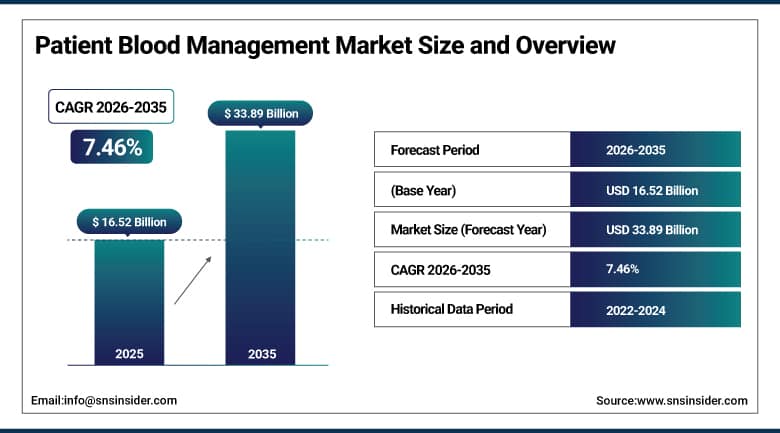
The Patient Blood Management Market was valued at USD 16.52 Billion in 2025 and is projected to reach USD 33.89 Billion by 2035, expanding at a CAGR of 7.46% during the forecast period 2026–2035.
There is a growing demand for patient blood management as many health care facilities are implementing evidence-based approaches to enhance patient outcomes without increasing their reliance on allogeneic blood transfusions. The implementation of blood conservation practices involves the application of pre-operative anemia management, intra-operative blood preservation solutions, and post-operative transfusion optimization measures. The growing volume of surgical procedures, the increased number of patients with chronic conditions leading to anemia, as well as the necessity to increase clinical efficiency are factors stimulating the development of PBM in many health care facilities.
Growing digitization of transfusion services, widespread use of clinical decision support systems and improvements in blood monitoring technologies are also contributing to market growth. On a parallel note, rising consciousness about patient safety, the need to cut down healthcare costs, and other positive developments encouraging value-based care are continuously fueling the growth. With hospitals enhancing their facilities to support surgeries and adopting technologies for precision medicine, the need for sophisticated blood management equipment, diagnostic tests, and software will keep rising in the coming years.
Market Size and Forecast
-
Market Size 2026E: USD 17.74 Billion
-
Market Size 2035: USD 33.89 Billion
-
CAGR: 7.46% from 2026 to 2035
-
Fastest Growing Region: Asia Pacific
-
Largest Region: North America
To Get More Information On Patient Blood Management Market - Request Free Sample Report
Patient Blood Management Market Trends
-
Increasing implementation of comprehensive patient blood management programs across hospitals.
-
Rising adoption of AI-enabled transfusion decision support and clinical analytics platforms.
-
Growing integration of digital blood inventory management with electronic health records.
-
Expanding utilization of blood conservation technologies during complex surgical procedures.
-
Continuous investments in precision diagnostics, hospital digitalization, and value-based transfusion management.
The U.S. Patient Blood Management Market Size Outlook
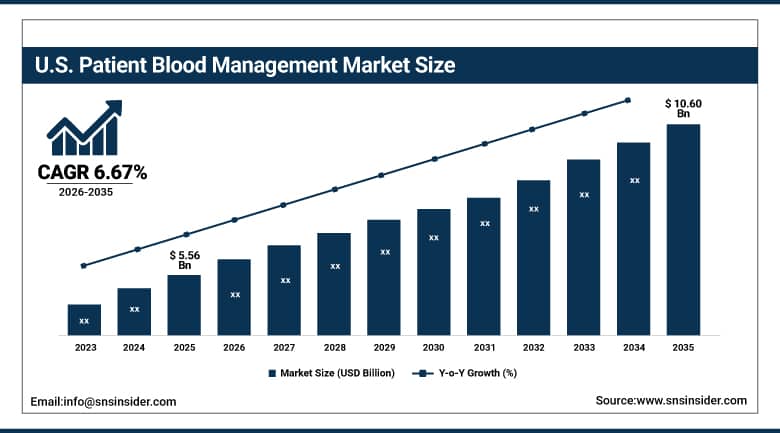
The U.S. Patient Blood Management Market was valued at USD 5.56 billion in 2025 and is expected to reach approximately USD 10.60 billion by 2035, expanding at a CAGR of 6.67% during 2026–2035.
The leading position of the United States in the North American patient blood management market is associated with the development of the healthcare sector in the region, the implementation of the evidence-based transfusion medicine approach, and the introduction of advanced solutions for hospital digitalization. PBM programs have been introduced to help hospitals optimize blood utilization, enhance patient outcomes after surgery, and avoid unnecessary transfusions in different fields such as orthopedic surgery, cardiovascular interventions, oncological treatment, and trauma treatment. Due to the increasing number of patients with diseases that require major surgeries and the need for ensuring patient safety and optimizing healthcare expenses, hospitals invest in advanced blood management equipment and software and lab information systems.
The rise in value-based healthcare, the development of AI-supported clinical decision-making processes, and EHR-to-transfusion management system interoperability continue to foster the expansion of the market in the United States. Predictive analytics to detect transfusion risks, manage the blood inventory in real-time mode, and adhere to PBM protocols have become more popular recently. The investments in minimally invasive surgical procedures, hospital renovations, and perioperative blood conservation technologies offer more opportunities for players in the industry.
Patient Blood Management Market Segment Analysis
-
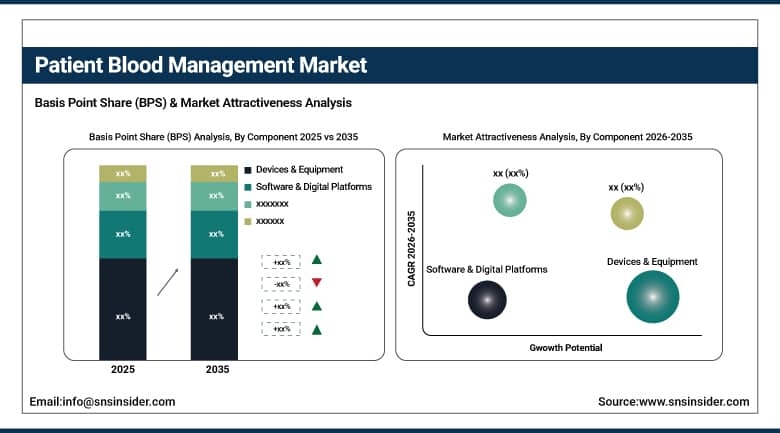
By Component, devices & equipment dominated the market with 46.00% share in 2025, while software & digital platforms are projected to witness the fastest growth with 11.90% CAGR during the forecast period.
-
By Application, surgical & perioperative care dominated the market with 48.00% share in 2025, while obstetrics & maternal care is projected to witness the fastest growth with 8.48% CAGR during the forecast period.
-
By End User, hospitals & health systems dominated the market with 58.00% share in 2025, while specialty clinics & cancer centers are projected to witness the fastest growth with 11.36% CAGR during the forecast period.
By Component, devices & equipment dominated, while software & digital platforms fastest-growing.
Devices & equipment formed 46.00% of the market share in 2025 and is the most revenue-generating segment of the market. This segment is responsible for the maximum revenues generated owing to the heavy usage of auto transfusion systems, blood collection devices, infusion systems, blood warmers, and intraoperative blood salvage devices in major surgeries. Healthcare facilities are continually upgrading their blood management technologies for efficient transfusion processes, minimizing perioperative blood losses and bettering patients' results. In January 2026, Haemonetics Corporation augmented its offerings in the hospital blood management space with advanced automation and analytics tools to optimize transfusion processes.
Software & digital platforms is anticipated to be the fastest-growing segment registering a CAGR of 11.90%. Hospitals are quickly integrating cloud-based transfusion management platforms, clinical decision support systems using artificial intelligence (AI), and lab information management systems into their IT infrastructures to optimize the management of their blood inventories, minimize waste, and comply with regulations. Increasing availability of electronic health records interfaced with transfusion data helps in making informed transfusion decisions. Increased investment in digital hospital solutions. In 2025, Haemonetics kept up with its efforts towards enhancing digital hospital solutions by increasing interoperability between blood management and hospital information systems.
By Application, surgical & perioperative care dominated, while obstetrics & maternal care fastest-growing.
The surgical & perioperative care segment dominated the market share in 2025 by contributing 48.00% due to the increasing adoption of patient blood management approaches prior to, during, and post-complex surgery. Blood conservation techniques such as cell salvaging, coagulation monitoring, and restrictive blood transfusion practices are required in orthopedic, cardiovascular, neurosurgery, and transplantation surgeries. The healthcare industry is continuously striving to ensure that perioperative blood optimization is achieved without complications, shortened hospitalization and enhanced surgical success without any reliance on the donor blood. AABB has continued in 2025 to promote latest patient blood management guidelines to support the evidence-based transfusion practices during the perioperative period.
The obstetrics & maternal care segment is expected to witness the highest CAGR of 8.48%. Awareness levels about the management of postpartum hemorrhage, maternal anemia screening and early blood conservation practices are motivating the healthcare providers to adopt PBM practices in obstetrics. Programs for maternal health that focus on decreasing the number of avoidable deaths during childbirth through optimized transfusion and hemorrhage management are being strengthened by governments and healthcare institutions. In 2025, WHO has been focusing on providing evidence-based maternal blood management approaches to decrease mortality related to postpartum hemorrhage globally.
By End User, hospitals & health systems dominated, while specialty clinics & cancer centers fastest-growing.
The hospitals & health systems market segment captured the highest revenue market share of 58.00% in 2025 attributed to the higher availability of complex surgery cases, trauma, intensive care, and transfusion services at hospital facilities. Big healthcare systems have been making investments towards integrated blood management technology, digital transfusion platforms, laboratory automation, and multidisciplinary patient blood management programs to enhance clinical outcome and reduce blood consumption cost. Adoption of evidence-based transfusion guidelines, hospital modernization initiatives, and increased surgical capacity continue fueling the market demand. Fresenius Kabi launched a number of transfusion and infusion therapy products at hospitals in support of comprehensive patient blood management program in 2025.
The specialty clinics & cancer centers market segment will register the fastest CAGR of 11.36% during the forecast period. The rising prevalence of hematologic cancers, chemotherapy-induced anemia, and personalized oncology care has fueled the adoption of patient blood management solutions at specialty care clinics. Oncology cancer centers have adopted advanced diagnostic solutions, personalized transfusion protocols, and digital patient monitoring to maximize treatment efficacy and minimize transfusion complications. The National Comprehensive Cancer Network (NCCN) continued promoting evidence-based supportive care guidelines which included optimized anemia management and transfusion stewardship in oncology treatment.
Regional Analysis:
|
Region |
Major Country |
Share within Region, 2025 (%) |
|---|---|---|
|
North America |
United States |
91.00% |
|
Europe |
Germany |
30.00% |
|
Asia Pacific |
China |
25.00% |
|
Middle East & Africa |
UAE |
4.00% |
|
Latin America |
Brazil |
4.00% |
North America Patient Blood Management Market Insights
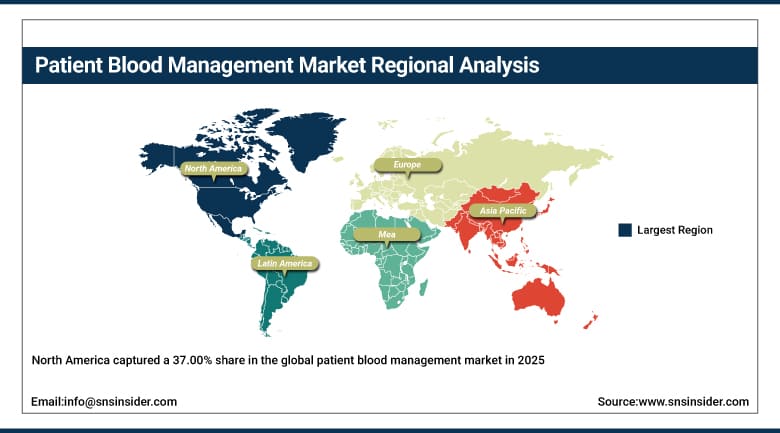
North America captured a 37.00% share in the global patient blood management market in 2025 and continued to retain its market leadership role. This leadership of the region is attributed to the superior healthcare facilities, widespread availability of patient blood management (PBM) guidelines, high number of surgeries, and extensive use of digital transfusion management solutions. Hospitals in the US and Canada are increasingly adopting blood conservation solutions, laboratory automation, decision support systems, and artificial intelligence solutions to ensure patient safety and minimize excessive use of blood products.
Availability of top medical device companies, favorable reimbursement frameworks, and rising focus on value-based care also play an important role in propelling growth. Continued investments towards the digital transformation of hospitals and development of comprehensive electronic health records systems are expected to maintain North America's dominance over the forecast period. In 2025, Haemonetics Corporation launched new hospital blood management solutions incorporating increased automation and digital workflows to enhance transfusions.
Get Customized Report as Per Your Business Requirement - Enquiry Now
Europe Patient Blood Management Market Insights
Europe remains one of the key regions within the global patient blood management market owing to the availability of complete transfusion guidelines, aging population, and growing government involvement in evidence-based blood use. Some of the countries such as Germany, UK, France, Italy, and Spain have been improving their PBM programs within the hospitals through implementation of clinical protocols, perioperative anemia management, and transfusion systems.
Hospitals are focusing on incorporating advanced blood saving devices and laboratory information system in order to enhance the surgery results and optimize the cost of health care. Growing emphasis on patient safety along with the rise in the number of minimally invasive surgeries and multidisciplinary approach towards PBM has led to the creation of growth opportunities within the European healthcare industry. In 2025, the European Blood Alliance (EBA) has been supporting various efforts related to sustainable blood management within Europe.
Asia Pacific Patient Blood Management Market Insights
The Asia Pacific patient blood management market is anticipated to witness the highest CAGR of 10.14% during the forecast period. Growth of the regional market is being spurred by rapid growth in healthcare infrastructure, rise in surgical procedures, increase in health insurance penetration, and increased awareness about patient blood conservation techniques. Countries like China, Japan, India, South Korea, and Australia are making significant investments in healthcare infrastructure, advanced laboratory equipment, and surgical technology.
Additionally, governments are developing their blood safety programs and are motivating hospitals to implement blood transfusion management solutions along with the use of digital health solutions. Increased number of chronic disease cases requiring surgery and increased healthcare spending is likely to fuel demand for patient blood management solutions in the region. In 2025, Terumo Corporation continued growing its advanced blood management and cardiovascular technology solutions in Asia-Pacific healthcare facilities.
Middle East & Africa and Latin America Patient Blood Management Market Insights
The Middle East & Africa patient blood management market continues to show steady growth driven by the efforts of governments to update their healthcare systems, build tertiary care hospitals and blood services infrastructure. Such countries as Saudi Arabia, the UAE and South Africa have initiated hospital quality improvement programs aimed at optimizing transfusion practices, improving blood management processes and surgery outcomes. The growth in usage of digital healthcare technology and expansion of specialized surgery centers are expected to drive regional market growth in the future. In 2025, Saudi Arabia continued the development of the healthcare transformation initiatives as part of Vision 2030.
Latin America - Brazil, Mexico, Argentina, and Chile continue developing hospital infrastructure, blood safety programs and automated clinical laboratories to optimize transfusion practices and improve patient outcomes. Rising awareness of patient blood management practices, increasing numbers of surgeries and expansion of specialized healthcare facilities are encouraging healthcare facilities to adopt advanced blood management equipment and digital transfusion technology. Steady investments into healthcare and better access to modern medical technology are expected to drive regional market growth in the coming years. In 2025, Grifols continued expanding its transfusion medicine and hospital solutions portfolio across Latin American market.
Growth Drivers: Increasing adoption of evidence-based patient blood management programs of surgeries.
The growing adoption of evidence-based patient blood management (PBM) programs in hospitals is one of the main drivers of the market growth. Healthcare facilities are moving away from their conventional practice based on transfusions and opting for multi-disciplinary PBM solutions including anemia management, reduction in blood loss during surgery, and improved recovery postoperatively. Growing volumes of orthopedic, cardiothoracic, transplant, and trauma surgeries are further propelling demand for advanced blood management equipment, diagnostics, and digital transfusion platforms. At the same time, hospitals are implementing AI-powered clinical decision support systems, laboratory automation tools, and real-time blood inventory management solutions aimed at improving patient care, cutting down blood waste, and lowering overall healthcare costs.
Restraints: The high cost of implementation and inconsistency in clinical practice across healthcare organizations.
Although the advantages of patient blood management have been increasingly recognized, the cost factor remains a barrier for healthcare providers especially those in developing countries. To implement a complete PBM program, it is necessary to invest in advanced blood conservation devices, automated laboratories, software for transfusion management, as well as hospital process restructuring and staff training. Small-scale hospitals usually lack financial resources and professionals to implement PBM programs. Moreover, reimbursement policies, different clinical guidelines, and reluctance to shift to more efficient transfusion practices might delay the implementation. Finally, the integration of transfusion management software into existing EHR systems may cause difficulties in implementing such programs in resource-limited healthcare facilities.
Opportunities: Expanding scope of AI driven transfusion management, and digital hospitals.
The ongoing digitalization in the healthcare industry offers huge growth potential for the Patient Blood Management Market. The integration of Artificial Intelligence, predictive analytics tools, cloud based transfusion management software and interoperable electronic health records to enable efficient blood usage and evidence based clinical decision making is increasing in hospitals. The development of smart hospitals, precision medicine, minimally invasive surgeries and lab analytics technology is creating conducive environment for the adoption of advanced PBM technologies. The expansion of tertiary healthcare facilities and establishment of national blood safety programs in emerging countries is offering huge business opportunity to medical devices and software companies.
Recent Developments
-
2026: Haemonetics Corporation expanded its hospital blood management portfolio with advanced automation, data analytics, and digital workflow capabilities designed to improve transfusion efficiency and patient outcomes.
-
2025: Terumo Corporation strengthened its blood management technologies by expanding advanced surgical and cardiovascular solutions supporting perioperative blood conservation across healthcare facilities.
-
2025: Fresenius Kabi continued expanding its transfusion medicine and infusion therapy portfolio with solutions supporting patient blood management and hospital efficiency initiatives.
-
2025: The Association for the Advancement of Blood & Biotherapies (AABB) updated educational initiatives and guidance promoting standardized Patient Blood Management implementation across hospitals and healthcare systems.
Patient Blood Management Market Key Players are:
-
B. Braun SE
-
Medtronic plc
-
Grifols, S.A.
-
ICU Medical, Inc.
-
LivaNova PLC
-
Teleflex Incorporated
-
Getinge AB
-
Zimmer Biomet Holdings, Inc.
-
Stryker Corporation
-
Nipro Corporation
-
Macopharma SA
-
Sarstedt AG & Co. KG
-
Kaneka Corporation
-
Asahi Kasei Medical Co., Ltd.
-
Johnson & Johnson MedTech
-
Abbott Laboratories
-
Baxter International Inc.
Patient Blood Management Market Report Scope:
| Report Attributes | Details |
|---|---|
| Market Size in 2025 | USD 16.52 Billion |
| Market Size by 2035 | USD 33.89 Billion |
| CAGR | CAGR of 7.46% From 2026 to 2035 |
| Base Year | 2025 |
| Forecast Period | 2026-2035 |
| Historical Data | 2022-2024 |
| Report Scope & Coverage | Market Size, Segments Analysis, Competitive Landscape, Regional Analysis, DROC & SWOT Analysis, Forecast Outlook |
| Key Segments | • By Component (Devices & Equipment, Software & Digital Platforms, Diagnostics & Consumables, Implementation, Training & Managed Services) • By Application (Surgical & Perioperative Care, Trauma & Emergency Care, Oncology & Hematology, Obstetrics & Maternal Care, Others) • By End User (Hospitals & Health Systems, Blood Banks & Transfusion Centers, Ambulatory Surgical Centers, Specialty Clinics & Cancer Centers, Others) |
| Regional Analysis/Coverage | North America (US, Canada), Europe (Germany, UK, France, Italy, Spain, Russia, Poland, Rest of Europe), Asia Pacific (China, India, Japan, South Korea, Australia, ASEAN Countries, Rest of Asia Pacific), Middle East & Africa (UAE, Saudi Arabia, Qatar, South Africa, Rest of Middle East & Africa), Latin America (Brazil, Argentina, Mexico, Colombia, Rest of Latin America). |
| Company Profiles | Haemonetics Corporation, Fresenius SE & Co. KGaA, Terumo Corporation, B. Braun SE, Medtronic plc, Grifols, S.A., ICU Medical, Inc., LivaNova PLC, Teleflex Incorporated, Getinge AB, Zimmer Biomet Holdings, Inc., Stryker Corporation, Nipro Corporation, Macopharma SA, Sarstedt AG & Co. KG, Kaneka Corporation, Asahi Kasei Medical Co., Ltd., Johnson & Johnson MedTech, Abbott Laboratories, Baxter International Inc. |
Frequently Asked Questions
The market is projected to reach USD 33.89 Billion by 2035.
The Patient Blood Management Market was valued at USD 16.52 Billion in 2025.
The market is anticipated to expand at a CAGR of 7.46% during the forecast period.
North America dominated the global Patient Blood Management Market in 2025.
