
Patient-Derived Organoid Market Report Scope & Overview:
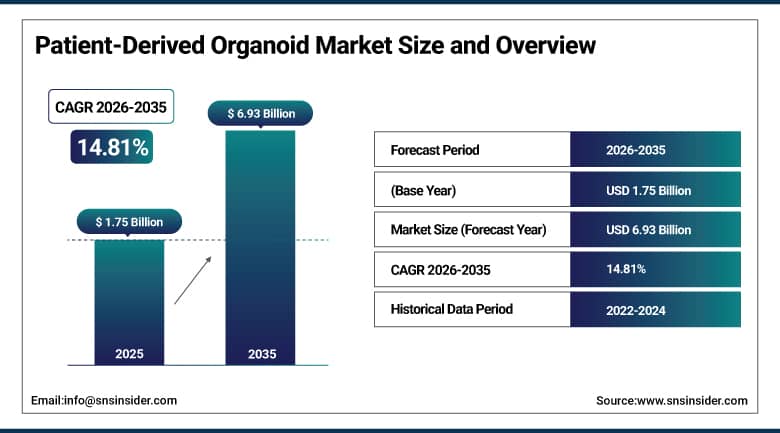
The Patient-Derived Organoid Market was valued at USD 1.75 billion in 2025 and is expected to reach USD 6.93 billion by 2035, growing at a CAGR of 14.81% from 2026-2035.
The Patient-Derived Organoid Market is witnessing strong growth due to increasing demand for advanced disease modeling and personalized medicine approaches. Organoids that are patient-derived mimic biological properties of specific tumors and tissues, which helps researchers understand how diseases develop, respond to medicines, and determine appropriate treatment methods. The growing use of organoids in drug discovery, cancer studies, regenerative medicine, and precision medicine will fuel growth in the market. Besides, increasing investment in biotechnological and pharmaceutical research, development of technologies in stem cell and 3D culture, and the need to lower drug development failures are also promoting adoption.
The WHO estimated approximately 20 million new cancer cases globally in 2022, with 9.7 million deaths, reinforcing the need for more representative disease models and personalized treatment strategies.
To Get More Information On Patient-Derived Organoid Market - Request Free Sample Report
Patient-Derived Organoid Market Trends
-
Rising demand for personalized medicine is driving adoption of patient-derived organoids for individualized treatment selection and therapeutic response evaluation.
-
Increasing use of organoids in drug discovery and development is improving preclinical testing, disease modeling, and assessment of drug efficacy.
-
Growing prevalence of cancer and complex diseases is expanding demand for patient-derived organoids that accurately replicate patient-specific disease characteristics.
-
Advancements in stem cell technologies and three-dimensional cell culture are improving organoid development, scalability, reproducibility, and physiological relevance.
-
Increasing investments in precision oncology are accelerating adoption of patient-derived tumor organoids for drug screening and personalized cancer treatment strategies.
U.S. Patient-Derived Organoid Market Outlook
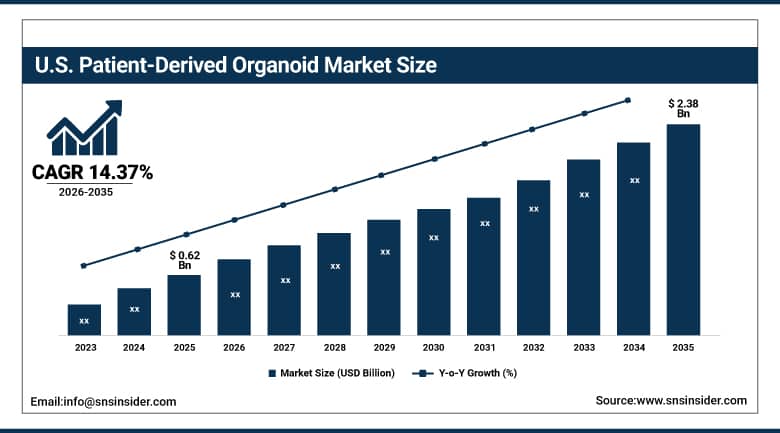
The U.S. Patient-Derived Organoid Market was valued at USD 0.62 billion in 2025 and is expected to reach USD 2.38 billion by 2035, growing at a CAGR of 14.37% from 2026-2035.
The U.S. Patient-Derived Organoid Market is witnessing strong growth because of the rising demand for customized medication, advanced modeling of diseases, and predictive approaches to drug testing. Patient-derived organoids allow scientists to mimic the features of particular tissues or tumors, helping with drug development, assessing treatment efficacy, and studying diseases. Greater funding in areas such as pharmaceutical and biotechnology research, cancer research, regenerative medicine, and precision medicine also contributes to greater use of patient-derived organoids. Furthermore, the progress achieved in stem cell technology, 3D cell cultures, and organoids enhances the opportunities for research. Moreover, increasing collaboration between pharmaceutical firms, academic institutions, hospitals, and biotechnology firms in the USA also promotes the adoption of this technology.
The National Cancer Institute estimates approximately 2.1 million new cancer cases in the United States in 2025, creating substantial demand for improved tumor models, drug-response testing, and precision oncology research.
Patient-Derived Organoid Market Segment Analysis
-
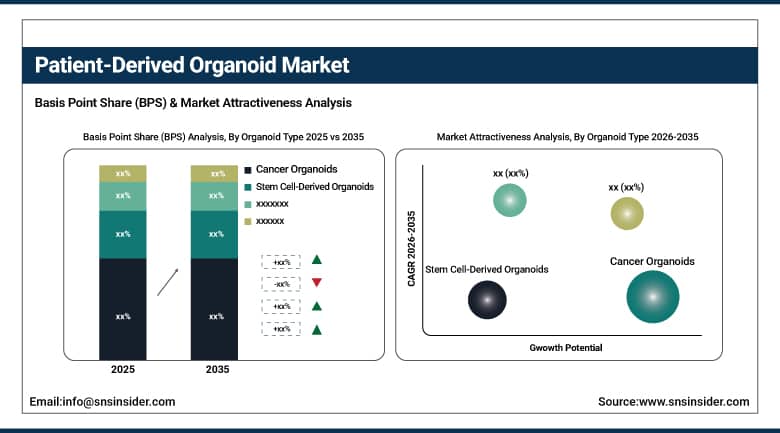
By Organoid Type, Cancer Organoids dominated the Patient-Derived Organoid Market with 36% share in 2025; Stem Cell-Derived Organoids are expected to grow at the fastest CAGR of 16.20% from 2026–2035.
-
By Application, Drug Discovery & Development dominated the Patient-Derived Organoid Market with 38% share in 2025; Personalized Medicine is expected to grow at the fastest CAGR of 16.54% from 2026–2035.
-
By End User, Pharmaceutical & Biotechnology Companies dominated the Patient-Derived Organoid Market with 44% share in 2025; Contract Research Organizations (CROs) are expected to grow at the fastest CAGR of 17.43% from 2026–2035.
By Organoid Type, Cancer Organoids dominate the patient-derived organoid market, Stem Cell-Derived Organoids grow fastest.
Cancer Organoids segment dominated the Patient-Derived Organoid Market with the highest revenue share of about 36% in 2025 due to its application in cancer research, drug testing, tumor modeling, and response to treatment. Organoids of cancer closely mimic the characteristics of tumors in patients, hence making disease modeling and treatment testing realistic. Increased incidences of cancer and investment in oncological research continue to drive global uptake.
Stem Cell-Derived Organoids segment is expected to grow at the fastest CAGR of 16.20% from 2026-2035 Due to their wide application in the study of diseases, regenerative medicine, developmental biology, and pharmaceutical research. They provide flexible tools that allow researchers to investigate biological mechanisms through diverse tissues modeling. Increased use of stem cells and new technologies in developing organoids enhance their adoption.
By Application, Drug Discovery & Development dominates the patient-derived organoid market, Personalized Medicine grows fastest.
Drug Discovery & Development segment dominated the Patient-Derived Organoid Market with the highest revenue share of about 38% in 2025 Due to the rising need for predictive preclinical models that mirror the disease biology of humans. Organoids derived from patients can be used for drug screening, efficacy testing, toxicity testing, and response to treatments. The rising investments in R&D in pharmaceuticals has contributed to this trend.
Personalized Medicine segment is expected to grow at the fastest CAGR of 16.54% from 2026-2035 Due to increased need for personalized therapy and better treatment outcomes. The use of patient-derived organoids helps reproduce patient-specific characteristics of the disease and test various drugs before treating patients. Growing use of precision health care, oncology research, and advancements in organoids technologies will promote personalized medicine practices worldwide.
By End User, Pharmaceutical & Biotechnology Companies dominate the patient-derived organoid market, Contract Research Organizations (CROs) grow fastest.
Pharmaceutical & Biotechnology Companies segment dominated the Patient-Derived Organoid Market with the highest revenue share of about 44% in 2025 as a result of the broad utilization of organoids for drug discovery, disease modeling, and efficacy testing. This is because of the increase in demand by such companies for human-relevant preclinical models. The increased research and development spending and the adoption of biological platforms contribute to this dominance.
Contract Research Organizations (CROs) segment is expected to grow at the fastest CAGR of 17.43% from 2026-2035 Due to increased outsourcing of drug discovery, preclinical testing, and specialized organoid research. CROs offer technical know-how and scalable testing facilities to the pharma companies without making huge investments. Increase in the pharmaceutical pipeline and need for efficient research services is going to drive the CRO market.
Regional Analysis
|
Region |
Major Country |
Share within Region, 2025 (%) |
|---|---|---|
|
North America |
United States |
89.0% |
|
Europe |
Germany |
22.0% |
|
Asia Pacific |
China |
38.0% |
|
Middle East & Africa |
UAE |
18.0% |
|
Latin America |
Brazil |
34.0% |
North America Patient-Derived Organoid Market Insights
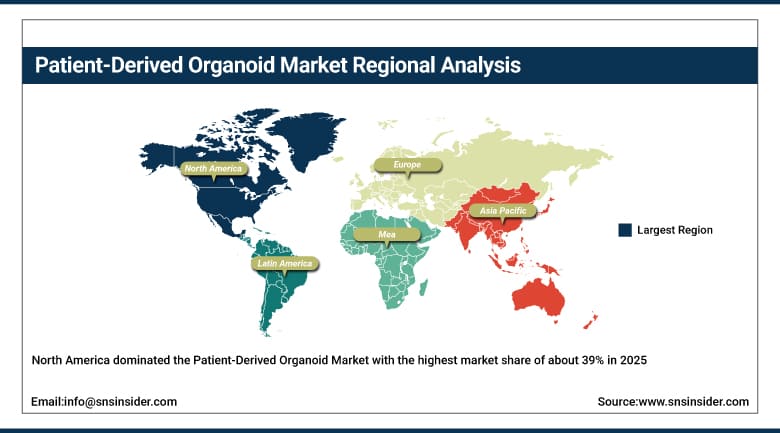
North America dominated the Patient-Derived Organoid Market with the highest market share of about 39% in 2025, led by advanced biomedical research, robust pharmaceuticals and biotechnology industries, as well as increasing personalized medicine practices. Substantial funding and resources allocated to drug discovery, cancer research, regenerative medicine, and 3D cell culture have reinforced regional dominance in the market.
The U.S. Patient-Derived Organoid Market accounted for a market share of 89.0%, backed by cutting-edge biomedical research, flourishing pharmaceutical and biotechnology industry, and increased application of personalized medicines. Investments in the discovery of drugs, cancer research, disease modeling, and regenerative medicines are fueling the need. The existence of research facilities, sophisticated 3D cell cultures, and funding for innovations in life sciences is helping the market to grow.
Get Customized Report as Per Your Business Requirement - Enquiry Now
Europe Patient-Derived Organoid Market Insights
Europe Patient-Derived Organoid Market is witnessing steady growth, driven By enhancing pharmaceutical and biotechnology research, increasing the demand for personalized medicines, and utilizing them in the field of drug discovery and disease modeling. Good research expertise in academia, development in regenerative medicine, use of 3D cell culture technology, and health care research are some other factors that are boosting the use of organoids in Europe.
The Germany Patient-Derived Organoid Market accounted for a market share of 22.0%, Motivated by robust pharmaceutical research, state-of-the-art academic organizations, and the rise in personalized medicine and disease modeling systems. Increasing investments in drug discovery, regenerative medicine, and 3D cell cultures have helped to generate demand. Government research funding, biotech development, and partnerships between research organizations and pharmaceutical companies are further helping to increase the use of organoids in Germany.
Asia Pacific Patient-Derived Organoid Market Insights
Asia Pacific is expected to grow at the fastest CAGR of about 16.21% from 2026–2035, backed by growth in investments in biotechnology, pharmaceutical R&D, personalized medicines, and regenerative medicines. Growth in healthcare infrastructure, increased number of clinical research activities, increasing usage of cell-culture technology, and encouragement from the government to develop life sciences will further speed up the use of organoids derived from patients in the region.
The China Patient-Derived Organoid Market accounted for a market share of 38.0%, Backed by development in biotechnology and pharmaceuticals sectors, increasing biomedical research, and investment in personalized medicine. Increasing applications in drug discovery, cancer research, and disease modeling are also adding to adoption. Development in biotechnology through government initiatives, development in research facilities, increasing activities in clinical research, and developments in 3D cell cultures technology are adding to market growth.
Middle East & Africa and Latin America Patient-Derived Organoid Market Insights
The Middle East & Africa and Latin America Patient-Derived Organoid Market Biotechnology industry is gradually increasing owing to increased biotech investments, pharmaceutical research, and personalized medicine trends. Increased investments in healthcare infrastructure, partnerships in research, and use of modern cell-culture technologies are opening up avenues. In addition, government support for life sciences research, increase in clinical research activity, and the need for innovative disease models are also driving regional market growth.
The UAE Patient-Derived Organoid Market accounted for a market share of 18.0%, supported by rising investments in biotechnology, healthcare R&D, and personalized medicine. Increasing use of advanced cell culture techniques and rising research on pharmaceuticals is leading to new possibilities. Government policies encouraging innovations in life sciences, development of healthcare infrastructure, collaborations for research, and rising interest in disease modeling and regenerative medicine are also helping patient-derived organoids gain popularity in the UAE.
Market Dynamics
Growth Drivers: Growing demand for personalized medicine and patient-specific disease modeling is accelerating adoption of patient-derived organoids globall
Increasing demand for personalized medicine is significantly driving the Patient-Derived Organoid Market. Patient-derived organoids have the potential to mimic the physiological attributes of a particular patient's tissue or tumor, which allows for studying the nature of the disease and the effectiveness of treatment in the models created specifically for the patient. The potential to create a more realistic biological model than two-dimensional cell cultures is driving increasing interest in organoids in cancer research, drug discovery, and precision medicine. The use of organoids by pharmaceutical and biotech companies in order to assess the effectiveness and toxicity of drugs, and response to treatment, is becoming more common prior to clinical trials. Rising incidence of cancer and emphasis on personalized treatment approaches are adding further impetus to the trend.
Restraints: High costs and technically demanding culture processes can limit widespread adoption of patient-derived organoid technologies globally
High costs and complex laboratory requirements remain significant challenges for the Patient-Derived Organoid Market. The cultivation of organoids from patient material depends on the following aspects: special laboratory equipment, highly qualified specialists, appropriate culture conditions, growth factors, special media, and quality patient material. In addition, the development of reproducible organoids takes some time and skills, especially when using different types of tissues or tumor samples. Moreover, variations in patient material may affect the cultivation process itself, growth rate, and characteristics of models obtained. All of these aspects may increase the costs associated with the process for academic institutions, hospitals, and small companies that have low funding possibilities.
Opportunities: Growing adoption of precision oncology creates significant opportunities for patient-derived organoid applications in personalized treatment development.
Increasing adoption of precision oncology is creating substantial opportunities for patient-derived organoid technologies. Organoids generated from cancer may have some features of individual tumors. Scientists will be able to use this information to test various treatments and explore how resistant some tumors can be to specific drugs. Pharmaceutical companies and clinicians will be able to find new ways to treat patients by screening various drugs using organoids. The need for personalized treatment is growing; thus, patient-specific organoids become more interesting. Combining organoids' data with molecular analysis, sequencing, and artificial intelligence may help to make predictions about therapy response in an individual patient. As research on oncology is becoming more personalized, organoids may play a great role in drug development and finding biomarkers for treatment.
Recent Developments:
-
2026 – Crown Bioscience partnered with Turbine to integrate AI-driven prediction with tumor organoid validation, connecting virtual biology with patient-relevant models to improve translational oncology research.
-
2026 –InSphero launched the 3D InSight DIGIT platform, combining patient-derived intestinal organoids with automated imaging for standardized, high-throughput gastrointestinal toxicity assessment in drug discovery.
-
2026 –Bruker announced a majority investment in MIMETAS, combining organoid and organ-on-chip technologies with multiomics, spatial biology, and imaging capabilities for human-relevant drug development.
-
2025 –MIMETAS became a founding member of IAMPS, an industry alliance created to advance organoids, organs-on-chips, and microphysiological systems as scalable human-relevant alternatives to traditional models.
Patient-Derived Organoid Market Key Players are:
-
Crown Bioscience
-
Merck KGaA
-
STEMCELL Technologies
-
DefiniGEN Limited
-
InSphero AG
-
Cellesce Ltd.
-
MIMETAS B.V.
-
OcellO B.V.
-
Organoid Therapeutics
-
3Dnamics Inc.
-
Charles River Laboratories International, Inc.
-
Corning Incorporated
-
Thermo Fisher Scientific Inc.
-
Bio-Techne Corporation
-
Danaher Corporation
-
ATCC
-
CN Bio Innovations Ltd.
-
Newcells Biotech Ltd.
-
TissUse GmbH
-
Prellis Biologics, Inc.
Patient-Derived Organoid Market Report Scope:
| Report Attributes | Details |
|---|---|
| Market Size in 2025 | USD 1.75 Billion |
| Market Size by 2035 | USD 6.93 Billion |
| CAGR | CAGR of 14.81% From 2026 to 2035 |
| Base Year | 2025 |
| Forecast Period | 2026-2035 |
| Historical Data | 2022-2024 |
| Report Scope & Coverage | Market Size, Segments Analysis, Competitive Landscape, Regional Analysis, DROC & SWOT Analysis, Forecast Outlook |
| Key Segments | • By Organoid Type (Cancer Organoids, Tissue-Specific Organoids, Stem Cell-Derived Organoids, Other Organoid Types) • By Application (Drug Discovery & Development, Personalized Medicine, Disease Modeling, Toxicology Testing, Regenerative Medicine, Other Applications) • By End User (Pharmaceutical & Biotechnology Companies, Academic & Research Institutes, Hospitals & Clinics, Contract Research Organizations (CROs), Other End Users) |
| Regional Analysis/Coverage | North America (US, Canada), Europe (Germany, UK, France, Italy, Spain, Russia, Poland, Rest of Europe), Asia Pacific (China, India, Japan, South Korea, Australia, ASEAN Countries, Rest of Asia Pacific), Middle East & Africa (UAE, Saudi Arabia, Qatar, South Africa, Rest of Middle East & Africa), Latin America (Brazil, Argentina, Mexico, Colombia, Rest of Latin America). |
| Company Profiles | Crown Bioscience, Merck KGaA, STEMCELL Technologies, DefiniGEN Limited, InSphero AG, Cellesce Ltd., MIMETAS B.V., OcellO B.V., Organoid Therapeutics, 3Dnamics Inc., Charles River Laboratories International, Inc., Corning Incorporated, Thermo Fisher Scientific Inc., Bio-Techne Corporation, Danaher Corporation, ATCC, CN Bio Innovations Ltd., Newcells Biotech Ltd., TissUse GmbH, and Prellis Biologics, Inc. |

Frequently Asked Questions
The Patient-Derived Organoid Market is expected to grow at a CAGR of 14.81% from 2026 to 2035.
The Patient-Derived Organoid Market was valued at USD 1.75 billion in 2025.
The major growth factor is rising demand for personalized medicine and predictive drug discovery, as patient-derived organoids closely replicate patient-specific disease characteristics and drug responses.
The Cancer Organoids segment dominated the Patient-Derived Organoid Market in 2025.
North America dominated the Patient-Derived Organoid Market in 2025.
