
Photoinitiator Market Report Scope & Overview:
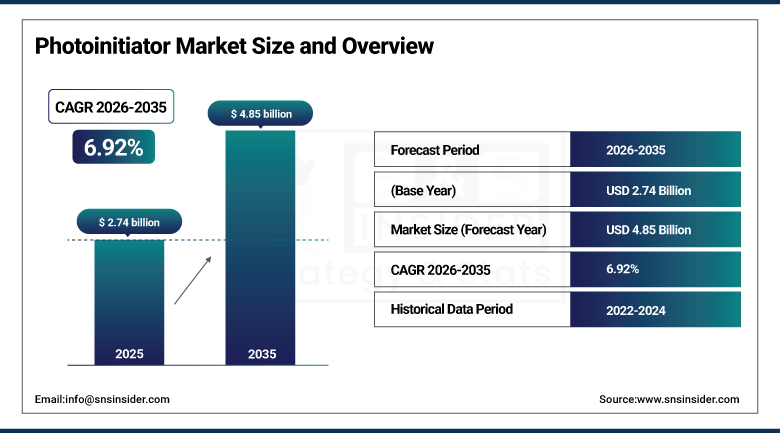
The Photoinitiator Market was valued at USD 2.74 Billion in 2025 and is expected to reach USD 4.85 Billion by 2035, growing at a CAGR of 6.92% from 2026 to 2035.
The report gives a good indication of the global supply with a detailed analysis of production capacity and utilization rates by country and product line. The report provides insights into regional feedstock pricing, discussing the fluctuations in price and its impact on the competitiveness of the market. The regulatory environment across all key regions is examined, and compliance difficulties and the effect of the same on the product development process is considered. Environmental parameters such as emissions, among others, are studied to provide information about the extent to which the industry is complying with green regulations at a global level. R&D spends and innovation patterns by photoinitiator type are considered along with photoinitiator adoption rates.
BASF has launched a new line of photoinitiators for UV curable coatings and inks in 2023 to respond to the growing demand by packaging and electronics manufacturers for VOC free curing solutions. The product launch reflects the commercial momentum toward low emission UV curing technologies, where regulatory pressure from the EPA and EU REACH frameworks is systematically shifting industrial coating and printing operations away from conventional solvent-based systems toward photoinitiator enabled UV curable alternatives.
To Get more information on Photoinitiator Market - Request Free Sample Report
Photoinitiator Market Trends
-
Rising adoption of UV- and LED-curable systems is driving photoinitiator demand due to low VOC emissions and higher production efficiency.
-
LED-curable photoinitiators are gaining momentum owing to superior energy efficiency, longer lamp life, and reduced heat generation.
-
Growing use of 3D printing and printed electronics is creating demand for high-reactivity, specialized photoinitiator formulations.
-
Packaging and electronics industries are boosting photoinitiator consumption through increasing adoption of UV-curable inks and protective coatings.
-
Bio-based and low-migration photoinitiators are gaining traction due to stricter regulations for food-contact and skin-contact applications.
The U.S. Photoinitiator Market Outlook
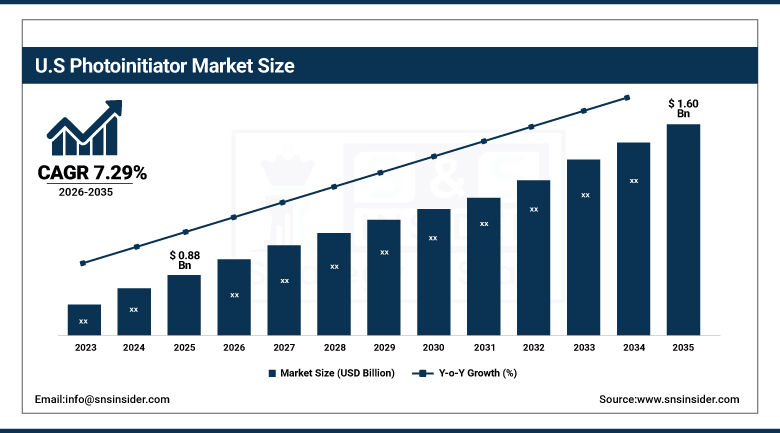
The U.S. photoinitiator market was valued at approximately USD 0.88 Billion in 2025 and is expected to reach approximately USD 1.60 Billion by 2035, growing at a CAGR of approximately 7.29%.
USA was found to be the largest country level player in the photoinitiator market. This is mainly due to its already well-developed printing, packaging and coating industry that uses photoinitiators extensively for their UV curable applications. In addition to that, strong demand for advanced materials in the automotive, electronics and healthcare industry where UV curable coatings, adhesives and inks are used abundantly is adding value to the growth of the market. Moreover, presence of key players, sound R&D capabilities and early adoption of new technologies such as 3D printing and high performance inks has made USA one of the leading markets in the photoinitiator market.
In 2024, Evonik expanded its production capacity for specialty photoinitiators at its German site, targeting growing demand from European electronics and automotive coating manufacturers transitioning to LED curable UV systems. The capacity expansion demonstrates the commercial scale of photoinitiator demand growth in the automotive and electronics sectors, where manufacturers' transition from conventional solvent-based coating systems to UV and LED curable alternatives creates structured incremental demand for photoinitiator specialty chemicals.
Photoinitiator Market Segment Analysis
-
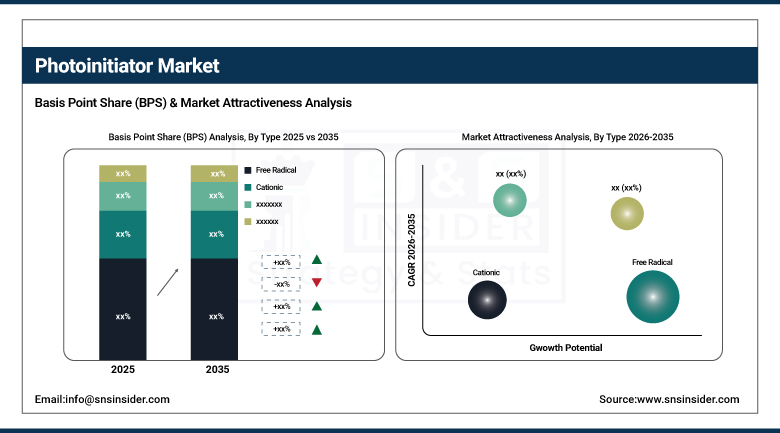
By Type, the free radical segment dominated the photoinitiator market with approximately 71.55% share in 2025, while the cationic segment is the fastest growing.
-
By Formulation, the liquid segment dominated the photoinitiator market with approximately 62.8% share in 2025, while the solid segment is the fastest growing.
-
By Light Source, the mercury vapor lamps segment dominated the photoinitiator market with approximately 57.4% share in 2025, while the UV led curing segment is the fastest growing.
-
By End-Use Industry, the coating segment dominated the photoinitiator market with approximately 41.6% share in 2025, while the adhesives segment is the fastest growing.
By Type, free radical dominates, cationic holds specialty niches
Free radical photoinitiators have been leading the market for photoinitiators with about 71.55% share in terms of revenue in 2025 owing to the suitability of these photoinitiators for acrylate and methacrylate systems that form the basis of the largest number of commercial UV curing applications. Free radical photoinitiators enable rapid polymerization with high efficiency under UV and LED light exposure, making them the primary choice across conventional packaging, printing, and industrial coating applications. Each printing operation, coating manufacturer, and adhesive formulator whose UV curable system relies on acrylic chemistry creates free radical photoinitiator procurement whose commercial aggregate across global manufacturing sustains the type's commanding market position.
Cationic photoinitiators retain important commercial niches in electronics encapsulation, fiber optic coatings, and dental applications that require the low shrinkage and high adhesion properties that epoxy and vinyl ether curing chemistry provides. These specialized applications create premium pricing opportunities relative to commodity free radical grades, with cationic photoinitiators' unique performance characteristics in acid catalyzed polymerization systems sustaining their commercial relevance despite lower overall market share.
By End-Use Industry, ink dominates, coating grows fastest
Ink dominated the photoinitiator market in 2025 as printing inks and coating held the highest proportion of global consumption. There is an advantage in the UV curable printing ink which provides quick curing, higher color density, scratch-resistant properties, and versatile substrates than traditional solvent-based and water-based ink. This forms structural commercial preference for commercial printers, packaging, and labeling producers. Every single printing operation that invests in UV inkjet and flexographic printing will result in procurement of photoinitiator which adds up to the changing trends in premium packaging.
The coating segment is expected to register the fastest CAGR as UV curable coatings' advantages including fast curing, high performance, and low VOC emissions compared to traditional solvent-based coatings drive above average adoption growth. The coating industry includes auto coating, wood coating, industrial coating, and protective coating segments, with UV curable coating demand on a consistent rise because of their outstanding features and green nature of the material. Every company that shifts its coating specifications from conventional to UV curable systems becomes a structured demand source for photoinitiators for its commercial importance.
Regional Analysis
|
Region |
Major Country |
Share within Region, 2025 (%) |
|---|---|---|
|
North America |
United States |
87.4% |
|
Europe |
Germany |
22.3% |
|
Asia Pacific |
China |
44.8% |
|
Middle East & Africa |
UAE |
31.2% |
|
Latin America |
Brazil |
44.2% |
Asia Pacific Photoinitiator Market Insights
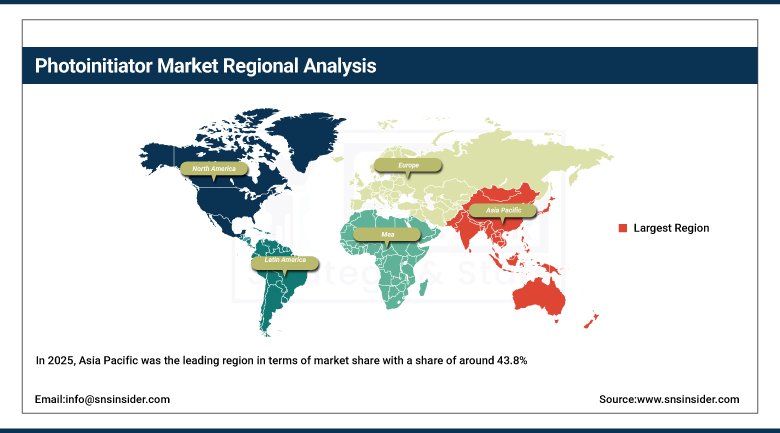
In 2025, Asia Pacific was the leading region in terms of market share with a share of around 43.8% owing to high levels of industrialization, increased need for UV-curable coatings, and increased manufacturing activities in China, Japan, South Korea, and India. The nerve centers of manufacturing operations in the region keep the photoinitiator market highly connected to regional electronics and packaging chains. China accounts for approximately 44.8% of Asia Pacific revenues through its extraordinary manufacturing scale across printing, packaging, and electronics production operations that collectively represent the world's largest photoinitiator consumption base.
Japan and South Korea represent technically sophisticated secondary markets within Asia Pacific where advanced electronics manufacturing and high precision coatings applications create above average per unit value photoinitiator procurement that complements the high-volume commodity consumption of China's packaging and printing industries.
Get Customized Report as per Your Business Requirement - Enquiry Now
North America Photoinitiator Market Insights
North America remains a strong photoinitiator market, driven by technological innovation, sustainability initiatives, and strict environmental regulations favoring low emission curing systems. The United States accounts for approximately 87.4% of North American revenues through IGM Resins, BASF's domestic operations, and other major photoinitiator suppliers serving the country's well-established printing, packaging, and coating industries.
Canada contributes complementary North American revenue through its growing packaging manufacturing sector and increasing adoption of UV curable coatings across the country's automotive and industrial manufacturing base.
Europe Photoinitiator Market Insights
The European market is one where there is significant maturity in the photoinitiator market because regulations such as EU REACH will create demand for products that have low migration and low toxicity properties to meet food contact and consumer goods requirements. In Europe, Germany makes up about 22.3% of sales because of the strong presence of Evonik’s domestic manufacturing plants.
The United Kingdom and France are significant secondary markets where established printing and packaging industries and growing electronics manufacturing create consistent procurement. RAHN AG's Swiss headquarters and other European specialty chemical manufacturers sustain regional commercial supply across the continent's photoinitiator landscape.
MEA & Latin America Photoinitiator Market Insights
The UAE leads MEA revenues through its growing printing and packaging sector and expanding electronics manufacturing investment across the Gulf region's industrial diversification programs supporting multiple free trade zone manufacturing operations. Saudi Arabia's Vision 2030 industrial development initiatives add substantial complementary regional demand.
Brazil dominates Latin America’s revenue generation by virtue of having a huge packaging manufacturing industry and increasing application of UV curable coatings. The growth in the electronic and automobile manufacturing industries in Mexico and the growth in chemical manufacturing industries in Argentina ensures market development till 2035.
Market Dynamics
Growth Drivers: Environmental sustainability demands and UV-LED technology adoption
The rising global emphasis on environmental sustainability and regulatory pressure to reduce volatile organic compounds have significantly accelerated the adoption of photoinitiators in ecofriendly applications. In packaging and industrial coatings, photoinitiators enable UV curable technologies that emit minimal VOCs compared to conventional solvent-based systems. The Environmental Protection Agency of the United States and EU legislation like REACH are encouraging industries to move towards safe and greener options, which have resulted in industries resorting to the use of UV curing technologies with photoinitiators for quick curing and low energy consumption.
The sectors that include electronics, automobiles, and printing are adopting these sustainable technologies, thereby boosting the demand for photoinitiators. There will be an increasing tendency toward sustainable packaging and low-emission interior paints among consumers, which will enhance this trend, making photoinitiators an important contributor to the field of green chemistry. In addition, improvements being made in LED-curable photoinitiator systems are also aiding this trend, as LED technology is relatively more efficient compared to traditional UV systems that use mercury lamps.
Restraints: Health and environmental concerns over certain photoinitiator chemistries
Although there are many advantages to using photoinitiators in terms of energy efficiency and curing rate, some photoinitiators may cause adverse health and environmental effects, especially when used for food packaging or human skin contact materials. Certain derivatives of benzophenone and amine-containing photoinitiators are reported to exhibit endocrine disruption properties, cytotoxicity, and environmental persistence. Many regulatory bodies, such as the European Chemicals Agency and U.S. Food and Drug Administration, have banned certain photoinitiator chemicals in critical uses, posing challenges for manufacturers in relevant industries.
Consumer concern over the need for clean label material that is not harmful has led firms to rethink the compositions of their photoinitiators. This issue may impede the market growth because such high-performance photoinitiators cannot be used freely in case there is no alternative product of equal effectiveness.
Opportunities: 3D printing and printed electronics expansion
The rapid evolution of additive manufacturing and printed electronics has created new avenues for photoinitiator application, particularly in UV curable resins and inks. Photoinitiators play an important role in the process of stereolithography and digital light processing in 3D printing technology. The rising applications of 3D printing technology in prototype manufacturing, dentistry, consumer goods, and bioprinting applications are largely responsible for the growing demand for highly reactive and minimal yellowing photoinitiators.
Simultaneously, printed electronics such as flexible circuits, OLED displays, and RFID tags rely on UV curable inks where photoinitiators ensure rapid curing and durability. With growing investment in digital fabrication technology and smart manufacturing techniques by companies operating in different sectors, it can be anticipated that there will be high demand for innovative photoinitiators suitable for such applications. This evolving trend presents lucrative business opportunities for companies engaged in development of new formulations.
Recent Developments:
-
2023: BASF introduced a new range of photoinitiators in 2023 designed for use in UV curable coatings and inks, targeting growing demand from packaging and electronics manufacturers seeking VOC free curing solutions.
-
2024: Evonik expanded its production capacity for specialty photoinitiators in 2024 at its German site, targeting growing demand from European electronics and automotive coating manufacturers.
-
2023: IGM Resins expanded its LED compatible photoinitiator portfolio in 2023 with new acylphosphine oxide formulations designed for efficient curing at the 365 nm to 405 nm wavelength range preferred by UV LED systems.
-
2024: Lambson Limited, a specialty chemical company, introduced new polymeric photoinitiator grades in 2024 targeting food packaging applications requiring low migration performance to comply with EU food contact material regulations.
-
2024: Tianjin Jiuri New Materials expanded its manufacturing capacity for specialty photoinitiators in 2024, targeting growing demand from Asian electronics and packaging manufacturers adopting UV curable systems.
Photoinitiator Market Key Players are:
-
BASF SE
-
IGM Resins B.V.
-
Evonik Industries AG
-
RAHN AG
-
Lambson Ltd.
-
Changzhou Tronly New Electronic Materials Co. Ltd.
-
Tianjin Jiuri New Materials Co. Ltd.
-
Zhejiang Yangfan New Materials Co. Ltd.
-
Hubei Gurun Technology Co. Ltd.
-
Arkema SA
-
Syensqo
-
Miwon Specialty Chemical Co. Ltd.
-
TCI Chemicals
-
Allnex Belgium SA
-
Eutec Chemical Co. Ltd.
-
New Sun Poly Tech Co. Ltd.
-
San-Apro Ltd.
-
Double Bond Chemical Ind. Co., Ltd.
-
ADEKA Corporation
-
Esstech, Inc.
Photoinitiator Market Report Scope:
| Report Attributes | Details |
|---|---|
| Market Size in 2025 | USD 2.74 Billion |
| Market Size by 2035 | USD 4.85 Billion |
| CAGR | CAGR of 6.92% From 2026 to 2035 |
| Base Year | 2025 |
| Forecast Period | 2026-2035 |
| Historical Data | 2022-2024 |
| Report Scope & Coverage | Market Size, Segments Analysis, Competitive Landscape, Regional Analysis, DROC & SWOT Analysis, Forecast Outlook |
| Key Segments | • By Type (Free Radical, Cationic) • By Formulation (Liquid, Solid) • By Light Source (UV LED Curing, Mercury Vapor Lamps, Excimer Lamps, Others) • By End-Use Industry (Adhesives, Ink, Coating, Others) |
| Regional Analysis/Coverage | North America (US, Canada), Europe (Germany, UK, France, Italy, Spain, Russia, Poland, Rest of Europe), Asia Pacific (China, India, Japan, South Korea, Australia, ASEAN Countries, Rest of Asia Pacific), Middle East & Africa (UAE, Saudi Arabia, Qatar, South Africa, Rest of Middle East & Africa), Latin America (Brazil, Argentina, Mexico, Colombia, Rest of Latin America). |
| Company Profiles | BASF SE, IGM Resins B.V., Evonik Industries AG, RAHN AG, Lambson Ltd., Changzhou Tronly New Electronic Materials Co. Ltd., Tianjin Jiuri New Materials Co. Ltd., Zhejiang Yangfan New Materials Co. Ltd., Hubei Gurun Technology Co. Ltd., Arkema SA, Syensqo, Miwon Specialty Chemical Co. Ltd., TCI Chemicals, Allnex Belgium SA, Eutec Chemical Co. Ltd., New Sun Poly Tech Co. Ltd., San-Apro Ltd., Double Bond Chemical Ind. Co., Ltd., ADEKA Corporation, Esstech, Inc. |
Frequently Asked Questions
Rising global emphasis on environmental sustainability and regulatory pressure to reduce volatile organic compounds accelerating adoption of UV curable technologies.
The Photoinitiator Market was valued at USD 2.74 Billion in 2025.
The market is expected to grow at a CAGR of 6.92% from 2026 to 2035.
Asia Pacific dominated the Photoinitiator Market in 2025.
