
RFID Printers Market Report Scope & Overview:
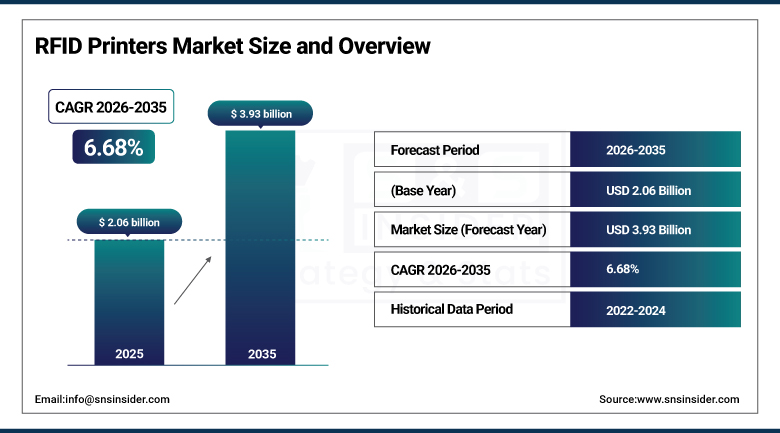
The RFID Printers Market size was valued at USD 2.06 Billion in 2025 and is projected to reach USD 3.93 Billion by 2035, expanding at a CAGR of 6.68% during the forecast period 2026–2035.
The market for RFID-enabled labeling solutions is getting bigger and bigger. Companies are using these solutions to keep track of their inventory automatically identify their assets and make their supply chains more efficient. More and more companies are selling their products in different ways and they need to automate their warehouses use digital technology in their factories and keep track of their products. This is driving up the demand for RFID printing technologies in many industries, including manufacturing, logistics, healthcare and transportation. RFID printing technologies are getting better and better. Companies are making improved RFID printers that can connect to the internet be managed from the cloud and work well with other systems that companies use to manage their resources and warehouses.
This is helping companies in different countries to use RFID printing technologies. Manufacturers are making RFID printers that have many features, including the ability to connect to the internet be managed from the cloud and work well with other systems. Many companies are investing in technologies, such as smart factories and automated retail systems and they need RFID printers to keep track of their products. This is creating opportunities, for companies that make RFID printers.
Market Size and Forecast
-
Market Size 2026E: USD 2.20 Billion
-
Market Size 2035: USD 3.93 Billion
-
CAGR: 6.68% from 2026 to 2035
-
Fastest Growing Region: Asia Pacific
-
Largest Region: North America
To Get more information on RFID Printers Market - Request Free Sample Report
RFID Printers Market Trends
-
Increasing deployment of RFID-enabled inventory management across retail and warehouse operations.
-
Rising adoption of Industry 4.0 and smart manufacturing driving industrial RFID printer installations.
-
Growing implementation of cloud-connected RFID printing and centralized device management platforms.
-
Expanding demand for item-level traceability and automated asset tracking across logistics and healthcare.
-
Continuous technological advancements in high-speed RFID encoding, multi-frequency compatibility, and enterprise integration solutions.
U.S. RFID Printers Market Size Outlook
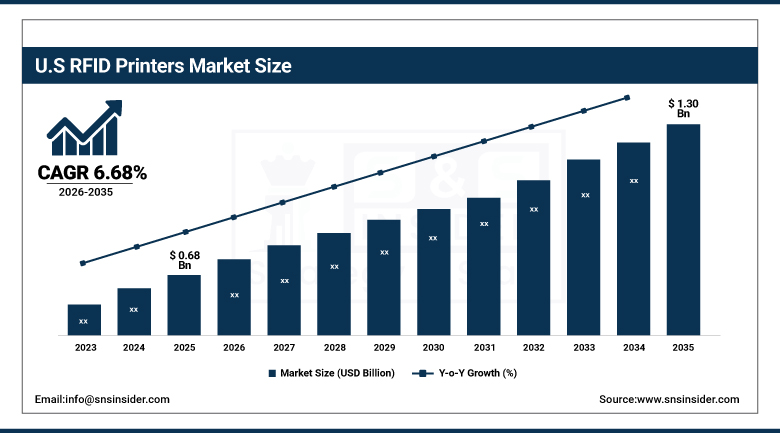
The U.S. RFID Printers Market was valued at USD 0.68 billion in 2025 and is expected to reach approximately USD 1.30 billion by 2035, expanding at a CAGR of 6.68% during 2026–2035.
The United States is still the leader in the American market. This is because many companies in the United States are using Radio Frequency Identification technologies. They are using these technologies in stores when they move goods from one place to another in hospitals when they make things and in government offices. Companies are spending a lot of money on machines that can do work by themselves in warehouses. They are also buying systems that can keep track of what they have in stock. They want to be able to get things to people no matter where they are. They are using Radio Frequency Identification printers that work well.
There are rules that companies have to follow. These rules are getting stricter. Many companies are trying to automate things so that they do not need to use people much. They are also trying to use computers and technology to change the way they do things. All of these things are helping the Radio Frequency Identification market get bigger. Between 2025 and 2026 some of the technology companies started selling new Radio Frequency Identification printers. These printers can connect to the internet. People can manage them from far away. They are also very good, at reading and writing information. They work well with other computer systems.
RFID Printers Market Segment Analysis
-
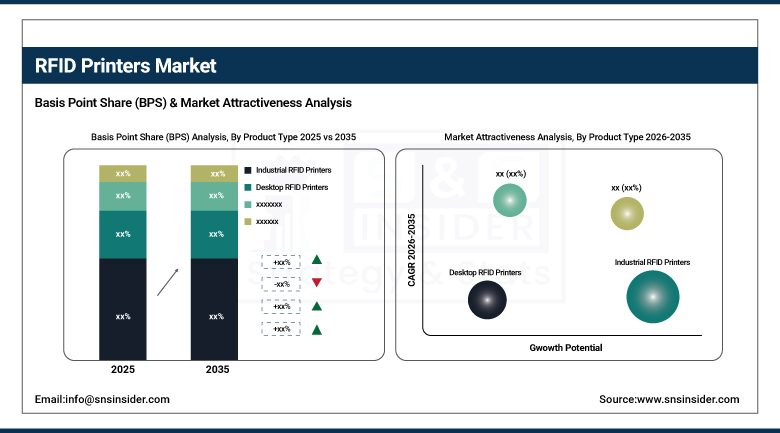
By Product Type, industrial RFID printers dominated the market with 39.00% share in 2025, while mobile RFID printers are projected to witness the fastest growth with 10.46% CAGR during the forecast period.
-
By Technology, thermal transfer dominated the market with 61.00% share in 2025, while inkjet RFID printing is projected to witness the fastest growth with 12.58% CAGR during the forecast period.
-
By End User, retail dominated the market with 33.00% share in 2025, while healthcare is projected to witness the fastest growth with 8.33% CAGR during the forecast period.
By Product Type, industrial RFID printers dominated, while mobile RFID printers’ fastest-growing.
The industrial RFID printers segment had the share of revenue which was 39.00% in 2025. This is because these printers are used a lot in manufacturing plants, distribution centers, warehouses and logistics hubs. In these places they need to print a lot of RFID labels and work all the time. Industrial RFID printers are very good because they last a time print fast and work well with other systems that manage warehouses and plan resources. This makes them the best choice for industrial operations. Zebra Technologies made its industrial RFID printing portfolio better with RFID encoding and cloud-based printer management for big supply chains.
The mobile RFID printers segment is expected to grow the fastest with a growth rate of 10.46% during the forecast period. This is because companies need to label things in time manage inventory in the field track assets and do last-mile logistics operations. Companies are giving mobile RFID printers to warehouse workers, retail workers and field service teams so they can work flexibly and make fewer mistakes. As e-commerce fulfillment retail that sells online and in stores and mobile workforce automation grow quickly more industries will start using RFID printers. SATO Holdings made RFID printing solutions, for warehouses, retail inventory management and field logistics applications.
By Technology, thermal transfer dominated, while inkjet RFID printing fastest-growing.
The thermal transfer segment had the part of the market with 61.00% in 2025. This is because Thermal Transfer can make strong and long-lasting RFID labels that work well in tough industrial and logistics environments. Many companies use Thermal Transfer technology in manufacturing, transportation, healthcare and retail because it gives print quality easy to read barcodes and reliable RFID tag encoding. More and more companies need asset identification and have to follow rules so Thermal Transfer stays on top. Honeywell made some thermal RFID printing solutions that are better at encoding and work well with companies systems.
The inkjet RFID printing segment is expected to grow the fastest at 12.58% in the years. This is because digital printing is getting better companies want customized RFID labels and more people are using run, high-quality printing. Inkjet-based RFID printing lets companies make labels that are personalized it is cheaper to set up. The graphics look good. This makes it a good choice, for branding, specialty packaging and healthcare labeling. As digital printing gets even better the market is expected to grow more. Toshiba Tec kept working on RFID printing to make high-quality labels and to make it easier for companies to print what they need.
By End User, retail dominated, while healthcare fastest-growing.
The retail segment had the part of the market with 33.00% in 2025. This is because many companies started using RFID technology to keep track of inventory send items to the places stop fake products and watch merchandise in real time. Big stores are still using RFID printers to make labels for each item. These labels help stores see what they have in stock automatically order items when they are needed reduce lost products and make customers happier. The fast growth of shopping, pick-up services is making stores invest more in RFID printing equipment around the world. Avery Dennison made its label and RFID solutions better to help big stores keep track of inventory and connect their supply chains.
The healthcare segment is expected to grow the fastest with 8.33% in the years. This is because more hospitals are using RFID technology to identify patients, label medicine track lab samples manage devices and watch hospital equipment. Hospitals are investing in RFID printing technology to keep patients safe reduce mistakes with medicine see what they have in stock and follow rules. Zebra Technologies enhanced healthcare-focused RFID printing solutions designed for specimen tracking, medication labeling, and hospital asset management applications.
Regional Analysis
|
Region |
Major Country |
Share within Region, 2025 (%) |
|---|---|---|
|
North America |
United States |
92.00% |
|
Europe |
Germany |
25.00% |
|
Asia Pacific |
China |
31.00% |
|
Middle East & Africa |
UAE |
4.00% |
|
Latin America |
Brazil |
4.00% |
North America RFID Printers Market Insights
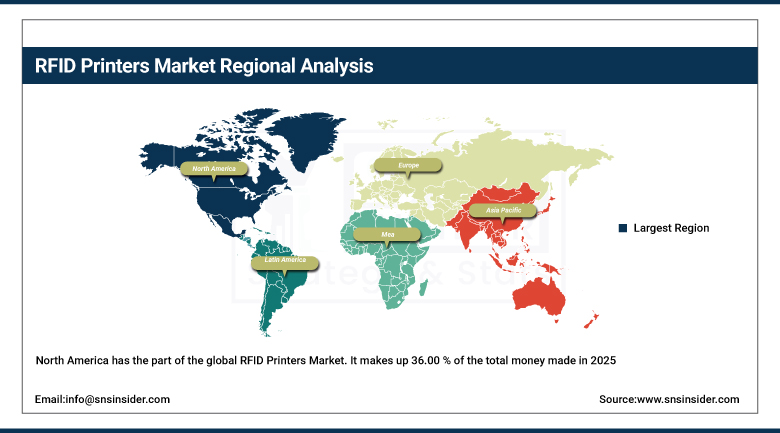
North America has the part of the global RFID Printers Market. It makes up 36.00 % of the total money made in 2025. This is because companies in North America started using RFID technologies on. They also have logistics systems and use automation in warehouses for retail, manufacturing, healthcare and transportation. Companies are still spending money on ways to manage their inventory automate their distribution centers and use digital systems to manage their supplies. They need RFID printing systems to do this.
Many companies are also investing in ways to sell products online and in stores and to keep track of their assets and make their businesses more mobile. They are also using technologies like Industry 4.0. All of this helps to increase the demand for RFID Printers in North America. The fact that there are big technology companies in North America and that they are always coming up with new products also helps North America to be the biggest market. Zebra Technologies made its RFID system for businesses better by adding industrial printers. These printers can be managed from the cloud, can read and write RFID tags better. They also have automation that can help with work, in distribution centers.
Get Customized Report as per Your Business Requirement - Enquiry Now
Europe RFID Printers Market Insights
Europe is seeing a lot of changes because of digitalization in areas like manufacturing, logistics, retail and healthcare. Companies in Germany the United Kingdom, France, Italy and the Nordic countries are spending money on RFID-enabled labeling systems. They want to make sure they have the items in stock can track them easily follow the rules and work more efficiently. The idea of factories, automated warehouses and sustainable supply chains is becoming more popular.
This means that companies need RFID printing technologies. Also more companies in the industrial sectors are using RFID to track their products and assets. This will help the market for RFID in Europe keep growing. SATO Holdings has made its European RFID portfolio stronger, by adding intelligent labeling solutions. These solutions are designed for manufacturing, healthcare and logistics.
Asia Pacific RFID Printers Market Insights
The Asia Pacific region is going to have the growth rate of 7.57 percent during the time we are looking at. This is because many countries in Asia Pacific such as China, Japan, South Korea, India and Southeast Asia are becoming more industrialized and their manufacturing is getting bigger. Also online shopping is becoming very popular. Companies are investing a lot in automating their warehouses. All these things are making companies want to use RFID printers more.
Governments and companies are putting a lot of money into making manufacturing smarter improving logistics and making inventory management better. They need RFID labeling technologies to do all these things. Toshiba Tec is making RFID-enabled printing solutions, across Asia Pacific. They want to support companies that are making manufacturing automating logistics and changing the way they do retail business.
Middle East & Africa and Latin America RFID Printers Market Insights
The Middle East and Africa RFID Printers Market is doing well because governments and companies are spending money on supply chain infrastructure and smart logistics. The United Arab Emirates, Saudi Arabia and South Africa are using RFID tracking technologies in retail, healthcare, aviation, manufacturing and transportation to keep track of inventory and make operations more efficient. Honeywell is helping this growth by expanding its warehouse automation and RFID solutions in the Middle East. This will help companies modernize their logistics and keep track of their assets.
In Latin America the RFID Printers Market is small but growing. Latin America makes up 4 percent of the global RFID Printers Market. This is because countries like Brazil, Mexico, Argentina and Chile are using RFID technology in retail, manufacturing, transportation and healthcare. Avery Dennison is helping this growth by expanding its label and RFID solutions, in Latin America. This will help companies transform their supply chains and optimize their retail inventory. The Latin America RFID Printers Market is expected to keep growing because of transformation initiatives, e-commerce activities and modernization of logistics infrastructure.
Growth Drivers: Increasing RFID-enabled warehouse automation and digital supply chain management.
The fact that warehouse automation and smart logistics are getting bigger fast is making a lot of people want to buy RFID printers. Companies are using RFID labels to keep track of their inventory make sure shipments are correct and reduce mistakes. They also want to be able to see the supply chain. Lots of companies like manufacturers, stores, logistics companies and hospitals are using RFID printers with their systems to work better. Zebra Technologies introduced improved RFID printing platforms that can connect to the cloud and work well with other devices, in a warehouse.
Restraints: High initial implementation costs and integration complexity.
The big problem with RFID Printers is that it costs a lot to get started and it is hard to set up. Even though more and more companies are using RFID Printers they still have to deal with the cost of putting everything in place and making sure it all works together. To get RFID printing going you need to buy a lot of things like RFID printers and tags and readers. All of these things can make it hard for companies to adopt RFID Printers even though they can be very helpful in the run. Honeywell made some changes, to its RFID solutions to make it easier for companies to use them with their systems like the ones they use to manage their warehouses and supply chains.
Opportunities: Expansion of smart warehouses, IoT connectivity and real-time asset tracking.
The expansion of warehouses is happening really fast and this means that companies that make RFID printers have a lot of chances to grow. Smart warehouses, supply chains that are connected and Industrial Internet of Things systems are all becoming more popular. This is because companies want to be able to see what they have in stock at all times and they want to be able to find their assets. Zebra Technologies has made its cloud-enabled RFID printing system better by adding features like remote printer management, IoT connectivity and intelligent analytics, for companies that do logistics work.
Recent Developments
-
2026: Zebra Technologies introduced next-generation industrial RFID printers featuring enhanced UHF RFID encoding, cloud-based fleet management, and intelligent workflow automation to improve warehouse productivity and enterprise asset visibility.
-
2025: Honeywell expanded its enterprise RFID printing portfolio with upgraded industrial label printing solutions supporting advanced warehouse automation, inventory management, and supply chain traceability applications.
-
2025: SATO Holdings Corporation launched enhanced RFID labeling solutions designed to improve manufacturing traceability, healthcare identification, and logistics efficiency through advanced RFID encoding technologies.
-
2026: Toshiba Tec Corporation strengthened its RFID printing portfolio by introducing enterprise-grade printing solutions with improved digital connectivity, high-speed encoding, and seamless integration with warehouse management systems.
RFID Printers Companies are:
-
Honeywell International Inc.
-
SATO Holdings Corporation
-
Toshiba Tec Corporation
-
TSC Auto ID Technology Co., Ltd.
-
Seiko Epson Corporation
-
Brother Industries, Ltd.
-
BIXOLON Co., Ltd.
-
Postek Electronics Co., Ltd.
-
Citizen Systems Japan Co., Ltd.
-
GoDEX International Co., Ltd.
-
Printronix Auto ID
-
Dascom Holdings Ltd.
-
Brady Corporation
-
Cab Produkttechnik GmbH & Co. KG
-
Novexx Solutions GmbH
-
Datalogic S.p.A.
-
GAINSCHA Technology Group
-
Star Micronics Co., Ltd.
RFID Printers Market Report Scope:
| Report Attributes | Details |
|---|---|
| Market Size in 2025 | USD 2.06 Billion |
| Market Size by 2035 | USD 3.93 Billion |
| CAGR | CAGR of 6.68% From 2026 to 2035 |
| Base Year | 2025 |
| Forecast Period | 2026-2035 |
| Historical Data | 2022-2024 |
| Report Scope & Coverage | Market Size, Segments Analysis, Competitive Landscape, Regional Analysis, DROC & SWOT Analysis, Forecast Outlook |
| Key Segments | • By Product (Industrial RFID Printers, Desktop RFID Printers, Mobile RFID Printers, RFID Print Engines, Others) • By Technology (Thermal Transfer, Direct Thermal, Inkjet RFID Printing, Laser RFID Printing) • By End User (Retail, Logistics & Transportation, Manufacturing, Healthcare, Others) |
| Regional Analysis/Coverage | North America (US, Canada), Europe (Germany, UK, France, Italy, Spain, Russia, Poland, Rest of Europe), Asia Pacific (China, India, Japan, South Korea, Australia, ASEAN Countries, Rest of Asia Pacific), Middle East & Africa (UAE, Saudi Arabia, Qatar, South Africa, Rest of Middle East & Africa), Latin America (Brazil, Argentina, Mexico, Colombia, Rest of Latin America). |
| Company Profiles | Zebra Technologies Corporation, Honeywell International Inc., SATO Holdings Corporation, Toshiba Tec Corporation, TSC Auto ID Technology Co., Ltd., Avery Dennison Corporation, Seiko Epson Corporation, Brother Industries, Ltd., BIXOLON Co., Ltd., Postek Electronics Co., Ltd., Citizen Systems Japan Co., Ltd., GoDEX International Co., Ltd., Printronix Auto ID, Dascom Holdings Ltd., Brady Corporation, Cab Produkttechnik GmbH & Co. KG, Novexx Solutions GmbH, Datalogic S.p.A., GAINSCHA Technology Group, Star Micronics Co., Ltd. |

Frequently Asked Questions
