
Shotgun and Rifles Market Report Scope & Overview:
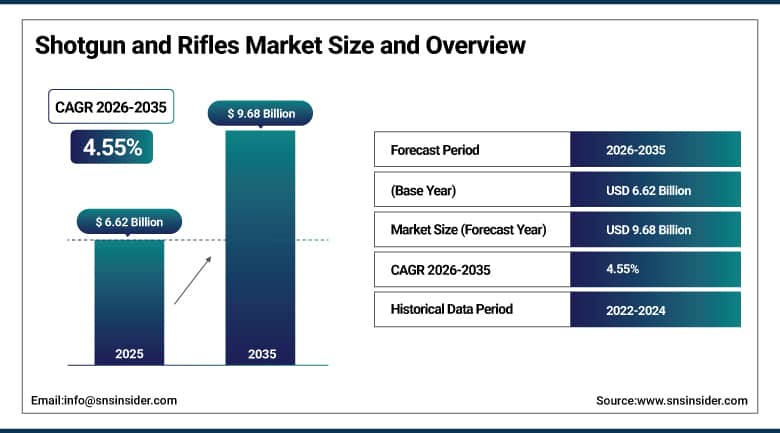
Shotgun and Rifles Market was valued at USD 6.62 billion in 2025 and is expected to reach USD 9.68 billion by 2035, growing at a CAGR of 4.55% from 2026–2035.
The Global shotgun and rifles market is expected to witness steady growth over the forecast period, due to modernization of defence initiatives, increasing civilian demand for hunting & shooting activities and advancements in firearm technology. Upgrades including lightweight composite frame, a 2-stage recoil systems, refined barrel architecture and modern day optics have improved the lethality of firearms while also broadening their use in military, policing and civilian sectors.
In April 2025, supporting this trend, the Stockholm International Peace Research Institute reported that global military spending reached a record USD 2.7 trillion in 2024, marking a 9.4% increase and the steepest rise since the Cold War, driven by rising geopolitical tensions and increased defense investments worldwide.
To Get More Information On Shotgun and Rifles Market - Request Free Sample Report
Shotgun and Rifles Market Trends:
-
-
Rising demand for advanced firearms, supported by SIPRI data on increasing global military spending and arms transfers, is driving defense modernization and law enforcement upgrades.
-
New technologies such as lightweight materials, modular designs, recoil reduction, and precision optics are improving accuracy, efficiency, and weapon sustainability.
-
Government and industry investments in next-generation weapons with better safety and ergonomics continue to grow, supported by events like Milipol.
-
Focus on lifecycle efficiency is increasing demand for systems with lower maintenance needs and longer service life in defense use.
-
Expansion of training infrastructure is improving operational readiness across defense and law enforcement sectors.
-
Growth is further supported by broader applications in defense, security, hunting, and sport shooting, as noted by Small Arms Survey.
-
Strict regulatory frameworks, including oversight by agencies like the ATF, continue to shape controlled market adoption.
-
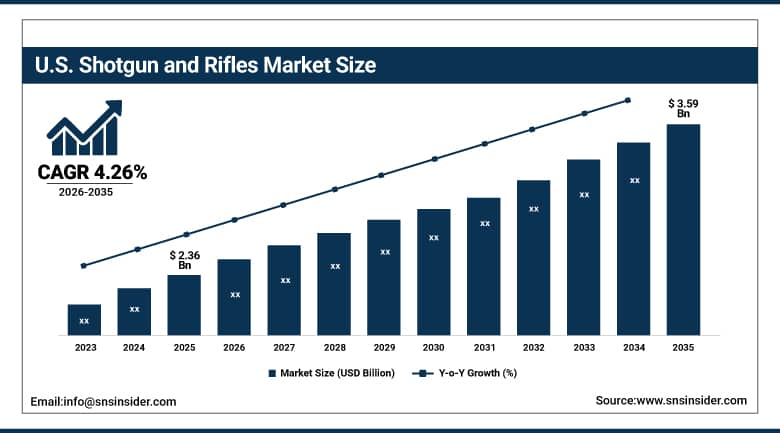
The value of U.S. Shotgun and Rifles Market is projected to be USD 2.36 billion in 2025 and it will grow to USD 3.59 billion in 2035, witnessing a CAGR of 4.26% during the forecast period from 2026 to 2035.
U.S. Shotgun and Rifles Market is the biggest in the global market due to its advanced healthcare setup, better reimbursement structure and availability of top medical devices suppliers including Medtronic, Intuitive Surgical, Stryker, and Johnson & Johnson. Better reimbursement policies by CMS have further bolstered growth of robotic and laparoscopic surgeries among hospital surgical units as well as ASCs.
The CDC reports that 42% of U. S. adults are obese, greatly widening the demographic population to be minimally invasive in bariatric, orthopedic, and metabolic treatment options. The increase in chronic disease burden along with the rising prevalence of cardiovascular and oncological diseases is supporting the high demand for advanced MIS across various specialties.
The U.S. Food and Drug Administration (FDA) keeps focusing on fast-track approvals and 510(k) clearances to speed up innovation. Not only did we see the da Vinci 5 Surgical System receive clearance in March of 2024, but also Virtual Incision's MIRA miniaturized robotic platform is due to win authorization this February (2024) a clear indication that regulatory momentum behind next-gen robotic surgery is quickening, establishing the U.S as the worldwide leader in minimally-invasive surgical innovation.
Shotgun and Rifles Market Segment Highlights
-
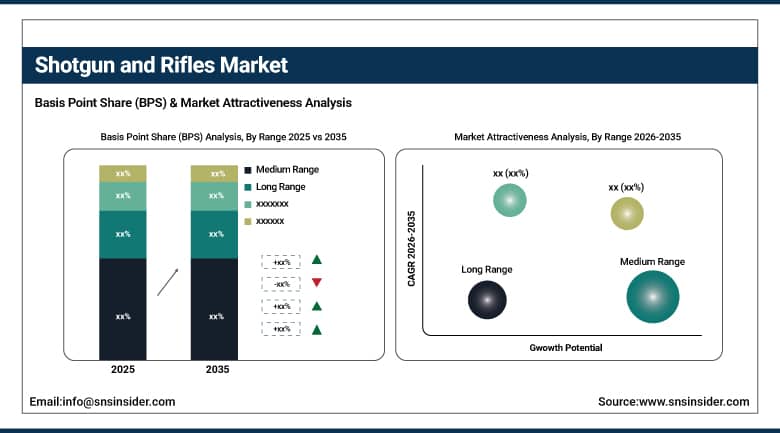
By Range Segments, Medium Range dominated the Shotgun and Rifles Market with 44.92% share in 2025; Long Range fastest growing (CAGR).
-
By End User, Military dominated the Shotgun and Rifles Market with 39.68% share in 2025; Civilian fastest growing (CAGR).
-
By Loading Mechanism, Semi-Automatic/Automatic systems dominated the Shotgun and Rifles Market with 55.43% share in 2025; also the fastest growing segment (CAGR).
By Range Segment, Medium Range segment dominates the Shotgun and Rifles Market, Long Range Systems segment expected to grow fastest
The Shotgun and Rifles Market is primarily driven by a segment that offers an ideal balance between performance, versatility, and ease of use. Weapons in this category deliver high accuracy, controllable recoil, and operational flexibility, making them a preferred choice for both professional users and civilian applications across diverse operational environments.
The Long-Range segment is anticipated to witness the fastest growth owing to rising demand for precision shooting, advanced hunting applications, and military sniper operations. Improvements in optics, barrel design, and ballistic performance are enhancing accuracy and effective engagement distances, thereby accelerating adoption by military and law enforcement agencies, as well as increasing interest among civilian competitive shooters.
By End User Segment, Military dominates the Shotgun and Rifles Market, Civilian segment expected to grow fastest
The Shotgun and Rifles Market is dominated by the Military segment, which holds the largest market share owing to extensive utilization in combat operations, training activities, border security, and tactical missions. Defense forces are increasingly investing in cutting-edge firearm systems to achieve improved accuracy and reliability while overcoming operational limitations in various high-intensity battlefield environments.
The Civilian segment is projected to be the fastest-growing market from 2023 - 2025, as a result of increasing participation in sport shooting and hunting activities around the world along with increasing trend of licensed firearm ownership in several regions. Recent advancements in the availability of modern firearms, including a greater focus on safety and with improved ergonomics and performance features suggests that the recreational shooting sports remain attractive.
By Loading Mechanism, Semi-Automatic/Automatic Systems dominates the Shotgun and Rifles Market, Manual Systems expected to grow fastest
The Semi-Automatic/Automatic system dominates the Shotgun & Rifles Market owing to their better firing efficiency, quick reloading ability, and operational effectiveness in the fields of defense and law enforcement. The Semi/Auto systems have an edge over other systems due to their efficiency, making them more popular in the market.
Manual systems are growing steadily, driven by demand from traditional hunters, sport shooters, and regions with regulatory preferences for simpler firearm mechanisms. Their reliability, ease of maintenance, and cost-effectiveness continue to support consistent adoption, particularly in civilian and training applications.
Shotgun and Rifles Market Regional Analysis:
|
Region |
Major Country |
Share within Region (%) |
|---|---|---|
|
North America |
United States |
78.60% |
|
Europe |
Germany |
32.40% |
|
Asia Pacific |
China |
46.85% |
|
Middle East & Africa |
UAE |
12.30% |
|
Latin America |
Brazil |
55.20% |
North America Shotgun and Rifles Market Insights
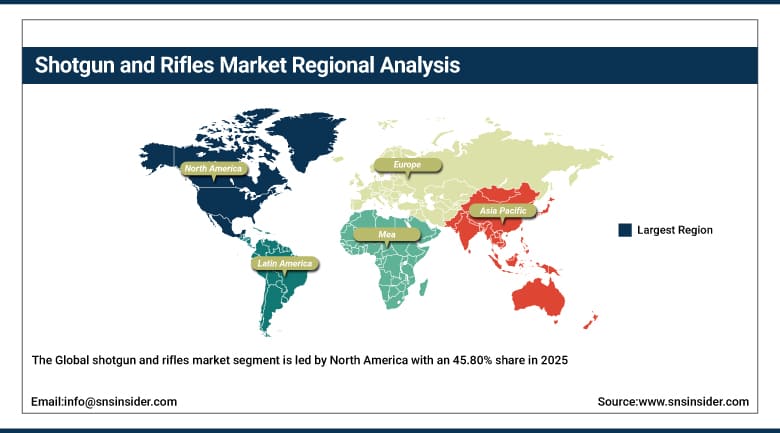
The Global shotgun and rifles market segment is led by North America with an 45.80% share in 2025, attributable to the US being one of highest civilian firearm ownership rates in the world according to the Small Arms Survey; and strong local production presence of leading companies such as Remington Arms, Smith & Wesson, and Sturm Ruger Co.
The US have highly investments towards defense expenditure, as is seen in the Department of Defense spending allocation of over USD 800 billion annually, which contributes to regular purchasing of firearms for use by the military and police forces. Additionally, the strong sporting culture in the US, right to carry firearms as stipulated in the constitution, and the practice of target shooting contribute to steady demand from civilians.
In terms of market dominance, the US occupies the leading position due to an established system of civilian firearm ownership and regular procurement cycles for the law enforcement bodies. The ongoing modernization of firearm systems for defense, homeland security, and training purposes contributes to the dominance of the region.
Get Customized Report as Per Your Business Requirement - Enquiry Now
Asia Pacific Shotgun and Rifles Market Insights
The Asia Pacific accounted for the maximum share of shotgun and rifles industry as its major contribution to growth comes from defense modernization program implemented under national defense white papers issued by China, Japan, South Korea etc. China fills the regional void with large scale acquisition based on the People’s Liberation Army modernization roadmap and extensive small arms manufacturing capabilities supported by the Chinese state.
Japan 14% regional share and South Korea 11% regional share maintain highly regulated civilian firearm environments while continuing to invest in advanced defense and law enforcement weapon systems, supported by national security enhancement strategies and interoperability-focused modernization programs aligned with allied defense frameworks, with combined annual defense modernization growth estimated at around 5%.
China 48% regional contribution remains the primary contributor due to its centralized defense procurement system, integration of small arms into internal security architecture, and long-term modernization strategies focused on improving military readiness, surveillance capability, and tactical response efficiency under state-driven defense planning initiatives, supported by estimated annual capability expansion of around 7%.
Europe Shotgun and Rifles Market Insights
Europe is a significant contributor in terms of the global shotgun and rifles market given that various European nations have long traditions of hunting and regulated civilian firearm ownership frameworks established by EU Firearms Directive regulations in national laws, notably Germany, France and Finland. Regionally, Germany gets ahead of the game, buoyed up by organized licensing regulations and powerful hunting groups like the German Hunting Association (DJV) to complement the defense procurement efforts that meet NATO capability needs.
The United Kingdom, France, and Italy also contribute through controlled civilian sport shooting markets and military modernization programs, while strict regulatory environments ensure compliance-driven demand and limited but high-value firearm adoption across the region.
Middle East & Africa and Latin America Shotgun and Rifles Market Insights
The market in Middle East & Africa region holds a considerable share of the global shotgun and rifles market, due to defense procurement cycles and internal security needs. Countries such as Saudi Arabia and the UAE are major contributors, backed by high defence expenditure in line with Stockholm International Peace Research Institute (SIPRI) publications and a series of national transformation programs including Saudi Vision 2030. South Africa also plays a part by policing game farms and establishing controlled markets for civilian hunting. Nonetheless, export restrictions in many parts of the world restrict expansion into civilian markets, maintaining a demand structure more reliant on defense throughout the region.
Shotgun and Rifles Market Growth Drivers:
-
Rising defense modernization, regulated civilian firearm ownership, and strong hunting and sport shooting culture are driving steady demand across military, law enforcement, and civilian segments globally.
Growth in the focus of national security namely, through border protection and infantry modernization. The U.S. Department of Defense small arms upgrades, NATO standardization initiatives is one such key driver. Countries, such as the US and Canada that have a well-established civilian firearm ecosystem continue to ensure there is ongoing demand through regulated hunting and sport shooting as well as licensing ownership whilst law-enforcement agencies are embracing modern rifles and tactical shotguns for policing and counter-terrorism.
Supporting this trend, the Stockholm International Peace Research Institute (SIPRI) reports sustained global defense spending, indicating continuous investment in small arms procurement and modernization programs across major economies.
Advancements in firearm design, including recoil control systems, modular weapon platforms, enhanced optics compatibility, digital sighting systems, and lightweight materials, are further supporting adoption by improving accuracy, operational efficiency, and adaptability across defense, law enforcement, and civilian applications.
Shotgun and Rifles Market Restraints:
-
Strict firearm regulations, evolving gun control policies, and international arms trade restrictions are limiting market growth, creating a fragmented and compliance-heavy global environment.
Government-created frameworks, like licensing systems, background checks and civilian ownership bans are big obstacles to progress. European Union firearms law, governed by the European Commission Firearms Directive places strict control over possession and transfer, in contrast with U.S. state-level firearm laws that command a patchwork of compliance standards for vendors. The establishment of international arms control agreements such as the Wassenaar Arrangement limits the exportation of small arms across borders. It is also a contributing factor for the delay in obtaining approval for exportation processes. The expansion into the market is hampered by higher compliance costs, troublesome licensing processes, restricted marketing measures, and increased safety concerns. Additional barriers to global expansion are the spread of illicit arms and different nations' approaches to civilian firearms ownership.
Shotgun and Rifles Market Opportunities:
-
Rising demand for civilian self-defense, hunting, and sport shooting drives increased adoption of modern shotguns and rifles globally
In urban and semi-urban areas, the public is increasingly buying quality firearms such as shotguns and within home defense rifles due to heightened concerns over their own safety. At the same time, interest in recreational hunting and sport shooting is increasing in other areas of the world with many countries embracing shooting clubs or holding organized competitions. Licensing regulation is also getting eased in some nations, allowing easier access to firearms. The increased disposable income also gives consumers the purchasing ability for more sophisticated and personalized firearms. Together, these elements provide an increasingly compelling growth opportunity for manufacturers to introduce additional product lines and address a wider base of civilian users with unique and accessible firearms solutions.
In 2025, NATO governments reaffirmed stronger defence cooperation by increasing military and security spending commitments beyond the traditional 2% of GDP target. This collaboration focuses on joint procurement, interoperability, and modernization of weapons systems across member countries to enhance collective security and readiness.
Recent Developments:
-
2026: SIG Sauer, Inc. advanced next-generation modular rifle systems integrated with smart optics and digital fire-control technologies, supporting enhanced battlefield awareness and precision engagement capabilities for modern military forces, especially within NATO-aligned procurement programs.
-
2025: FN Herstal (Winchester SX4 platform under FN Browning Group) advanced tactical shotgun development with the introduction of upgraded semi-automatic shotgun configurations adapted for counter-drone and close-range defense applications, reflecting growing demand for multi-role shotgun systems in security and military operations.
-
2024: Smith & Wesson Brands, Inc. strengthened its modern firearm lineup with new rifle and pistol platforms emphasizing optics-ready designs, modularity, and improved ergonomics, reflecting sustained consumer and law enforcement demand in the U.S. firearms market.
-
2023: SIG Sauer, Inc. and Smith & Wesson Brands, Inc. remained among the top global firearm producers, with SIG Sauer surpassing 1 million firearms production and Smith & Wesson maintaining strong revolver and rifle output. The year also saw continued procurement of SIG Sauer rifles by military forces, including large-scale defense contracts for frontline modernization.
Shotgun and Rifles Companies are:
-
Sturm, Ruger & Company, Inc.
-
Smith & Wesson Brands, Inc.
-
FN Herstal
-
Beretta Holding S.p.A.
-
SIG Sauer, Inc.
-
Heckler & Koch GmbH
-
Remington Arms (RemArms)
-
Olin Corporation (Winchester Ammunition / Winchester Firearms legacy)
-
Colt’s Manufacturing Company LLC
-
Israel Weapon Industries (IWI) Ltd.
-
CZ Group (Česká zbrojovka Group SE)
-
Thales Group
-
Rheinmetall AG
-
L3Harris Technologies, Inc.
-
Kalashnikov Concern
-
Savage Arms
-
O.F. Mossberg & Sons (Mossberg)
-
Browning Arms Company
-
Benelli Armi S.p.A.
-
Barrett Firearms Manufacturing Inc.
Shotgun and Rifles Market Report Scope:
| Report Attributes | Details |
|---|---|
| Market Size in 2025 | USD 6.62 Billion |
| Market Size by 2035 | USD 9.68 Billion |
| CAGR | CAGR of 11.20% From 2026 to 2033 |
| Base Year | 2025 |
| Forecast Period | 2026-2035 |
| Historical Data | 2022-2024 |
| Report Scope & Coverage | Market Size, Segments Analysis, Competitive Landscape, Regional Analysis, DROC & SWOT Analysis, Forecast Outlook |
| Key Segments | • By Range(Short Range, Medium Range, Long Range) • By End User(Military, Civilian, Law Enforcement) • By Loading Mechanism(Manual, Semi-Automatic/Automatic) |
| Regional Analysis/Coverage | North America (US, Canada), Europe (Germany, UK, France, Italy, Spain, Russia, Poland, Rest of Europe), Asia Pacific (China, India, Japan, South Korea, Australia, ASEAN Countries, Rest of Asia Pacific), Middle East & Africa (UAE, Saudi Arabia, Qatar, South Africa, Rest of Middle East & Africa), Latin America (Brazil, Argentina, Mexico, Colombia, Rest of Latin America). |
| Company Profiles | Sturm, Ruger & Company, Inc., Smith & Wesson Brands, Inc., FN Herstal S.A., Beretta Holding S.p.A., Sig Sauer, Inc., Heckler & Koch GmbH, RemArms (Remington Firearms), Olin Corporation (Winchester Repeating Arms), Colt’s Manufacturing Company LLC, Israel Weapon Industries (IWI) Ltd., CZ Group (Česká zbrojovka Group SE), Thales Group, Rheinmetall AG, L3Harris Technologies, Inc., Kalashnikov Concern (Rostec State Corporation) |
Frequently Asked Questions
The Shotgun and Rifles Market is expected to grow at a CAGR of 4.55% from 2026 to 2035.
The Shotgun and Rifles Market was valued at USD 6.62 billion in 2025.
Rising defense modernization programs, sustained civilian firearm ownership in regulated markets, and strong hunting and sport shooting culture are the primary growth drivers of the Shotgun and Rifles Market.
The Medium Range segment dominated the Shotgun and Rifles Market in 2025.
North America dominated the Shotgun and Rifles Market in 2025.
