
Space Robots Market Report Scope & Overview:
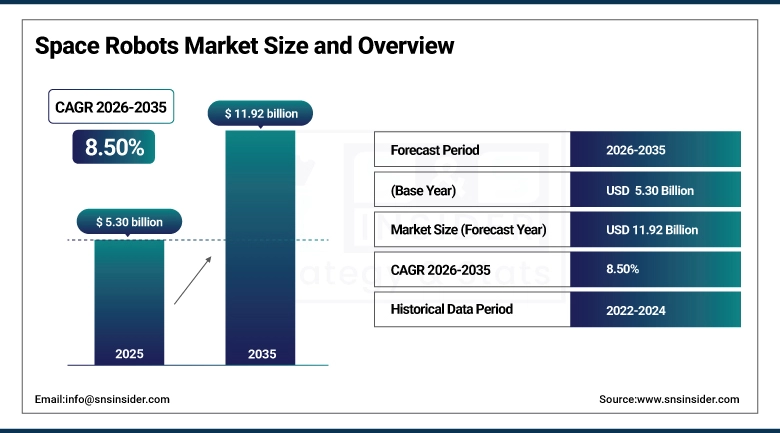
The Space Robots Market size is valued at USD 5.30 Billion in 2025 and is projected to reach USD 11.92 Billion by 2035, growing at a CAGR of 8.50% during the forecast period 2026–2035.
The Space Robots Market report is an exhaustive evaluation of market dynamics, emerging technologies, and applications. The growing need for satellite repair services and space junk cleanup, the launch of deep space mission plans, the increasing use of autonomous robots, the development of AI-based systems, and significant funding by governmental bodies and commercial organizations are fuelling the market's impressive growth rate from 2026 to 2035.
By 2025, space robotics deployments exceeded 3000 thousand of mission-critical units, driven by satellite constellations, lunar exploration initiatives, and the need for reliable in-orbit servicing solutions.
Market Size and Forecast:
-
Market Size in 2025: USD 5.30 Billion
-
Market Size by 2035: USD 11.92 Billion
-
CAGR: 8.50% from 2026 to 2035
-
Base Year: 2025
-
Forecast Period: 2026–2035
-
Historical Data: 2022–2024
To Get more information on Space Robots Market - Request Free Sample Report
Space Robots Market Trends:
-
Satellite servicing & life extension is becoming a major driver, with robotic arms enabling refueling, repair, and repositioning.
-
Orbital debris removal is gaining traction as space traffic increases, requiring autonomous capture and deorbit systems.
-
Lunar and Mars exploration missions are accelerating demand for rovers, drones, and manipulators.
-
AI and autonomy integration is transforming robotics into self-learning, adaptive systems for complex space tasks.
-
In-orbit manufacturing & assembly (ISAM) is emerging, with robots building large structures directly in space.
-
Miniaturization and modular design are enabling cost-effective, scalable robotic solutions for small satellites and CubeSats.
-
Commercial participation is expanding, with private companies (SpaceX, Blue Origin, Astroscale) competing alongside government agencies.
-
Defense and security applications are rising, with robotics used for surveillance, satellite protection, and strategic missions.
-
International collaborations (NASA–ESA, US–Japan, etc.) are fostering joint robotic missions and technology sharing.
U.S. Space Robots Market Insights:
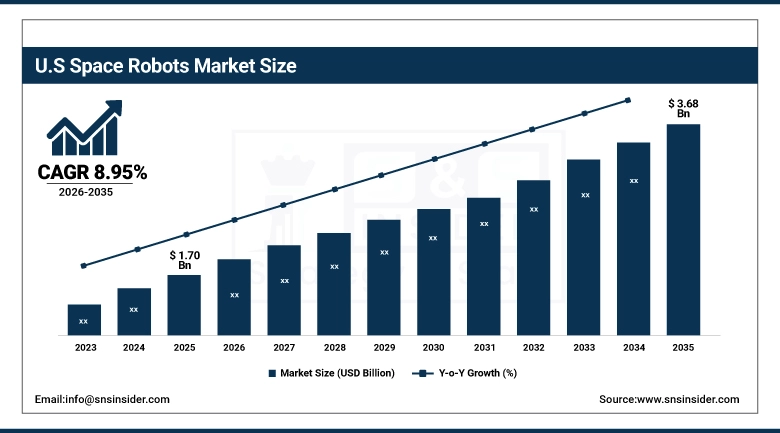
The U.S. Space Robots Market is projected to grow from USD 1.70 Billion in 2025 to USD 3.68 Billion by 2035, at a CAGR of 8.95%. The growth of the space robot’s industry is being fueled by the high demand for satellite maintenance and debris cleanup, growing space exploration ventures into deep space, widespread acceptance of robotics and automation with the use of artificial intelligence, and investment in advanced robotic arms, rovers, drones, and orbiters.
Space Robots Market Growth Drivers:
-
Rising satellite deployments and deep-space missions driving demand for advanced space robotics
Increasing use of satellites and more deep space exploratory programs are some of the main factors contributing to the growth of the Space Robotics Market. The use of highly advanced robotic systems such as autonomous rovers, robotic arms, and AI-enabled servicing robots by space agencies and businesses is being done to ensure better performance in terms of satellite repair, exploration, and other tasks. Advancements in areas such as autonomous navigation, machine vision, and modularity in robotic systems are driving adoption and improving results.
Over 60% of space missions and satellite servicing operations utilized advanced space robotic systems in 2025 to improve mission efficiency, reduce human risk, and enable complex in-orbit and deep-space tasks.
Space Robots Market Restraints:
-
High development costs and technical complexities limiting widespread adoption
The high cost of development and technical complexity are the major restraints for the growth of the Space Robotics Market. Both government space agencies and commercial organizations find it extremely difficult to design, test, and deploy robots that can work under harsh conditions in outer space. There is a requirement for precision equipment, strict validation procedures, and customization of robots according to each mission. All this leads to increased costs and delays in development.
Over 45% of small and mid-sized space companies in 2025 reported cost and technical constraints as major barriers to adopting advanced space robotic systems.
Space Robots Market Opportunities:
-
Growing demand for on-orbit servicing and space debris management creating new opportunities
Increasing demands for on-orbit services and rising threats from space debris have been contributing immensely to opportunities within the Space Robotics Market. There has been an increase in investment by satellite operators and space organizations in the application of robotics technology to provide services such as repairing satellites, refueling, extending their lives, and eliminating space debris. Technological breakthroughs in automated docking, intelligent navigation, and manipulation of robots are enhancing efficiency and scalability in providing such services.
Over 50% of planned satellite missions and space sustainability initiatives by 2030 are expected to incorporate robotic servicing or debris mitigation technologies, highlighting strong future growth potential.
Space Robots Market Segmentation Analysis:
-
By Solution, Remotely Operated Vehicles (ROV) held the largest market share of 34.51% in 2025, while Software Solutions is expected to grow at the fastest CAGR of 9.31% during 2026–2035.
-
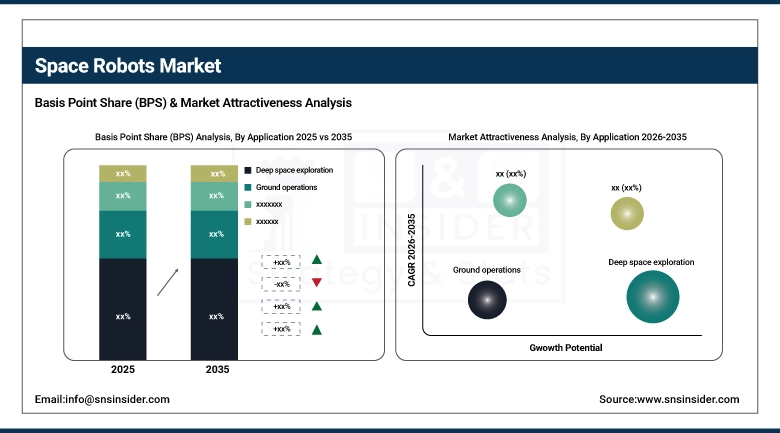
By Application, Deep space exploration dominated with 43.58% market share in 2025, whereas Near space (LEO operations) are projected to record the fastest CAGR of 9.05% through 2026–2035.
-
By Product Type, Robotic arms accounted for the highest market share of 37.49% in 2025, while Drones are expected to grow at the fastest CAGR of 9.61% during the forecast period.
-
By End User, Government agencies dominated with a 44.71% share in 2025, while Commercial companies are anticipated to expand at the fastest CAGR of 9.02% through 2026–2035.
-
By Component, Sensors held the largest share of 25.46% in 2025, while Software are expected to grow at the fastest CAGR of 9.82% during the forecast period.
By Application, Deep Space Exploration Dominates While Near Space (LEO Operations) Grow Rapidly:
The Deep Space Exploration segment accounted for dominant share owing to rising investments in planet missions, inter-planetary explorations, and extended periods of space missions by leading space organizations. The application of space robotics is extremely crucial in accomplishing intricate processes like surface exploration, sample collecting, and navigation in far and hostile terrains where human interference is unfeasible.
Near space (LEO Operations) have been identified as the fastest growing segments with respect to the growth of robotic technologies, fueled by the rise in satellite constellations, activities at space stations, and commercial LEO missions. Growing requirements for on-site servicing, inspection, and maintenance of equipment are fueling adoption, while advancements in real-time and automated operations in this segment have also contributed to growth.
By Solution, Remotely Operated Vehicles (ROV) Dominate While Software Grows Rapidly:
The Remotely Operated Vehicle (ROV) category dominates the industry because it plays a crucial part in satellite servicing, space station maintenance, and mission-critical activities that require human intervention. This technology is highly preferred by space organizations and businesses when carrying out activities that require utmost precision and dependability within the space environment.
The Software Solutions segment experiences fastest growth due to the rising use of artificial intelligence, autonomous navigation, and data-processing capabilities in space robotics. The rising need for mission autonomy, less delay in communications in deep-space exploration, and increased operational efficiency is boosting the adoption of complex software solutions.
By Product Type, Robotic Arms Dominate While Drones Grow Rapidly:
The Robotic Arms segment dominate the market because of the wide application of these robots in the servicing, assembly, repair, and functioning of space stations. Robotic arms enable precision and reliability in performing vital functions in space. The long history of utilization in several missions made this product an integral part of space robotics.
The Drones represent the fastest growing segment because of the rising popularity of autonomous inspection, surveillance, and exploration activities. They can cover difficult-to-access sites and make timely data analysis. Innovations related to drone propulsion, navigation, and AI-controlled movements are the additional factors boosting the segment's development.
By End User, Government Agencies Dominate While Commercial Companies Grow Rapidly:
Government Agencies Segmentation had a dominant share in the market owing to massive funding, space exploration activities, and huge investment in advanced robotics technologies. There would always be a high demand for robotics by national space agencies for their missions, scientific discoveries, and construction activities.
The Commercial Companies segment is showing the fastest rate of growth because of the rapid rise of private organizations engaged in space activities. Commercial investments have been growing in areas such as satellites, space tourism, and in-orbit activities. This is leading to an increased use of cost-efficient and scalable robotic solutions.
By Component, Sensors Dominate While Software Grows Rapidly:
The Sensors segment dominate the market owing to its importance in making space robotic systems perceive their environment and make decisions. Sensors are indispensable to monitor environmental parameters, detect obstacles, and perform tasks precisely under difficult space conditions. The growing demand for sophisticated sensor technology will ensure a steady adoption rate across all types of missions.
The Software segment is expected to grow fastest rate, propelled by the rising requirement for autonomous operations, incorporation of AI, and data analysis within space robots. The development of better machine learning capabilities, simulations, and control algorithms has made space robots smarter and adaptable. As space missions evolve into more complex and data-driven processes, software will be crucial for achieving higher efficiency and success rates.
Space Robots Market Regional Analysis:
North America Space Robots Market Insights
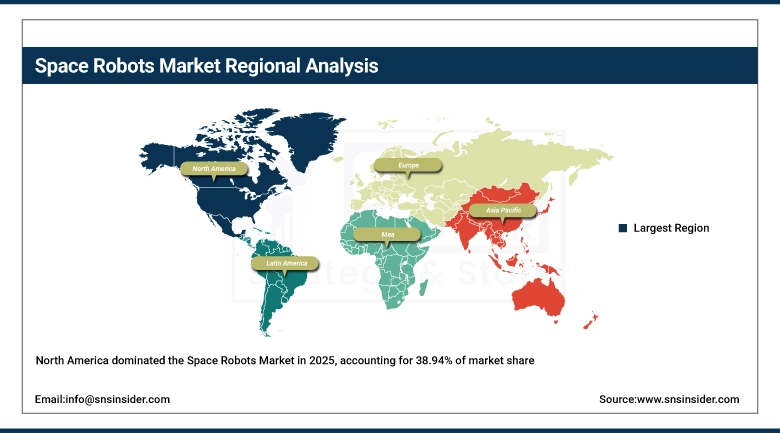
North America emerges as the leading country in the international space robotics market with almost 38.94% market share in 2025, due to the massive investments made by organizations like NASA, SpaceX, and Northrop Grumman. This continent is endowed with an excellent aerospace industry infrastructure, along with considerable investments in satellite servicing. The need for the elimination of orbital debris and in-space manufacturing will further increase its market domination. With consistent advancements in robotic arms, rovers, and autonomous systems, along with public-private partnerships, North America will remain the dominant market until 2035.
Get Customized Report as per Your Business Requirement - Enquiry Now
U.S. Space Robots Market Insights
The US occupies the largest market share in North America due to the contributions made by the NASA Artemis project, SpaceX Starlink satellite network, and servicing operations by Northrop Grumman. Private companies’ involvement, research and development in AI-based robots, and expertise in satellite servicing technology contribute significantly to the dominance of the USA. Increasing efforts on lunar missions and defense applications further boost the growth rate. Due to its unmatched capabilities for innovation and financial resources, the USA maintains its domination in global space robotics.
Asia-Pacific Space Robots Market Insights
The Asia-Pacific region has emerged as the fastest-growing region, posting a CAGR of 10.11%, owing to higher investments by China, Japan, and India. The robotic arms developed by JAXA, the lunar missions of ISRO, and the Mars and Moon expeditions undertaken by China showcase the prowess of the Asia-Pacific region. Rapid adoption can be attributed to growing involvement of businesses, lower costs of launching spacecraft, and exploration activities backed by governments.
China Space Robots Market Insights
China has been rising to prominence in the field of space robotics through substantial government funding and space exploration projects. The nation’s robotic lunar exploration vehicles, missions to Mars, and satellite repair services reflect China’s cutting-edge robotic technology. As more attention is paid to artificial intelligence and autonomous operations, and space debris elimination, China’s influence will continue to grow quickly. The country’s collaboration with local aerospace companies and defense-related purposes will only strengthen its position.
Europe Space Robots Market Insights
Europe has a considerable stake in the space robotics industry, headed by ESA, Airbus, and Thales Alenia Space. Europe is particularly interested in developing robotic arms for missions involving servicing, the Moon, and cooperation with NASA and JAXA. A strong focus on sustainability, cleaning space debris, and manufacturing satellites in orbit will lead to growth. Europe’s existing aerospace sector, along with its partnerships, will ensure consistent growth. Europe will contribute to space robotics globally up until 2035.
Germany Space Robots Market Insights
Germany is a key player in Europe’s space robotics industry owing to the major contribution made by Airbus and DLR. Robotics in Germany involves robot arms, sensors, and autonomous technology used for maintenance and exploration. This is because of its heavy investments in research and development and partnerships with the European Space Agency. Germany is known for its precise engineering, and space robotics is no exception.
Latin America Space Robots Market Insights
Latin America is an emerging space robotics market, with Brazil and Mexico being at the forefront of space robotics activities in the region. Satellite services, ground support services, and collaboration with foreign aerospace companies have been driving the acceptance of space robotics technology. Although Latin America’s market share is still small, there are projections that it will grow due to the increased investment of governments and partnerships with other space agencies.
Middle East & Africa Space Robots Market Insights
Middle East & Africa is slowly becoming part of the space robotics market due to investment from the United Arab Emirates (UAE) and South Africa. The success of the UAE’s Mars mission and satellite program demonstrates that the region has developed its skills in the industry. Cooperation with international companies and national efforts have encouraged the development of the market. Despite having a small market share, the region could become a major player in space robotics because of increased interest in space exploration.
Space Robots Market Competitive Landscape:
SpaceX
SpaceX is an important American aerospace firm with a huge influence in the global space robotics industry due to the Dragon spacecraft and the Falcon 9 rocket systems which provide robotic operations such as cargo transportation and autonomous docking. SpaceX’s product lines focus on reusable rockets, orbital operations, and robotic payload integration, all supported by innovation and business collaborations. Autonomous technology, space missions, and satellite constellations developed by SpaceX strengthen its competitiveness in the field of space robotics.
-
In April 2025, SpaceX successfully launched its 32nd commercial resupply mission to the International Space Station (ISS), marking another milestone in its long-standing partnership with NASA. The Dragon spacecraft carried approximately 6,700 pounds of critical cargo, including advanced robotics experiments, precision atomic clocks for navigation research, and next-generation life-support systems.
Northrop Grumman
Northrop Grumman is an important prime contractor for defense and aerospace industries in the United States. Northrop Grumman has an important contribution to space robotics through one of its subsidiaries called SpaceLogistics LLC. Northrop Grumman has developed a revolutionary technique for robotic satellite servicing at geostationary orbits. Northrop Grumman is utilizing the latest technology of using two robotic arms together with autonomy systems. Northrop Grumman’s business operations cover various segments includes propulsion, launch vehicles, and autonomous systems for the aerial, maritime, and space environments.
-
In June 2025, Northrop Grumman integrated U.S. Naval Research Laboratory robotic arms onto its Mission Robotic Vehicle (MRV), targeting a 2026 launch for robotic satellite servicing. Equipped with dual robotic manipulators, the system will enable precise docking and autonomous servicing tasks in space.
Airbus
Airbus SE is an aerospace OEM based in Europe with significant integration of robotics within their manufacturing processes, defense applications, and space program offerings. In the field of space robotics, Airbus’s contributions include its involvement in the European Robotic Arm (ERA) onboard the International Space Station and robotics used for purposes of servicing and space exploration. Robotics at Airbus is viewed as infrastructure, whereby automation is integrated into production and space missions.
-
In September 2025, Airbus expanded its robotics portfolio with in-house Medium-Sized Drilling Robots (MSDR) and Flextrack systems to enhance aerospace manufacturing efficiency. These innovations not only strengthened Airbus’s competitiveness in aerospace manufacturing but also demonstrated its commitment to integrating advanced robotics.
Space Robots Market Key Players:
Some of the Space Robots Market Companies are:
-
SpaceX
-
Northrop Grumman
-
Airbus
-
Boeing
-
Lockheed Martin
-
Maxar Technologies
-
Astrobotic Technology
-
iSpace
-
Honeybee Robotics
-
Altius Space Machines
-
Made In Space
-
Effective Space Solutions
-
Olis Robotics
-
Metecs
-
Blue Origin
-
Rocket Lab
-
Relativity Space
-
Mitsubishi Heavy Industries
-
Thales Alenia Space
| Report Attributes | Details |
|---|---|
| Market Size in 2025 | USD 5.30 Billion |
| Market Size by 2035 | USD 11.92 Billion |
| CAGR | CAGR of 8.50% From 2026 to 2035 |
| Base Year | 2025 |
| Forecast Period | 2026-2035 |
| Historical Data | 2022-2024 |
| Report Scope & Coverage | Market Size, Segments Analysis, Competitive Landscape, Regional Analysis, DROC & SWOT Analysis, Forecast Outlook |
| Key Segments | • By Solution (Remotely Operated Vehicles (ROV), Remote Manipulator Systems (RMS), Software Solutons, Services, Others), • By Application (Deep Space Exploration, Near Space (LEO Operations), Ground Operations, Others), • By Product Type (Robotic Arms, Rovers, Drones, Orbiters, Others), • By End User (Government Agencies, Commercial Companies, Defense & Research Institutions, Others), • By Component (Sensors, Software, Controllers, Actuators, Hardware, Others) |
| Regional Analysis/Coverage | North America (US, Canada), Europe (Germany, UK, France, Italy, Spain, Russia, Poland, Rest of Europe), Asia Pacific (China, India, Japan, South Korea, Australia, ASEAN Countries, Rest of Asia Pacific), Middle East & Africa (UAE, Saudi Arabia, Qatar, South Africa, Rest of Middle East & Africa), Latin America (Brazil, Argentina, Mexico, Colombia, Rest of Latin America). |
| Company Profiles | SpaceX, Northrop Grumman, Airbus, Boeing, Lockheed Martin, Maxar Technologies, Astrobotic Technology, iSpace, Honeybee Robotics, Altius Space Machines, Made In Space, Effective Space Solutions, Olis Robotics, Metecs, Blue Origin, Rocket Lab, Relativity Space, Mitsubishi Heavy Industries, Thales Alenia Space, Sierra Space. |
Frequently Asked Questions
North America dominated with a 38.94% share in 2025, while Asia-Pacific is the fastest-growing region, expected to expand at a CAGR of 10.11% during 2026–2035.
Robotic arms dominated with a 37.49% share in 2025, while Drones are projected to grow at the fastest CAGR of 9.61% during 2026–2035.
Growth is driven by increasing demand for satellite servicing and life extension, rising need for orbital debris removal, expanding deep space exploration programs, and advancements in autonomous robotics and AI.
The market is valued at USD 5.30 Billion in 2025 and is projected to reach USD 11.92 Billion by 2035.
The Space Robots Market is projected to grow at a CAGR of 8.50% during 2026–2035.
