
Spatial Proteomics Market Report Scope & Overview:
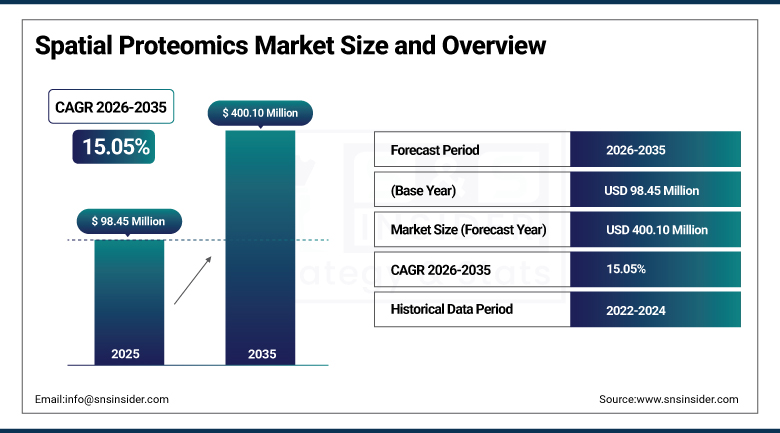
The Spatial Proteomics Market was valued at USD 98.45 Million in 2025 and is expected to reach USD 400.10 Million by 2035, growing at a CAGR of 15.05% from 2026 to 2035.
The Spatial Proteomics Market is growing significantly, owing to the increasing prevalence of cancer and chronic conditions leading to the need for precision oncology research, adoption of advanced imaging and mass spectrometry-based protein mapping solutions in drug discovery for pharmaceuticals, and usage of AI-based solutions that enhance the throughput of spatial protein analysis and interpretative accuracy. Spatial proteomics solutions help in retaining the intact tissue structure while analyzing protein expression, localization, and interactions at single-cell and subcellular levels something which is not possible via traditional bulk proteomics techniques. Such technology has become essential for a variety of applications, including oncology, immunology, neurology, and drug discovery, where tumor microenvironment analysis is crucial.
10x Genomics completed its acquisition of RareCyte in 2025 for USD 200 Million, strengthening its spatial proteomics portfolio and expanding its high-plex protein imaging capabilities for oncology and immunology research customers across pharmaceutical and academic markets.
To Get more information On Spatial Proteomics Market - Request Free Sample Report
Spatial Proteomics Market Trends:
-
Growing integration of artificial intelligence and machine learning into spatial proteomics workflows is improving the speed and accuracy of protein mapping analysis.
-
Rising adoption of multiplexed imaging platforms is enabling simultaneous detection of dozens of protein markers within a single tissue section.
-
Increasing use of spatial proteomics in immuno-oncology biomarker discovery is broadening pharmaceutical research and development applications.
-
Growing preference for FFPE-compatible workflows is expanding spatial proteomics adoption in retrospective and archival clinical tissue studies.
-
Expanding collaborations between instrument manufacturers and pharmaceutical companies are accelerating development of application-specific spatial proteomics platforms.
U.S. Spatial Proteomics Market Outlook:
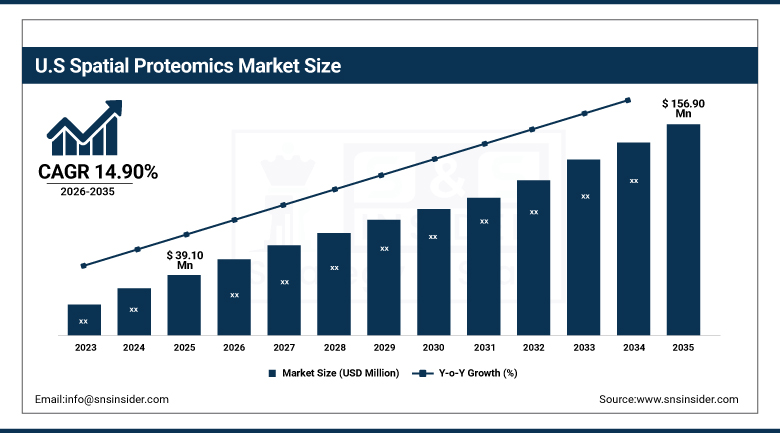
The U.S. Spatial Proteomics Market was valued at USD 39.10 Million in 2025 and is projected to reach USD 156.90 Million by 2035, growing at a CAGR of 14.90% during 2026–2035.
Research institutions dealing in pharmaceuticals, biotechnologies, and academia in the country keep on investing in spatial proteomics technology because of the availability of domestic funding for precision oncology studies, life sciences instrumentation providers, and multiplex protein imaging being used in translational and clinical studies. The presence of contract research organizations that help in pharmaceutical biomarker discovery and the continued innovations in the platforms from the domestic instrumentation providers guarantee the sustained demand for spatial proteomics technology.
In 2026, Bruker expanded its U.S. spatial proteomics manufacturing and applications support infrastructure following the commercial rollout of its CellScape-XR platform, strengthening its ability to supply high-resolution protein imaging systems to domestic pharmaceutical, academic, and clinical research customers.
Spatial Proteomics Market Segmentation Analysis:
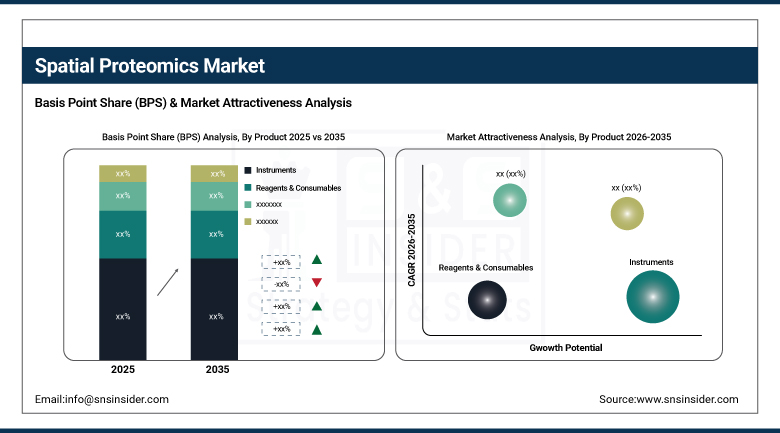
- By Product, Instruments dominated the Spatial Proteomics Market with a 43.20% share in 2025, while Software & Services is the fastest-growing product segment with a CAGR of 17.40% from 2026–2035.
-
By Technology, Imaging-Based dominated the Spatial Proteomics Market with a 51.80% share in 2025, while Mass Spectrometry-Based is the fastest-growing technology segment with a CAGR of 16.90% from 2026–2035.
-
By Sample Type, FFPE dominated the Spatial Proteomics Market with a 58.60% share in 2025, while Fresh Frozen Tissue is the fastest-growing sample type segment with a CAGR of 15.60% from 2026–2035.
-
By End User, Academic & Research Institutes dominated the Spatial Proteomics Market with a 52.40% share in 2025, while Pharmaceutical & Biotechnology Companies is the fastest-growing end user segment with a CAGR of 16.60% from 2026–2035.
By Product, Instruments dominated the Spatial Proteomics Market, while Software & Services is the fastest-growing segment.
Instruments dominated was the most prominent segment in the Spatial Proteomics Market in 2025. Instruments are the foremost products because of their significant importance in high-resolution and multiplexed protein imaging and mass spectrometry analysis in both clinical and research setups. Growing investments from pharma companies, CROs and academic core facilities in advanced imaging mass cytometry instruments, multiplexed immunofluorescence scanners, and spatial analysis workstations are driving the segment's growth. In addition, continuous development in platforms and new launches of instruments are aiding the adoption in the fields of oncology, immunology, neuroscience and biomarker research.
Software & Services is expected to witness the highest CAGR from 2026 to 2035. Growing complexity of spatial proteomics data is boosting the need for bioinformatics software that can automate the processes of image segmentation, protein quantitation, and cellular phenotyping. Cloud computing and AI-powered interpretation solutions are assisting the pharmaceutical firms and research institutes in processing large data sets in an efficient manner while minimizing dependency on specialized knowledge. Furthermore, contract research organizations are extending their offerings in terms of providing complete solutions starting from sample preparation, data analysis, and interpretation services.
By Technology, Imaging-Based dominated the Spatial Proteomics Market, while Mass Spectrometry-Based is the fastest-growing segment.
The Imaging-Based segment had the largest share of the Spatial Proteomics market in 2025. Multiplexed immunofluorescence, imaging mass cytometry, and immunohistochemistry techniques are commonly used in proteomics owing to their ease of use in formalin-fixed paraffin-embedded tissue workflows. Such methods help visualize the protein location in the tissue context at the subcellular level and also help detect multiple protein targets.
The Mass Spectrometry-Based Segment is expected to have the highest CAGR. The growing demand for label-free, highly sensitive protein detection in thousands in the spatially resolved tissues is encouraging the usage in pharmaceutical firms and academic laboratories. Improvements in the techniques of laser micro-dissection, MALDI imaging, sample preparation, and computational analysis are boosting the sensitivity and resolution of the technique. Combination of deconvolution and single-cell technologies is increasing the applicability in studying drugs mechanisms, validating biomarkers, and researching post-translational modifications.
By Sample Type, FFPE dominated the Spatial Proteomics Market, while Fresh Frozen Tissue is the fastest-growing segment.
FFPE dominated in the year 2025 due to its availability in the pathology laboratory, stability at room temperature for a long time, and compatibility with imaging procedures. The existence of retrospective FFPE tissue cohorts associated with clinical outcome data allows large scale validation and translation studies without collecting new fresh tissues. Antigen retrieval and antibody panels compatible with fixation have improved the suitability of FFPE for spatial proteomics studies in various fields including oncology and immunology.
Fresh Frozen Tissue category is expected to witness the highest CAGR in the forecast period between 2026-2035. Fresh frozen storage provides a good stability of protein antigenicity, RNA quality, and molecular structures, and it is therefore helpful for advanced multi-omic spatial studies combining genomics, transcriptomics, and proteomics studies. The increase in cryopreserved tissue biobanking in academia hospitals and pharmaceutical clinical trials is one of the key drivers of its increasing popularity, especially in precision oncology projects.
By End User, Academic & Research Institutes dominated the Spatial Proteomics Market, while Pharmaceutical & Biotechnology Companies is the fastest-growing segment.
The Academic & Research Institutes segment accounted for the largest revenue share in the Spatial Proteomics Market in 2025. The academic institutes and translational research institutes continue to be the leading end-users of spatial proteomics market due to significant government and foundation investments for scientific research on basic tissue biology, disease mechanisms, and heterogeneity of cells in addition to the development of specialized spatial biology core facilities in major research universities and medical institutions. Such institutes are the early adopters of the latest spatial proteomics platforms and often work in partnership with spatial technology providers in terms of method development and validation, thus emphasizing their significance in the development and use of new technology platforms in the field of oncology, immunology, neuroscience, and developmental biology researches.
The Pharmaceuticals and Biotechnology Companies segment is anticipated to exhibit the highest CAGR from 2026 to 2035. Increasing investments by the pharmaceutical companies in the development of precision medicine drugs, biomarkers for patient selection, and understanding of the mechanism of action is driving the demand for spatial proteomics solutions that will enable the study of tumor microenvironment and immune cells infiltration in drug response prediction. Increasing adoption of spatial proteomics in preclinical and translational drug development and increasing investments made by pharmaceutical companies in in-house spatial biology technologies and partnerships with service providers are contributing to this growth trend.
Regional Analysis:
|
Region |
Major Country |
Share within Region, 2025 (%) |
|---|---|---|
|
North America |
United States |
87.10% |
|
Europe |
Germany |
26.80% |
|
Asia Pacific |
China |
42.60% |
|
Middle East & Africa |
Saudi Arabia |
27.30% |
|
Latin America |
Brazil |
39.20% |
North America Spatial Proteomics Market Insights
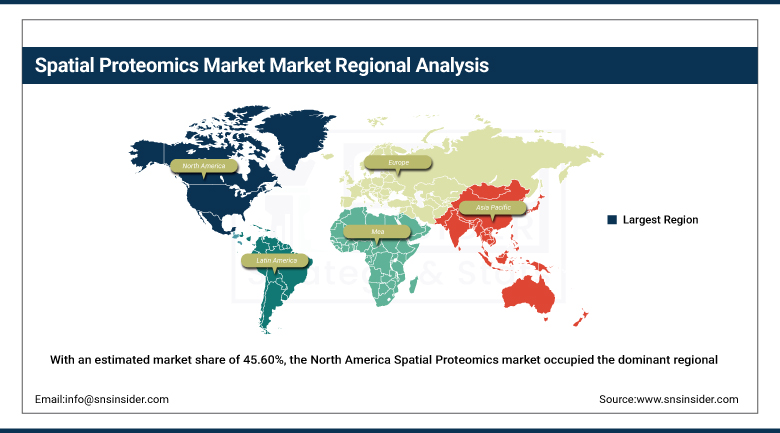
With an estimated market share of 45.60%, the North America Spatial Proteomics market occupied the dominant regional market share position in 2025 due to the strong biotech and pharmaceutical research infrastructure in the region, along with the significant investments made by governments and private enterprises in precision oncology and translational research programs and early adoption of sophisticated multiplexed imaging and mass spectrometry protein detection systems. The presence of major spatial proteomics instruments manufacturers based in the region and the extensive contract research organizations working on pharmaceutical biomarkers discovery programs are the key factors contributing to the leadership of North America in the global spatial proteomics industry. Favorable regulatory environment for precision medicine programs and increasing development of spatial biology core facilities in major universities is expected to fuel the demand in the region.
The United States had the biggest market share in the North America Spatial Proteomics Market in 2025 at 87.10%, owing to the significant investments made in research in its pharmaceuticals and biotech industry, presence of key spatial proteomics instrument and reagents manufacturers, and increasing usage of multiplexed protein imaging in cancer centers and research institutions. Canada is playing a role in driving regional growth with its increasing biotech research industry, government spending on precision medicine, and increasing adoption of spatial biology platforms in key research universities and hospital-affiliated research institutes in Canada.
Get Customized Report as per Your Business Requirement - Enquiry Now
Europe Spatial Proteomics Market Insights
The Europe region was one of the prominent regions in the Spatial Proteomics Market in 2025, and it was predicted to have relatively higher growth rates during the forecast period. This is due to the presence of a strong research culture in terms of molecular and systems biology in this region, established research funding framework for precision oncology and immunology studies in this region, and increasing investments from the pharmaceutical industry for developing drugs based on biomarkers in this region.
Germany was one of the key markets in the Europe region due to a significant presence of life sciences instruments manufacturers and spatial biology technology providers in this region. Other countries such as Switzerland, the United Kingdom, and France that had prominent proteomics research institutes and academic centers were also adding value to the market due to spatial biology research activities in these countries.
Asia Pacific Spatial Proteomics Market Insights
The Asia Pacific Spatial Proteomics Market is predicted to exhibit the highest CAGR of 16.70% during the forecast period 2026-2035. Some of the factors responsible for the growth in this market include fast-growing biopharmaceutical research & development expenditure, increasing funding from the government towards precision medicine and genomics, and setting up of academic spatial biology core facilities by various major and emerging research economies in the region that are adopting advanced strategies in life sciences.
One of the countries that is driving the growth of the Asia Pacific Spatial Proteomics Market is China, as it has a fast-growing biopharmaceutical manufacturing and research landscape, along with domestic development of instruments for spatial biology research. On the other hand, Japan and South Korea have some of the advanced infrastructures and medical institutions in life sciences research in the region. These two countries are making a significant contribution to regional growth through their growing precision oncology research programs and increasing adoption of multiplexed protein imaging technologies.
Middle East & Africa and Latin America Spatial Proteomics Market Insights
Spatial proteomics is slowly gaining traction in the Middle East & Africa and Latin American regions due to increased investment in academic and pharmaceutical research in these two regions. This is coupled with the growing emphasis from governments in these two regions on developing innovations in biotechnology and the development of precision medicine research programs by academic medical centers within these regions.
The Brazilian region is expected to become a major Latin American market driven by the growing interest in academic biomedical research and the development of the pharmaceutical industry in translational oncology research. In the Middle East & Africa region, there is Saudi Arabia and the UAE investing in state-of-the-art life sciences research infrastructure which is slowly driving the need for spatial proteomics in the region.
Market Dynamics:
Growth Drivers: Rising precision oncology adoption and multiplexed protein imaging demand driving market growth
The increase in cancer and other chronic diseases globally along with the increasing application of precision medicine approaches involving the characterization of tumor microenvironment and distribution of immune cells are some of the key factors behind the growth of the Spatial Proteomics Market. Spatial proteomics technologies offer scientists a distinct advantage in mapping proteins expression and interactions in their natural cellular context, thus providing invaluable insights that would not be possible with any other method, such as traditional proteomics or genomics and facilitating the discovery of biomarkers and therapeutic targets for almost all disease areas, from oncology and immunology to neurodegenerative diseases.
With developments made to multiplex imaging and mass spectrometry techniques for protein detection, there has been a considerable increase in the level of resolution, throughput, and plex that can be achieved through a spatial proteomics workflow process. Recently developed platforms can now detect more protein biomarkers in one tissue sample than ever before possible on older technology platforms. Moreover, greater investments being made by the pharmaceutical industry in developing biomarkers as part of their new drugs along with increasing usage of spatial proteomics in patient stratification in clinical trials will drive the market forward. The use of spatial proteomics will eventually lead to replacement of traditional bulk tissue analysis processes.
Restraints: High instrument costs and workflow complexity limiting broader market adoption
Perhaps one of the most crucial hurdles that hinder the development of the market is the amount of money that must be invested into sophisticated spatial proteomics equipment that is out of reach for small-scale laboratories and research centers with budgetary limitations. These initial costs coupled with the need for additional expenses on specialty reagents, antibody cocktails, and other consumables needed in multiplexing protein analysis continue to impede wide utilization of spatial proteomics instruments in resource-limited research environments, especially in developing countries.
Furthermore, the technical difficulties that arise when implementing spatial proteomics workflows, from sample preparation to multiplexed staining, imaging at high resolution, and subsequent computation of the data, necessitates highly specialized technical knowledge which is not readily available at many institutions, thus forming an impediment to the independent implementation of the workflow. In addition to this, the lack of standardized protocols and interoperability between different spatial proteomics techniques hinders the validation of results across different platforms, making further investment necessary before implementing the workflow fully.
Opportunities: AI-driven data analysis and emerging market expansion creating new growth avenues
The development of platforms that facilitate the use of machine learning and artificial intelligence algorithms in analyzing spatial proteomics datasets to automate cell segregation and phenotyping in large volumes of multiplexed imaging datasets has created many opportunities for the developers of such technology looking to increase efficiency and make the platforms accessible to those without expertise in bioinformatics. There is an increasingly popular approach in integrating multi-omics datasets such as genomic, transcriptomic and proteomic data from the same tissue section which creates opportunities for platform developers to provide a solution for complex research needs.
A lot of potential can be realized from the increased use of spatial proteomics technologies in the emerging pharmaceutical and biotech research industries in the Asia-Pacific region and Latin America because of growing investments in precision medicine infrastructure and development of academic core facilities for spatial biology which creates the research environment necessary for more widespread platform use. The outsourcing of spatial proteomics workflows by specialized contract research organizations along with the growing need in the pharmaceutical industry for biomarker-enabled clinical trial support will contribute to market growth due to more access to spatial biology platforms by smaller biotech firms without the need for heavy investment into infrastructure.
Recent Developments:
-
2025: Lunaphore demonstrated its progress in spatial proteomics and multiomics workflows by showcasing its automated COMET platform that allows analysis of many biomarkers at once while keeping the integrity of the tissue sample. It helps scientists to research the interaction of cells and mechanisms of diseases.
-
2025: Standard BioTools launched its Hyperion XTi imaging mass cytometry system, offering researchers expanded multiplexing capacity and faster acquisition speeds for high-parameter tissue protein analysis.
-
2026: Akoya Biosciences launched PhenoCycler Fusion 2.0, an upgraded multiplexed imaging system enabling researchers to detect a significantly expanded panel of protein biomarkers within a single tissue section.
Spatial Proteomics Market Key Players are:
-
Akoya Biosciences, Inc.
-
Thermo Fisher Scientific Inc.
-
Agilent Technologies, Inc.
-
Illumina, Inc.
-
F. Hoffmann-La Roche Ltd.
-
Merck KGaA
-
Danaher Corporation
-
Bio-Techne Corporation
-
Revvity, Inc.
-
Ionpath, Inc.
-
Lunaphore Technologies SA
-
Nikon Instruments Inc.
-
S2 Genomics, Inc.
-
Seven Bridges Genomics, Inc.
-
Ultivue, Inc.
-
Visiopharm A/S
-
Vizgen, Inc.
Spatial Proteomics Market Report Scope
| Report Attributes | Details |
|---|---|
| Market Size in 2025 | USD 98.45 Million |
| Market Size by 2035 | USD 400.10 Million |
| CAGR | CAGR of 15.05% From 2026 to 2035 |
| Base Year | 2025 |
| Forecast Period | 2026-2035 |
| Historical Data | 2022-2024 |
| Report Scope & Coverage | Market Size, Segments Analysis, Competitive Landscape, Regional Analysis, DROC & SWOT Analysis, Forecast Outlook |
| Key Segments | • By Product (Instruments, Reagents & Consumables, Software & Services) • By Technology (Imaging-Based, Mass Spectrometry-Based, Sequencing-Based) • By Sample Type (FFPE, Fresh Frozen Tissue) • By End User(Pharmaceutical & Biotechnology Companies, Academic & Research Institutes, Hospitals & Diagnostic Laboratories, Contract Research Organizations) |
| Regional Analysis/Coverage | North America (US, Canada, Mexico), Europe (Eastern Europe [Poland, Romania, Hungary, Turkey, Rest of Eastern Europe] Western Europe] Germany, France, UK, Italy, Spain, Netherlands, Switzerland, Austria, Rest of Western Europe]), Asia Pacific (China, India, Japan, South Korea, Vietnam, Singapore, Australia, Rest of Asia Pacific), Middle East & Africa (Middle East [UAE, Egypt, Saudi Arabia, Qatar, Rest of Middle East], Africa [Nigeria, South Africa, Rest of Africa], Latin America (Brazil, Argentina, Colombia, Rest of Latin America) |
| Company Profiles | 10x Genomics Inc., Bruker Corporation, Standard BioTools Inc., Akoya Biosciences Inc., Thermo Fisher Scientific Inc., Agilent Technologies Inc., Illumina Inc., F. Hoffmann-La Roche Ltd., Merck KGaA, Danaher Corporation, Bio-Techne Corporation, Revvity Inc., Ionpath Inc., Lunaphore Technologies SA, Nikon Instruments Inc., S2 Genomics Inc., Seven Bridges Genomics Inc., Ultivue Inc., Visiopharm A/S, Vizgen Inc. |
Frequently Asked Questions
Key Players include 10x Genomics Inc., Bruker Corporation, Standard BioTools Inc., Akoya Biosciences Inc., and Thermo Fisher Scientific Inc., among others
Key opportunities include expanding precision oncology, biomarker discovery, AI-powered spatial data analysis, multi-omics integration, and clinical adoption offer significant growth opportunities.
The market is driven by rising precision oncology research, growing adoption of multiplexed imaging and mass spectrometry-based technologies, and increasing integration of artificial intelligence in spatial data analysis.
The Academic & Research Institutes segment dominated the Spatial Proteomics Market in 2025, accounting for approximately 52.40% market share.
The North America region dominated the Spatial Proteomics Market in 2025, driven by strong biotechnology infrastructure and early adoption of advanced spatial protein analysis platforms.
