
Tactical Optics Market Report Scope & Overview:
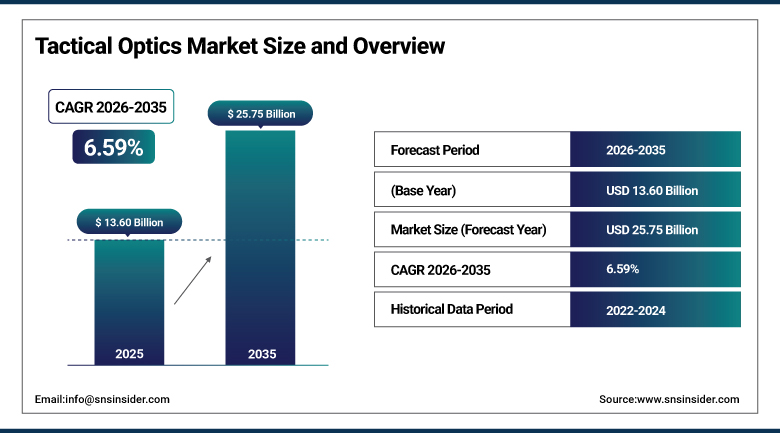
The Tactical Optics Market was valued at USD 13.60 Billion in 2025 and is expected to reach USD 25.75 Billion by 2035, growing at a CAGR of 6.59% from 2026 to 2035.
The Tactical Optics Market is experiencing steady growth, owing to rising defense budgets driving military modernization programs and increasing demand for advanced targeting and surveillance systems. Battlefield digitization programs, miniaturized sensor breakthroughs, and heightened geopolitical flashpoints are collectively lifting demand for precision-guided fire-control and 24/7 situational-awareness solutions. Growing adoption of night vision technology and thermal imaging optics, combined with improved border security systems, continues expanding the category’s applications beyond traditional military use. Besides this, falling thermal-core prices derived from automotive-scale production, rising soldier system upgrade budgets across NATO allies, and growing tactical shooting sports enthusiasm among civilian consumers are contributing to this trend.
In May 2026, the U.S. Army awarded Elbit Systems of America a firm-fixed-price contract to develop and test the Binocular Night Observation Device, positioning the company to compete for a subsequent production phase valued at up to USD 450.6 Million as part of a broader USD 1.3 Billion multi-vendor award announced in February 2026.
To Get more information Tactical Optics Market - Request Free Sample Report
Tactical Optics Market Trends
- Growing night vision scope adoption is advancing at a 9.84% CAGR, driven by rising demand for 24/7 operational capability across military and law enforcement applications.
- Rising battlefield digitization programs, including digital optronic core upgrades replacing analog video systems, are reshaping combat vehicle and soldier system requirements.
- Expanding soldier system modernization budgets across the United States, India, and NATO allies continue reinforcing long-term tactical optics spending.
- Increasing miniaturization and falling thermal-core prices, driven by automotive-scale production economies, are lowering entry barriers for mid-tier optics suppliers.
- Growing civilian tactical shooting sports participation is sustaining demand for mil-spec optics with premium accuracy among recreational and competitive shooters.
U.S. Tactical Optics Market Outlook
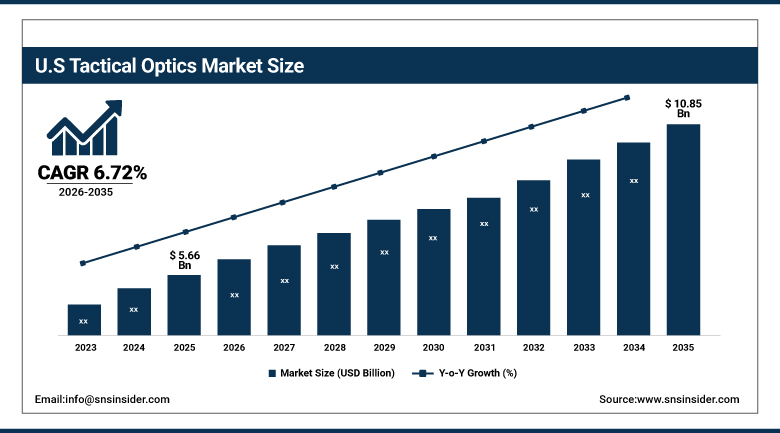
The U.S. Tactical Optics Market was valued at USD 5.66 Billion in 2025 and is projected to reach USD 10.85 Billion by 2035, growing at a CAGR of 6.72% during 2026-2035.
The U.S. Tactical Optics Market is growing steadily, due to sustained soldier system upgrade budgets and modernization programs across the Army, Navy, and Marine Corps prioritizing enhanced situational awareness and target acquisition capabilities. Growing defense procurement for advanced electro-optic and infrared technologies continues reinforcing the country’s position as a leading tactical optics market. Border surveillance requirements are driving demand for lightweight, long-range sighting systems capable of identifying threats across challenging terrain. Innovations such as helmet-mounted binocular night vision systems with stereoscopic vision are driving customer choice options for infantry and close-combat units. Robust distribution networks through direct defense contracts and specialized law enforcement suppliers are increasing product availability. Furthermore, increasing investments by prime contractors and shifting military priorities toward soldier lethality programs are opening up new growth avenues.
In May 2026, the U.S. Army awarded Elbit Systems of America a USD 212 Million delivery order for Enhanced Night Vision Goggle-Binocular production, consolidating production to a single supplier after previous procurements split output between multiple vendors, with deliveries running through 2028.
Tactical Optics Market Segment Analysis
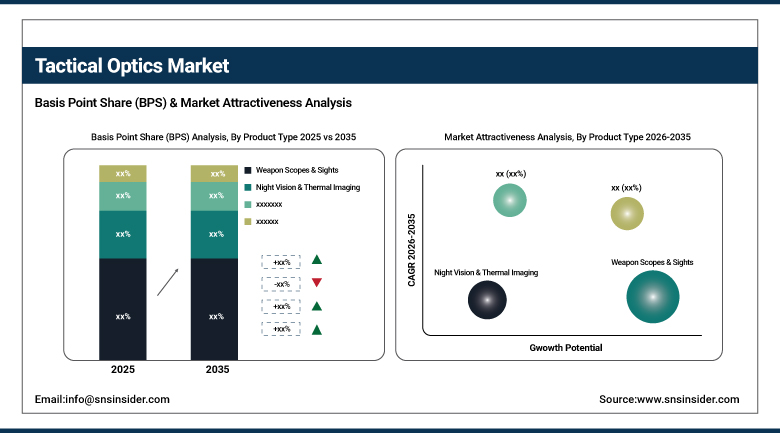
- By Product Type, weapon scopes & sights segment dominated the tactical optics market in 2025 with around 45% share; night vision & thermal imaging segment is the fastest-growing segment.
- By Application, ISR segment dominated the market in 2025 with around 35% share; border security & surveillance segment is the fastest-growing segment.
- By Platform, airborne segment dominated the market in 2025 with around 28% share; naval segment is the fastest-growing segment.
- By End-User, military segment dominated the market in 2025; law enforcement & civilian segment is the fastest-growing segment.
By Product Type, Weapon Scopes & Sights Dominates the Tactical Optics Market While Night Vision & Thermal Imaging Register the Fastest Growth
Weapon Scopes & Sights dominates the Tactical Optics Market owing to their fundamental role across nearly every military and law enforcement small-arms application, from individual soldier rifles to crew-served weapon systems. These devices benefit from established production infrastructure and decades of optical engineering expertise among leading Tier 1 defense contractors. The broad applicability and established manufacturing base for weapon scopes and sights across dismounted soldier and vehicle-mounted applications are reinforcing this segment’s continued market leadership.
Night Vision & Thermal Imaging is experiencing rapid growth, advancing at a 9.84% CAGR, driven by rising demand for 24/7 operational capability that eliminates reliance on daylight or active illumination for target acquisition and situational awareness. Falling thermal-core prices, derived from automotive-scale production economies, continue lowering entry barriers and expanding addressable applications for mid-tier suppliers. Growing soldier system programs replacing legacy monocular devices with advanced binocular stereoscopic systems are opening up substantial opportunities for commercial utilization in this segment.
By Application, ISR Dominates the Tactical Optics Market While Border Security & Surveillance Emerges as the Fastest-Growing Application
ISR dominates the Tactical Optics Market as intelligence, surveillance, and reconnaissance operations require real-time data and situational awareness capabilities that are fundamental to modern combat operations. Military forces rely on ISR-optimized tactical optics for long-range target identification, threat assessment, and battlefield awareness across airborne, ground, and naval platforms. The critical operational necessity and broad deployment across virtually every military branch are reinforcing this segment’s continued market leadership.
Border Security & Surveillance is growing rapidly on account of increasing government investment in lightweight, long-range sighting systems designed to identify threats across challenging and remote terrain. Rising geopolitical tensions and immigration enforcement priorities are compelling border security agencies to expand tactical optics procurement for surveillance towers, mobile units, and personnel equipment. Advances in long-range detection technology suited for extended perimeter monitoring are opening up substantial opportunities for commercial utilization in this segment.
By Platform, Airborne Dominates the Tactical Optics Market While Naval Registers the Fastest Growth
Airborne commands the largest share of the Tactical Optics Market with a revenue contribution of 28% in 2025 owing to the increased usage of drones and unmanned aerial vehicles that necessitate advanced electro-optic and infrared payload systems for reconnaissance and target identification. This segment benefits from the rapid proliferation of manned and unmanned aircraft among military forces that require integrated optical sensing solutions. Increased proliferation and procurement demands for airborne optical payloads ensure its dominant market position.
Naval segment is witnessing huge growth as the naval forces invest heavily on the development of advanced electro-optic and infrared capabilities in surface vessels and submarine periscope systems for extended maritime domain awareness. Increased investment in naval modernization projects by the leading maritime countries are encouraging the defense contractors to develop more ruggedized and maritime environment certified tactical optics solutions. The growing demand for integrated surveillance and targeting solutions for extended maritime missions creates ample business opportunity in this segment.
Regional Analysis
|
Region |
Country |
Share (2025) |
|
North America |
United States |
84.30% |
|
Europe |
Germany |
21.80% |
|
Asia Pacific |
China |
32.60% |
|
Middle East & Africa |
UAE |
17.40% |
|
Latin America |
Brazil |
23.50% |
North America Tactical Optics Market Insights
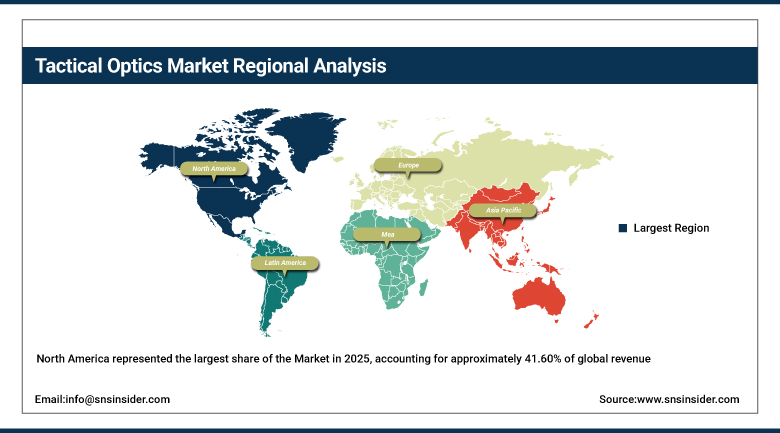
North America represented the largest share of the global Tactical Optics Market in 2025, accounting for approximately 41.60% of global revenue, supported by sustained defense budget allocations, extensive soldier system modernization programs, and the presence of leading Tier 1 defense contractors headquartered across the region. Rising border surveillance requirements and law enforcement modernization continue reinforcing demand across both military and civilian security applications. Growing tactical shooting sports participation is further supporting civilian market segment growth. Well-established defense procurement infrastructure across the United States and Canada is also improving product accessibility and sustaining regional market development.
The United States accounted for approximately 84.30% of the North American market in 2025, reflecting its position as the world’s largest defense spender and home to leading tactical optics manufacturers. Canada is contributing to regional growth through steady defense procurement and law enforcement modernization initiatives.
Get Customized Report as per Your Business Requirement - Enquiry Now
Europe Tactical Optics Market Insights
The Tactical Optics Market had a considerable stake in Europe in 2025 due to the efforts by NATO partners to develop their capabilities amid increasing tensions on their eastern flanks along with consistent investments in military modernization. Increasing demand for AR-enabled surveillance systems and digital optronics in Germany, France, and the UK is fueling innovations in products. Increasing government focus on developing the defense industrial base along with soldier modernization is further strengthening Europe's position in this market.
Germany accounted for 21.80% of the regional market in 2025 owing to its well-developed defense industrial base along with Infanterist der Zukunft soldier modernization program. The contributions from France and the UK have also been considerable due to programs like combat vehicle modernization that use digital optronics at their core.
Asia Pacific Tactical Optics Market Insights
Asia Pacific is expected to register the fastest CAGR in the Tactical Optics Market during 2026–2035, driven by defense modernization programs across China, India, and other regional powers responding to evolving geopolitical dynamics. China is forecasted to grow at approximately 7.99% CAGR, backed by sustained defense modernization investment and expanding domestic optics manufacturing capability. Rising product innovation and growing government investment in soldier system upgrades are further supporting market expansion. Rising demand for advanced targeting and surveillance systems is also reinforcing Asia Pacific’s above-average growth trajectory compared with more mature markets.
China accounted for approximately 32.60% of the Asia Pacific market in 2025, supported by its expanding defense modernization program and growing domestic optics manufacturing base. Japan and India are also contributing meaningfully to regional growth, with India’s soldier system upgrade programs, including variable-power optics initiatives, driving sustained procurement.
Middle East & Africa and Latin America Tactical Optics Market Insights
The Middle East and Africa segment is witnessing strong growth due to increased modernization of the defense industry in the Gulf states, along with growing spending on border security and surveillance systems. The Latin American segment too is witnessing growth due to increasing modernization of the military sector and growing spending by law enforcement agencies on optics equipment.
The UAE is leading the Middle East and Africa market with a regional share of 17.40% in 2025, owing to increased spending on defense modernization and border security systems. Brazil holds 23.50% of the Latin American market in 2025, owing to increased modernization of the military sector, while Mexico is also contributing to regional growth.
Market Dynamics
Growth Drivers: Defense Modernization and Night Vision Technology Adoption Driving Market Growth
The main factors influencing the growth of the Tactical Optics Market include rising defense budgets driving military modernization programs and increasing demand for advanced targeting and surveillance systems. As battlefield digitization programs and heightened geopolitical flashpoints collectively lift demand for precision fire-control and situational-awareness solutions, defense contractors are recognizing sustained growth opportunities, contributing to expansion in the global market for this category.
Growing adoption of night vision technology and thermal imaging optics continues to expand the category’s applications across military, law enforcement, and border security use cases. Increasing innovation in miniaturized sensor technology is influencing new product development trends across the overall tactical optics market.
Restraints: High Development Costs and Export Control Regulations Limiting Market Expansion
Although there is positive demand, there are some constraints that come from high research and development costs that need to be put in place for development of advanced electro-optic and infrared sensor technology that make it difficult for small manufacturers to enter the market. Export regulations related to the sensitive military optics technology are still shaping export possibilities, and manufacturers have to make substantial investments for compliance.
The long process of military procurement, as well as certification process, can also greatly prolong the process of generating revenue from new products. High costs involved in developing advanced sensors, testing, and certification are adding to the high production costs making products uncompetitive for small manufacturers. At the same time, competition among the already established Tier 1 defense contractors and emerging Tier 2 and Tier 3 manufacturers is making pricing more competitive.
Opportunities: Miniaturization Innovation and Civilian Market Expansion Creating New Growth Avenues
Opportunities lie in the areas of miniaturized sensors, market expansion, and modernization of new markets' defenses. The development of cost-efficient thermal imaging devices using automotive production economy could be utilized to serve the increasing needs of mid-level military and police clients. There are business opportunities in the increased participation in tactical shooting sports that drive the need for mil-spec optics with high levels of precision. Border security and surveillance are other application occasions which would increase visibility and help in winning more than the traditional military clients.
Product differentiation and positioning in the next generation can be achieved through innovations in digital optronic integration and network-enabled multi-function systems to win the modernization of defense customers. Contract and partnership consolidations with major defense contractors present another opportunity to gain production contracts. Entry into the emerging markets where there are increased budget allocations for defense modernization is a way of capitalizing on the long-term growth.
Recent Developments:
- 2026: The U.S. Army awarded USD 1.3 Billion in contracts to Elbit Systems of America and two other companies to develop, produce, and test Binocular Night Observation Device systems.
- 2025: L3Harris Technologies received a USD 263 Million order under the Enhanced Night Vision Goggle-Binocular full-rate production contract.
Tactical Optics Market key players are:
- Elbit Systems Ltd.
- RTX Corporation (Raytheon)
- Leonardo DRS, Inc.
- BAE Systems plc
- Kongsberg Gruppen ASA
- Saab AB
- L3Harris Technologies, Inc.
- Thales Group
- Teledyne FLIR LLC
- Trijicon, Inc.
- Leupold & Stevens, Inc.
- Vortex Optics
- Aimpoint AB
- EOTECH, Inc.
- Steiner Optics (Beretta Holding)
- Safran Vectronix AG
- Meopta - optika, s.r.o.
- Chess Dynamics Ltd.
- Hensoldt AG
- ATN Corp.
Tactical Optics Market Report Scope :
| Report Attributes | Details |
|---|---|
| Market Size in 2025 | USD 13.60 Billion |
| Market Size by 2035 | USD 25.75 Billion |
| CAGR | CAGR of 6.59% From 2026 to 2035 |
| Base Year | 2025 |
| Forecast Period | 2026-2035 |
| Historical Data | 2022-2024 |
| Report Scope & Coverage | Market Size, Segments Analysis, Competitive Landscape, Regional Analysis, DROC & SWOT Analysis, Forecast Outlook |
| Key Segments | • By Product Type (Weapon Scopes & Sights, Night Vision & Thermal Imaging, and Others) • By Application (ISR, Border Security & Surveillance, and Others) • By Platform (Airborne, Naval, Ground, and Others) • By End-User (Military, and Law Enforcement & Civilian) |
| Regional Analysis/Coverage | North America (US, Canada), Europe (Germany, UK, France, Italy, Spain, Russia, Poland, Rest of Europe), Asia Pacific (China, India, Japan, South Korea, Australia, ASEAN Countries, Rest of Asia Pacific), Middle East & Africa (UAE, Saudi Arabia, Qatar, South Africa, Rest of Middle East & Africa), Latin America (Brazil, Argentina, Mexico, Colombia, Rest of Latin America). |
| Company Profiles | Elbit Systems Ltd.; RTX Corporation (Raytheon); Leonardo DRS, Inc.; BAE Systems plc; Kongsberg Gruppen ASA; Saab AB; L3Harris Technologies, Inc.; Thales Group; Teledyne FLIR LLC; Trijicon, Inc.; Leupold & Stevens, Inc.; Vortex Optics; Aimpoint AB; EOTECH, Inc.; Steiner Optics (Beretta Holding); Safran Vectronix AG; Meopta - optika, s.r.o.; Chess Dynamics Ltd.; Hensoldt AG; ATN Corp. |
Frequently Asked Questions
Key players include Elbit Systems Ltd., RTX Corporation, Leonardo DRS, Inc., BAE Systems plc, and Kongsberg Gruppen ASA, among others.
Key opportunities include miniaturized thermal sensor innovation, civilian and law enforcement market expansion, border security and surveillance applications, digital optronic integration, and emerging market defense modernization.
The market is driven by rising defense budgets driving military modernization programs and increasing demand for advanced targeting and surveillance systems.
The Weapon Scopes & Sights segment dominated the Tactical Optics Market in 2025, accounting for 45.00% of revenue share.
The North America region dominated the Tactical Optics Market in 2025, accounting for approximately 41.60% of global market share, driven by sustained defense budget allocations and extensive soldier system modernization programs.
