
Targeting Pods Market Report Scope & Overview:
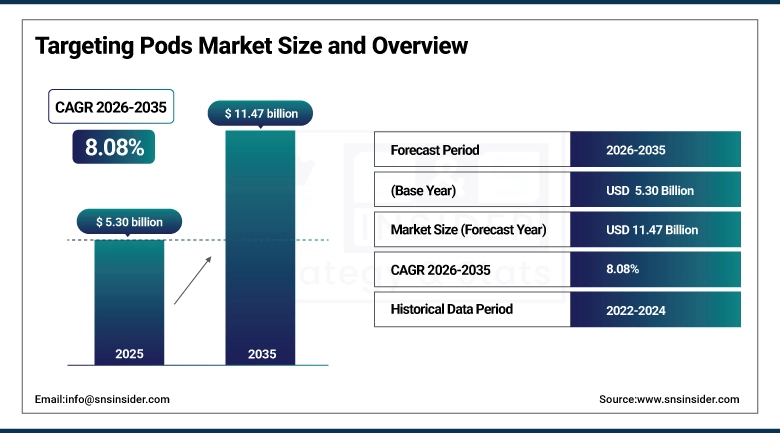
The Targeting Pods Market size is valued at USD 5.30 Billion in 2025 and is projected to reach USD 11.47 Billion by 2035, growing at a CAGR of 8.08% during the forecast period 2026–2035.
Insights on the Targeting Pods Market provides an extensive review of the trends and advances in technology, alongside developments in the area of enhanced capabilities associated with precise target identification and ISR missions within defense systems globally. There is strong momentum for growth within the market due to the rise in procurement of advanced aircrafts and UAVs, increased utilization of AI-driven multi-sensor targeting pods, quick advancement and integration of technologies including EO/IR, FLIR, laser designation, and SAR-based pods, and demand for strike capabilities in military operations. Along with constant innovations within lightweight, modular, and high-performance targeting pod structures will further fuel market expansion between 2026 and 2035.
Targeting pod systems are deployed across thousands of combat aircraft, UAVs, and rotary-wing platforms worldwide by 2025, with adoption expanding rapidly through next-generation ISR and precision engagement platforms by 2035.
To Get more information on Targeting Pods Market - Request Free Sample Report
Targeting Pods Market Trends:
-
Increasing demand for precision-guided strike missions is boosting deployment of advanced EO/IR, FLIR, and laser designation targeting pods across military aviation fleets.
-
Rapid modernization of legacy fighter aircraft and rotary-wing fleets is accelerating adoption of next-generation targeting pods with enhanced imaging and tracking.
-
Growing shift toward network-centric warfare is enabling seamless data exchange between targeting pods, avionics, and command systems.
-
Increasing integration of SAR and all-weather imaging technologies is improving target detection and strike accuracy in harsh environments.
-
Rising defense modernization investments are fueling demand for lightweight, modular, and high-performance targeting pod systems.
-
Expanding deployment on UAV platforms is driving adoption of compact, AI-enabled, and multi-mission targeting solutions.
-
Advancements in sensor fusion, edge computing, and onboard analytics are transforming targeting pods into intelligent ISR systems.
U.S. Targeting Pods Market Insights:
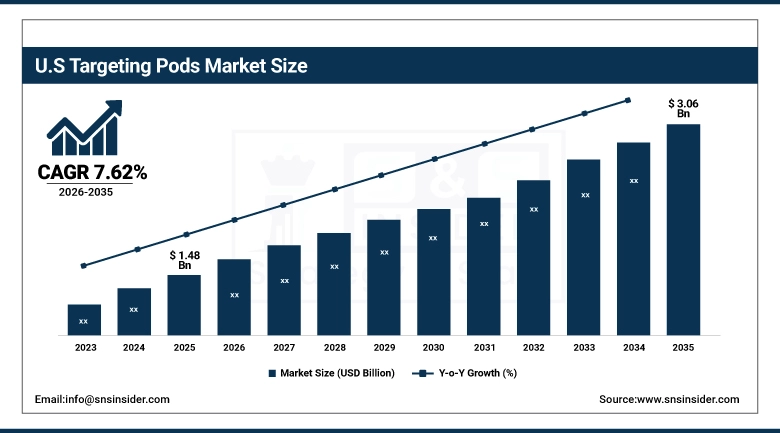
The Targeting Pods Market is projected to grow from USD 1.48 Billion in 2025 to USD 3.06 Billion by 2035, at a CAGR of 7.62%. The positive factors influencing the growth of the market are an increase in the number of procurement of advanced combat aircraft, UAVs, and attack helicopters, increased use of guided weapon systems using EO/IR, FLIR, laser designators, and SAR integrated targeting pods, and the incorporation of artificial intelligence for autonomous target recognition and battle field analytics. Network centric warfare, fleet upgrades, and the development of lightweight modular targeting pods have also contributed significantly to the efficiency of military operations.
Targeting Pods Market Growth Drivers:
-
Rising demand for precision-guided strike missions and modernization of combat aircraft fleets is driving strong demand for advanced targeting pod integration to enhance target acquisition accuracy, situational awareness, and mission effectiveness.
Fast-paced technological developments in AI-assisted target recognition, sensor fusion, and high-resolution imaging systems have been fueling the uptake of advanced targeting pods that feature EO/IR, FLIR, laser designation, and SAR sensors, allowing for real-time observation and precision targeting in intricate combat scenarios. The rising capital expenditures on military modernization initiatives, network-centric warfare operations, and unmanned aerial vehicles (UAVs) for combat and intelligence missions have been bolstering the requirement for advanced targeting pod systems.
More than 60% of advanced fighter aircraft and armed UAV platforms globally are integrated with advanced targeting and sensor pod systems as of 2025.
Targeting Pods Market Restraints:
-
High procurement, integration complexity, and maintenance costs associated with advanced targeting pod systems are restraining rapid large-scale deployment across cost-sensitive defense programs and emerging military markets globally.
The Targeting Pod Market is affected by the dependency on older designs of aircraft avionics architecture and traditional targeting systems, which continue to be entrenched in the current fighter jets, helicopters, and surveillance aircraft. High costs involved in developing, certifying, and integrating modern EO/IR, FLIR, laser designator, SAR pod, and AI-based target recognition technology, sensor fusion, and networked communication are hindering the adoption of these pods, especially among cash-strapped defense organizations.
Targeting Pods Market Opportunities:
-
Rapid expansion of next-generation combat aircraft programs and increasing adoption of unmanned precision-strike platforms are creating significant opportunities for advanced targeting pod technologies globally.
The Targeting Pods Market is seeing an increase in demand due to the evolving combat scenario toward multi-domain operations, which involve the use of targeting pods for synchronized surveillance, targeting, laser designation, and precise strikes in multi-domain air, ground, and maritime defensive systems. Investments in advanced sixth-generation fighter jets, unmanned combat aerial vehicles, and mission systems using artificial intelligence have made it possible to achieve enhanced accuracy, integration, and flexibility. Military forces are now favoring modular, compact, and multi-sensor systems, enabling ease of customization and integration with avionics systems and smart munitions.
Over 55% of next-generation combat aircraft and armed UAV procurement programs globally are expected to prioritize AI-integrated and network-enabled targeting pod systems by 2035.
Targeting Pods Market Segmentation Analysis:
-
By Type, FLIR & Laser Designator Pods held the largest market share of 34.55% in 2025, while Laser Spot Tracker / Laser Marker Pods are expected to grow at the fastest CAGR of 9.33% during 2026–2035.
-
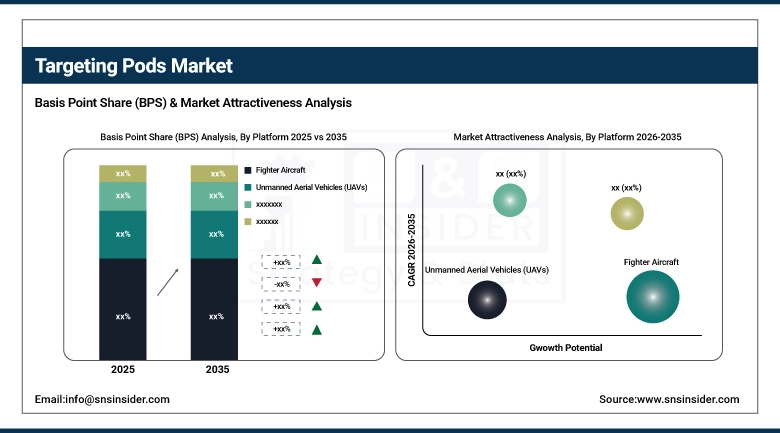
By Platform, Fighter Aircraft held the largest market share of 47.45% in 2025, while Unmanned Aerial Vehicles (UAVs)are expected to grow at the fastest CAGR of 9.20% during 2026–2035.
-
By Technology, Imaging Infrared (IIR) held the largest market share of 31.85% in 2025, while Synthetic Aperture Radar (SAR)-Integrated Pods are expected to grow at the fastest CAGR of 9.54% during 2026–2035.
-
By End User, Defense Forces held the largest market share of 71.54% in 2025, while Homeland Security / Border Security Agencies are expected to grow at the fastest CAGR of 8.24% during 2026–2035.
-
By Application, Surveillance & Reconnaissance held the largest market share of 28.87% in 2025, while Search & Rescue / ISR Missions are expected to grow at the fastest CAGR of 8.54% during 2026–2035.
By Platform, Fighter Aircraft Dominates While Unmanned Aerial Vehicles (UAVs) Grows Rapidly:
Fighter Aircraft segment dominated the market due to its wide usage in combat missions, precision strike missions, and ISR applications amongst various defense forces worldwide. The ability of this category to work seamlessly with next-generation targeting pods for laser marking, surveillance, and target tracking makes it the frontrunner in the targeting pods platforms domain.
Unmanned Aerial Vehicles (UAVs) is the fastest-growing segment, which is attributed to the increasing usage of armed UAVs and ISR platforms for carrying out precision strikes and surveillance missions. This category's growing application in next-generation UAV platforms for using targeting pod technology is propelling its growth.
By Type, FLIR & Laser Designator Pods Dominates While Laser Spot Tracker / Laser Marker Pods Grows Rapidly:
FLIR & Laser Designator Pods segment dominated in terms of revenue, owing to its wide-scale use in precise-strike, reconnaissance, and target acquisition missions, delivering excellent imaging, laser designator, and tracking capabilities in varying combat situations. The widespread adoption of this segment in various fighter jets, attack helicopters, and UAVs, along with ongoing developments in EO/IR and thermal imagery systems, will ensure its continued supremacy in the worldwide targeting pods industry.
Laser Spot Tracker / Laser Marker Pods is the fastest-growing segment, driven by rising demand for enhanced target marking, laser-guided weapon support, and coordinated battlefield engagement capabilities across modern warfare platforms.
By Technology, Imaging Infrared (IIR) Dominates While Synthetic Aperture Radar (SAR)-Integrated Pods Grows Rapidly:
Imaging Infrared (IIR) segment dominated the market as this segment offered excellent target detection, night vision, and thermal imaging features for both surveillance and combat purposes. The high level of integration of this segment in existing targeting pod systems, coupled with the need to improve visibility in challenging weather conditions, contributed to the dominance of this segment in the targeting pods market.
Synthetic Aperture Radar (SAR)-Integrated Pods is the fastest-growing segment due to the rising need for all-weather imaging and long-range surveillance and precision targeting. Increased deployment for ISR activities, terrain mapping, and target detection through clouds and heavy weather was further propelling the growth of this segment.
By End-User, Defense Forces Dominates While Homeland Security / Border Security Agencies Grows Rapidly:
Defense Forces segment dominated the market due to the extensive procurement of high-end targeting pod systems that have been incorporated into the fighter jets, attack helicopters, and UAVs for conducting reconnaissance, intelligence, and targeted attacks. The constant upgrades in the military aviation system along with growing geopolitical threats will continue to hold the largest market share.
Homeland Security / Border Security Agencies is the fastest-growing among all segments due to the growing applications of targeting pods in homeland and border security applications such as border surveillance, coastal security, and anti-terrorism.
By Application, Surveillance & Reconnaissance Dominates While Search & Rescue / ISR Missions Grows Rapidly:
Surveillance & Reconnaissance segment dominated the market attributed to its widespread utilization of targeting pods for collecting information, battle field surveillance, and situational awareness in military defense activities. The high usage rate of EO/IR, FLIR, and imaging sensors in today’s military surveillance applications makes this segment the market leader in targeting pods application.
Search & Rescue / ISR Missions is the fastest-growing segment, owing to the growing demand for advanced targeting pods for identifying targets, locating them, and coordinating missions in rescue and ISR missions.
Targeting Pods Market Regional Analysis:
North America UAV Payload & Subsystems Market Insights:
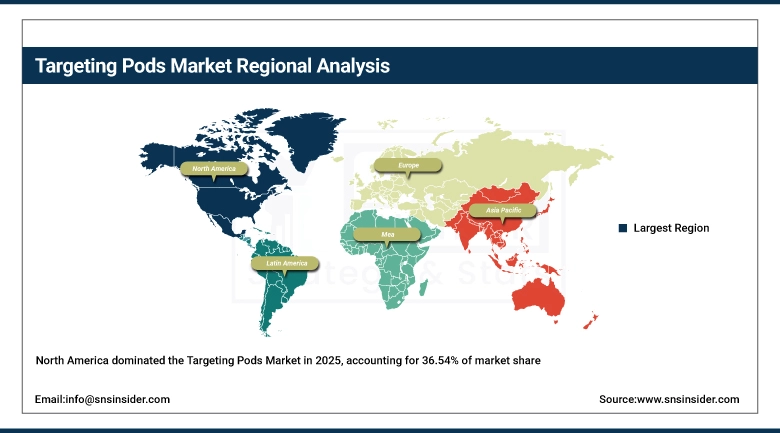
The North America Targeting Pods Market is dominated, holding a 36.54% share in 2025 owing to the high level of development of the region in terms of military aviation, defense electronics, and combat systems ecosystems. Such regions benefit immensely from the presence of several key defense contractors, producers of combat aircraft, and sophisticated sensor technology suppliers, thereby facilitating the deployment of EO/IR, FLIR, laser designation, and SAR-integrated targeting pods. Continuous investments in the development of next-generation fighter aircraft, AI-based combat systems, and network-centric warfare systems will further cement market dominance in this region. The wide-scale use of targeting pods in missions such as precision-guided strikes, ISR missions, border surveillance, and multi-domain combat will sustain strong demand.
Get Customized Report as per Your Business Requirement - Enquiry Now
United States Targeting Pods Market Insights:
The US Targeting Pods Market occupies a dominant position within the regional market owing to its advanced combat aircraft upgrade programs, robust defense R&D ecosystem, and early adoption of next-generation precision targeting technology. Continuous investments have been made by the US in the development of AI-based target recognition systems, multi-sensor targeting pods, and advanced battlefield analytics systems for air superiority and precision strike missions.
Asia-Pacific Targeting Pods Market Insights:
The Asia-Pacific Targeting Pods Market is the fastest-growing region, projected to expand at a CAGR of 9.14% during 2026–2035. It is driven by the fast-paced development of military aviation modernization programs, increasing geopolitical tensions, and growing adoption of advanced fighter aircraft and UAV combat systems. Nations including China, India, Japan, and South Korea are making significant investments in developing indigenous defense technology, advanced targeting sensor technology, and AI integrated combat platforms. Growing applications of targeting pods for border security operations, maritime surveillance, and precision strike operations are driving growth in the regional market for advanced targeting technology solutions.
China Targeting Pods Market Insights:
The Targeting Pods Market of China is driven by heavy investments in the military aviation sector, fast-paced development of indigenous fighter aircraft, and robust focus on modernizing its defense capabilities. It is developing advanced EO/IR targeting pods, AI integrated surveillance/strike systems, and high-end radar/imaging systems. Active participation in border security operations and maritime missions is propelling its market growth.
Europe Targeting Pods Market Insights:
The Europe Targeting Pods Market is backed by robust aerospace engineering capabilities, state-of-the-art defense electronics manufacturing, and increased efforts toward precision guided warfare technology. Nations like France, Germany, United Kingdom, and Italy are making significant investments into next-gen fighter aircraft, attack helicopters, and UAVs with advanced EO/IR, FLIR, laser designating, and multi-sensor targeting pod systems. There has been an increase in the need for targeting pods in the NATO's modernization programs and regional defense efforts. Stringent regulations and the growing importance of interoperability of combat systems have increased the demand for cutting-edge targeting pod technologies in the region.
Germany Targeting Pods Market Insights:
The Germany Targeting Pods Market is driven by its highly advanced aerospace engineering expertise, advanced precision manufacturing facilities, and active participation in European defense modernization projects. There have been significant efforts made by the country towards advanced combat aircraft enhancements that are equipped with advanced imaging systems, laser-based target detection technology, and advanced mission avionics. Investments in AI-based combat system and sensor technologies for future military aviation platforms have been steadily growing.
Latin America Targeting Pods Market Insights:
The Latin America Targeting Pods Market is registering gradual growth owing to increased defense modernization, border surveillance needs, and rising deployment of aerial surveillance systems. The countries including Brazil, Mexico, and Argentina are ramping up the usage of fighter jets, helicopters, and ISR systems that are installed with targeting pods to increase efficiency during the surveillance and security operations. Moderate investments in the improvement of military aviation systems and collaborations with global defense technology firms are gradually boosting the market growth in the region.
Middle East & Africa Targeting Pods Market Insights:
The Middle East & Africa Targeting Pods Market is registering emerging growth owing to increasing defense budgets, rising border surveillance needs, and growing adoption of aerial precision strike and intelligence systems. The countries including UAE, Saudi Arabia, Israel, and South Africa are implementing advanced fighter jets, UAVs, and surveillance aircraft that are equipped with EO/IR, laser designator, and advanced targeting pods for the purpose of security and combat operations. Increased emphasis on developing indigenous defense programs and collaboration with foreign defense technology companies is boosting the adoption of advanced targeting pods.
Targeting Pods Market Competitive Landscape:
Lockheed Martin Corporation is an industry pioneer in state-of-the-art targeting pod technology, specializing in electro-optical and infrared targeting, laser designation, and networked ISR technology. The corporation has a vital contribution to the provision of its field-tested Sniper Advanced Targeting Pod and future Sniper Networked Targeting Pod systems that are utilized in various fighter jets and air forces around the world. The strategic advantage of the corporation is due to its extensive aerospace engineering knowledge, well-established military contacts, and consistent development of artificial intelligence for targeting and sensor fusion.
-
In January 2026, Lockheed Martin advanced its targeting systems portfolio by successfully completing the first multi-aircraft flight demonstration of its Sniper Networked Targeting Pod (NTP) on F-16 aircraft, enabling real-time targeting data exchange and strengthening its position in network-centric precision targeting systems.
RTX Corporation is a top-notch aerospace and defense company that is involved in many different projects involving research and development in the field of advanced aerial targeting, guidance systems for weapons, and ISR technology through subsidiaries like Collins Aerospace and Raytheon. This company provides critical avionics equipment, sensors, and mission-critical targeting technology for tactical aviation, missiles, and defense systems. The firm is very competitive owing to its involvement in many defense programs, state-of-the-art R&D capacity, and high integration with avionics, surveillance, and precision engagement systems.
-
In January 2026, RTX reported continued investment in expanding advanced defense and aerospace capabilities, including avionics, mission systems, and next-generation sensing technologies, strengthening its broader position in airborne targeting and precision engagement markets.
Northrop Grumman Corporation is one of the world’s largest defense contractors with substantial experience in airborne ISR, EO targeting systems, and future-generation sensors for fighter jets and unmanned aerial vehicles. The firm is a key player in the design of advanced surveillance systems, navigation, and mission systems that aid in precision targeting and battlefield intelligence. Its strengths include sensor innovation, the use of AI in mission systems, and high levels of involvement in future-generation military aviation and combat operations.
-
In October 2025, Northrop Grumman continued expanding its advanced airborne sensor and mission systems portfolio through ongoing development of next-generation ISR, electro-optical, and integrated targeting technologies for modern combat aircraft and unmanned defense platforms.
Targeting Pods Market Key Players:
Some of the Targeting Pods Market Companies are:
-
Lockheed Martin Corporation
-
RTX Corporation
-
Northrop Grumman Corporation
-
L3Harris Technologies, Inc.
-
Thales Group
-
Leonardo S.p.A.
-
BAE Systems plc
-
Elbit Systems Ltd.
-
ASELSAN A.S.
-
Israel Aerospace Industries (IAI)
-
Rafael Advanced Defense Systems Ltd.
-
Teledyne FLIR LLC
-
General Dynamics Corporation
-
Saab AB
-
Safran Electronics & Defense
-
Collins Aerospace
-
Hensoldt AG
-
Moog Inc.
-
Ultra Electronics Holdings plc
-
Rheinmetall AG
| Report Attributes | Details |
|---|---|
| Market Size in 2025 | USD 5.30 Billion |
| Market Size by 2035 | USD 11.47 Billion |
| CAGR | CAGR of 8.08% From 2026 to 2035 |
| Base Year | 2025 |
| Forecast Period | 2026-2035 |
| Historical Data | 2022-2024 |
| Report Scope & Coverage | Market Size, Segments Analysis, Competitive Landscape, Regional Analysis, DROC & SWOT Analysis, Forecast Outlook |
| Key Segments | • By Type (FLIR & Laser Designator Pods, Laser Spot Tracker / Laser Marker Pods, Standalone Navigation Pods, Multi-Function / Multi-Sensor Targeting Pod) • By Platform (Fighter Aircraft, Unmanned Aerial Vehicles (UAVs), Attack Helicopters, Bombers / Special Mission Aircraft) • By Technology (Imaging Infrared (IIR), Charge-Coupled Device (CCD) / CMOS, Laser Range Finder & Designators, Synthetic Aperture Radar (SAR)-Integrated Pods) • By End User (Defense Forces, Homeland Security / Border Security Agencies, Special Operations Forces, Others) • By Application (Surveillance & Reconnaissance, Target Acquisition, Precision-Guided Strike, Close Air Support / Combat Missions, Search & Rescue / ISR Missions) |
| Regional Analysis/Coverage | North America (US, Canada), Europe (Germany, UK, France, Italy, Spain, Russia, Poland, Rest of Europe), Asia Pacific (China, India, Japan, South Korea, Australia, ASEAN Countries, Rest of Asia Pacific), Middle East & Africa (UAE, Saudi Arabia, Qatar, South Africa, Rest of Middle East & Africa), Latin America (Brazil, Argentina, Mexico, Colombia, Rest of Latin America). |
| Company Profiles | Lockheed Martin Corporation, RTX Corporation, Northrop Grumman Corporation, L3Harris Technologies, Inc., Thales Group, Leonardo S.p.A., BAE Systems plc, Elbit Systems Ltd., ASELSAN A.S., Israel Aerospace Industries (IAI), Rafael Advanced Defense Systems Ltd., Teledyne FLIR LLC, General Dynamics Corporation, Saab AB, Safran Electronics & Defense, Collins Aerospace, Hensoldt AG, Moog Inc., Ultra Electronics Holdings plc, Rheinmetall AG. |
Frequently Asked Questions
North America dominated with a 36.54% share in 2025, while Asia-Pacific is the fastest-growing region, expected to expand at a CAGR of 9.14% during 2026–2035.
FLIR & Laser Designator Pods dominated with a 34.55% share in 2025, Laser Spot Tracker / Laser Marker Pods are projected to grow at the fastest CAGR of 9.33% during 2026–2035.
Growth is driven by increasing demand for precision-guided strike missions, rising modernization of combat aircraft and UAV fleets, and growing integration of AI-enabled targeting, EO/IR, FLIR, and laser designation technologies.
The market is valued at USD 5.30 Billion in 2025 and is projected to reach USD 11.47 Billion by 2035.
The Targeting Pods Markets projected to grow at a CAGR of 8.08% during 2026–2035.
