
UAV Flight Training And Simulation Market Report Scope & Overview:
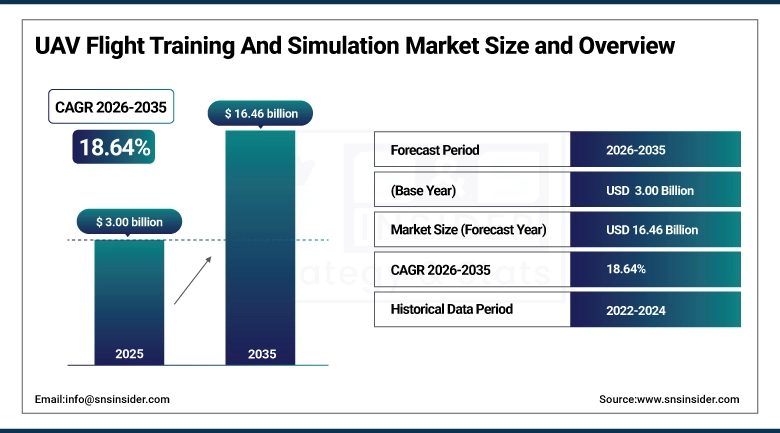
The UAV Flight Training And Simulation Market size is valued at USD 3.00 Billion in 2025 and is projected to reach USD 16.46 Billion by 2035, growing at a CAGR of 18.64% during the forecast period 2026–2035.
Market Insights for the UAV Flight Training and Simulation Market give an overall analysis regarding trends, technological development in simulations, and the growing use of UAVs. The growing number of defense UAVs, commercial UAV pilots' certification requirements, the adoption of artificial intelligence and virtual reality/augmented reality simulations, and the desire to cut down on costs related to live-flight training are some of the main reasons why this market is experiencing steady growth between 2026 and 2035.
The use of UAV flight training and simulation systems is expected to support the training and certification of Billions of UAV operators globally across military, logistics, agriculture, surveillance, and industrial inspection applications in 2025.
Market Size and Forecast:
-
Market Size in 2025: USD 3.00 Billion
-
Market Size by 2035: USD 16.46 Billion
-
CAGR: 18.64% from 2026 to 2035
-
Base Year: 2025
-
Forecast Period: 2026–2035
-
Historical Data: 2022–2024
To Get more information on UAV Flight Training And Simulation Market - Request Free Sample Report
UAV Flight Training And Simulation Market Trends:
-
Rising adoption of AI-powered simulation platforms is improving pilot training efficiency, adaptive learning, and real-time performance analytics across UAV operations.
-
Increasing demand for military UAV mission rehearsal and pilot training systems is boosting deployment of advanced tactical and ISR simulation environments.
-
Rapid growth of commercial drone operations and BVLOS certification is accelerating adoption of scalable virtual training platforms.
-
Growing shift toward VR/AR-based immersive simulators is enhancing mission realism while reducing live-flight training costs and risks.
-
Increasing use of cloud-based simulation platforms is enabling remote pilot training and multi-location collaboration.
-
Rising investments in defense modernization and unmanned systems programs are fueling demand for high-fidelity UAV simulators.
-
Expanding adoption of digital twin and real-time scenario replication is improving mission planning and operational readiness.
-
Growing integration of haptic feedback and real-time analytics tools is making UAV training more personalized and data-driven.
U.S. UAV Flight Training And Simulation Market Insights:
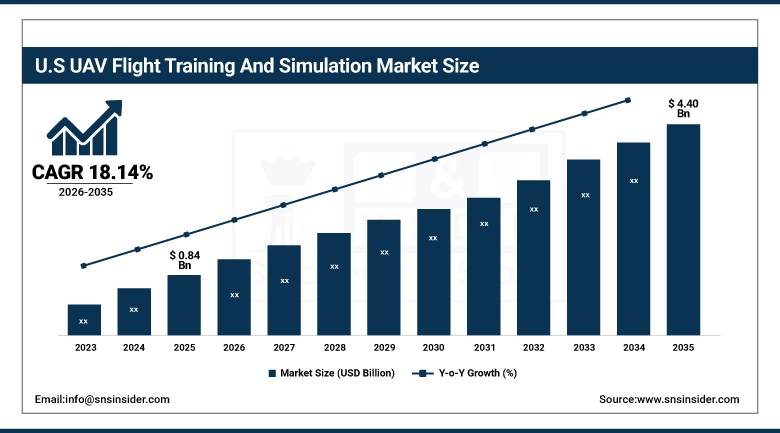
The UAV Flight Training And Simulation Market is projected to grow from USD 0.84 Billion in 2025 to USD 4.40 Billion by 2035, at a CAGR of 18.14%. The favorable growth drivers include the fast growth in the defense and commercial UAV sector, increasing demands for pilot certification training, recurrent training, and growing use of simulations powered by artificial intelligence (AI), virtual reality (VR)/augmented reality (AR), and cloud-based solutions. There is a growing trend towards beyond visual line-of-sight (BVLOS) flights, mission simulation rehearsals, digital twin simulation, and low-cost virtual pilot training systems that enhance the efficiency of the mission and increase pilot readiness from 2026 through 2035.
UAV Flight Training And Simulation Market Growth Drivers:
-
Rising deployment of UAVs across defense, commercial, and government sectors is driving strong demand for advanced flight training and simulation systems to improve pilot readiness, mission accuracy, and operational safety.
The development of cutting-edge adaptive learning software, VR/AR simulation technology, and digital twin solutions is rapidly boosting the adoption of UAV simulators for future training purposes, providing realistic mission simulations and real-time performance evaluations. The modernization of military forces, growth in BVLOS flights, and higher standards of certification for commercial pilots will considerably enhance the demand for simulation solutions.
More than 50% of advanced UAV training programs globally are estimated to incorporate AI-assisted or immersive simulation technologies as of 2025.
UAV Flight Training And Simulation Market Restraints:
-
High implementation costs and technical complexity associated with advanced UAV flight training and simulation systems are restraining rapid large-scale adoption across commercial operators and budget-constrained defense organizations globally.
UAV Flight Training and Simulation Market is influenced by the dependence on the traditional approach to training using live-flight simulation and old simulation infrastructure that is well entrenched within the current training setup of the military and civil aviation sector. The expense involved in adopting simulation technologies powered by AI, virtual reality/augmented reality, cloud training systems, and mission rehearsal is posing an obstacle in the uptake of these systems.
UAV Flight Training And Simulation Market Opportunities:
-
Rapid expansion of autonomous UAV ecosystems and regulated commercial drone operations is creating significant opportunities for advanced UAV flight training and simulation solutions globally.
The UAV Flight Training and Simulation market is enjoying the fast-emerging demand for comprehensive pilot certification, coordinated mission operations across operators, and simulations using different scenarios in the areas of defense, logistics, agriculture, and emergency services. The increasing amount of spending on remote training infrastructure, cloud simulation systems based on subscription, and AI-based personalized training solutions is making it possible to conduct scalable and affordable operator training.
Over 55% of next-generation UAV training programs globally are expected to prioritize AI-integrated, cloud-enabled, and immersive simulation platforms by 2035.
UAV Flight Training And Simulation Market Segmentation Analysis:
-
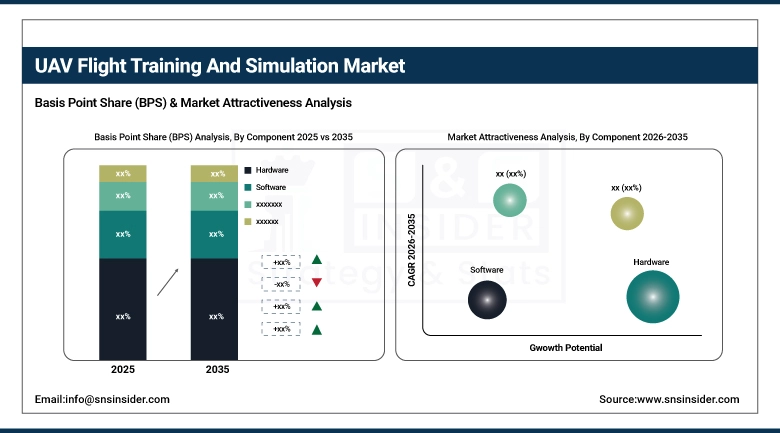
By Component, Hardware held the largest market share of 41.55% in 2025, while Software is expected to grow at the fastest CAGR of 20.03% during 2026–2035.
-
By Simulation Type, Virtual Simulation held the largest market share of 49.45% in 2025, while Live Simulation is expected to grow at the fastest CAGR of 19.92% during 2026–2035.
-
By UAV Type, Fixed-Wing UAV held the largest market share of 46.85% in 2025, while Hybrid UAV is expected to grow at the fastest CAGR of 20.98% during 2026–2035.
-
By Application, Military & Defense Training dominated with 52.21% market share in 2025, while Commercial Operator Training is expected to grow at the fastest CAGR of 20.04% during 2026–2035.
-
By End User, Defense Organizations held the largest share of 48.61% in 2025, while Commercial Drone Service Providers are expected to grow at the fastest CAGR of 20.14% during 2026–2035.
-
By Technology, AI-Based Simulation held the largest market share of 31.40% in 2025, while VR/AR-Based Training is expected to grow at the fastest CAGR of 19.24% during 2026–2035.
By Component, Hardware Dominates While Software Grows Rapidly:
Hardware segment dominated the market owing to its essential contribution in providing a realistic experience to pilots in training through simulators, control consoles, cockpit replica units, motion bases, and haptic feedback devices. The extensive use of hardware in military and academic institutions for training purposes, coupled with consistent investments in building hi-fidelity simulators, makes the hardware category dominant in the worldwide UAV flight training and simulation environment.
Software is the fastest-growing segment, attributed to the growing requirement for AI-driven simulation software, mission planning software, adaptive learning software, and real-time analytics software.
By Simulation Type, Virtual Simulation Dominates While Live Simulation Grows Rapidly:
Virtual Simulation segment has dominated the market due to its ability to provide economical, scalable, and risk-free pilot training by means of simulating missions in an actual flight environment. The extensive application of the Virtual Simulation segment within the military and civilian UAV training programs, coupled with technological advances within VR/AR simulations, supports the dominance of the segment within the market.
Live Simulation is the fastest-growing segment in the market as a result of the growing need for live mission rehearsals and operator training in dynamic combat and commercial environments.
By UAV Type, Fixed-Wing UAV Dominates While Hybrid UAV Grows Rapidly:
Fixed-Wing UAV segment dominated the market share because of the high utilization of this segment in long-range surveillance, reconnaissance, and endurance-based training missions. The high utilization of fixed-wing UAVs in military ISR operations and the requirement for specific endurance-based flight training further support the dominant role played by this segment within the UAV training market.
The Hybrid UAVs have been growing at the highest rate since there is an increase in demand for UAVs that can perform vertical take-off but are also capable of flying over long distances.
By Application, Military & Defense Training Dominates While Commercial Operator Training Grows Rapidly:
Military and Defense Training is the dominant segment in the UAV simulator market, as the increased use of UAV simulators in mission rehearsals and combat simulation and training contributes to its dominance in the global market. The dominance of this segment will be further boosted by the increase in defense modernization initiatives as well as military drone acquisitions.
Commercial Operator Training is the fastest-growing segment, in the global UAV simulator market, owing to the rapid growth of commercial applications for drones and the increased need for pilot training and licensing.
By End User, Defense Organizations Dominates While Commercial Drone Service Providers Grows Rapidly:
The defense organizations segment was highly dominant within the market since military organizations constitute one of the largest consumers of UAV simulation systems due to their application in training pilots. Constant investment in synthetic training systems and UAV deployment programs further cemented its dominant standing.
Commercial Drone Service Providers is the fastest-growing segment, that there is an increasing demand for pilots operating UAVs for commercial purposes. The increase in demand for qualified drone pilots in commercial drone delivery, surveillance, and inspection services fuels the growth of this segment.
By Technology, AI-Based Simulation Dominates While VR/AR-Based Training Grows Rapidly:
AI-Based Simulation segment dominated the market owing to wide deployment in adaptive learning, automatic creation of mission scenarios, performance analysis, and intelligent piloting evaluation in military and commercial UAV training systems. High-level integration of AI-based decision-making support, forecasting tools, and customized training packages ensures that it continues to lead the UAV training simulation technologies market.
VR/AR-Based Training is the fastest-growing segment, owing to increasing demand for immersive environment training aimed at improving pilots' situational awareness and reducing reliance on expensive live flight missions.
UAV Flight Training And Simulation Market Regional Analysis:
North America UAV Payload & Subsystems Market Insights:
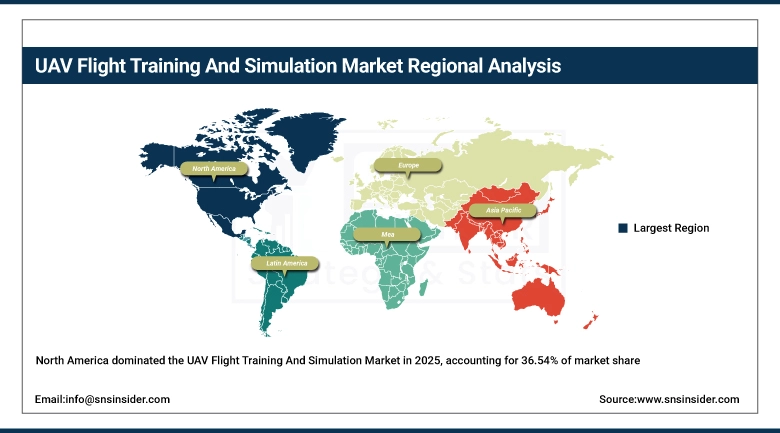
The North America UAV Flight Training And Simulation Market is dominated, holding a 36.54% share in 2025 because of its highly developed ecosystem in defense aviation, sound regulatory framework, and early adoption of simulation-based pilot training solutions. There is ample potential of leveraging the presence of leading simulation solution vendors, defense agencies, and UAV manufacturers that are contributing towards widespread adoption of AI-assisted, VR/AR-supported, and cloud-based pilot training solutions. Ongoing investments towards defense modernization, BVLOS regulatory frameworks, and commercial drone certification programs will only enhance market dominance.
Get Customized Report as per Your Business Requirement - Enquiry Now
United States UAV Flight Training And Simulation Market Insights:
Amongst other regional markets, the United States UAV Flight Training And Simulation Market has been the dominant player because of advanced UAV flight training programs, sound commercial drone industry ecosystem, and adoption of highly sophisticated simulation-based training solutions. The country has seen heavy investment in AI-enabled adaptive learning systems, immersive mission rehearsal platforms, and digital twin-powered training environments. The strong involvement of defense agencies, commercial drone operators, and simulation solution providers is continuously fueling innovations in remote pilot certification and simulation-based training systems.
Asia-Pacific UAV Flight Training And Simulation Market Insights:
The Asia-Pacific UAV Flight Training And Simulation Market is the fastest-growing region, projected to expand at a CAGR of 19.85% during 2026–2035. The UAV flight training and simulation market in the region will be propelled by high growth in drone-related business activities, increased procurement of defense UAVs, and increased attention to pilot certifications and safety of operations. Nations such as China, India, Japan, and South Korea are making heavy investments into developing their own UAV pilot training programs, simulation infrastructures, and AI-driven education tools. Increasing UAV operations for purposes of surveillance, disaster management, agriculture, and logistics are contributing to this trend. Increased investments into smart defense and commercial drones are revolutionizing the region's UAV training industry.
China UAV Flight Training And Simulation Market Insights:
There are several key drivers of the China UAV Flight Training And Simulation Market. They include high investments into domestic UAV manufacturing and drone-based service commercialization, as well as an active process of defense modernization taking place in the nation. China is actively implementing new technological innovations such as advanced virtual pilot training systems, AI-driven simulation infrastructures, and drone pilots' certifications programs.
Europe UAV Flight Training And Simulation Market Insights:
The Europe UAV Flight Training And Simulation Market benefits from robust aerospace training capabilities, advanced defense aviation capabilities, and growing need for unmanned aircraft certification and pilot training. Some of the key countries adopting next-generation UAV simulator technology and VR/AR-based pilot training, immersive mission simulation solutions and AI-powered mission rehearsal solutions include France, Germany, UK, and Italy. There is high uptake of UAV pilot training solutions for industrial applications like inspections, environmental monitoring, and emergency situations. Growing aviation safety norms along with emphasis on remote pilot training will further bolster growth in the use of advanced simulation technologies.
Germany UAV Flight Training And Simulation Market Insights:
Growing use of simulation technology and UAV pilot training programs can be attributed to the presence of advanced aerospace and industrial capabilities in the country. Moreover, it has an active involvement in UAVs and simulation technologies in the European defense industry. The country is focusing on AI-based training solutions, simulation technologies, and cloud-enabled pilot training programs in both defense and commercial spaces.
Latin America UAV Flight Training And Simulation Market Overview:
The Latin America UAV Flight Training And Simulation Market is expected to exhibit steady growth as there is increased use of UAVs in agriculture, mining, environmental monitoring, and public safety purposes. In countries such as Brazil, Mexico, and Argentina, there is growing implementation of UAV pilot training courses and simulation solutions in order to enhance performance levels and ensure compliance in commercial UAV flights. Defense-related upgrades have been taking place in limited quantities, which would aid the growth of tactical UAV flight training and mission simulation products.
Middle East & Africa UAV Flight Training And Simulation Market Insights:
The Middle East & Africa UAV Flight Training And Simulation Market is anticipated to grow due to increased investments in defense budgets, rising need for border surveillance, and greater adoption of UAV-based intelligence gathering and monitoring tools. In nations such as UAE, Saudi Arabia, Israel, and South Africa, sophisticated UAV flight training simulators and other UAV mission simulators are being deployed for use in military pilot training missions, security operations, and mission rehearsals.
UAV Flight Training And Simulation Market Competitive Landscape:
CAE Inc. is among the world's leading firms offering training technologies and simulation systems, including those for UAV flights training, mission rehearsals, and immersive simulation. This company is responsible for providing advanced virtual training technologies, intelligent learning systems and mission environments that are utilized by defense agencies and other drone users around the globe. Its competitive advantage includes its comprehensive expertise in aviation training programs, partnerships within global defense agencies, and consistent innovation in simulation, digital twins, and training in the cloud.
-
In November 2025, CAE Inc. signed a global cooperation agreement with Saab to provide advanced training and simulation platforms for GlobalEye AEW&C aircraft programs, strengthening its position in defense training and mission simulation solutions.
L3Harris Technologies Inc. is one of the largest companies in the world providing defense and aerospace solutions for various mission-critical tasks. This organization is well-known for being one of the major suppliers of unmanned aerial vehicle simulation systems, mission management software, and operator training solutions. Among the strengths of the company is its focus on AI-enabled mission solutions, ISR training solutions, and communication technology systems that help with mission rehearsals. The competitive strength of L3Harris is based on its strong defense solutions portfolio, government relations, and autonomous systems.
-
In September 2025, L3Harris Technologies Inc. partnered with Shield AI to demonstrate an AI-powered unmanned threat detection and tracking system, strengthening its capabilities in AI-driven mission systems and unmanned operational training technologies.
Northrop Grumman Corporation is a renowned aerospace and defense manufacturing firm specializing in cutting-edge unmanned systems, mission simulation technology, and UAV training solutions for the military. Northrop Grumman provides a comprehensive range of solutions such as simulation platforms, autonomous mission systems, and mission management training platforms focused on ISR missions. The reason why Northrop Grumman stands out is due to their numerous defense contracts, research & development capacity, and unmanned system integrations.
-
In December 2025, Northrop Grumman Corporation secured a major contract under the Space Development Agency’s Tranche 3 Tracking Layer program to build advanced tracking satellites, strengthening its position in mission-critical surveillance, autonomous systems, and defense technology programs.
UAV Flight Training And Simulation Market Key Players:
Some of the UAV Flight Training And Simulation Market Companies are:
-
CAE Inc.
-
L3Harris Technologies Inc.
-
Northrop Grumman Corporation
-
Textron Systems Corporation
-
General Atomics Aeronautical Systems Inc.
-
Thales Group
-
Israel Aerospace Industries Ltd.
-
Leonardo S.p.A.
-
Lockheed Martin Corporation
-
BAE Systems plc
-
Elbit Systems Ltd.
-
Kratos Defense & Security Solutions Inc.
-
FlightSafety International Inc.
-
Zen Technologies Limited
-
Presagis USA Inc.
-
Quantum3D Inc.
-
Simlat Ltd.
-
HAVELSAN Inc.
-
Boeing
-
Crew Training International Inc.
| Report Attributes | Details |
|---|---|
| Market Size in 2025 | USD 3.00 Billion |
| Market Size by 2035 | USD 16.46 Billion |
| CAGR | CAGR of 18.64% From 2026 to 2035 |
| Base Year | 2025 |
| Forecast Period | 2026-2035 |
| Historical Data | 2022-2024 |
| Report Scope & Coverage | Market Size, Segments Analysis, Competitive Landscape, Regional Analysis, DROC & SWOT Analysis, Forecast Outlook |
| Key Segments | • By Component (Hardware, Software, Services) • By Simulation Type (Live Simulation, Virtual Simulation, Constructive Simulation) • By UAV Type (Fixed-Wing UAV, Rotary-Wing UAV, Hybrid UAV) • By Application (Military & Defense Training, Commercial Operator Training, Civil & Government Training, Others) • By End User (Defense Organizations, Commercial Drone Service Providers, Training Academies / Institutions, Government & Law Enforcement Agencies, Others) • By Technology (AI-Based Simulation, VR/AR-Based Training, Cloud-Based Simulation, Conventional Simulation Systems, Others) |
| Regional Analysis/Coverage | North America (US, Canada), Europe (Germany, UK, France, Italy, Spain, Russia, Poland, Rest of Europe), Asia Pacific (China, India, Japan, South Korea, Australia, ASEAN Countries, Rest of Asia Pacific), Middle East & Africa (UAE, Saudi Arabia, Qatar, South Africa, Rest of Middle East & Africa), Latin America (Brazil, Argentina, Mexico, Colombia, Rest of Latin America). |
| Company Profiles | CAE Inc., L3Harris Technologies Inc., Northrop Grumman Corporation, Textron Systems Corporation, General Atomics Aeronautical Systems Inc., Thales Group, Israel Aerospace Industries Ltd., Leonardo S.p.A., Lockheed Martin Corporation, BAE Systems plc, Elbit Systems Ltd., Kratos Defense & Security Solutions Inc., FlightSafety International Inc., Zen Technologies Limited, Presagis USA Inc., Quantum3D Inc., Simlat Ltd., HAVELSAN Inc., Boeing, Crew Training International Inc. |
Frequently Asked Questions
North America dominated with a 36.54% share in 2025, while Asia-Pacific is the fastest-growing region, expected to expand at a CAGR of 19.85% during 2026–2035.
Hardware dominated with a 41.55% share in 2025, while Software are projected to grow at the fastest CAGR of 20.03% during 2026–2035.
Growth is driven by rising defense and commercial UAV deployment, increasing demand for pilot certification and mission rehearsal, and growing adoption of AI-powered, VR/AR-based, and cloud-enabled simulation platforms.
The market is valued at USD 3.00 Billion in 2025 and is projected to reach USD 16.46 Billion by 2035.
The UAV Flight Training And Simulation Markets projected to grow at a CAGR of 18.64% during 2026–2035.
