
Unmanned Combat Aerial Vehicle Market Report Scope & Overview:
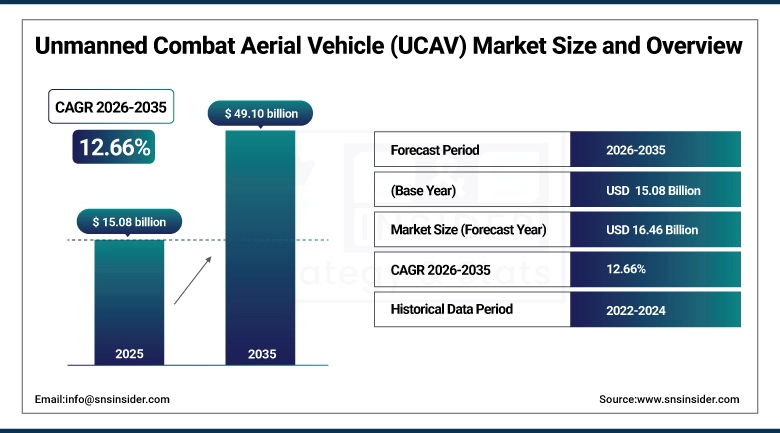
The Unmanned Combat Aerial Vehicle (UCAV) Market size is valued at USD 15.08 Billion in 2025 and is projected to reach USD 49.10 Billion by 2035, growing at a CAGR of 12.66% during the forecast period 2026–2035.
Insights on the UCAV Market provide a comprehensive analysis of trends, technological advancements, and evolving defense modernization programs across global military forces. Increased demand for autonomous combat systems, rapid integration of AI-enabled mission control, rising investments in stealth and swarm UCAV technologies, and growing emphasis on precision strike and intelligence, surveillance & reconnaissance (ISR) capabilities are some of the major factors driving continuous market expansion from 2026 to 2035.
The adoption of UCAV systems across global defense forces is expected to expand significantly, supporting multi-domain operations across air, land, and maritime theatres, with increasing deployment in over 90+ countries engaged in UAV-based defense modernization programs by 2025.
To Get more information on Unmanned Combat Aerial Vehicle (UCAV) Market - Request Free Sample Report
Unmanned Combat Aerial Vehicle Market Trends:
-
Increasing demand for ISR and precision strike capabilities driving advanced multi-sensor UCAV integration.
-
Rapid expansion of swarm UCAV technologies enabling coordinated autonomous aerial combat formations.
-
Growing deployment of stealth UCAV platforms enhancing survivability in contested airspace environments.
-
Increasing focus on HALE and long-endurance UCAV systems for persistent surveillance and deep-strike missions.
-
Rising integration of manned-unmanned teaming (MUM-T) across modern air combat doctrines.
-
Expanding use of electronic warfare and SEAD-capable UCAV platforms for air defense suppression.
-
Increasing defense modernization programs accelerating procurement of next-generation UCAV fleets globally.
U.S. Unmanned Combat Aerial Vehicle Market Insights:
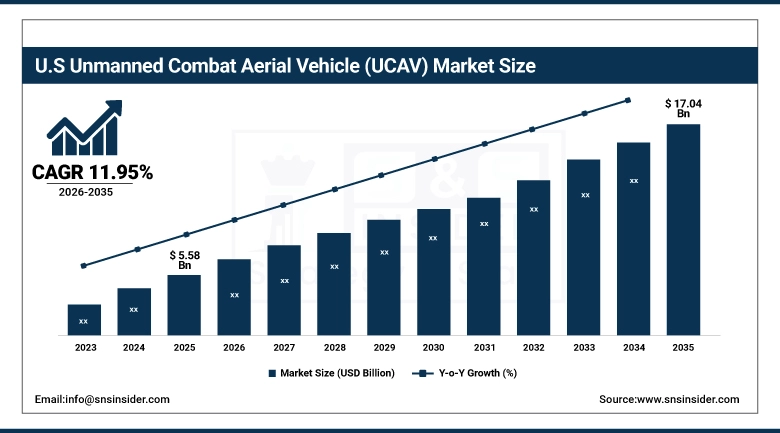
The Unmanned Combat Aerial Vehicle (UCAV) Market is projected to grow from USD 5.58 Billion in 2025 to USD 17.04 Billion by 2035, at a CAGR of 11.95% during the forecast period 2026–2035Positive growth drivers in the sector are the quick development of autonomous combat air vehicles, higher usage of AI-powered UCAVs for ISR and precise attack roles, and the growing use of stealth, swarm, and multi-domain capabilities in contemporary armies. The trend toward longer HALE UCAVs, MUM-T configurations, and network-centric warfare is boosting coordination on the battlegrounds and strategic attacks during missions between 2026 and 2035.
Unmanned Combat Aerial Vehicle Market Growth Drivers:
-
Rising deployment of next-generation unmanned combat aerial vehicles (UCAVs) across modern defense forces is driving strong demand for advanced autonomy, stealth capability, and precision strike systems to enhance mission effectiveness and battlefield superiority.
The fast pace of development for AI-driven autonomous flying control, formation coordination, and real-time battlefield information processing is fostering the emergence of combat systems that can perform in extremely contested battlefields. The rise in the level of modernization of the military air force, drone warfare strategy, and the rising investment in the development of UCAVs with longer endurance and high payload capacity are some of the key factors fueling demand.
As of 2025, over 60% of the new-age defense UAVs being developed worldwide will include capabilities such as AI-driven autonomous combat and mission execution.
Unmanned Combat Aerial Vehicle Market Restraints:
-
High development cost and integration complexity of advanced UCAV platforms is significantly restraining large-scale adoption across global defense markets.
The integration of autonomous AI, stealth aircraft frame technology, swarm-based coordination, and sustained flight power systems will incur significant costs for research and development, procurement, and maintenance throughout their life cycles. The highly expensive and sophisticated nature of such technologies restricts their broad application to only a few advanced military budgets.
Unmanned Combat Aerial Vehicle Market Opportunities:
-
Rapid expansion of AI-enabled autonomous combat aviation programs and Collaborative Combat Aircraft (CCA) initiatives is creating strong opportunities for next-generation UCAV platforms globally.
Advancements made in the UCAV industry through greater investment in autonomous strike platforms, digital battlespace operations, and AI-based mission planning have been positively influencing the growth of the UCAV market. Militaries are gradually moving towards autonomous fleets that can be employed in conjunction with manned combat aircraft, which would contribute significantly to efficiency and scalability.
Over 48% of all the future defense modernization plans are expected to focus on the procurement of autonomous UCAVs along with integrated AI command structures until 2035.
Unmanned Combat Aerial Vehicle Market Segmentation Analysis:
-
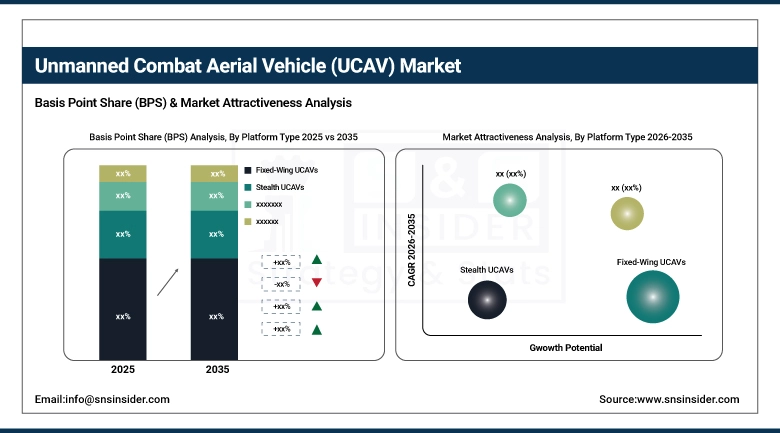
By Platform Type, Fixed-Wing UCAVs held the largest market share of 48.55% in 2025, while Swarm UCAV Systems are expected to grow at the fastest CAGR of 17.45% during 2026–2035.
-
By Mission Type, ISR (Intelligence, Surveillance & Reconnaissance) held the largest share of 34.45% in 2025, while SEAD / Air Defense Suppression is expected to grow at the fastest CAGR of 14.64% during 2026–2035.
-
By Range / Endurance, Long Range (1000–3000 km) held the largest market share of 34.85% in 2025, HALE / Very Long Endurance are expected to grow at the fastest CAGR of 13.54% during 2026–2035.
-
By Payload Type, Precision-Guided Munitions are held the largest market share of 30.21% in 2025, while Multi-role Modular Payload Systems are expected to grow at the fastest CAGR of 14.54% during 2026–2035.
-
By End User, Air Forces held the largest share of 55.51% in 2025, while Special Operations Forces are expected to grow at the fastest CAGR of 14.21% during 2026–2035.
By Platform Type, Fixed-Wing UCAVs Dominates While Swarm UCAV Systems Grows Rapidly:
The Fixed-Wing UCAVs market segment holds dominance in the market owing to the segment's superior endurance, operational reach, and compatibility in conducting intelligence, surveillance, and precision strikes in global defense organizations. The market segment has already established itself as the most reliable segment for conducting long-range operations and has been incorporated into several existing military airforces.
Swarm UCAV Systems is the fastest-growing segment owing to innovations in coordination, collaboration, and mission conduct in combat scenarios through automation and artificial intelligence.
By Mission Type, ISR Dominates While SEAD / Air Defense Suppression Grows Rapidly:
ISR (Intelligence, Surveillance & Reconnaissance) segment dominated owing to its importance in enhancing situational awareness through intelligence gathering and monitoring of strategic regions throughout defense missions. This segment’s wide use in all defense branches and multi-sensor integration in the UCAV system gives it a solid foundation in mission planning.
SEAD / Air Defense Suppression is the fastest-growing segment, as there is an increasing requirement for neutralizing enemy defenses for successful deep-strike missions. Increasing geopolitical tensions and demands for superiority in electronic warfare are contributing to the fast uptake of this segment.
By Range / Endurance, Long Range UCAVs Dominates While HALE / Very Long Endurance Grows Rapidly:
Long Range UCAVs segment dominated the market because of the right combination of range, load carrying, and flexibility in operations in both precision attack and ISR roles. The extensive use of these aircraft in current defense systems allows efficient observation and engagement in deep areas without any need for high-altitude facilities.
The HALE/Very Long Endurance UCAVs category is the fastest-growing one due to the growing importance of persistent intelligence gathering, continuous battlefield surveillance, and strategic surveillance. Their use in border patrol, maritime surveillance, and long-duration reconnaissance operations is boosting their growth in advanced defense systems.
By Payload Type, Precision-Guided Munitions Dominates While Multi-role Modular Payload Systems Grows Rapidly:
Precision-Guided Munitions segment dominated the market, owing to their wide-scale application in UCAV-powered attacks, which ensure accurate target acquisition, minimize collateral damage, and destroy valuable enemy targets. High-level integration into contemporary combat drones guarantees steady usage in precision strikes and tactical warfare engagements.
Multi-role Modular Payload Systems is the fastest-growing segment, as the growing requirement for versatile UCAVs that can be adapted to different roles like Intelligence, Surveillance & Reconnaissance (ISR), attack, and electronic warfare missions propels its growth.
By End User, Air Forces Dominates While Special Operations Forces Grows Rapidly:
Air Forces segment dominated the market owing to bulk purchase of UCAVs for ISR and precision attack applications. The consistent upgrading of air combat aircraft and the growing preference for using unmanned systems in hazardous operations have cemented its leadership position within the UCAV space.
The Special Operations Forces is the fastest-growing segment because of increasing requirements for secret missions, fast response, and precise strikes in hostile environments. The increased employment of stealth-capable UCAV assets for targeted operations and asymmetric warfare is boosting the growth of this category.
Unmanned Combat Aerial Vehicle Market Regional Analysis:
North America Unmanned Combat Aerial Vehicle Market Insights:
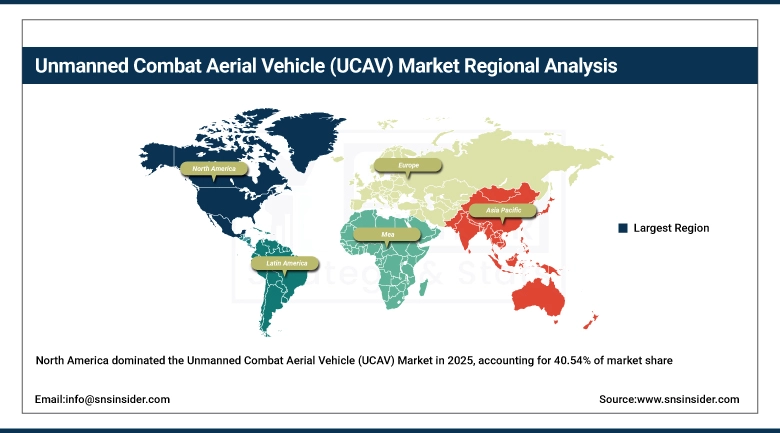
The North America UCAV Market is dominated, holding a 40.54% share in 2025 by virtue of its advanced aerospace defense ecosystem, high-end research and development, and early implementation of autonomous combat aerial technologies. The region is motivated by heavy utilization of advanced generation unmanned combat platforms to undertake tasks such as precision strikes, ISR operations, and electronic warfare missions within their military services. Continued investments in Collaborative Combat Aircraft (CCA) programs, artificial intelligence-based autonomous systems, and stealth UCAV platforms will continue to foster regional supremacy in the market. Presence of key defense companies and robust network-centric warfare infrastructure will help to maintain market supremacy in the future.
Get Customized Report as per Your Business Requirement - Enquiry Now
United States Unmanned Combat Aerial Vehicle Market Insights:
The United States UCAV Market holds a strong position within the regional market due to large-scale military modernization programs, advanced unmanned combat aircraft development, and technology leadership within autonomous combat aerial systems. The nation is heavily investing in AI-powered combat aircraft, stealthy UCAVs, and swarming missions within the region. Defense agencies and aerospace Original Equipment Manufacturers (OEMs) have been instrumental in fostering innovation within autonomous systems, manned-unmanned teaming missions, and advanced strike capabilities.
Asia-Pacific Unmanned Combat Aerial Vehicle Market Insights:
The Asia-Pacific UCAV Market is the fastest-growing region, projected to expand at a CAGR of 13.65% during 2026–2035. Its growth will be propelled by increased modernization efforts in defense, high geopolitical tension, and growing need for next-generation unmanned combat aircrafts. Nations including China, India, Japan, and South Korea are increasingly investing in their own unmanned combat air vehicle programs and developing technologies including stealth drones, artificial intelligence-enabled autonomy, and long endurance combat air systems. Rising demands for border security, maritime surveillance, and deterrence are increasing adoption rates.
China Unmanned Combat Aerial Vehicle Market Insights:
The China UCAV market is fueled by significant investments in defense, expansion in indigenous unmanned combat aircrafts program, and emphasis on self-sufficiency in advanced aerospace systems technology. The country is working toward developing stealth UCAVs, AI-powered autonomous unmanned combat aircrafts, and swarm drones. Growing government support for incorporation of unmanned combat aerial vehicles in military operations like border security, maritime operations, and high altitude surveillance is also contributing to its growth.
Europe Unmanned Combat Aerial Vehicle Market Insights:
The Europe UCAV Market is backed by strong defense aerospace engineering skills, cutting-edge unmanned combat aircraft development, and growing investments in collaborative air combat systems. Nations including France, Germany, the UK, and Italy are heavily investing in future generation UCAV systems with stealth capability, AI-based autonomy, and sophisticated mission management solutions to enable precision strike and reconnaissance missions. Collaborative combat aircraft and manned-unmanned aircraft system developments are gaining significant traction in the region. Growing emphasis on interoperability in NATO defense architecture and sovereign combat UAV systems is adding to market demand.
Germany Unmanned Combat Aerial Vehicle Market Insights:
The Germany UCAV Market is fueled by its advanced aerospace engineering prowess, developed defense manufacturing sector, and involvement in European collaborative combat UAV projects. Germany is increasingly engaged in the development of next generation autonomous UCAV systems with secure communication systems, avionics, and AI-based mission planning solutions for defense purposes. Investments in stealth airframes, sensor fusion, and strike capabilities are bolstering Germany's presence in the European unmanned combat aviation sector.
Latin America Unmanned Combat Aerial Vehicle Market Insights:
The Latin America UCAV Market is exhibiting steady progress due to rising modernization initiatives, growing border security threats, and increasing usage of unmanned aerial vehicles in surveillance applications. Nations like Brazil, Mexico, and Chile are progressively employing UCAV technology in intelligence collection, maritime surveillance, and tactical reconnaissance activities. Small yet increasing investment in domestic UAV research and development projects and purchases of foreign-made UCAVs is aiding the market's expansion. The widespread adoption of UCAVs in security monitoring of far-off areas, safeguarding vital infrastructure, and counternarcotics campaigns is also positively impacting the regional market.
Middle East & Africa Unmanned Combat Aerial Vehicle Market Insights:
The Middle East & Africa UCAV Market is showing robust emerging growth fueled by rising defense budgets, escalating geopolitical conflicts, and heightened demand for advanced unmanned combat systems. Nations including the United Arab Emirates, Saudi Arabia, Israel, and Turkey are extensively investing in stealth UCAV aircraft, autonomous strike platforms, and endurance surveillance UAVs for both strategic and tactical purposes. Increasing application of UCAVs in border surveillance, oil & gas infrastructure protection, and electronic warfare operations is boosting regional acceptance of UCAVs.
Unmanned Combat Aerial Vehicle Market Competitive Landscape:
General Atomics Aeronautical Systems Inc. is a pioneer in developing UCAVs, with its primary focus on the development of MALE UCAV platforms, autonomous mission systems, and ISR-strike systems using artificial intelligence. General Atomics has successfully developed its MQ series platforms, which are highly versatile when employed in global defense operations with expertise in long endurance surveillance and precision strike missions. The key strengths of the company include scalable UCAV manufacturing, extensive integration within the U.S. defense industry, and mission intelligence systems.
-
In February 2025, General Atomics advanced its UCAV portfolio by enhancing AI-driven autonomous mission capabilities and expanding collaborative combat functionalities across its next-generation unmanned platforms, strengthening multi-domain operational effectiveness.
Northrop Grumman Corporation is one of the leading aerospace and defense contractors with vast experience in the field of stealth UCAV systems, autonomous combat aircraft, and cutting-edge collaborative aerial systems. It plays a vital role in unmanned combat aviation technology, specializing in stealth, AI mission systems, and air dominance solutions for the future generation. Its competitive strength includes stealth aircraft technology, strong ties with the U.S. Air Force, and collaborative combat aircraft programs.
-
In June 2025, Northrop Grumman advanced its unmanned combat aviation capabilities through expanded development of stealth-enabled autonomous aircraft systems and enhanced integration within next-generation collaborative combat aircraft programs.
The Lockheed Martin Company operates globally in the field of military defense and involves itself in the development of high-tech unmanned combat aerial vehicles, autonomous aircraft through artificial intelligence technology, and air combat systems. It plays an important role in shaping the future of UCAS technology, including manned-unmanned aircraft operations, digital battlefields, and autonomous strike systems. Its competitive edge stems from its significant defense contracts, expertise in stealth aircrafts, and innovation in combat aircrafts technology.
-
In April 2025, Lockheed Martin strengthened its UCAV development initiatives by advancing AI-enabled mission systems and expanding integration of autonomous capabilities within collaborative air combat and next-generation defense platforms.
Unmanned Combat Aerial Vehicle Market Key Players:
Some of the Unmanned Combat Aerial Vehicle Market Companies are:
-
General Atomics Aeronautical Systems Inc.
-
Northrop Grumman Corporation
-
Lockheed Martin Corporation
-
Boeing Defense, Space & Security
-
RTX Corporation (Raytheon Technologies)
-
Kratos Defense & Security Solutions Inc.
-
Elbit Systems Ltd.
-
Israel Aerospace Industries (IAI)
-
Turkish Aerospace Industries (TAI)
-
Baykar Technologies
-
Aviation Industry Corporation of China (AVIC)
-
China Aerospace Science and Technology Corporation (CASC)
-
Dassault Aviation
-
BAE Systems plc
-
Saab AB
-
Hindustan Aeronautics Limited (HAL)
-
AeroVironment Inc.
-
Leonardo S.p.A.
-
Denel Dynamics
-
QinetiQ Group plc
| Report Attributes | Details |
|---|---|
| Market Size in 2025 | USD 15.08 Billion |
| Market Size by 2035 | USD 49.10 Billion |
| CAGR | CAGR of 12.66% From 2026 to 2035 |
| Base Year | 2025 |
| Forecast Period | 2026-2035 |
| Historical Data | 2022-2024 |
| Report Scope & Coverage | Market Size, Segments Analysis, Competitive Landscape, Regional Analysis, DROC & SWOT Analysis, Forecast Outlook |
| Key Segments | • By Platform Type (Fixed-Wing UCAVs, Stealth UCAVs, Hybrid VTOL UCAVs, Swarm UCAV Systems, Others) • By Mission Type (ISR – Intelligence, Surveillance & Reconnaissance, Precision Strike / Combat Operations, Electronic Warfare (EW), SEAD / Air Defense Suppression, Border & Maritime Security, Others) • By Range / Endurance (Short Range UCAVs (<300 km), Medium Range UCAVs (300–1000 km), Long Range UCAVs (1000–3000 km), HALE / Very Long Endurance UCAVs (>3000 km), Others) • By Payload Type (Precision-Guided Munitions, Air-to-Ground Missiles, ISR Sensors (EO/IR, Radar, SIGINT), Electronic Warfare Payloads, Multi-role Modular Payload Systems, Others) • By End User (Air Forces, Naval Forces, Army Tactical Units, Homeland Security Agencies, Special Operations Forces, Others) |
| Regional Analysis/Coverage | North America (US, Canada), Europe (Germany, UK, France, Italy, Spain, Russia, Poland, Rest of Europe), Asia Pacific (China, India, Japan, South Korea, Australia, ASEAN Countries, Rest of Asia Pacific), Middle East & Africa (UAE, Saudi Arabia, Qatar, South Africa, Rest of Middle East & Africa), Latin America (Brazil, Argentina, Mexico, Colombia, Rest of Latin America). |
| Company Profiles | General Atomics Aeronautical Systems Inc., Northrop Grumman Corporation, Lockheed Martin Corporation, Boeing Defense, Space & Security, RTX Corporation (Raytheon Technologies), Kratos Defense & Security Solutions Inc., Elbit Systems Ltd., Israel Aerospace Industries (IAI), Turkish Aerospace Industries (TAI), Baykar Technologies, Aviation Industry Corporation of China (AVIC), China Aerospace Science and Technology Corporation (CASC), Dassault Aviation, BAE Systems plc, Saab AB, Hindustan Aeronautics Limited (HAL), AeroVironment Inc., Leonardo S.p.A., Denel Dynamics, QinetiQ Group plc |
Frequently Asked Questions
North America dominated with a 40.54% share in 2025, while Asia-Pacific is the fastest-growing region, expected to expand at a CAGR of 13.65% during 2026–2035.
Fixed-Wing UCAVs dominated with a 48.55% share in 2025, while Swarm UCAV Systems are projected to grow at the fastest CAGR of 17.45% during 2026–2035.
Growth is driven by rising demand for AI-enabled autonomous combat systems, precision strike capabilities, and advanced ISR missions, along with increasing adoption of stealth UCAV platforms and swarm-based aerial warfare technologies.
The market is valued at USD 15.08 Billion in 2025 and is projected to reach USD 49.10 Billion by 2035.
The Unmanned Combat Aerial Vehicle Markets projected to grow at a CAGR of 12.66% during 2026–2035.
