
Aerospace Maintenance Chemicals Market Report Scope & Overview:
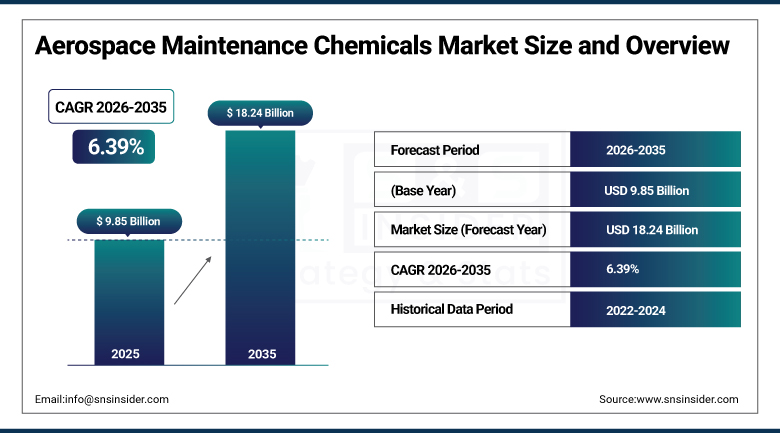
The Aerospace Maintenance Chemicals Market was valued at USD 9.85 Billion in 2025 and is expected to reach USD 18.24 Billion by 2035, growing at a CAGR of 6.39% from 2026 to 2035.
Aerospace Maintenance Chemicals Market is witnessing steady growth owing to the rise in global aircraft fleet size, increase in aircraft usage, and increased importance of maintenance, repair, and overhaul operations. Aerospace maintenance chemicals such as cleaners, degreasers, lubricants, anti-corrosion agents, sealants, and coatings are essential components used to ensure the performance, durability, and reliability of the aircrafts. Increasing air travel and upgrade of the fleet size are increasing the demand for maintenance chemicals in commercial, military, and general aviation. Moreover, strict safety regulations in aviation industry and the importance of aircraft service life have been leading to the adoption of advanced maintenance chemicals.
Henkel AG & Co. KGaA expanded its Bonderite aqueous cleaner portfolio in 2025 to help MRO providers transition away from solvent-based degreasing systems, while PPG Industries advanced composite-safe coating removers in 2026 to meet growing demand for airframe-compatible maintenance chemistries amid tightening emissions regulation across commercial and defense aviation.
To Get more information On Aerospace Maintenance Chemicals Market - Request Free Sample Report
Aerospace Maintenance Chemicals Market Trends:
-
Rising adoption of low-VOC and REACH-compliant solvent formulations is reshaping product development across the industry.
-
Growing preference for waterborne cleaning and corrosion-control chemistries is reducing reliance on legacy solvent-based systems.
-
Expanding MRO capacity across Asia Pacific hubs is accelerating regional demand for specialized aerospace maintenance chemicals.
-
Increasing use of composite-compatible cleaners and strippers is supporting maintenance of next-generation airframe materials.
-
Strategic collaborations between chemical manufacturers and MRO providers are driving development of application-specific product lines.
U.S. Aerospace Maintenance Chemicals Market Outlook:
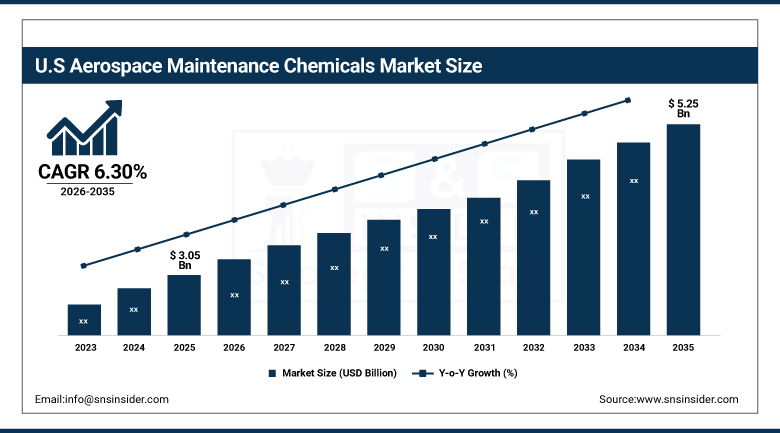
The U.S. Aerospace Maintenance Chemicals Market was valued at USD 3.05 Billion in 2025 and is projected to reach USD 5.25 Billion by 2035, growing at a CAGR of 6.30% during 2026–2035.
The prominent players providing maintenance, repair, and overhaul services, commercial airlines, and military maintenance depots in the region continue to increase the usage of certified aerospace chemicals owing to the large size of the aircraft fleet and its aging nature, outsourcing of heavy maintenance checks to third-party maintenance, repair, and overhaul organizations, and rising regulatory mandate of the FAA to use greener and lower emission products. The presence of leading airframe and engine OEMs along with high MRO network density in and around prominent aviation centers will continue to provide a robust domestic demand for aerospace maintenance chemicals.
In 2026, Quaker Houghton expanded its U.S. aerospace fluid manufacturing footprint with a new blending line dedicated to Aerosafe hydraulic fluids, strengthening its ability to supply domestic MRO facilities and commercial airline maintenance bases with certified, aerospace-grade hydraulic and cleaning chemistries.
Aerospace Maintenance Chemicals Market Segment Analysis:
-
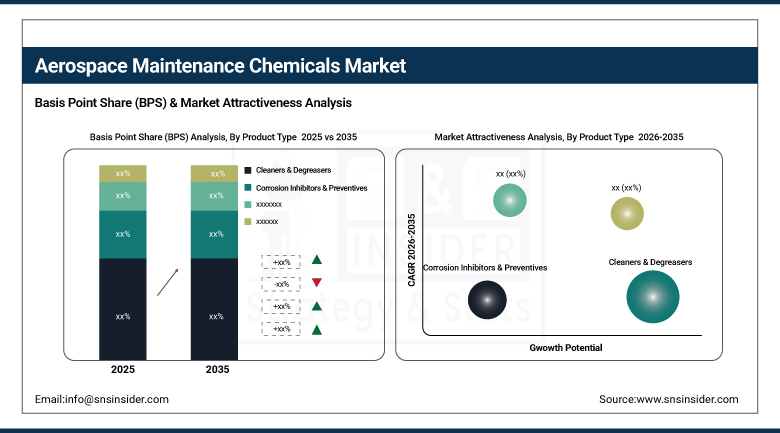
By Product Type, Cleaners & Degreasers dominated the Aerospace Maintenance Chemicals Market with a 31.50% share in 2025, while Corrosion Inhibitors & Preventives is the fastest-growing product type segment with a CAGR of 7.40% from 2026–2035.
-
By Formulation, Solvent-Based dominated the Aerospace Maintenance Chemicals Market with a 57.80% share in 2025, while Water-Based is the fastest-growing formulation segment with a CAGR of 7.90% from 2026–2035.
-
By Application, Airframe & Fuselage Maintenance dominated the Aerospace Maintenance Chemicals Market with a 37.60% share in 2025, while Engine & Powerplant Maintenance is the fastest-growing application segment with a CAGR of 7.20% from 2026–2035.
-
By End User, MRO Service Providers dominated the Aerospace Maintenance Chemicals Market with a 46.40% share in 2025, while Airlines & Fleet Operators is the fastest-growing end-user segment with a CAGR of 6.95% from 2026–2035.
By Product Type, Cleaners & Degreasers led the market, Corrosion Inhibitors & Preventives is the fastest-growing segment
Cleaners & Degreasers was the key revenue contributor with a market share of 31.50% in the Aerospace Maintenance Chemicals Market in 2025. This is because the Cleaners & Degreasers have been in the top position because of their frequent usage in airframe washing, engine bay cleaning, and interior maintenance activities undertaken at almost all maintenance check intervals, along with their proven formulations that have been approved by all OEM maintenance manuals. Compatibility of these chemicals with various types of substrates used in different parts of the aircraft including aluminum fuselage panels to composite fairings has further strengthened their market position.
The Corrosion Inhibitors & Preventives segment is expected to witness the highest CAGR of 7.40% during the forecast period 2026-2035. Adoption is accelerating as airlines extend aircraft service life and operate in increasingly corrosive coastal and humid environments, driving demand for advanced, long-lasting protective compounds over legacy chemical treatments. Rising emphasis on reducing unscheduled maintenance events tied to corrosion damage, together with growing use of these compounds on both airframe structures and landing gear assemblies, is propelling above-average growth for this segment relative to the rest of the aerospace maintenance chemicals category.
By Formulation, Solvent-Based formulations led the market, Water-Based is the fastest-growing segment.
The Solvent-Based category held a market share of 57.80% of the Aerospace Maintenance Chemicals Market in 2025. Solvent-based formulations continue to dominate as they deliver strong degreasing and paint-stripping performance on stubborn hydraulic fluid residue, carbon deposits, and legacy coatings, and remain specified within numerous OEM maintenance manuals for critical engine and airframe cleaning tasks where proven, certified performance is prioritized over emerging alternatives by maintenance crews across commercial and defense aviation.
The Water-Based segment is anticipated to grow at the fastest rate during the forecast period 2026-2035, at a CAGR of 7.90%. Rising regulatory pressure to cut volatile organic compound emissions at MRO facilities, together with growing airline sustainability commitments, is accelerating adoption of waterborne cleaners, corrosion inhibitors, and coating-removal chemistries across hangar and line-maintenance environments worldwide.
By Application, Airframe & Fuselage Maintenance led the market, Engine & Powerplant Maintenance is the fastest-growing segment.
The Airframe & Fuselage Maintenance segment dominated the Aerospace Maintenance Chemicals Market with a revenue share of 37.60% in 2025. This application remains the largest owing to the sheer surface area requiring cleaning, corrosion protection, and coating maintenance across every scheduled check, from routine exterior washing to heavy structural inspections, sustaining consistent, high-volume chemical demand across airline and MRO maintenance programs regardless of fleet type or region.
The Engine & Powerplant Maintenance segment is expected to register the fastest CAGR of 7.20% during the forecast period 2026-2035. Growing engine shop visit frequency tied to an aging global fleet, combined with rising use of specialized cleaning and corrosion-control chemistries for turbine blades, combustion chambers, and fuel systems, is driving strong demand for precision-formulated products designed to protect increasingly complex, high-value engine components.
By End User, MRO Service Providers led the market, Airlines & Fleet Operators is the fastest-growing segment.
The MRO Service Providers segment dominated the Aerospace Maintenance Chemicals Market with a revenue share of 46.40% in 2025. Independent and OEM-affiliated MRO providers remain the largest consumer base as they perform the bulk of scheduled heavy maintenance, engine overhaul, and structural repair work outsourced by airlines and lessors, requiring continuous, high-volume procurement of certified cleaning, corrosion-control, and coating-removal chemistries across their global facility networks.
The Airlines & Fleet Operators segment is expected to witness the fastest CAGR of 6.95% during the forecast period 2026-2035. Growing in-house line-maintenance capability among low-cost and regional carriers, combined with rising fleet utilization rates and shorter turnaround windows between flights, is increasing direct airline procurement of aerospace maintenance chemicals for day-to-day cleaning and minor corrosion-prevention tasks performed between scheduled MRO visits.
Regional Insights
|
Region |
Major Country |
Share within Region, 2025 (%) |
|---|---|---|
|
North America |
United States |
84.14% |
|
Europe |
Germany |
24.30% |
|
Asia Pacific |
China |
41.50% |
|
Middle East & Africa |
UAE |
27.40% |
|
Latin America |
Brazil |
34.60% |
North America Aerospace Maintenance Chemicals Market Insights
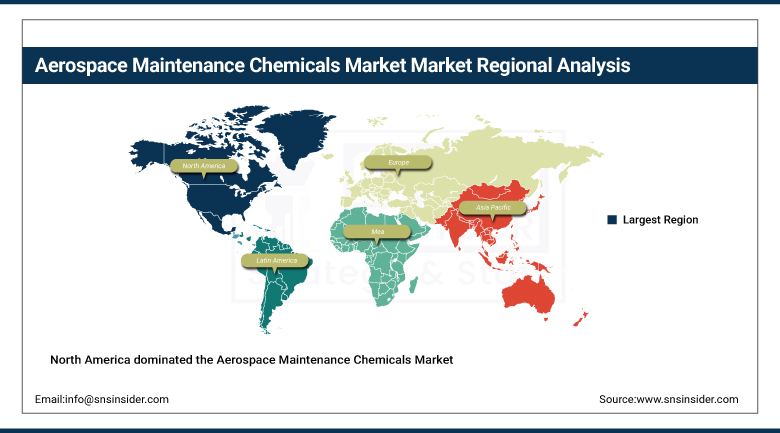
North America dominated the Aerospace Maintenance Chemicals Market with the highest market share of about 36.80% in 2025, due to the presence of a large number of commercial and defense aircraft fleet in service, highly concentrated MRO centers at various major aviation centers, and established FAA guidelines that require stringent corrosion control, cleaning, and surface treatment procedures to keep the aircraft airworthy. The presence of well-established aerospace manufacturing operations in North America along with leading chemical formulators and long-term supply contracts with major airlines and MRO networks further strengthens North America as the largest consumer of certified aerospace maintenance chemicals.
The US was the leading country within the North America Aerospace Maintenance Chemicals Market in 2025 with a market share of 84.14% of the regional market, owing to their robust domestic MRO facilities, sizeable fleet of commercial and military planes that require regular scheduled maintenance services, and continued focus of the FAA in transitioning solvent-based chemistries to low emission ones. Canada is playing its role in regional market growth by developing its own MRO facilities and aerospace component overhauling capabilities, along with using environmentally compliant maintenance chemicals in their commercial aircrafts.
Get Customized Report as per Your Business Requirement - Enquiry Now
Europe Aerospace Maintenance Chemicals Market Insights
The Europe region was a major contributor to the Aerospace Maintenance Chemicals Market in 2025, expected to register comparatively higher growth for REACH-compliant, low-emission maintenance chemistries during the forecast period. This is attributed to the region's stringent environmental and occupational safety regulatory framework, well-established commercial aircraft manufacturing and MRO base, and growing airline sustainability commitments driving accelerated adoption of waterborne cleaning and corrosion-control alternatives across member states pursuing broader emissions-reduction objectives.
Germany is one of the major markets in Europe owing to its strong aerospace manufacturing and MRO ecosystem, along with the presence of leading aerospace chemical formulators and major airframe assembly operations serving both domestic and international customers. Other countries such as France, the United Kingdom, and Italy, home to major aircraft OEM facilities and MRO networks, are also contributing to market growth through extensive maintenance chemical procurement and formulation research and development investment.
Asia Pacific Aerospace Maintenance Chemicals Market Insights
The Asia Pacific Aerospace Maintenance Chemicals Market is expected to witness the fastest growth rate of 8.10% CAGR during the forecast period 2026-2035. Market growth is driven by rapidly expanding commercial fleet sizes, large-scale investment in new MRO hub capacity across the region, and increasing air passenger traffic across major and emerging aviation markets pursuing greater maintenance self-sufficiency and reduced reliance on overseas heavy-maintenance outsourcing.
China is one of the main growth drivers in the Asia Pacific Aerospace Maintenance Chemicals Market, owing to its rapidly expanding domestic commercial fleet and growing network of state-backed MRO facilities supporting both local and export-oriented maintenance operations. India and Singapore, both emerging as prominent regional MRO hubs, are also contributing to regional growth through expanding heavy-maintenance capacity and increasing adoption of internationally certified aerospace maintenance chemistries.
Middle East & Africa and Latin America Aerospace Maintenance Chemicals Market Insights
Middle East & Africa and Latin American regions are gradually expanding aerospace maintenance chemical adoption as regional MRO and fleet maintenance investment grows across both regions, supported by rising long-haul carrier fleet sizes and growing government focus on developing regional maintenance self-sufficiency.
Brazil is set to be a prominent Latin American market fueled by its established regional aircraft manufacturing base and growing commercial MRO capacity serving both domestic and neighboring carriers. The Middle East & Africa region has UAE and Saudi Arabia investing heavily in modern MRO infrastructure that is gradually increasing demand for aerospace maintenance chemicals across their expanding long-haul and regional fleet maintenance operations.
Market Dynamics
Growth Drivers: Expanding global fleet size and stricter airworthiness compliance requirements driving market growth
The continuous expansion of the global commercial and defense aircraft fleet, combined with rising frequency of scheduled MRO checks and increasingly stringent airworthiness and safety compliance requirements enforced by regulators such as the FAA and EASA, are among the primary drivers of the Aerospace Maintenance Chemicals Market. Aerospace maintenance chemicals offer guaranteed performance throughout their cleaning, protection against corrosion, and coatings maintenance operations which are essential for ensuring airframe and engine performance, thus becoming an integral part of all stages of an aircraft's operation cycle, starting from line maintenance and finishing with the overhaul of engines.
Technological advancements in chemical formulation have significantly improved performance-to-emission ratios, with recent innovations enabling waterborne and low-VOC chemistries to match the cleaning and corrosion-control performance of legacy solvent-based systems. Rising outsourcing of heavy maintenance to third-party MRO providers, growing utilization of composite-compatible chemistries suited to next-generation airframe materials, and continued capacity investment by leading chemical manufacturers are further supporting demand across the forecast period, as airlines and MRO networks increasingly standardize on certified, next-generation maintenance chemistries.
Restraints: Stringent certification requirements and raw material cost volatility limiting market expansion
One of the most critical obstacles to market growth is the lengthy and costly OEM and regulatory certification process required before new aerospace maintenance chemical formulations can be approved for use, which significantly slows the pace at which manufacturers can bring innovative, lower-emission products to market. This certification burden particularly disadvantages smaller specialty chemical formulators competing against established suppliers with existing OEM-approved product portfolios and long-standing airline supply relationships.
Moreover, the fluctuations in the prices of feedstocks for raw materials and specialty solvents have a direct effect on the economics of manufacture of chemicals for use in aircraft maintenance. In addition, the fact that there are high technical specifications in the preparation of chemistries which will be effective and stable at extremely high temperatures, altitudes, and pressures necessitates a significant amount of money for research and development of new products.
Opportunities: Expansion of waterborne chemistries and composite-compatible formulations creating new growth avenues
The increasing need for waterborne and low-VOC maintenance chemistries capable of matching legacy solvent-based performance, combined with rising investment in composite-compatible formulations suited to next-generation airframe materials, will provide ample growth opportunities in the Aerospace Maintenance Chemicals Market. The continued expansion of MRO capacity across emerging aviation markets in Asia Pacific and Latin America, supported by government efforts to build regional maintenance self-sufficiency, will further ensure sustained future demand.
There is tremendous opportunity for development within the segment of highly developed maintenance chemical products for engines and power plants which increase service life and decrease unscheduled maintenance events, resulting in substantial cost savings for airlines and MRO companies. Increased optimization of maintenance schedules through digital technology along with an increased focus on prolonging the service life of aircraft through effective corrosion control initiatives will create increasing demand for such aerospace maintenance chemicals.
Recent Developments:
-
2025: PPG Industries, Inc. introduced a new composite-safe Desothane HS coating remover formulated to strip topcoats from advanced composite airframe structures without damaging underlying substrate materials.
-
2026: Quaker Houghton expanded production of its Aerosafe hydraulic fluid range at its European blending facility to meet rising demand from commercial MRO providers upgrading fleet hydraulic systems.
-
2026: Chemetall GmbH, a BASF Group company, introduced its Turco 6849 corrosion-inhibiting compound for airframe protection, targeting airlines seeking extended intervals between scheduled corrosion treatments.
Aerospace Maintenance Chemicals Companies are:
-
Henkel AG & Co. KGaA
-
PPG Industries, Inc.
-
3M Company
-
BASF SE
-
Chemetall GmbH (A BASF Group Company)
-
Eastman Chemical Company
-
Exxon Mobil Corporation
-
The Dow Chemical Company
-
Socomore
-
Arrow Solutions LLC
-
Callington Haven Pty Ltd.
-
Dasic International Ltd.
-
Nuvite Chemical Compounds
-
International Aerospace Coatings Ltd.
-
Aviation Chemical Solutions, Inc.
-
Aerokem Chemical Corporation
-
EnviroTech Surface Technologies Ltd.
-
Flamemaster Corporation
Aerospace Maintenance Chemicals Market Report Scope:
| Report Attributes | Details |
|---|---|
| Market Size in 2025 | USD 9.85 Billion |
| Market Size by 2035 | USD 18.24 Billion |
| CAGR | CAGR of 6.39% From 2026 to 2035 |
| Base Year | 2025 |
| Forecast Period | 2026-2035 |
| Historical Data | 2022-2024 |
| Report Scope & Coverage | Market Size, Segments Analysis, Competitive Landscape, Regional Analysis, DROC & SWOT Analysis, Forecast Outlook |
| Key Segments | • By Product Type (Cleaners & Degreasers, Corrosion Inhibitors & Preventives, Paints, Coatings & Strippers, Lubricants & Hydraulic Fluids) • By Formulation (Solvent-Based, Water-Based) • By Application (Airframe & Fuselage Maintenance, Engine & Powerplant Maintenance, Interior & Cabin Maintenance, Landing Gear & Undercarriage Maintenance) • By End User (MRO Service Providers, Airlines & Fleet Operators, OEMs) |
| Regional Analysis/Coverage | North America (US, Canada), Europe (Germany, UK, France, Italy, Spain, Russia, Poland, Rest of Europe), Asia Pacific (China, India, Japan, South Korea, Australia, ASEAN Countries, Rest of Asia Pacific), Middle East & Africa (UAE, Saudi Arabia, Qatar, South Africa, Rest of Middle East & Africa), Latin America (Brazil, Argentina, Mexico, Colombia, Rest of Latin America). |
| Company Profiles | Henkel AG & Co. KGaA, PPG Industries, Inc., 3M Company, BASF SE, Chemetall GmbH (A BASF Group Company), Quaker Houghton, Eastman Chemical Company, Exxon Mobil Corporation, The Dow Chemical Company, Socomore, Arrow Solutions LLC, Callington Haven Pty Ltd., Dasic International Ltd., Nuvite Chemical Compounds, McGean-Rohco, Inc., International Aerospace Coatings Ltd., Aviation Chemical Solutions, Inc., Aerokem Chemical Corporation, EnviroTech Surface Technologies Ltd., Flamemaster Corporation. |
Frequently Asked Questions
