
Aircraft Gearbox Market Report Scope & Overview:
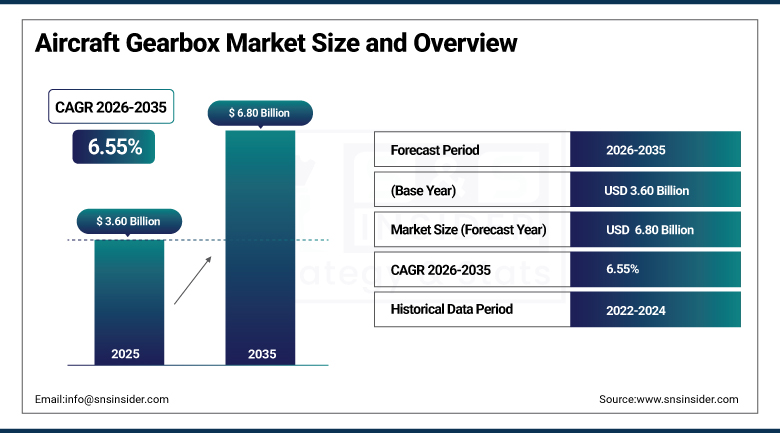
The Aircraft Gearbox Market was valued at USD 3.60 Billion in 2025 and is expected to reach USD 6.80 Billion by 2035, growing at a CAGR of 6.55% from 2026-2035.
The Aircraft Gearbox Market growth is being driven primarily by substantial order backlogs for next-generation single-aisle jets and the broad deployment of geared-turbofan engine architecture, which relies on a dedicated reduction gearbox to let the fan and low-pressure turbine spin at their own optimal speeds rather than a shared shaft speed. This architecture cuts block fuel burn by up to 20% and trims perceived noise by roughly 75% relative to conventional turbofan designs, giving airlines a compelling economic case to specify geared-turbofan-powered aircraft on new orders. Early commercial demonstrations of hybrid-electric propulsion systems and renewed interest in efficient regional turboprop platforms are further sustaining gearbox shipment volumes, since both propulsion approaches depend on reduction gearing to convert engine output into usable propeller or rotor speed.
Pratt & Whitney's GTF Advantage engine achieved FAA type certification for the Airbus A320neo family in February 2025, adding 4% to 8% more take-off thrust without sacrificing the engine's baseline fuel-savings profile.
To Get more information On Aircraft Gearbox Market - Request Free Sample Report
Aircraft Gearbox Market Trends:
-
Accelerating adoption of geared-turbofan engine architecture across next-generation single-aisle aircraft platforms.
-
Growing retrofit demand as operators upgrade legacy gearbox systems to improve fuel efficiency and reduce maintenance costs.
-
Rising interest in hybrid-electric propulsion systems requiring specialized reduction gearing for electric motor integration.
-
Expanding upgraded main gearbox technology improving safety and operational efficiency in helicopter applications.
-
Increasing adoption of lightweight gear systems and smart sensor-integrated gearbox housings across new aircraft programs.
-
Growing demand for efficient regional turboprop platforms sustaining steady reduction gearbox procurement outside major commercial programs.
U.S. Aircraft Gearbox Market Outlook:
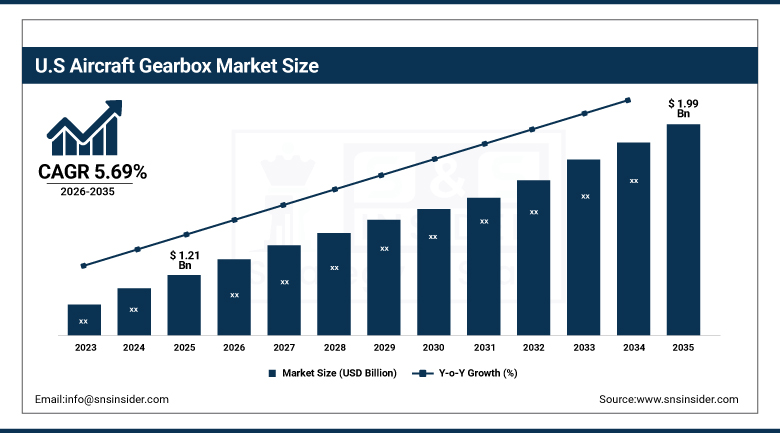
The U.S. Aircraft Gearbox Market was valued at USD 1.21 Billion in 2025 and is expected to reach USD 1.99 Billion by 2035, growing at a CAGR of 5.69% from 2026-2035.
U.S. Aircraft Gearbox Market growth is further propelled by the involvement of key aerospace manufacturers such as Boeing and General Electric as well as investments made in research and development that drive innovations leading to regular upgrade and replacement of gearbox parts. Innovation and performance focus of the domestic aerospace industry as well as high levels of activity in commercial aviation and defense will continue to contribute to steady procurement.
Pratt & Whitney, headquartered in East Hartford, Connecticut, reported in January 2026 that its GTF engine deliveries increased 6% during 2025 while the company continued recovering from its powder metal inspection program, and confirmed plans to certify and install Hot Section Plus components on current-generation engines during 2026.
Aircraft Gearbox Market Segment Analysis:
-
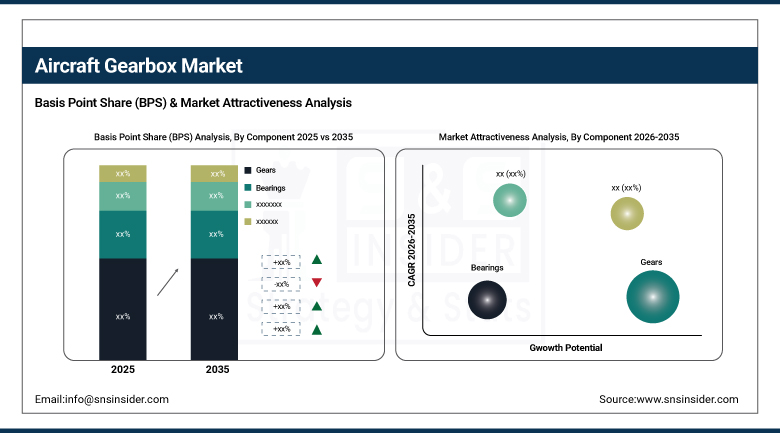
By Component, the Gear segment dominated the Aircraft Gearbox Market with approximately 45.00% share in 2025, while the Bearing segment is the fastest growing with a CAGR of approximately 7.60%.
-
By Application, the Engine segment dominated the Aircraft Gearbox Market with approximately 65.00% share in 2025, while the Airframe segment is the fastest growing with a CAGR of approximately 6.90%.
-
By Aircraft Type, the Commercial Aircraft segment dominated the Aircraft Gearbox Market with approximately 43.36% share in 2025, while the Helicopter segment is the fastest growing with a CAGR of approximately 7.40%.
-
By Fit, the Line-Fit segment dominated the Aircraft Gearbox Market with approximately 73.45% share in 2025, while the Retrofit segment is the fastest growing with a CAGR of approximately 9.20%.
By Component, Gear Leads, Bearing Grows Fastest
Gears continue to anchor the component segment, forming the core mechanical element responsible for transmitting power and converting rotational speed within virtually every aircraft gearbox configuration currently in production. Precision manufacturing requirements and the safety-critical nature of gear performance keep this component the largest single cost driver across the broader gearbox bill of materials. Manufacturers investing early in advanced bearing materials engineered for extended service life are positioned to capture premium value as engine speeds and operating loads continue climbing across next-generation platforms.
Bearings represent the fastest-growing component category, as increasingly demanding operating speeds and loads across geared-turbofan and hybrid-electric applications push manufacturers toward more sophisticated bearing designs capable of sustained high-speed operation. Growing adoption of advanced bearing materials engineered for extended service life continues to reinforce this segment's above-average growth trajectory.
By Application, Engine Leads, Airframe Grows Fastest
The engine application market holds sway in terms of the application type, considering the importance of gearboxes in controlling the speed, torque, and mechanical power transfer in aircraft propulsion systems where there is need to deal with huge amounts of force and stress during the entire flying process. The development of actuation gearboxes for use in increasingly electric flight control systems is likely to be an attractive prospect to gain significant market share.
The airframe segment emerges as the fastest growing category owing to the rising number of applications of actuation gearboxes in flight control surfaces, landing gear systems, and other mechanical power transmission mechanisms in structural systems.
By Aircraft Type, Commercial Leads, Helicopter Grows Fastest
Commercial aircraft continue to dominate the aircraft-type segment, consistent with the sheer scale of global commercial fleet size and sustained new aircraft delivery rates across major manufacturers, sustaining consistent demand for both original equipment and aftermarket replacement gearboxes. Rotorcraft operators across both commercial and military fleets continue prioritizing safety and operational efficiency improvements, creating sustained demand for upgraded gearbox technology beyond routine maintenance replacement cycles.
Helicopters represent the fastest-growing aircraft-type category, driven by upgraded main gearbox technology improving safety and operational efficiency across both commercial and military rotorcraft fleets. Continued modernization of legacy helicopter gearbox systems continues to reinforce this segment's accelerating adoption.
By Fit, Line-Fit Leads, Retrofit Grows Fastest
Installations of line-fits continue to rule the roost in the fitments market, pointing to how integral gearbox specification is in the initial aircraft and engine design stage as opposed to decision making after delivery by the operator/lessor of the aircraft. Retrofit investments have now come to be viewed as a practical means to prolong the aircraft’s useful life span, alongside delivering significant fuel savings without incurring the high costs of total aircraft replacements.
Retrofit investments form the fastest-growing segment, with increasing amounts being spent on upgrading existing gearbox systems in order to achieve greater fuel efficiency and lower maintenance costs. The strong aftermarket demand for enhanced-performance gearbox fits continues to support above-average growth trends in this segment.
Regional Analysis:
|
Region |
Major Country |
Share within Region, 2025 (%) |
|---|---|---|
|
North America |
United States |
73.08% |
|
Europe |
Germany |
25.60% |
|
Asia Pacific |
China |
38.40% |
|
Latin America |
Brazil |
26.80% |
|
Middle East & Africa |
UAE |
29.40% |
North America Aircraft Gearbox Market Insights
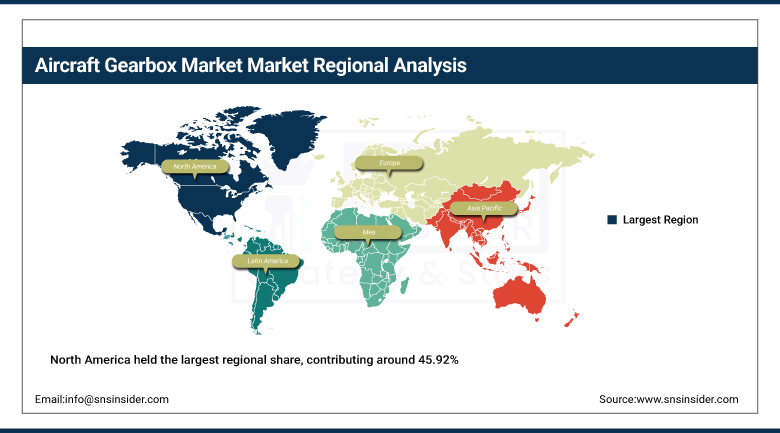
North America held the largest regional share, contributing around 45.92% to the total global Aircraft Gearbox Market by 2025, creating revenue of about USD 1.65 billion. This status is credited to the presence of major players like Boeing and General Electric, as well as consistent efforts towards R&D and regular updates and replacements of the gearbox. Consistent domestic efforts for developing technology for producing advanced gears further help North America hold its position as the leader despite the narrowing technology gaps of international rivals in certain materials.
The participation of Canada in the aerospace supply chain of North America also helps boost regional demand for the products. The technologically advanced aerospace industry of the region that focuses on innovations and performance also supports North America’s leadership.
Get Customized Report as per Your Business Requirement - Enquiry Now
Asia Pacific Aircraft Gearbox Market Insights
Asia Pacific is projected to expand at the fastest CAGR across the Aircraft Gearbox Market during the 2026-2035 forecast period, at approximately 8.97% annually, driven by rapid fleet expansion and manufacturing scale-up across the region's largest economies. China represents a significant contributor within the region, supported by expanding domestic commercial aviation manufacturing capability. Continued government-backed aerospace manufacturing investment across the region's largest economies further accelerates the pace at which domestic suppliers close the technology gap with more established Western competitors.
India and South Korea contribute additional regional demand, supported by growing fleet modernization programs and expanding indigenous aerospace manufacturing ambitions. Rising regional aircraft orders continue to reinforce Asia Pacific's accelerating growth trajectory.
Europe Aircraft Gearbox Market Insights
The Aircraft Gearbox Market share of Europe was about 21.98% in 2025, resulting in revenue of approximately USD 0.80 billion, owing to the presence of significant aircraft manufacturing facilities in Germany and the existence of leading gearbox manufacturers, such as MTU Aero Engines and Liebherr-International, in the region. The focus on adoption of geared turbofan engine in the region influences the product development process among German and French engine and gearbox manufacturers.
France and the UK are some other regions that provide regional demand due to the presence of aircraft structures manufacturing facility and defense and regulatory purchases.
MEA & Latin America Aircraft Gearbox Market Insights
The Middle East and Africa region reflects growing strategic importance, with the UAE accounting for the largest regional contribution through its position as a major international aviation hub supporting expanding MRO capacity and offshore rotary mission requirements. Saudi Arabia is following a similar trajectory as it builds out domestic aviation infrastructure alongside broader economic diversification investment across the Gulf states.
Latin America is led by Brazil, home to Embraer, whose continued regional jet delivery programs support sustained demand for aircraft gearboxes. Mexico and Argentina contribute additional secondary demand tied to their respective aviation sectors.
Market Dynamics:
Growth Drivers: Geared-Turbofan Adoption and Fleet Expansion
Substantial order backlogs for next-generation single-aisle jets and the broad deployment of geared-turbofan engine architecture represent the principal driver of market growth, as this technology's fuel-savings and noise-reduction advantages continue winning airline orders across the commercial aviation sector. Rising demand for efficient regional turboprop platforms further reinforces this underlying demand trend, as both propulsion approaches depend on reduction gearing to convert engine output into usable rotational speed.
A resurgence in air travel and expanding aircraft fleets provide an additional significant source of growth, as growing passenger and cargo traffic drives demand for both new aircraft and aftermarket gearbox maintenance. Early commercial demonstrations of hybrid-electric propulsion systems further reinforce this underlying demand trend.
Restraints: High Technology Costs and Certification Complexity
The high costs involved in introducing new gearbox technology represent a significant restraint, as achieving airworthiness certification for novel gear architectures or materials requires years of testing and validation before commercial deployment becomes possible. Smaller suppliers without dedicated regulatory affairs capability face particular difficulty absorbing these extended certification timelines when competing for major OEM contracts against larger, established competitors.
Extended qualification timelines for geared-turbofan and hybrid-electric gearbox systems add a further restraint, particularly for smaller suppliers without the deep engineering resources larger established primes can dedicate to new program development.
Opportunities: Hybrid-Electric Propulsion and Helicopter Upgrades
Continued development of hybrid-electric propulsion systems presents a substantial growth opportunity, as manufacturers engineering specialized reduction gearing for electric motor integration are positioned to capture meaningful new demand as these platforms advance toward commercial deployment. Manufacturers developing dedicated engineering capability specifically for rotorcraft applications are positioned to capture meaningful design-win volume as helicopter fleet modernization programs continue expanding worldwide.
Upgraded main gearbox technology for helicopter applications represents a further opportunity, as operators increasingly prioritize safety and efficiency improvements across both commercial and military rotorcraft fleets, creating sustained retrofit and modernization demand.
Recent Developments:
-
In October 2023, Northrop Grumman announced a strategic partnership with General Electric to collaboratively develop next-generation aircraft components using 3D printing technologies, aiming to streamline gearbox and related component supply chains while improving manufacturing sustainability.
-
Safran continued expanding its gearbox manufacturing capacity in 2025 to support growing demand for geared-turbofan engine programs, reinforcing its position as a leading supplier of reduction gearing for next-generation single-aisle aircraft.
-
Collins Aerospace continued advancing its actuation gearbox technology throughout 2025, supporting flight control surface and landing gear system integration across multiple commercial and military aircraft platforms.
-
Liebherr-International continued expanding its aerospace gearbox aftermarket service capacity in 2025, supporting growing retrofit demand as operators upgrade legacy systems to improve fuel efficiency and reduce long-term maintenance costs.
Aircraft Gearbox Market Key Players:
-
Safran S.A.
-
Honeywell International Inc.
-
Collins Aerospace (RTX Corporation)
-
GE Aerospace
-
Rolls-Royce Holdings plc
-
Liebherr-International AG
-
MTU Aero Engines AG
-
Triumph Group, Inc.
-
Meggitt PLC
-
Woodward, Inc.
-
Moog Inc.
-
Circor International, Inc.
-
ZF Friedrichshafen AG
-
Nidec Corporation
-
RENK Group AG
-
Pratt & Whitney (RTX Corporation)
-
The Boeing Company
-
Airbus SE
-
Bell Textron Inc.
-
Sikorsky (Lockheed Martin Corporation)
Aircraft Gearbox Market Report Scope:
| Report Attributes | Details |
|---|---|
| Market Size in 2025 | USD 3.60 Billion |
| Market Size by 2035 | USD 6.80 Billion |
| CAGR | CAGR of 6.55% From 2026 to 2035 |
| Base Year | 2025 |
| Forecast Period | 2026-2035 |
| Historical Data | 2022-2024 |
| Report Scope & Coverage | Market Size, Segments Analysis, Competitive Landscape, Regional Analysis, DROC & SWOT Analysis, Forecast Outlook |
| Key Segments | • by Gearbox Type (Reduction Gearbox, Accessory Gearbox, Actuation Gearbox, Tail-Rotor Gearbox, Auxiliary Power Unit Gearbox) • by Component (Gears, Bearing, Housing) • by Application (Engine, Airframe, Auxiliary Power Unit) • by Aircraft Type (Commercial Aircraft, Regional Aircraft, General Aviation, Military Aircraft, Helicopter) • by Fit (Line-Fit, Retrofit) |
| Regional Analysis/Coverage | North America (US, Canada), Europe (Germany, UK, France, Italy, Spain, Russia, Poland, Rest of Europe), Asia Pacific (China, India, Japan, South Korea, Australia, ASEAN Countries, Rest of Asia Pacific), Middle East & Africa (UAE, Saudi Arabia, Qatar, South Africa, Rest of Middle East & Africa), Latin America (Brazil, Argentina, Mexico, Colombia, Rest of Latin America). |
| Company Profiles | Safran S.A., Honeywell International Inc., Collins Aerospace (RTX Corporation), GE Aerospace, Rolls-Royce Holdings plc, Liebherr-International AG, MTU Aero Engines AG Triumph Group, Inc., Meggitt PLC, Woodward, Inc., Moog Inc., Circor International, Inc., ZF Friedrichshafen AG, Nidec Corporation, RENK Group AG, Pratt & Whitney (RTX Corporation), The Boeing Company, Airbus SE, Bell Textron Inc., Sikorsky (Lockheed Martin Corporation) |

Frequently Asked Questions
Key players include Safran S.A., Honeywell International Inc., Collins Aerospace, GE Aerospace, and Rolls-Royce Holdings plc, among other leading aerospace manufacturers.
Continued development of hybrid-electric propulsion systems and upgraded main gearbox technology for helicopter applications represent the primary opportunities.
Growth is primarily driven by substantial order backlogs for next-generation single-aisle jets and the broad deployment of geared-turbofan engine architecture.
By Application, Engine dominated the market with approximately 65.00% share in 2025, given the pivotal role gearboxes play in aircraft propulsion systems.
North America dominated the market with approximately 45.92% share in 2025, supported by leading aerospace manufacturers and continuous R&D investment.
