
Biologic Excipients Market Report Scope and Overview:
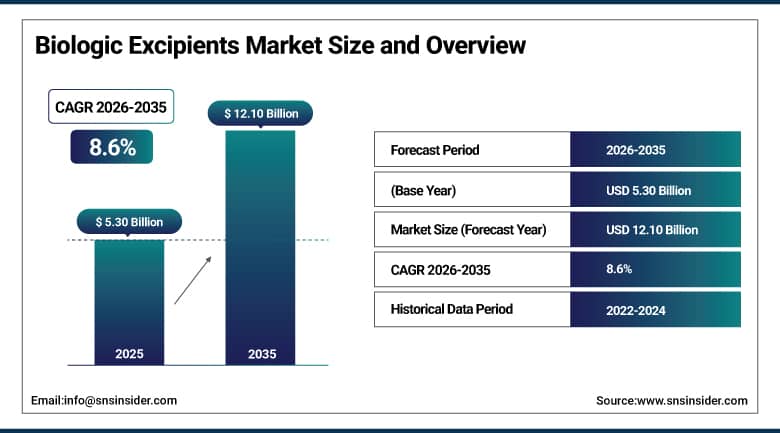
The Biologic Excipients Market was valued at USD 5.30 Billion in 2025 and is projected to reach USD 12.10 Billion by 2035, registering a CAGR of 8.6% from 2026 to 2035.
The Biologic Excipients Market is changing the whole process of formulation and stabilization of large molecules by providing various stabilizers, surfactants, buffers, and bulking agents to protect monoclonal antibodies, vaccines, recombinant proteins, and cell and gene therapies during the manufacturing, storage, and delivery process. The market is driven by increasing demand for high concentration protein formulations, rising subcutaneous and self-administration of biologics, use of innovative excipients with expanding regulatory pathways, and adoption across oncology, autoimmune, and rare diseases treatment. There is significant development taking place in the domain of lyophilization stabilizers, viscosity reduction systems, and animal origin free excipients considering that there is a massive investment being made in the formulation science in order to protect the structure of protein and enhance shelf-life.
Croda International Plc advanced its BioXPro range of biologic excipients through 2025 and into 2026, expanding its Super Refined Poloxamer 188 portfolio to support high-concentration monoclonal antibody formulations for biopharmaceutical manufacturers worldwide.
To Get More Information On Biologic Excipients Market - Request Free Sample Report
Biologic Excipients Market Trends
-
Rising adoption of high-concentration subcutaneous biologic formulations continues driving demand for viscosity-reduction and stabilization excipients.
-
Growing shift toward animal-origin-free and synthetic excipient grades continues easing regulatory qualification for biopharmaceutical manufacturers.
-
Increasing use of novel excipients under expanded regulatory pathways continues opening new formulation possibilities beyond compendial ingredients.
-
Rising investment in lyophilization and cold-chain-independent formulation technology continues extending biologic drug shelf life and distribution reach.
-
Expanding cell and gene therapy pipelines continue creating fresh demand for specialized cryoprotectants and stabilization excipients.
U.S. Biologic Excipients Market Outlook
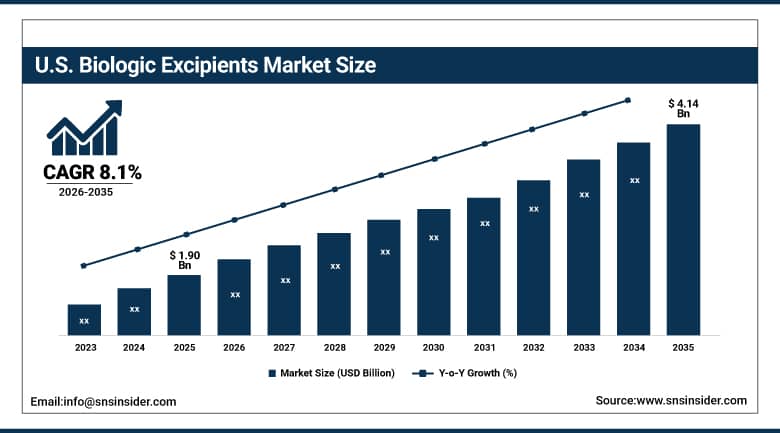
The U.S. Biologic Excipients Market was valued at approximately USD 1.90 Billion in 2025 and is projected to reach approximately USD 4.14 Billion by 2035, registering a CAGR of approximately 8.1% from 2026 to 2035.
Demand across the United States continued to be shaped by a dense concentration of leading biopharmaceutical manufacturers, contract development and manufacturing organizations, and specialty excipient suppliers headquartered across the country, alongside sustained FDA approvals of monoclonal antibody and cell and gene therapy products requiring specialized formulation support. Rising adoption of high-concentration, self-administered biologic formulations by domestic manufacturers continued reinforcing the country's position as both an early adopter and a genuine innovation hub for advanced excipient technology. Growing investment in domestic biomanufacturing capacity, spurred by supply chain resilience initiatives, added further layers of sustained demand for GMP-grade stabilizers, surfactants, and buffering agents well beyond the industry's traditional monoclonal antibody base.
MilliporeSigma, the U.S. life science business of Merck KGaA, opened a new BioReliance testing facility in 2025 to expand release and stability testing capacity for monoclonal antibody and cell therapy formulations supplied to American biopharmaceutical manufacturers.
Biologic Excipients Market Segmentation Analysis
-
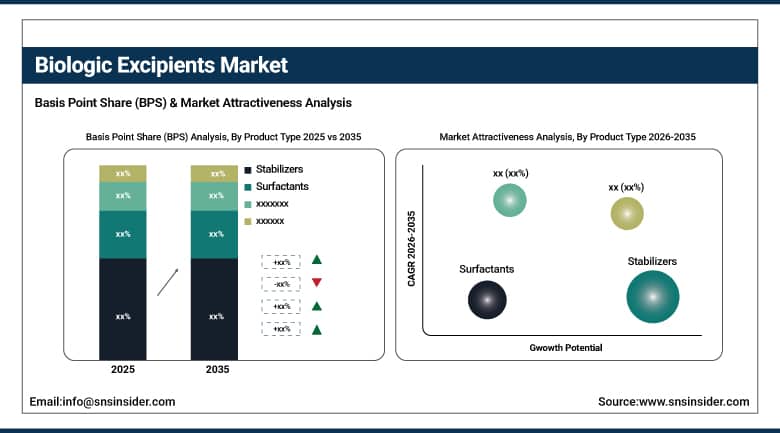
By Product Type, Stabilizers segment dominated the Biologic Excipients Market in 2025 with 38% share; Surfactants segment is the fastest growing segment, registering a CAGR of approximately 8.5%.
-
By Formulation, Liquid/Parenteral segment dominated the market in 2025 with 59% share; Lyophilized segment is the fastest growing segment, registering a CAGR of approximately 9.03%.
-
By Source, Synthetic segment dominated the market in 2025 with 63% share; Natural/Biological segment is the fastest growing segment, registering a CAGR of approximately 9.5%.
-
By Application, Monoclonal Antibodies segment dominated the market in 2025 with 56% share; Cell & Gene Therapies segment is the fastest growing segment, registering a CAGR of approximately 10.3%.
-
By End User, Biopharmaceutical & Biotechnology Companies segment dominated the market in 2025 with 62% share; CDMOs/CMOs segment is the fastest growing segment, registering a CAGR of approximately 9.2%.
By Product Type: Stabilizers Lead, Surfactants Grow Fastest
Stabilizers was the dominating segment in the Biologic Excipients Market in 2025 owing to the common application of sugar, polyol, and amino acid-derived stabilizers like sucrose, trehalose, and mannitol for the prevention of aggregation, oxidation, and denaturation of monoclonal antibodies, recombinant proteins, and vaccine antigens. The rising number of high-concentration and subcutaneous biologic formulations entering commercial and late-stage clinical pipelines has necessitated substantial investment in advanced stabilization chemistries capable of preserving conformational integrity across a broader range of temperature and shear stress conditions. Increasing use of co-processed and multi-functional stabilizer blends in both liquid and lyophilized formulations has boosted revenues for established excipient suppliers, and these products are expected to continue contributing the largest share of total category spending through the forecast period.
The Surfactants segment is the fastest growing in the Biologic Excipients Market owing to the rising need for polysorbate and poloxamer-based surfactants that prevent protein aggregation at the air-water and container-surface interfaces encountered during filling, shipping, and administration of injectable biologics. Growing regulatory scrutiny of polysorbate degradation and particulate formation has accelerated demand for higher-purity, animal-origin-free surfactant grades among biopharmaceutical manufacturers seeking to reduce immunogenicity risk and extend shelf life. Rising adoption of poloxamer alternatives in high-concentration subcutaneous formulations, combined with growing CDMO investment in surfactant characterization and quality-by-design formulation platforms, is expected to keep this category expanding meaningfully faster than the broader biologic excipients market through 2035.
By Formulation: Liquid/Parenteral Formulations Dominate, Lyophilized Leads Growth
The Liquid/Parenteral segment dominated the Biologic Excipients Market because most monoclonal antibody, vaccine, and recombinant protein products continue to reach patients through injectable routes that demand excipients formulated for immediate stability, sterility, and syringeability. Manufacturers rely on liquid-compatible stabilizers, tonicity agents, and buffering systems to maintain protein conformation and prevent aggregation across the cold-chain distribution networks that most commercial biologics still depend upon. Rising demand for prefilled syringes, autoinjectors, and other self-administration devices has further reinforced the dominance of liquid parenteral formulation excipients, as manufacturers prioritize ready-to-use products that reduce reconstitution error and improve patient convenience across chronic disease treatment settings, including oncology, autoimmune, and metabolic disorder therapies.
The Lyophilized segment is the fastest growing in the Biologic Excipients Market owing to the rising number of cell and gene therapies, antibody-drug conjugates, and thermally sensitive biologics that require freeze-drying to achieve commercially viable shelf life without continuous cold-chain support. Growing demand for cryoprotectants and lyoprotectant excipients, including trehalose, sucrose, and specialized polymer blends, continues supporting formulation scientists in preserving product potency through the freezing, primary drying, and secondary drying stages of the lyophilization cycle. Expanding distribution of biologics into regions with limited cold-chain infrastructure is further accelerating adoption of lyophilized formulation approaches, keeping this category's growth rate meaningfully ahead of liquid parenteral formulations through the forecast period.
By Source: Synthetic Excipients Dominate, Natural/Biological Sources Grow Fastest
The Synthetic segment has led the market for Biologic Excipients because of its batch-to-batch consistency, less risk of contamination, and easier regulatory approval than natural excipients. Pharmaceutical companies involved in the production of monoclonal antibodies and recombinant proteins on a large scale have been relying on synthetic categories of excipients so that lot-to-lot variations and contamination from adventitious agents can be minimized. An increase in the production capacity of synthetic-grade excipients by leading companies in the market, along with pharmacopoeia guidelines, has helped the segment maintain its dominance in both established and emerging biomanufacturing markets.
The Natural/Biological segment is the fastest growing in the Biologic Excipients Market owing to rising demand for animal-origin-free, plant-derived, and fermentation-based excipients that align with sustainability commitments and reduce transmissible spongiform encephalopathy risk in biologic formulations. The increasing tendency of manufacturers to use bio-derived stabilizers and bulk agents based on polysaccharides can be seen as the result of both regulatory push and customer preference for products with sustainable and traceable raw material sources. The increasing investments made by specialized ingredient manufacturers into the production of fermented amino acids and biopolymers will ensure the growth of this segment outpacing the competitors through 2035.
By Application: Monoclonal Antibodies Dominate, Cell & Gene Therapies Grow Fastest
The Monoclonal Antibodies segment dominated the Biologic Excipients Market due to the sheer scale of commercial mAb manufacturing across oncology, autoimmune, and inflammatory disease treatment, which continues to require large volumes of specialized stabilizers, surfactants, and buffering agents to maintain protein structure through production, fill-finish, and distribution. The growing number of high-concentration and subcutaneous mAb formulations entering the market has further increased excipient intensity per approved product, as formulators incorporate viscosity-reduction platforms and advanced stabilizer blends to enable patient self-administration. Continued expansion of the global monoclonal antibody pipeline, supported by biosimilar approvals and next-generation antibody formats, is expected to keep this application the largest excipient consumer through the forecast period.
The Cell & Gene Therapies segment is the fastest growing in the Biologic Excipients Market owing to the rapid expansion of chimeric antigen receptor cell therapy and gene therapy pipelines, which require highly specialized cryoprotectants, buffers, and stabilization excipients capable of preserving cell viability and vector integrity through freezing, thawing, and administration. Rising regulatory approvals for cell and gene therapy products, combined with growing investment in commercial-scale manufacturing capacity by both established biopharmaceutical companies and specialized CDMOs, continues creating fresh demand for excipients formulated specifically for living cells and viral vectors rather than conventional protein biologics, keeping this application's growth rate well ahead of the broader market.
Regional Analysis
|
Region |
Major Country |
Share within Region, 2025 (%) |
|---|---|---|
|
North America |
United States |
82.30% |
|
Europe |
Germany |
22.60% |
|
Asia Pacific |
China |
33.40% |
|
Middle East and Africa |
Saudi Arabia |
24.80% |
|
Latin America |
Brazil |
36.20% |
North America Biologic Excipients Market Insights
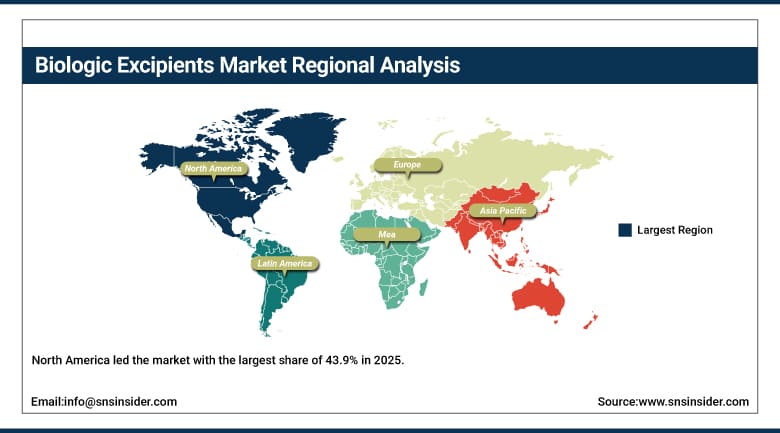
North America led the market with the largest share of 43.9% in 2025. The region's dense concentration of major biopharmaceutical manufacturers, contract development and manufacturing organizations, and specialty excipient suppliers, combined with a sustained pace of monoclonal antibody and cell and gene therapy approvals, continued reinforcing this dominant regional position. Established regulatory pathways for novel excipient qualification through the FDA, together with deep capital availability for biomanufacturing expansion, further supported the region's leadership in adopting advanced stabilization and formulation technologies across both commercial-scale and clinical-stage biologic drug development programs.
The United States accounted for roughly 82.30% of regional revenue, anchored by its concentration of leading biopharmaceutical companies, CDMOs, and excipient manufacturers, alongside substantial federal and private investment in domestic biomanufacturing capacity. Canada added further regional demand through its own growing biotechnology sector and expanding cell and gene therapy manufacturing base, and that combined strength kept the continent the largest addressable market for biologic excipient suppliers through the forecast period.
Get Customized Report as Per Your Business Requirement - Enquiry Now
Europe Biologic Excipients Market Insights
Europe held a meaningful share of global revenue, supported by a well-established biopharmaceutical manufacturing base, strong regulatory alignment through the European Medicines Agency, and continued government investment in biomanufacturing sovereignty across the region's major economies. Growing emphasis on animal-origin-free and sustainably sourced excipients across European pharmacopeial guidance continued shaping supplier strategy and product development priorities throughout the region's biologic drug development ecosystem.
Germany led demand of European revenue, supported by its substantial biopharmaceutical manufacturing base and concentration of specialty chemical and excipient producers. The UK and France contributed substantial additional demand through their own expanding biotechnology and cell and gene therapy manufacturing sectors, and continued European investment in domestic biomanufacturing capacity should keep regional demand for biologic excipients climbing through the forecast period.
Asia Pacific Biologic Excipients Market Insights
Asia Pacific is advancing at the fastest pace among all regions tracked in this report, registering a CAGR of approximately 10.4% from 2026 to 2035, driven by rapid expansion of domestic biomanufacturing capacity, growing biosimilar and monoclonal antibody production, and rising government-backed investment in biopharmaceutical infrastructure across the region's largest economies. That combination of manufacturing scale-up and rapidly growing biologic drug pipelines kept the region's growth trajectory well ahead of every other region tracked in this report.
China led the pack, supported by substantial government investment in domestic biopharmaceutical manufacturing capability and an expanding pipeline of monoclonal antibody and biosimilar products. Japan and South Korea contributed meaningful additional demand, with Japan's advanced formulation science capability and South Korea's growing biosimilar manufacturing base both reinforcing the region's position as the fastest-growing market tracked in this report.
MEA and Latin America Biologic Excipients Market Insights
The Middle East and Africa and Latin America both showed steady growth, driven by expanding domestic pharmaceutical manufacturing initiatives, growing government focus on biomanufacturing self-sufficiency, and rising demand for locally produced biosimilars and vaccines across both regions. As these markets continued building out modern biopharmaceutical manufacturing infrastructure, biologic excipients proved a genuinely essential input for achieving product stability and regulatory compliance.
Saudi Arabia led Middle East and Africa demand, backed by investments made by the nation in biomanufacturing within its plans to diversify industry. On the other hand, South Africa added more demand due to its increasing capacity to manufacture vaccines and biosimilars. Brazil was the biggest contributor to Latin America’s demand with growing biosimilar production in the region.
Market Dynamics
Growth Drivers: Rising Demand for High-Concentration Biologic Formulations and Expanding Cell & Gene Therapy Pipelines
The industry is driven by rising demand for high-concentration and subcutaneous biologic formulations, expansion of monoclonal antibody and biosimilar manufacturing capacity, increasing adoption of novel and animal-origin-free excipient grades, and growing investment across oncology, autoimmune, and rare disease therapeutic pipelines. As the number of approved biologic drugs and late-stage clinical candidates continues to rise, the need for specialized stabilizers, surfactants, and buffering systems capable of preserving protein structure across manufacturing, storage, and administration continues driving adoption of advanced excipient technologies.
Rising investment in cell and gene therapy manufacturing continues reinforcing this driver, as these living-cell and viral-vector products require highly specialized cryoprotectants and stabilization excipients unlike those used in conventional protein biologics. Growing regulatory support for novel excipient qualification pathways, combined with expanding CDMO investment in high-concentration formulation and lyophilization capacity, continues defining a formulation landscape that increasingly favors suppliers capable of delivering both established and next-generation excipient chemistries, and that combination of therapeutic diversity and formulation complexity is exactly what keeps demand climbing at such a sustained pace.
Restraints: High Qualification Costs for Novel Excipients and Limited Compendial Standards
The substantial cost and multi-year timeline required to qualify novel excipients through regulatory review continues posing a genuine restraint on faster market-wide adoption of innovative stabilization chemistries, particularly for smaller excipient developers without the regulatory affairs budgets that established suppliers can commit. That qualification burden has kept many biopharmaceutical formulators reliant on a comparatively narrow set of compendial excipients with established regulatory precedent.
Limited harmonization of excipient quality standards across different regulatory jurisdictions continues posing a further restraint, as manufacturers supplying multiple global markets must navigate varying documentation, testing, and qualification requirements for the same excipient grade. That complexity keeps some novel excipient introductions more technically and administratively complicated than established compendial materials, slowing the pace at which genuinely differentiated stabilization technologies reach commercial biologic formulations.
Opportunities: Subcutaneous Self-Administration Formulations and Emerging Market Biomanufacturing Expansion
Rising demand for subcutaneous, self-administered biologic formulations represents a genuinely significant opportunity, as viscosity-reduction platforms and high-concentration stabilizer systems become essential to enabling patient-administered delivery of therapies that previously required infusion center visits. Vendors positioned early in high-concentration formulation excipient technology stand to capture meaningful share as chronic disease treatment continues shifting toward home-based biologic administration.
Increasing biomanufacturing capabilities in developing economies provides another significant growth area, where government programs designed to develop the capability to produce vaccines and biosimilars have generated a new need for GMP-grade excipients within countries that traditionally relied on imports of biopharmaceutical products. Companies that possess an effective and economical excipient solution should be able to capitalize on increasing investments in biomanufacturing capabilities in developing economies.
Recent Developments:
-
2026: BASF expanded its pharmaceutical excipients portfolio through enhanced manufacturing capabilities and continued investment in high-purity excipient solutions for biologic formulations.
-
2025: Croda's Avanti Research division entered a strategic supply partnership with Amino GmbH to strengthen global availability of pharmaceutical-grade amino acid excipients used in monoclonal antibody and biotherapeutic formulation.
-
2025: Evonik Industries AG partnered with evitria to offer a ready-to-use CHO cell-based protein expression kit, expanding its portfolio of tools supporting biopharmaceutical formulation and development.
Biologic Excipients Market Key Players are:
-
BASF SE
-
Evonik Industries AG
-
DuPont de Nemours, Inc.
-
Ashland Inc.
-
Croda International Plc
-
Merck KGaA (MilliporeSigma)
-
Roquette Frères
-
JRS Pharma
-
Colorcon, Inc.
-
Avantor, Inc.
-
Lonza Group AG
-
Wacker Chemie AG
-
Gattefossé SAS
-
International Flavors & Fragrances Inc. (IFF)
-
FUJIFILM Wako Pure Chemical Corporation
-
Kerry Group plc
-
NOF Corporation
-
Spectrum Chemical Manufacturing Corp.
-
Fenchem Biotek Ltd.
-
Nitta Gelatin Inc.
Biologic Excipients Market Report Scope:
| Report Attributes | Details |
|---|---|
| Market Size in 2025 | USD 5.30 Billion |
| Market Size by 2035 | USD 12.10 Billion |
| CAGR | CAGR of 8.6% From 2026 to 2035 |
| Base Year | 2025 |
| Forecast Period | 2026-2035 |
| Historical Data | 2022-2024 |
| Report Scope & Coverage | Market Size, Segments Analysis, Competitive Landscape, Regional Analysis, DROC & SWOT Analysis, Forecast Outlook |
| Key Segments | • By Product Type (Stabilizers, Surfactants, Bulking Agents & Diluents, Buffering Agents, Others) • By Formulation (Liquid/Parenteral, Lyophilized) • By Source (Synthetic, Natural/Biological) • By Application (Monoclonal Antibodies, Vaccines, Recombinant Proteins, Cell & Gene Therapies, Other Biologics) • By End User (Biopharmaceutical & Biotechnology Companies, CDMOs/CMOs, Academic & Research Institutes), and Region. |
| Regional Analysis/Coverage | North America (US, Canada), Europe (Germany, UK, France, Italy, Spain, Russia, Poland, Rest of Europe), Asia Pacific (China, India, Japan, South Korea, Australia, ASEAN Countries, Rest of Asia Pacific), Middle East & Africa (UAE, Saudi Arabia, Qatar, South Africa, Rest of Middle East & Africa), Latin America (Brazil, Argentina, Mexico, Colombia, Rest of Latin America). |
| Company Profiles | BASF SE, Evonik Industries AG, DuPont de Nemours, Inc., Ashland Inc., Croda International Plc, Merck KGaA (MilliporeSigma), Roquette Frères, JRS Pharma, Colorcon, Inc., Avantor, Inc., Lonza Group AG, Wacker Chemie AG, Gattefossé SAS, International Flavors & Fragrances Inc. (IFF), FUJIFILM Wako Pure Chemical Corporation, Kerry Group plc, NOF Corporation, Spectrum Chemical Manufacturing Corp., Fenchem Biotek Ltd., Nitta Gelatin Inc. |
Frequently Asked Questions
Key Palyers include BASF SE, Evonik Industries AG, DuPont de Nemours, Inc., Ashland Inc., and Croda International Plc, among others.
Key opportunities include expanding biologics pipelines, increasing demand for advanced injectable formulations, development of high-performance excipients, and growing adoption of innovative drug-delivery technologies.
The major growth factor is rising demand for high-concentration and subcutaneous biologic formulations, expansion of monoclonal antibody and biosimilar manufacturing capacity, and increasing adoption of novel, animal-origin-free excipient grades.
The Stabilizers segment dominated the Biologic Excipients Market by product type, representing the largest share of revenue in 2025.
North America dominated the Biologic Excipients Market in 2025, holding an estimated 43.9% share of total global market revenue.
