
High Reliability Semiconductor Market Report Scope and Overview:
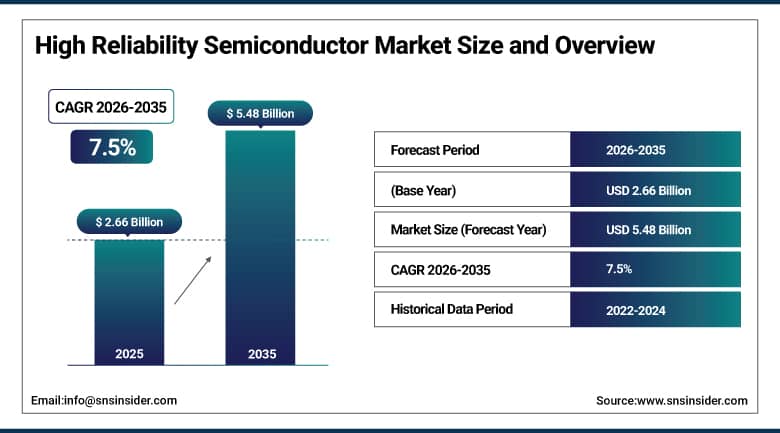
The High Reliability Semiconductor Market size was valued at USD 2.66 Billion in 2025 and is projected to reach USD 5.48 Billion by 2035, registering a CAGR of 7.5% from 2026 to 2035.
The High Reliability Semiconductor Market ensures the reliability of critical electronic systems through the design of semiconductors that are reliable enough to function in extreme conditions, such as radiation-hardened semiconductors used in space exploration, military communication, medical devices, and industrial control systems. The market is defined by increased revival of the aerospace industry, government expenditure on space exploration, defense upgrade initiatives among NATO allies countries, and increasing manufacture of medical devices, which require radiation-tolerant components for pacemakers and neurostimulators. Growth has been seen in satellite constellation systems, missile navigation, and down-hole drilling instruments, since the semiconductor manufacturers are heavily investing in the production of radiation-hardened and radiation-tolerant semiconductors meeting the MIL-STD-883 qualification standards.
Texas Instruments expanded manufacturing capacity at its Sherman, Texas facility throughout 2025 with capital investments exceeding $420 million, supporting increased aerospace and space semiconductor demand across its radiation-hardened product portfolio.
To Get More Information On High Reliability Semiconductor Market - Request Free Sample Report
High Reliability Semiconductor Market Trends
-
Growing commercial satellite constellation expansion continues driving demand for radiation-hardened power management and memory semiconductors.
-
Rising defense platform modernization across NATO allied nations continues expanding procurement of radiation-hardened logic and analog devices.
-
Increasing implantable medical device adoption among an aging global population continues driving demand for radiation-tolerant miniaturized semiconductors.
-
Expanding autonomous aerospace and defense systems continues broadening demand for radiation-hardened field-programmable gate array technology.
-
Growing industrial applications in extreme operating environments continues supporting sustained demand for high-temperature-rated semiconductor components.
U.S. High Reliability Semiconductor Market Size Outlook
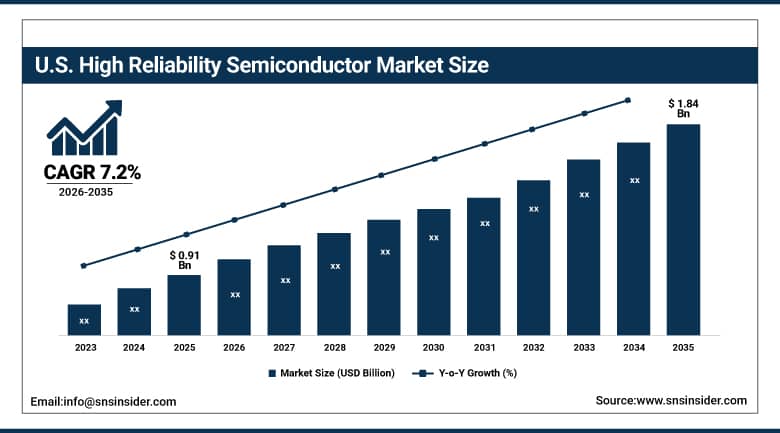
The U.S. High Reliability Semiconductor Market was valued at approximately USD 0.91 Billion in 2025 and is projected to reach approximately USD 1.84 Billion by 2035, registering a CAGR of approximately 7.2% from 2026 to 2035.
Demand across the United States continued to be shaped by dominant aerospace and defense spending, concentration of semiconductor manufacturers in Arizona and California, and extensive military procurement budgets. Rising deployment of radiation-hardened power management devices and specialized memory components by domestic defense and space programs continued reinforcing the country's position as both the largest and most innovation-driven market tracked in this report. Growing adoption across satellite constellation manufacturing, medical implant technology, and industrial down-hole instrumentation added further layers of sustained domestic demand well beyond the technology's traditional military and aerospace use case.
Analog Devices expanded its radiation-hardened operational amplifier and precision analog-to-digital converter portfolio throughout 2025, targeting medical implant and aerospace sensor interface applications requiring stringent signal accuracy standards.
High Reliability Semiconductor Market Segment Analysis
-
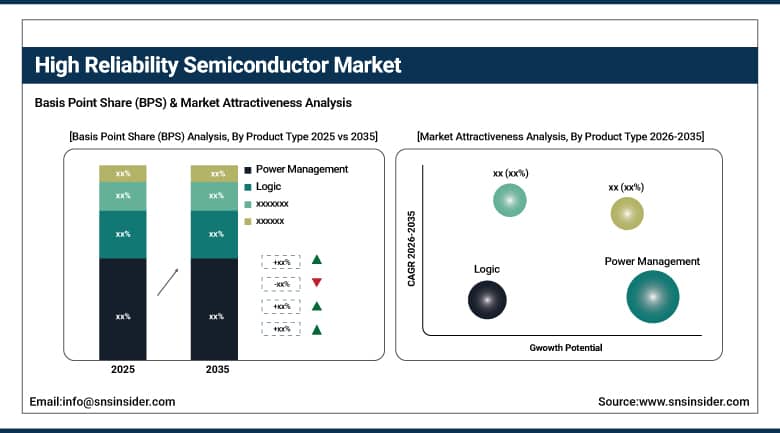
By Product Type, Power Management segment dominated the High Reliability Semiconductor Market in 2025 with 28.5% share; Logic segment is the fastest growing segment.
-
By Application, Aerospace segment dominated the market in 2025 with 31.2% share; Medical segment is the fastest growing segment.
-
By Technology, Radiation Hardened segment dominated the market in 2025 with 64.3% share; Radiation Tolerant segment is the fastest growing segment.
-
By End-User, Military segment dominated the market in 2025 with 41.7% share; Space segment is the fastest growing segment.
By Product Type, Power Management Leads While Logic Grows Fastest
The Power Management segment dominated the High Reliability Semiconductor Market in 2025 owing to sustained demand for voltage regulators, power conversion circuits, and specialized power distribution modules engineered to operate reliably across extended temperature ranges and radiation environments. Satellite bus architectures continue requiring multiple distinct power domain management circuits with redundant switching topologies ensuring mission success despite single-point component failures. Continued satellite constellation power system requirements have kept power management the largest single revenue contributor within the product type landscape tracked in this report.
The Logic segment is the fastest growing in the High Reliability Semiconductor Market owing to accelerating demand for radiation-hardened field-programmable gate arrays supporting satellite autonomous operation requirements and military platform digital transformation initiatives. Aerospace avionics systems increasingly incorporate field-programmable gate array-based solutions enabling in-orbit and in-flight functionality updates. Growing military communications equipment digitalization continues accelerating demand for radiation-hardened logic device technology across the industry.
By Application, Aerospace Dominates While Medical Records Fastest Growth
The Aerospace segment dominated the High Reliability Semiconductor Market in 2025 due to sustained commercial aircraft avionics demand and rapidly accelerating satellite manufacturing rates, with major contractors reporting substantial year-over-year production rate increases. Commercial aircraft manufacturers continue mandating radiation-tolerant semiconductor components in next-generation avionics architectures for aircraft operating polar routes experiencing elevated cosmic radiation exposure. Sustained satellite constellation deployment and commercial aircraft production has kept aerospace the largest overall revenue contributor across the market.
The Medical segment is the fastest growing in the High Reliability Semiconductor Market owing to the global aging population driving accelerating implantable cardioverter-defibrillator, pacemaker, and neurostimulator device demand requiring radiation-tolerant semiconductor components capable of sustained operation over extended implantation periods. Leadless pacemaker technology emergence has created specialized semiconductor miniaturization requirements incorporating analog mixed-signal devices in increasingly compact packages. Growing global aging population continues driving sustained growth in medical-oriented high reliability semiconductor demand.
By Technology, Radiation Hardened Leads While Radiation Tolerant Grows Fastest
The Radiation Hardened segment dominated the High Reliability Semiconductor Market in 2025 due to space applications predominantly specifying radiation-hardened components engineered with dedicated design and manufacturing process modifications providing inherent resistance to total ionizing dose effects and single-event upset phenomena. Government procurement regulations mandate qualification under MIL-STD-883 or equivalent aerospace standards for the most demanding space environments. Sustained space agency and defense procurement has kept radiation hardened technology the largest overall contributor to market revenue.
The Radiation Tolerant segment is the fastest growing in the High Reliability Semiconductor Market owing to rising aerospace and defense platform preference for commercial device architectures incorporating radiation-tolerant design practices that offer improved performance and density compared to radiation-hardened alternatives. This approach enables integration of higher-complexity digital functions supporting field-programmable gate array and application-specific integrated circuit applications with greater functional integration. Growing customer interest in enhanced error correction capabilities continues accelerating adoption of radiation-tolerant semiconductor technology across the industry.
By End-User, Military Leads While Space Grows Fastest
The Military segment dominated the High Reliability Semiconductor Market in 2025 due to sustained procurement of defense electronic systems, military communications platforms, radar systems, and electronic warfare equipment requiring extended operational lifespans and reliability in jamming-rich electromagnetic environments. Military communications modernization initiatives across NATO member states continued driving increased funding for next-generation tactical radio systems and satellite communications terminals. Continued global military platform modernization investment has kept this end-user segment the largest overall contributor to market revenue.
The Space segment is the fastest growing in the High Reliability Semiconductor Market owing to unprecedented satellite constellation development from private space ventures and government space agencies, with projected low-earth orbit satellite deployments reaching tens of thousands of units by the end of the forecast period. Commercial satellite manufacturers have substantially increased radiation-hardened semiconductor allocations to support mega-constellation programs. Accelerating global commercial and government space investment continues driving sustained growth in space-oriented high reliability semiconductor demand.
Regional Analysis
|
Region |
Major Country |
Share within Region, 2025 (%) |
|---|---|---|
|
North America |
United States |
90.00% |
|
Europe |
Germany |
32.00% |
|
Asia Pacific |
Japan |
34.00% |
|
Middle East and Africa |
UAE |
27.00% |
|
Latin America |
Brazil |
55.00% |
North America High Reliability Semiconductor Market Insights
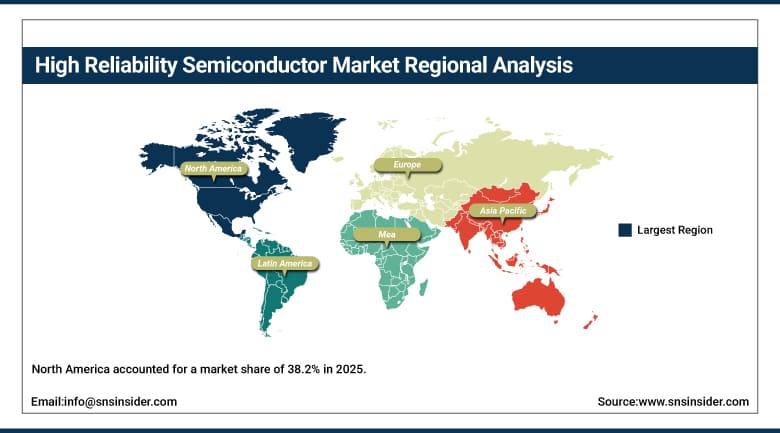
North America accounted for a market share of 38.2% in 2025. Dominant aerospace and defense spending, concentration of semiconductor manufacturers in Arizona and California, and extensive military procurement budgets continued reinforcing the region’s strong position. Integrated defense systems procurement modernization spanning advanced fighter aircraft platforms, long-range strike systems, and satellite communication networks ensured sustained demand for radiation-hardened power management devices, analog signal processors, and specialized memory components further strengthening North America’s standing as the largest market tracked in this report, with continued NASA and private space venture investment expected to sustain regional demand through the forecast period.
The United States accounted for roughly 90.00% of regional revenue, anchored by its concentration of leading radiation-hardened semiconductor manufacturers and substantial military and space procurement budgets. Canada added further regional demand through its own growing aerospace and defense technology sector, and that combined strength kept the continent the largest addressable market for high reliability semiconductor vendors through the forecast period, with continued satellite constellation investment expected to sustain regional demand.
Get Customized Report as Per Your Business Requirement - Enquiry Now
Europe High Reliability Semiconductor Market Insights
Europe represented a substantial share of global revenue, accelerating on the strength of the European Space Agency’s Copernicus earth observation constellation expansion, Galileo satellite navigation system enhancements, and European Defence Fund initiatives supporting autonomous weapons systems research. The region’s medical device manufacturers, concentrated in Germany, Switzerland, and Scandinavia, represent substantial end-users of radiation-tolerant semiconductor components for pacemakers, neurostimulators, and implantable cardioverter-defibrillators requiring multi-year implant reliability.
Germany led demand at roughly 32.00% of European revenue, supported by its substantial medical device manufacturing base and defense modernization investment. France and the UK contributed additional demand through aerospace and defense platform programs, and continued European Defence Fund-backed investment should keep regional demand for high reliability semiconductor technology climbing steadily through the forecast period.
Asia Pacific High Reliability Semiconductor Market Insights
Asia Pacific is advancing at the fastest pace among all regions, registering a CAGR of 8.5% from 2026 to 2035, with growth momentum centered on Japan’s aerospace component supply chain, India’s space program expansion through ISRO’s Chandrayaan and Gaganyaan initiatives, and South Korea’s emerging satellite constellation projects. The region’s medical device manufacturing base, particularly in Taiwan and Malaysia, drives incremental demand for radiation-tolerant mixed-signal semiconductors, kept the region’s growth trajectory well ahead of every other region tracked in this report.
Japan led the pack, supported by its established aerospace component supply chain and advanced semiconductor manufacturing capability. India contributed meaningful additional demand through its expanding national space program, with South Korea’s emerging satellite constellation projects and Taiwan’s medical device manufacturing base both reinforcing the region’s position as the fastest-growing high reliability semiconductor market tracked in this report.
MEA and Latin America High Reliability Semiconductor Market Insights
The Middle East and Africa and Latin America both showed steady growth, driven by military communications systems, satellite ground stations, and emerging renewable energy systems requiring semiconductor controllers rated for desert operating environments and extreme temperature cycling. Latin America’s growth concentrated on oil and gas down-hole instrumentation applications requiring high-temperature semiconductor devices and Brazilian aerospace component suppliers supporting Embraer defense platform production.
The UAE led Middle East and Africa demand, supported by military communications infrastructure and satellite ground station investment. Saudi Arabia contributed further demand through defense modernization programs. In Latin America, Brazil accounted for the dominant share of regional revenue, anchored by Embraer defense platform production and growing down-hole drilling instrumentation demand continuing to support regional demand for high reliability semiconductor technology.
Market Dynamics
Growth Drivers: Aerospace Modernization and Commercial Satellite Expansion
The industry is driven by global defense spending reaching record levels with growing annual allocation toward next-generation platform development, unprecedented satellite constellation deployment from private space ventures and government agencies, rising implantable medical device placement among an aging global population, and expanding industrial applications in extreme operating environments. As governments and manufacturers continue prioritizing mission-critical reliability, the need for expanded radiation-hardened and radiation-tolerant semiconductor technology continues driving sustained investment across the industry.
Rising NATO allied nation military technology investment continues reinforcing this driver, with semiconductor reliability specifications becoming non-negotiable procurement criteria across advanced fighter aircraft, hypersonic missile systems, and space-based sensor networks. Growing commercial spaceflight industry development continues defining a further layer of sustained demand, and that combination of defense modernization and space exploration investment is exactly what keeps overall demand climbing at such a steady, sustained pace.
Restraints: Supply Chain Concentration and Extended Manufacturing Lead Times
Semiconductor supply chain vulnerability continues posing a genuine restraint on faster market-wide expansion, with radiation-hardened semiconductor manufacturing concentrated among limited suppliers creating single-source supply risk for critical defense and space applications. Recent geopolitical tensions and export control regulations have restricted access to advanced semiconductor manufacturing capacity for certain international customers, potentially fragmenting global supply chains and increasing costs.
Lead time extensions for radiation-hardened memory and logic devices continue posing a further restraint, with procurement cycles extending to lengthy periods creating supply risk for customer programs requiring rapid deployment timelines. Manufacturing cost pressures from increasing wafer processing expenses and limited yield improvement opportunities at radiation-hardened process nodes constrain profit margins, keeping next-generation technology node development more administratively complicated than standard semiconductor manufacturing would otherwise require.
Opportunities: Emerging Space Markets and Autonomous Aerospace Systems
Emerging space markets represent a genuinely significant opportunity, with commercial space ventures collectively raising substantial venture capital funding supporting development of next-generation launch vehicles, satellite bus platforms, and in-space manufacturing capabilities requiring substantial semiconductor component procurement. Vendors positioned early in space-qualified semiconductor technology stand to capture meaningful share as this capability continues expanding from established government programs into broader commercial space ventures.
Expanding autonomous aerospace systems including unmanned aerial vehicles and advanced air mobility platforms offer a second substantial opportunity, requiring radiation-tolerant control electronics supporting extended operational lifespans and reliability requirements exceeding traditional aerospace standards. Vendors with proven, high reliability semiconductor technology stand to capture meaningful share as global autonomous aerospace development continues scaling across established and emerging application markets alike.
Recent Developments:
-
2025: Texas Instruments expanded manufacturing capacity at its Sherman, Texas facility with capital investments exceeding $420 million, supporting increased aerospace and space semiconductor demand across its radiation-hardened product portfolio.
-
2025: Analog Devices expanded its radiation-hardened operational amplifier and precision analog-to-digital converter portfolio, targeting medical implant and aerospace sensor interface applications requiring stringent signal accuracy standards.
-
2023: Micross Components acquired the high-reliability DC-DC converter business of Infineon Technologies, expanding its high-reliability power management solution capabilities for aerospace and defense customers.
High Reliability Semiconductor Companies are:
-
Analog Devices, Inc.
-
Microchip Technology Incorporated
-
Infineon Technologies AG
-
onsemi (ON Semiconductor Corporation)
-
STMicroelectronics N.V.
-
NXP Semiconductors N.V.
-
Teledyne Technologies Incorporated
-
Vishay Intertechnology, Inc.
-
Advanced Micro Devices, Inc. (AMD)
-
Broadcom Inc.
-
Cobham Advanced Electronic Solutions
-
TT Electronics plc
-
Micropac Industries, Inc.
-
The Boeing Company
-
BAE Systems plc
-
Northrop Grumman Corporation
-
RTX Corporation
-
Skyworks Solutions, Inc.
High Reliability Semiconductor Market Report Scope:
| Report Attributes | Details |
|---|---|
| Market Size in 2025 | USD 2.66 Billion |
| Market Size by 2035 | USD 5.48 Billion |
| CAGR | CAGR of 7.5% From 2026 to 2035 |
| Base Year | 2025 |
| Forecast Period | 2026-2035 |
| Historical Data | 2022-2024 |
| Report Scope & Coverage | Market Size, Segments Analysis, Competitive Landscape, Regional Analysis, DROC & SWOT Analysis, Forecast Outlook |
| Key Segments | • By Product Type (Power Management, Analog & Mixed Signal, Memory, Logic, Others) • By Application (Aerospace, Defense, Medical, Industrial, Others) • By Technology (Radiation Hardened, Radiation Tolerant) • By End-User (Military, Space, Commercial, Others) |
| Regional Analysis/Coverage | North America (US, Canada), Europe (Germany, UK, France, Italy, Spain, Russia, Poland, Rest of Europe), Asia Pacific (China, India, Japan, South Korea, Australia, ASEAN Countries, Rest of Asia Pacific), Middle East & Africa (UAE, Saudi Arabia, Qatar, South Africa, Rest of Middle East & Africa), Latin America (Brazil, Argentina, Mexico, Colombia, Rest of Latin America). |
| Company Profiles | Texas Instruments Incorporated, Analog Devices Inc., Microchip Technology Incorporated, Infineon Technologies AG, onsemi (ON Semiconductor Corporation), STMicroelectronics N.V., NXP Semiconductors N.V., Renesas Electronics Corporation, Teledyne Technologies Incorporated, Vishay Intertechnology Inc., Advanced Micro Devices Inc. (AMD), Broadcom Inc., Cobham Advanced Electronic Solutions, TT Electronics plc, Micropac Industries Inc., The Boeing Company, BAE Systems plc, Northrop Grumman Corporation, RTX Corporation, Skyworks Solutions Inc. |

Frequently Asked Questions
Key players in the High Reliability Semiconductor Market include Texas Instruments, Analog Devices, Microchip Technology, Infineon Technologies, and onsemi, among others.
Key opportunities in the High Reliability Semiconductor Market include emerging commercial space markets and the expansion of autonomous aerospace and defense systems.
The market is driven by aerospace and defense modernization, commercial satellite constellation expansion, increasing demand for radiation-hardened and radiation-tolerant semiconductors, and growing adoption of high-reliability components in medical devices.
The Power Management segment dominated the High Reliability Semiconductor Market, accounting for approximately 28.5% market share in 2025.
North America dominated the High Reliability Semiconductor Market in 2025 with a 38.2% share, driven by strong aerospace and defense spending, extensive military procurement, semiconductor manufacturing concentration, and growing space and satellite investment.
