
HVAC Sensors for Data Center Market Report Scope and Overview:
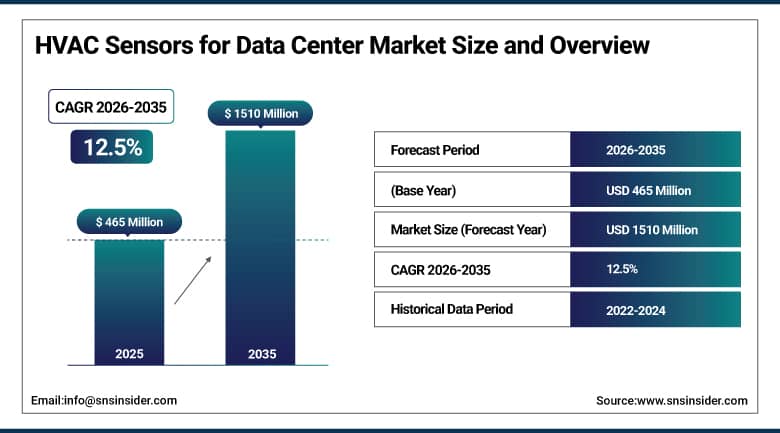
The HVAC Sensors for Data Center Market size was valued at USD 465 Million in 2025 and is projected to reach USD 1510 Million by 2035, registering a CAGR of 12.5% from 2026 to 2035.
The HVAC Sensors for Data Center Market is enabling precise thermal and environmental management across increasingly dense server infrastructure by providing temperature, humidity, airflow, and air quality monitoring capability essential to reliable cooling system operation. The market is characterized by rising deployment of sensors supporting hybrid air and liquid cooling architectures, growing adoption of wireless sensor networks reducing installation complexity in retrofit environments, and expanding integration with building automation and AI-driven cooling optimization platforms. Significant growth is being witnessed in hyperscale and colocation facility deployments, liquid cooling system monitoring, and predictive maintenance applications, considering that data center operators are investing heavily in granular environmental monitoring technology capable of supporting escalating power densities and increasingly stringent energy efficiency mandates.
Vertiv introduced its Vertiv Environet Alert environmental monitoring platform update throughout 2025, integrating expanded temperature, humidity, and airflow sensor support for liquid cooling-equipped data center racks.
To Get More Information On HVAC Sensors for Data Center Market - Request Free Sample Report
HVAC Sensors for Data Center Market Trends
-
Growing deployment of sensors supporting hybrid air and liquid cooling architectures continues addressing escalating rack power densities.
-
Rising adoption of wireless sensor networks continues reducing installation complexity across retrofit and brownfield data center environments.
-
Increasing integration with AI-driven cooling optimization platforms continues improving predictive maintenance and energy efficiency outcomes.
-
Expanding liquid cooling system deployment continues driving demand for specialized coolant temperature and leak-adjacent airflow sensors.
-
Growing hyperscale and colocation facility construction continues broadening sensor deployment across increasingly distributed data center footprints.
U.S. HVAC Sensors for Data Center Market Size Outlook
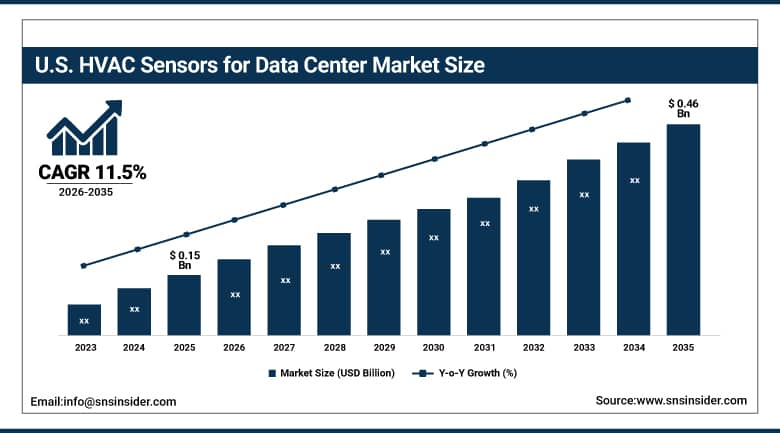
The U.S. HVAC Sensors for Data Center Market was valued at approximately USD 0.15 Billion in 2025 and is projected to reach approximately USD 0.46 Billion by 2035, registering a CAGR of approximately 11.5% from 2026 to 2035.
Demand across the United States continued to be shaped by aggressive hyperscale data center construction driven by generative AI infrastructure investment, sustained enterprise focus on energy efficiency compliance, and a deep concentration of leading environmental monitoring and building automation technology developers. Rising deployment of wireless, AI-integrated HVAC sensor networks by domestic hyperscale and colocation operators continued reinforcing the country's position as both the largest and one of the most innovation-driven markets tracked in this report. Growing adoption across liquid cooling monitoring, edge data center deployment, and predictive maintenance programs added further layers of sustained domestic demand well beyond the technology's traditional room-level monitoring use case.
Renesas Electronics expanded its RRH62000 environmental sensor module lineup throughout 2025, adding data center-grade calibration and extended operating temperature range for precision HVAC monitoring in server room applications.
HVAC Sensors for Data Center Market Segment Analysis
-
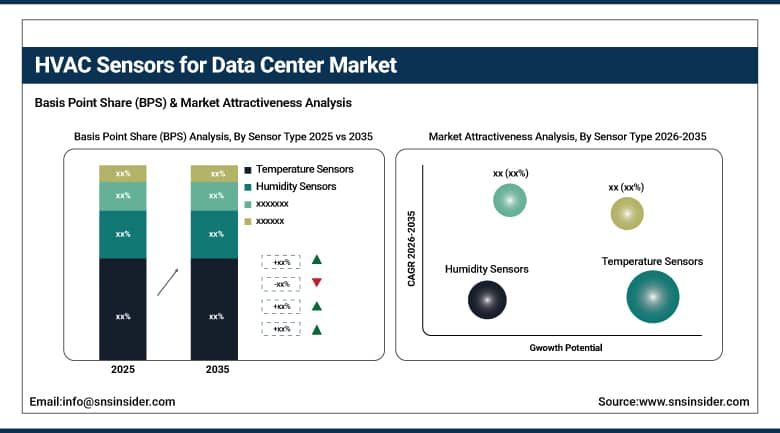
By Sensor Type, Temperature Sensors dominated the HVAC Sensors for Data Center Market with a 41.00% share in 2025, while Airflow/Differential Pressure Sensors is the fastest-growing segment with a CAGR of 14.20% from 2026–2035.
-
By Application, Room-Level/CRAC-CRAH Monitoring dominated the market with a 38.00% share in 2025, while Liquid Cooling Systems is the fastest-growing segment with a CAGR of 16.80% from 2026–2035.
-
By Connectivity, Wired dominated the market with a 63.00% share in 2025, while Wireless is the fastest-growing segment with a CAGR of 15.10% from 2026–2035.
-
By End-User, Colocation Data Centers dominated the market with a 34.00% share in 2025, while Hyperscale/Cloud Data Centers is the fastest-growing segment with a CAGR of 15.60% from 2026–2035.
By Sensor Type, Temperature Leads While Airflow Sensors Grow Fastest
The Temperature Sensors segment dominated the HVAC Sensors for Data Center Market in 2025 owing to its foundational role in monitoring chilled water supply and return temperatures, condenser loop performance, and air handler discharge conditions across virtually every data center cooling architecture. Facility operators continue relying on temperature sensing as the primary input for automated cooling system response. Continued growth in rack power density has kept temperature sensors the largest single revenue contributor within the sensor type landscape tracked in this report.
The Airflow/Differential Pressure Sensors segment is the fastest growing in the HVAC Sensors for Data Center Market owing to rising complexity in hot-aisle and cold-aisle containment management and increasing adoption of hybrid air-liquid cooling architectures requiring precise airflow balancing. Facility engineers increasingly deploy differential pressure sensors to optimize containment effectiveness and prevent recirculation-driven hot spots. Growing rack density and containment system sophistication continues accelerating demand for airflow and differential pressure sensing technology across the industry.
By Application, Room-Level Monitoring Dominates While Liquid Cooling Records Fastest Growth
The Room-Level/CRAC-CRAH Monitoring segment dominated the HVAC Sensors for Data Center Market in 2025 due to its established role as the primary application for HVAC sensor deployment across traditional air-cooled data center environments. Facility operators continue prioritizing room-level monitoring given its broad applicability across nearly every data center design regardless of scale. Sustained global data center construction has kept this application the largest overall revenue contributor across the market.
The Liquid Cooling Systems segment is the fastest growing in the HVAC Sensors for Data Center Market owing to rapid adoption of direct-to-chip and immersion cooling architectures required to manage thermal loads from increasingly power-dense AI accelerator racks. Facility engineers increasingly deploy specialized sensors to monitor coolant temperature, flow rate, and leak-adjacent conditions in liquid cooling loops. Accelerating global AI data center construction continues driving sustained growth in liquid cooling-oriented sensor demand.
By Connectivity, Wired Leads While Wireless Grows Fastest
The Wired segment dominated the HVAC Sensors for Data Center Market in 2025 due to its established reliability, consistent data transmission, and broad compatibility with existing building management system infrastructure across large-scale data center deployments. Facility operators continue favoring wired sensor networks for mission-critical monitoring applications where connection reliability is paramount. Sustained large-scale data center construction has kept wired connectivity the largest overall contributor to market revenue.
The Wireless segment is the fastest growing in the HVAC Sensors for Data Center Market owing to rising demand for lower-cost, faster-to-deploy sensor networks in retrofit and brownfield data center environments where extensive cabling is impractical. Facility engineers increasingly favor wireless sensors for their ease of installation and flexibility in reconfiguring monitoring points as rack layouts evolve. Growing retrofit and edge data center deployment continues accelerating demand for wireless HVAC sensor technology.
By End-User, Colocation Leads While Hyperscale Grows Fastest
The Colocation Data Centers segment dominated the HVAC Sensors for Data Center Market in 2025 due to the sheer number and geographic distribution of colocation facilities requiring comprehensive environmental monitoring to meet multi-tenant service level agreements. Colocation operators continue driving substantial sensor procurement given their need to demonstrate environmental compliance to diverse tenant customers. Continued global colocation facility expansion has kept this end-user segment the largest overall contributor to market revenue.
The Hyperscale/Cloud Data Centers segment is the fastest growing in the HVAC Sensors for Data Center Market owing to unprecedented hyperscale construction activity driven by generative AI infrastructure investment requiring sophisticated environmental monitoring across increasingly power-dense server halls. Hyperscale operators increasingly deploy comprehensive sensor networks to optimize cooling efficiency across massive server fleets. Accelerating global hyperscale data center construction continues driving sustained growth in this end-user category.
Regional Analysis
|
Region |
Major Country |
Share within Region, 2025 (%) |
|---|---|---|
|
North America |
United States |
90.00% |
|
Europe |
Germany |
24.50% |
|
Asia Pacific |
China |
36.00% |
|
Middle East and Africa |
UAE |
29.00% |
|
Latin America |
Brazil |
28.00% |
North America HVAC Sensors for Data Center Market Insights
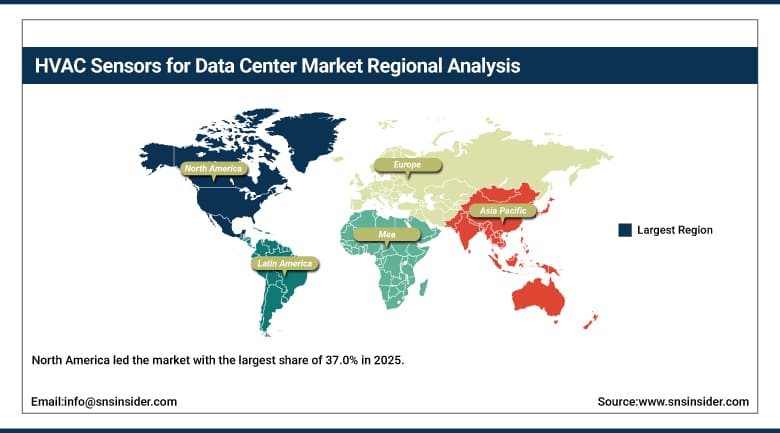
North America led the market with the largest share of 37.0% in 2025. Aggressive hyperscale data center construction driven by generative AI infrastructure investment, sustained enterprise focus on energy efficiency compliance, and a deep concentration of leading environmental monitoring and building automation technology developers continued reinforcing the region’s dominant position. Growing deployment of wireless, AI-integrated HVAC sensor networks across hyperscale, colocation, and edge data center applications further strengthened North America’s standing as both the largest and one of the most innovation-driven markets tracked in this report, with continued hyperscaler capital expenditure expected to sustain regional demand through the forecast period.
The United States anchored by its concentration of leading hyperscale and colocation operators and substantial AI infrastructure investment. Canada added further regional demand through its own growing data center investment, and that combined strength kept the continent the largest addressable market for HVAC sensor vendors serving data centers through the forecast period, with continued generative AI infrastructure buildout expected to sustain regional demand.
Get Customized Report as Per Your Business Requirement - Enquiry Now
Europe HVAC Sensors for Data Center Market Insights
Europe held a meaningful share of global revenue, supported by growing sovereign AI infrastructure investment and continued expansion of enterprise and colocation data center capability across the region’s major economies. Regulatory momentum around energy efficiency mandates under EU sustainability directives continued shaping regional infrastructure investment priorities without meaningfully slowing commercialization across the continent, while sustained colocation and enterprise computing demand kept the region among the more resilient HVAC sensor markets for data centers tracked in this report.
Germany led demand of European revenue, supported by planned sovereign AI computing investment and its substantial enterprise data center base. The UK and France contributed additional demand, and continued European investment in sovereign AI infrastructure should keep regional demand for HVAC sensor technology climbing steadily through the forecast period.
Asia Pacific HVAC Sensors for Data Center Market Insights
Asia Pacific is advancing at the fastest pace among all regions tracked in this report, registering a CAGR of 10.5% from 2026 to 2035, driven by rapidly expanding hyperscale and colocation data center construction, growing domestic cloud infrastructure investment, and sustained government-backed digital infrastructure programs across the region’s largest economies. That combination of expanding data center footprint and genuine downstream demand across hyperscale, colocation, and enterprise applications kept the region’s growth trajectory well ahead of every other region tracked in this report, with continued cloud infrastructure investment adding a further, sustained layer of demand.
China led the pack, supported by its rapidly expanding domestic cloud and hyperscale data center construction and substantial government investment in digital infrastructure. India and Japan contributed meaningful additional demand, with India’s expanding data center construction and Japan’s advanced building automation technology capability both reinforcing the region’s position as the fastest-growing HVAC sensor market for data centers tracked in this report.
MEA and Latin America HVAC Sensors for Data Center Market Insights
The Middle East and Africa and Latin America both showed steady growth, driven by expanding data center infrastructure investment, growing government focus on digital transformation initiatives, and rising enterprise demand for cloud computing capability across both regions. As these markets continued building out modern data center infrastructure, HVAC sensor technology proved a genuinely valuable enabler of increasingly reliable, locally hosted computing environments capable of withstanding harsh regional climate conditions.
The UAE led Middle East and Africa demand, supported by the country’s substantial data center infrastructure investment and regional cloud hub ambitions. Saudi Arabia contributed further demand through large-scale data center announcements tied to national digital transformation programs. In Latin America, Brazil accounted for the largest share of regional revenue, with growing cloud computing and data center investment continuing to anchor regional demand for HVAC sensor technology.
Market Dynamics
Growth Drivers: Rising Rack Power Density and AI Infrastructure Cooling Demand
The industry is driven by rising deployment of sensors supporting hybrid air and liquid cooling architectures, growing adoption of wireless sensor networks reducing installation complexity, expanding integration with AI-driven cooling optimization platforms, and increasing rack power density from generative AI accelerator deployment. As data center operators continue prioritizing reliable, energy-efficient thermal management, the need for granular environmental monitoring technology continues driving sustained investment across the industry.
Rising generative AI infrastructure buildout continues reinforcing this driver, as increasingly power-dense accelerator racks require sophisticated cooling architectures and corresponding sensor networks to prevent thermal-related outages. Growing energy efficiency regulation continues defining a further layer of sustained demand, and that combination of AI infrastructure investment and sustainability compliance pressure is exactly what keeps overall demand climbing at such a steady, sustained pace.
Restraints: Sensor Calibration Drift and Integration Complexity
Ongoing sensor calibration drift over extended operational deployment continues posing a genuine restraint on faster market-wide expansion, as facility operators must implement periodic recalibration and replacement programs to maintain measurement accuracy critical to automated cooling system response. That maintenance burden has kept total cost of ownership considerations a meaningful factor in sensor technology selection decisions.
Integration complexity across legacy building management systems and newer sensor network protocols continues posing a further restraint, as facility operators face genuine interoperability challenges when retrofitting modern sensor technology into established data center infrastructure. Limited standardization across competing sensor communication protocols in certain deployment scenarios keeps some integration projects more administratively complicated than greenfield deployment would otherwise require.
Opportunities: Liquid Cooling Expansion and Predictive Maintenance Integration
Rising liquid cooling system adoption represents a genuinely significant opportunity, as data center operators increasingly deploy direct-to-chip and immersion cooling architectures requiring specialized sensor technology beyond traditional air-cooling monitoring approaches. Vendors positioned early in liquid cooling-compatible sensor technology stand to capture meaningful share as this capability continues expanding from niche AI accelerator deployments into broader mainstream hyperscale infrastructure.
Expanding integration with AI-driven predictive maintenance platforms offers a second substantial opportunity, as facility operators increasingly seek to move from reactive to predictive cooling system management using historical sensor data patterns. Vendors with proven, analytics-ready sensor technology stand to capture meaningful share as global data center operators continue prioritizing operational efficiency and downtime prevention across established and emerging facility markets alike.
Recent Developments:
-
2026: Endress+Hauser introduced an OEM-configured Picomag electromagnetic flowmeter for data center liquid-cooling applications, combining flow, temperature, and conductivity measurement while offering a factory-deactivated wireless configuration for high-security facilities.
-
2026: AKCP launched Quicklime sensorCFD AI, integrating real-time environmental sensor data with AI-driven computational fluid dynamics to identify data center hot spots, cold spots, and cooling inefficiencies.
-
2024: Vigilent launched enhancements to its AI-driven cooling optimization platform, incorporating additional wireless temperature and airflow sensor integration for dynamic hot-aisle and cold-aisle containment management.
HVAC Sensors for Data Center Companies are:
-
Honeywell International Inc.
-
Johnson Controls International plc
-
Schneider Electric SE
-
Vertiv Holdings Co.
-
Rittal GmbH & Co. KG
-
STULZ GmbH
-
TE Connectivity Ltd.
-
Robert Bosch GmbH
-
Renesas Electronics Corporation
-
Analog Devices, Inc.
-
Texas Instruments Incorporated
-
Distech Controls Inc.
-
Delta Electronics, Inc.
-
Panduit Corp.
-
Vigilent Corporation
-
Sensatronics, LLC
-
AKCP (A.K.C.technology Co., Ltd.)
-
Emerson Electric Co.
HVAC Sensors for Data Center Market Report Scope:
| Report Attributes | Details |
|---|---|
| Market Size in 2025 | USD 465 Million |
| Market Size by 2035 | USD 1510 Million |
| CAGR | CAGR of 12.5% From 2026 to 2035 |
| Base Year | 2025 |
| Forecast Period | 2026-2035 |
| Historical Data | 2022-2024 |
| Report Scope & Coverage | Market Size, Segments Analysis, Competitive Landscape, Regional Analysis, DROC & SWOT Analysis, Forecast Outlook |
| Key Segments | • By Sensor Type (Temperature Sensors, Humidity Sensors, Airflow/Differential Pressure Sensors, Air Quality Sensors, Others) • By Application (Rack-Level Cooling Monitoring, Room-Level/CRAC-CRAH Monitoring, Liquid Cooling Systems, Air Handling Units, Others) • By Connectivity (Wired, Wireless) • By End-User (Colocation Data Centers, Hyperscale/Cloud Data Centers, Enterprise Data Centers, Edge Data Centers) |
| Regional Analysis/Coverage | North America (US, Canada), Europe (Germany, UK, France, Italy, Spain, Russia, Poland, Rest of Europe), Asia Pacific (China, India, Japan, South Korea, Australia, ASEAN Countries, Rest of Asia Pacific), Middle East & Africa (UAE, Saudi Arabia, Qatar, South Africa, Rest of Middle East & Africa), Latin America (Brazil, Argentina, Mexico, Colombia, Rest of Latin America). |
| Company Profiles | Honeywell International Inc., Siemens AG, Johnson Controls International plc, Schneider Electric SE, Vertiv Holdings Co., Rittal GmbH & Co. KG, STULZ GmbH, Sensirion AG, TE Connectivity Ltd., Robert Bosch GmbH, Renesas Electronics Corporation, Analog Devices, Inc., Texas Instruments Incorporated, Distech Controls Inc., Delta Electronics, Inc., Panduit Corp., Vigilent Corporation, Sensatronics, LLC, AKCP (A.K.C.technology Co., Ltd.), Emerson Electric Co. |

Frequently Asked Questions
Key players in the HVAC Sensors for Data Center Market include Honeywell International Inc., Siemens AG, Johnson Controls International plc, Schneider Electric SE, Vertiv Holdings Co., and others.
Key opportunities in the HVAC Sensors for Data Center Market include expansion of liquid cooling systems and integration with AI-driven predictive maintenance platforms.
The market is driven by rising rack power density, generative AI infrastructure deployment, and increasing demand for advanced cooling and environmental monitoring systems.
The Temperature Sensors segment dominated the HVAC Sensors for Data Center Market, accounting for approximately 41% market share.
The North America region dominated the HVAC Sensors for Data Center Market in 2025 with a 37.0% share, driven by aggressive hyperscale data center construction, AI infrastructure investment, and energy-efficiency initiatives.
