
Optoelectronic Components Market Report Scope & Overview:
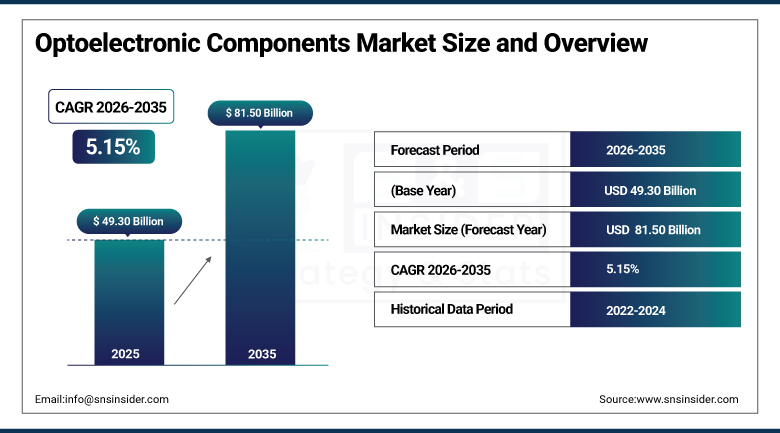
The Optoelectronic Components Market size was valued at USD 49.30 Billion in 2025 and is expected to reach USD 81.50 Billion by 2035, growing at a CAGR of 5.15% from 2026-2035.
Optoelectronic Components Market is experiencing its growth mainly due to increasing demand for light-emitting, light-sensing, and light-modulating devices in consumer electronics, automotive lighting and sensing systems, and telecommunications networks. Continuous developments in efficiency of LEDs, image sensors, and laser diodes keep extending the scope of commercially viable application areas ranging from smartphone cameras and automotive adaptive lighting to fiber optics data center connectivity and industrial machine vision systems. The demand is fueled also by growing tendency towards energy-saving lighting due to legislative and consumer demand, leading to a gradual replacement of traditional lighting technologies like incandescent and fluorescent lights by LED lights. The adoption of ADAS, LiDAR sensing, and optical data center interconnect systems drives the shift in the product demand structure towards more expensive laser diodes and sensing components.
In May 2025, ams OSRAM introduced the new laser diode with a color code of cyan that offered an increase of five times more optical power compared to previous generations of laser diodes. It was aimed at life science applications such as DNA sequencing and flow cytometry. It proves further development of suppliers of laser diodes in terms of their power for specialized uses other than lighting and displays.
To Get more information On Optoelectronic Components Market - Request Free Sample Report
Optoelectronic Components Market Trends
-
Rising adoption of laser diode-based LiDAR modules for automotive and industrial sensing applications.
-
Continued shift toward gallium nitride-based components for high-brightness LEDs and power-efficient designs.
-
Growing integration of optical interconnects and silicon photonics in AI-driven data center infrastructure.
-
Increasing use of advanced image sensors in automotive driver-monitoring and machine vision applications.
-
Continued regulatory and consumer pressure favoring energy-efficient LED lighting over legacy technologies.
U.S. Optoelectronic Components Market Size Outlook
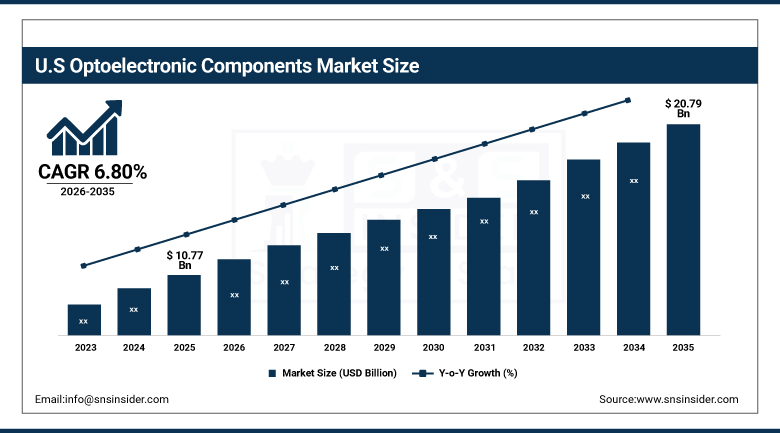
The U.S. Optoelectronic Components Market was valued at USD 10.77 Billion in 2025 and is projected to reach USD 20.79 Billion by 2035, at a CAGR of 6.80% During 2026-2035.
The growth in the US Optoelectronic Components Market is expected to get boosted by investments in the construction of data center and telecom infrastructure, growing usage of LiDAR and lighting systems in the automobile sector, and robust R&D efforts in the domestic semiconductor and photonics companies. The domestic demand also gets a boost owing to innovations in consumer electronics coupled with AI-driven computing infrastructure which requires optical interconnects and silicon photonics components. Automotive industry's efforts in developing self-driving cars and advanced driver assistance systems (ADAS) will also drive the demand for optoelectronic sensing components even though their manufacture is mainly done by suppliers in the Asia Pacific region.
In July 2025, LG Innotek made an investment of USD 50 million in Aeva Technologies, an American company engaged in LiDAR development. This is another case of cross-border investment in domestically developed optoelectronic sensors designed for applications in autonomous vehicles and industries. It is an example of increasing international interest in American companies working with optoelectronic sensing as LiDAR and other laser sensing technologies become more mature.
Optoelectronic Components Market Segment Analysis
-
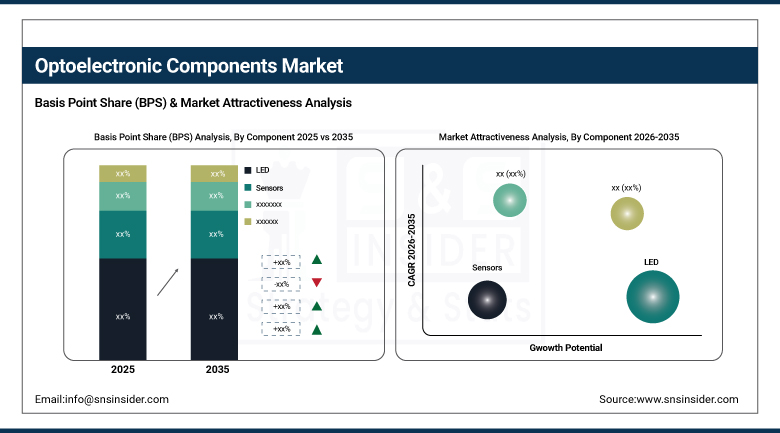
By Component, the LED segment dominated the Optoelectronic Components Market with approximately 42.50% share in 2025, while the Laser Diode segment is the fastest growing with a CAGR of approximately 7.80%.
-
By Material, the Gallium Arsenide segment dominated the Optoelectronic Components Market with approximately 34.50% share in 2025, while the Gallium Nitride segment is the fastest growing with a CAGR of approximately 7.50%.
-
By Application, the Lighting & Display segment dominated the Optoelectronic Components Market with approximately 39.50% share in 2025, while the Communications segment is the fastest growing with a CAGR of approximately 6.90%.
-
By End-User, the Consumer Electronics segment dominated the Optoelectronic Components Market with approximately 36.50% share in 2025, while the Automotive segment is the fastest growing with a CAGR of approximately 7.20%.
By Component, LED dominates and Laser Diode grows fastest
LEDs have continued to hold sway as the largest segment in the Optoelectronic Components Market due to their widespread adoption in applications such as general lighting, back-lighting displays, automotive lighting, and as indicator components in consumer electronics. This segment continues to be driven by the highly matured and efficient nature of LED production, which allows LEDs to remain cost-effective in comparison with both older lighting technology and other new solid-state technology options.
Laser Diodes are expected to grow at the fastest pace due to fast adoption of LiDAR modules in automotive and industrial sensing applications as well as increasing adoption in fiber optic communication systems and precise measuring instruments. The focus for laser diodes is on enhancing optical power output, wavelength accuracy, and thermal stability in order to capture a larger market share.
By Material, Gallium Arsenide dominates and Gallium Nitride grows fastest
Gallium Arsenide continues to be the leading material segment of the Optoelectronic Components Market due to its existing application as the substrate material in various LED and laser diodes, including infrared and red spectrum-based devices that are utilized in sensing, communication, and consumer electronic applications. The segment takes advantage of the decades of manufacturing process optimization that have made it easy to produce cost-effective and high-performance components.
Gallium Nitride is becoming the fastest growing material segment due to its excellent performance in high-brightness blue and white LEDs, along with its crossover applications in power electronics and high frequency laser diodes. The segment is working to optimize the substrate material and reduce costs as it looks to grow in the high-brightness lighting and sensing applications segments.
By Application, Lighting & Display dominates and Communications grows fastest
Lighting and Display applications continue to dominate in the Optoelectronic Components Market owing to the massive demand for general lighting, display backlighting, and automotive lighting systems based on LED technology in the global market space. The Lighting and Display applications segment is buoyed by increased demand for energy-efficient lighting technology due to the pressure from regulations and consumers.
Communications Applications are increasingly becoming the fastest-growing segment owing to the rapid growth of data center infrastructure powered by AI, which requires fast optical interconnects. In addition, this segment is also fueled by the continued construction of the fiber optic network globally. The applications segment is focused on developing laser diodes and photodetectors with higher bandwidths that can support next-generation data transmission speeds.
By End-User, Consumer Electronics dominates and Automotive grows fastest
Consumer Electronics has retained its position as the largest end-user segment of the Optoelectronic Components Market, as LEDs, image sensors, and infrared components are used in consumer electronics such as mobile phones, TV screens, wearables, and other electronic gadgets. The growth in this market segment is due to advancements in camera, display, and proximity sensing technologies in successive generations of consumer gadgets.
The Automotive segment is fast becoming the fastest-growing end-user segment due to the increased use of LED matrix headlights, LiDAR-based advanced driver-assistance systems, and driver-monitoring cameras in vehicles. The automotive segment requires optoelectronic components that are ruggedized and qualified for automotive use and can operate at stringent conditions of reliability and temperature.
Regional Analysis
|
Region |
Major Country |
Share within Region, 2025 (%) |
|---|---|---|
|
Asia Pacific |
China |
54.60% |
|
North America |
United States |
81.50% |
|
Europe |
Germany |
29.40% |
|
Latin America |
Brazil |
46.50% |
|
Middle East & Africa |
Israel |
27.80% |
Asia Pacific Optoelectronic Components Market Insights
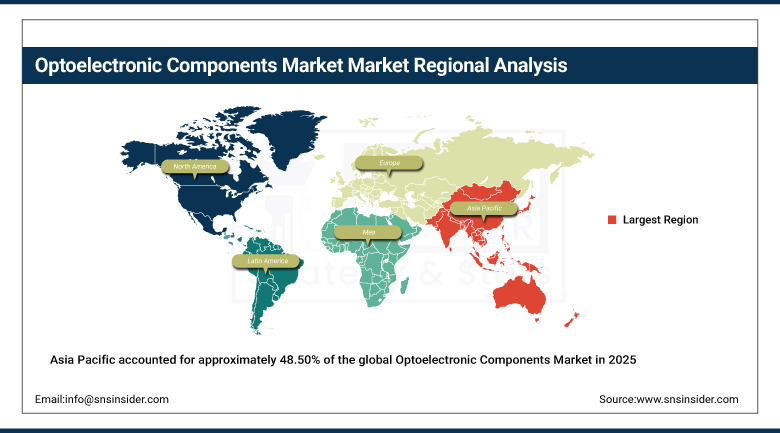
Asia Pacific accounted for approximately 48.50% of the global Optoelectronic Components Market in 2025, reflecting the region's concentration of LED, laser diode, and sensor manufacturing capacity. China represents the largest single contributor within the region, supported by its extensive electronics manufacturing base and rapid growth in domestic consumer electronics and automotive lighting production.
Japan, South Korea, and Taiwan continue to anchor higher-value optoelectronic component manufacturing within the region, leveraging decades of accumulated semiconductor and photonics engineering expertise across companies specializing in LEDs, image sensors, and laser diodes. Rising automotive and consumer electronics production across the broader region further reinforces Asia Pacific's position as both the largest producer and one of the largest consuming markets for optoelectronic component technology.
Get Customized Report as per Your Business Requirement - Enquiry Now
North America Optoelectronic Components Market Insights
The North American region is expected to register the highest CAGR of around 6.80% among all regions in the Optoelectronic Components Market over the forecast period from 2026 to 2035 owing to huge investments made towards building up the data centers infrastructure, increased application of LiDAR in the automotive sector and increased R&D activities.
The above trend in the growth rate of the region is supported by the continuous expansion in AI-driven computing infrastructure with high-speed optical interconnections and domestic investments made towards developing sensing technology for autonomous vehicles. The Canadian and Mexican regions add some volume to the region’s growth through their R&D institutions and automotive supply chains, respectively.
Europe Optoelectronic Components Market Insights
Europe is one of the major regional markets of optoelectronics components, driven by Germany due to its substantial market share of automotive and industrial manufacturing, as well as because of its numerous high-class car producers who invest heavily in lighting and sensor technologies. The share of Germany on this market is defined by its strong presence in the European automotive industry and domestic presence of such optoelectronic components' makers as ams OSRAM.
The French and British markets are important sources of regional demand due to well-established telecoms and industries of these countries. Energy efficiency standards of EU do not favor traditional technologies but support LED lighting systems. At the same time, automotive industry of Europe continues to invest in driver assistance technologies, which drives demand for optoelectronic sensors.
MEA & Latin America Optoelectronic Components Market Insights
Latin America's Optoelectronic Components Market is led by Brazil, which accounts for the majority of regional demand on the strength of its large consumer electronics and automotive assembly sectors. Gradual growth in domestic LED lighting adoption and rising automotive production continue to support steady, if comparatively modest, regional market development.
The Middle East & Africa region remains a smaller contributor to global demand, with research and development activity concentrated in markets such as Israel, which maintains a well-established technology and photonics research ecosystem relevant to sensor and laser diode development. Broader regional demand remains limited relative to Asia Pacific, North America, and Europe, reflecting the technology's concentrated manufacturing presence in major electronics hubs.
Market Dynamics
Growth Drivers: Automotive Sensing and Data Center Optical Infrastructure Demand
Rising automotive adoption of LED matrix headlights, LiDAR-based sensing, and driver-monitoring cameras represents a primary growth driver for the Optoelectronic Components Market, as vehicle manufacturers continue integrating advanced lighting and sensing systems to meet safety regulations and support autonomous driving development. This trend is reinforced by continued cost reduction in laser diode and image sensor manufacturing, which is gradually expanding the range of vehicle segments where these technologies are commercially viable.
Rapid expansion of AI-driven data center infrastructure requiring high-speed optical interconnects provides an additional significant source of demand, as data transmission requirements continue to outpace the capabilities of conventional copper-based interconnects. Continued regulatory and consumer pressure favoring energy-efficient LED lighting over legacy technology further supports broad-based replacement demand across residential, commercial, and industrial applications worldwide.
Restraints: Pricing Pressure and Raw Material Cost Volatility
Pricing pressures associated with commoditization of LED products and basic sensors will be a major constraint for the Optoelectronic Components Market since cost savings associated with increased scale of production have led to reduced profit margins. This will be especially true for general lighting applications where differentiation of the components has greatly diminished due to technological advancement.
Cost volatility of compound semiconductors raw materials such as gallium and indium will also be another constraint due to the periodic increases in cost inputs which may be difficult to pass through due to the competitive and price sensitive nature of the products. Geopolitical tensions associated with procurement of the raw materials will make matters worse.
Opportunities: LiDAR Sensing and Silicon Photonics Expansion
Continued maturation of LiDAR-based sensing technology presents a substantial growth opportunity for the Optoelectronic Components Market, particularly as automakers progress toward higher levels of driving automation requiring increasingly sophisticated sensing capability. Suppliers that can demonstrate reliable, automotive-qualified laser diode and sensor performance at competitive cost are well positioned to capture share as LiDAR adoption continues to expand beyond premium vehicle segments.
Rising demand for silicon photonics and high-speed optical interconnects in AI-driven data center infrastructure presents a longer-term opportunity for suppliers to move beyond conventional lighting and display applications into higher-value communications and computing infrastructure components. As data transmission speed requirements continue to increase, suppliers with early development experience in advanced optical interconnect technology are positioned to capture a disproportionate share of this emerging, higher-margin demand.
Recent Developments:
-
In May 2025, Seoul Semiconductor closed the competitive gap with ams OSRAM for the global No. 2 position in LED market share, according to Omdia's 2024 Global LED Market Share Rankings, sustaining both revenue and market share amid a broader industry slowdown that saw several competitors experience revenue declines.
-
In March 2025, LG Innotek announced a planned investment of USD 408 million to upgrade its chip substrate and camera module factory in Gumi, South Korea, through December 2026, expanding production capacity to support growing demand for optoelectronic-adjacent components including camera modules and chip substrates.
Optoelectronic Components Companies are:
-
Nichia Corporation
-
ams OSRAM AG
-
Samsung Electronics Co., Ltd.
-
Lumileds Holding B.V.
-
Wolfspeed, Inc.
-
Seoul Semiconductor Co., Ltd.
-
Everlight Electronics Co., Ltd.
-
LG Innotek Co., Ltd.
-
Epistar Corporation
-
LITE-ON Technology Corporation
-
Sony Corporation
-
Texas Instruments Incorporated
-
Broadcom Inc.
-
ON Semiconductor Corporation
-
Hamamatsu Photonics K.K.
-
ROHM Co., Ltd.
-
Vishay Intertechnology, Inc.
-
Coherent Corp.
-
Sharp Corporation
-
Renesas Electronics Corporation
Optoelectronic Components Market Report Scope:
| Report Attributes | Details |
|---|---|
| Market Size in 2025 | USD 49.30 Billion |
| Market Size by 2035 | USD 81.50 Billion |
| CAGR | CAGR of 5.15% From 2026 to 2035 |
| Base Year | 2025 |
| Forecast Period | 2026-2035 |
| Historical Data | 2022-2024 |
| Report Scope & Coverage | Market Size, Segments Analysis, Competitive Landscape, Regional Analysis, DROC & SWOT Analysis, Forecast Outlook |
| Key Segments | • By Component (LED, Sensors, Laser Diode, Infrared Components, and Optocouplers) • By Material (Gallium Arsenide, Gallium Nitride, Indium Phosphide, Silicon Carbide, and Others) • By Application (Lighting & Display, Sensing & Imaging, Communications, Security & Surveillance, and Others) • By End-User (Consumer Electronics, Automotive, Telecommunication, Industrial, Military & Aerospace, Medical, and Others) |
| Regional Analysis/Coverage | North America (US, Canada), Europe (Germany, UK, France, Italy, Spain, Russia, Poland, Rest of Europe), Asia Pacific (China, India, Japan, South Korea, Australia, ASEAN Countries, Rest of Asia Pacific), Middle East & Africa (UAE, Saudi Arabia, Qatar, South Africa, Rest of Middle East & Africa), Latin America (Brazil, Argentina, Mexico, Colombia, Rest of Latin America). |
| Company Profiles | Nichia Corporation, ams OSRAM AG, Samsung Electronics Co., Ltd., Lumileds Holding B.V., Wolfspeed, Inc., Seoul Semiconductor Co., Ltd., Everlight Electronics Co., Ltd., LG Innotek Co., Ltd., Epistar Corporation, LITE-ON Technology Corporation, Sony Corporation, Texas Instruments Incorporated, Broadcom Inc., ON Semiconductor Corporation, Hamamatsu Photonics K.K., ROHM Co., Ltd., Vishay Intertechnology, Inc., Coherent Corp., Sharp Corporation, Renesas Electronics Corporation. |
Frequently Asked Questions
Leading companies in the Optoelectronic Components Market include Nichia, ams OSRAM, Samsung Electronics, Seoul Semiconductor, and LG Innotek, among others.
Key opportunities include continued maturation of LiDAR-based automotive sensing technology and rising demand for silicon photonics and high-speed optical interconnects in AI-driven data center infrastructure.
Rising automotive adoption of advanced lighting and sensing systems, combined with rapid expansion of AI-driven data center infrastructure requiring high-speed optical interconnects, is the major factor driving market growth.
The LED segment dominated the Optoelectronic Components Market with approximately 42.50% share in 2025.
Asia Pacific dominated the Optoelectronic Components Market in 2025 with approximately 48.50% share, reflecting the region's concentration of LED, laser diode, and sensor manufacturing capacity, led by China.
