
Laser Diode Market Report Scope & Overview:
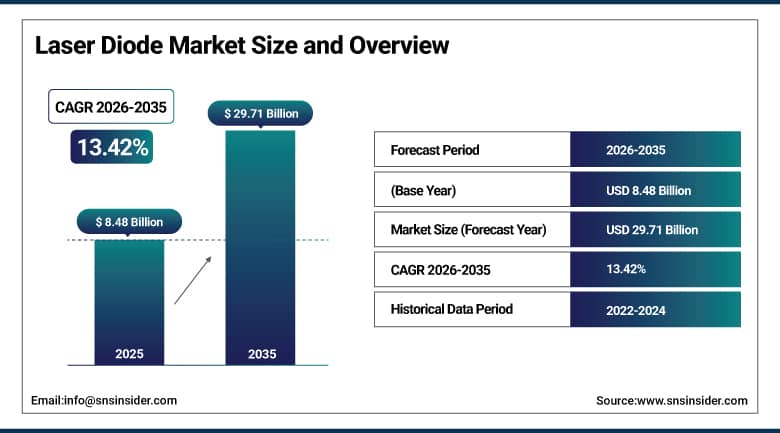
The Laser Diode Market was valued at USD 8.48 Billion in 2025 and is expected to reach USD 29.71 Billion by 2035, growing at a CAGR of 13.42% from 2026–2035.
Market for laser diodes is experiencing rapid growth in a global sense. Laser diodes are semiconductor devices that generate small-size and efficient sources of light with their ability to provide a bright output, controlled wavelength, and fast modulation speed. There is an increasing demand for highly-efficient and small-sized laser systems used in data centers, self-driving cars, medicine, and 3D printing. 5G technology is pushing up investments in the development of laser diodes that operate using photonic technology. The research and development of VCSEL and quantum cascade lasers is opening up the use of laser diodes in new sectors that ensure market growth.
In 2025, IPG Photonics released high-power lasers on a new RI platform leveraging next-generation laser pump diodes, reducing floor space by 60% and lowering total cost of ownership for manufacturing systems.
To Get More Information On Laser Diode Market - Request Free Sample Report
Laser Diode Market Trends
-
VCSEL adoption is accelerating in data centre optical interconnects, smartphone 3D sensing, and LiDAR for autonomous vehicles due to high efficiency, array integration capability, and manufacturing cost maturity.
-
Automotive LiDAR demand is creating above-average procurement as ADAS and autonomous vehicle programmes specify high-power pulsed laser diode arrays for obstacle detection at highway speeds.
-
Medical laser diode adoption is expanding across photobiomodulation therapy, dermatology, dental treatment, ophthalmology, and surgical applications as compact high-power diode systems replace bulkier gas laser alternatives.
-
Data centre AI infrastructure investment is driving 400G and 800G optical interconnect demand for high-speed directly modulated laser diodes and VCSELs whose bandwidth performance requirements sustain premium component procurement.
-
Quantum cascade laser development is enabling mid-infrared spectroscopy for environmental monitoring, industrial gas sensing, and medical breath analysis creating new commercial application categories beyond conventional laser diode markets.
U.S. Laser Diode Market Outlook
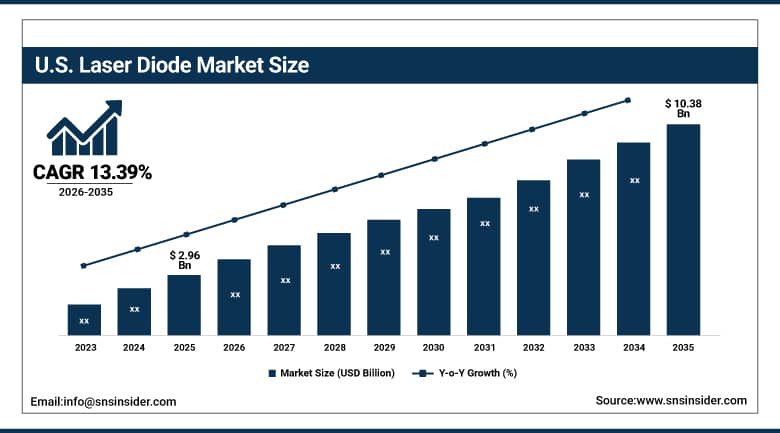
The U.S. Laser Diode Market was valued at approximately USD 2.96 Billion in 2025 and is expected to reach approximately USD 10.38 Billion by 2035, growing at a CAGR of approximately 13.39%.
The United States is considered to be the leading market for the laser diode industry among North American countries accounting for an estimated 40% of total global revenues in this area. Companies such as IPG Photonics, Coherent, Lumentum, and nLIGHT play the role of leaders in technology in the realm of laser diodes used for both high-power industrial purposes, data centers, as well as defense. Investments in the manufacture of semiconductors under the CHIPS Act are increasing the capacity in this area.
Lumentum Holdings unveiled breakthrough laser diode components for cloud, AI, and networking at OFC 2024, demonstrating commercial leadership in data centre photonics whose AI infrastructure expansion creates above-average demand for GPU cluster interconnects.
Laser Diode Market Segment Analysis
-
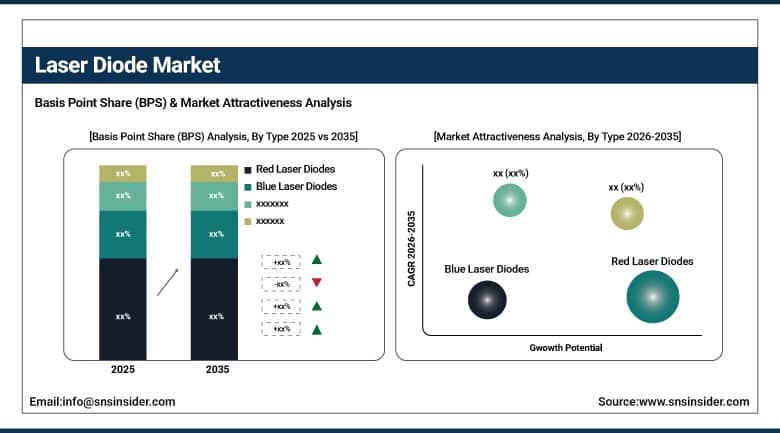
By Wavelength/Type, the Red Laser Diodes segment dominated the laser diode market with 35.1% share in 2025, while the Blue Laser Diodes segment is the fastest growing during 2026–2035 due to increasing adoption in laser projector systems and automotive LiDAR applications.
-
By Material, the gallium aluminum arsenide (GaAlAs) segment dominated the Laser Diode Market with 39.6% share in 2025, while the gallium arsenide (gaas) segment is the fastest growing due to better thermal stability and higher electron mobility than other semiconductor materials.
-
By Application, the optical communication & data storage segment dominated the Laser Diode Market with approximately 30% share in 2025, while the medical & healthcare segment is the fastest growing with a CAGR of approximately 16.5% as diagnostic, surgical, and phototherapy adoption accelerates.
-
By End User, the Consumer Electronics segment dominated the laser diode market with approximately 35% share in 2025, while the Automotive segment is the fastest growing with a CAGR of approximately 18.2% as LiDAR, ADAS sensing, and in-cabin applications drive above-average procurement.
By Wavelength/Type, red dominates, blue grows fastest
Red laser diodes retained the dominant wavelength position with 35.1% of the laser diode market in 2025. Their commercial primacy reflects the decades-long installed base of applications in barcode scanning, optical disc reading, laser printing, and biomedical instrumentation whose deployment across retail, logistics, healthcare, and office environments creates the largest single wavelength category by unit count. Red laser diode manufacturing maturity, competitive pricing, and broad application compatibility sustain dominance despite the rapid growth of blue and infrared categories in newer application domains.
Blue laser diodes are the fastest-growing wavelength because the convergence of laser projector commercial expansion, automotive LiDAR adoption, and high-power direct diode laser systems for materials processing creates above-average demand growth. GaN-based blue laser diode technology's continuous efficiency, power output, and manufacturing yield improvement progressively reduces cost barriers that historically limited adoption. Each new automotive platform that specifies solid-state LiDAR creates blue laser diode procurement whose per-vehicle value substantially exceeds consumer electronics application economics.
By Material, GaAlAs dominates, GaAs grows fastest
Gallium Aluminum Arsenide retained the dominant material position with 39.6% of the laser diode market in 2025. GaAlAs' optimised bandgap engineering for the 750-880nm wavelength range serves optical communication, remote control, and biomedical infrared laser applications at commercially mature cost levels. GaAlAs-based laser diodes for fibre optic pump lasers are critical components of optical communication infrastructure whose global network capacity expansion creates consistent high-volume procurement across telecom and data center customers.
Gallium Arsenide is the fastest-growing material because its superior electron mobility and thermal stability create performance advantages in high-power and high-speed laser diode applications. GaAs-based VCSEL arrays for data center interconnects and high-power pump laser modules whose thermal management requirements favor GaAs superior heat dissipation characteristics are creating the most commercially significant GaAs laser diode growth opportunities in the current market period.
By Application, optical communication dominates, medical grows fastest
Optical communications and storage remained the most prominent applications with about 30% market share for laser diodes by 2025. The rise in investments in artificial intelligence infrastructure is driving data center optical interconnects' demand, with GPU compute clusters requiring faster connections in the form of spine and leaf uplinks as well as fibre on the data center campus, which means 400G and 800G interface standards demand high-speed laser diodes. Each 1 MW of GPU compute power needs a specific number of laser diodes per optical interconnect.
Medical and healthcare is the fastest-growing application at approximately 16.5% CAGR because laser diode adoption across medical imaging, surgical procedures, photobiomodulation therapy, dental treatment, and dermatology progressively replaces less energy-efficient gas laser alternatives. Each FDA-cleared medical laser diode system creates recurring consumable and maintenance procurement whose clinical adoption compounds with device proliferation across hospital systems and outpatient medical specialty practices.
By End User, consumer electronics dominates, automotive grows fastest
The consumer electronics end user held the largest market share of about 35% in the market of laser diodes during 2025. The entire consumer electronics end-user ecosystem, which comprises smartphones with face recognition sensors, laser printers, barcode scanners, disc drives, and projector displays, forms a laser diode buying power that far outdoes all others. Every new generation of smartphones with upgraded 3D sensing capabilities for face recognition and AR requires additional VCSEL laser diodes, with global annual production volumes standing at 1.2 billion smartphones.
Automotive is the fastest-growing end user at approximately 18.2% CAGR because LiDAR adoption for ADAS and autonomous vehicle programmes creates a high-value laser diode demand category whose per-vehicle procurement value substantially exceeds consumer electronics applications. NCAP safety assessment programmes in Europe and the U.S. are progressively requiring advanced driver assistance features creating mandatory laser diode procurement across new vehicle programmes. Each automotive OEM that standardizes LiDAR across a platform creates a multi-year structured laser diode supply relationship.
Regional Analysis
|
Region |
Major Country |
Share within Region, 2025 (%) |
|---|---|---|
|
North America |
United States |
87.4% |
|
Europe |
Germany |
22.3% |
|
Asia Pacific |
China |
44.8% |
|
Middle East & Africa |
UAE |
38.4% |
|
Latin America |
Brazil |
44.2% |
North America Laser Diode Market Insights
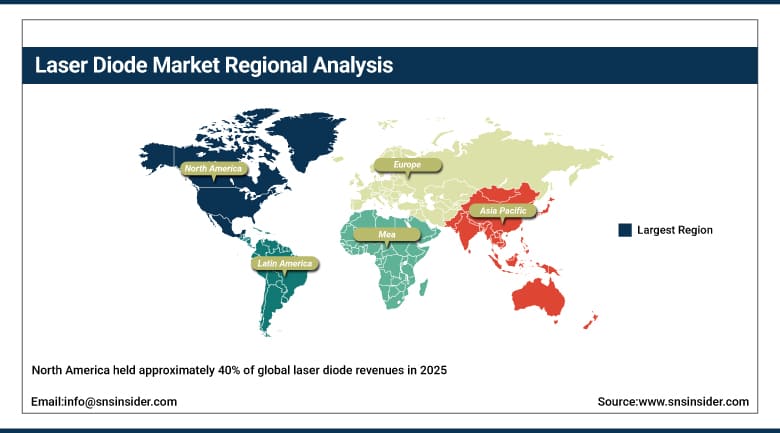
North America held approximately 40% of global laser diode revenues in 2025, with the United States at approximately 87.4% of North American revenues. IPG Photonics, Coherent, Lumentum, and nLIGHT define the U.S. technology frontier. Data centre photonics investment, medical laser procurement, and defense optical programmes sustain above-average demand whose per-unit commercial value substantially exceeds the consumer electronics-dominated Asia Pacific market.
Canada contributes approximately 12.6% of North American revenues through its photonics research ecosystem, telecom infrastructure optical component demand, and commercial photonics technology company presence sustaining consistent market contribution.
Get Customized Report as Per Your Business Requirement - Enquiry Now
Europe Laser Diode Market Insights
Europe is a technically sophisticated laser diode market. Jenoptik, Osram Opto Semiconductors, and Trumpf create domestic technology leadership across industrial, medical, and automotive applications. Germany accounts for approximately 22.3% of European revenues through automotive LiDAR adoption, industrial laser precision manufacturing, and photonics R&D programme investment that sustains European competitiveness at the commercial technology frontier.
The United Kingdom and France are significant secondary markets where defense photonics, telecommunications optical components, and medical laser adoption create consistent procurement. EU Photonics21 strategic research investment creates institutional support for laser diode technology development whose commercial output sustains European market competitiveness globally.
Asia Pacific Laser Diode Market Insights
Asia Pacific is the fastest-growing regional laser diode market, driven by China's manufacturing laser processing adoption, Japan and South Korea's consumer electronics and semiconductor laser demand, and India's growing industrial and telecom investment. China accounts for approximately 44.8% of Asia Pacific revenues through manufacturing sector laser adoption, consumer electronics production scale, and domestic laser diode manufacturer development whose competitive pricing expands market access.
Japan represents a sophisticated secondary market where Nichia, Hamamatsu Photonics, Sharp, Mitsubishi Electric, and Furukawa Electric create a complete domestic laser diode ecosystem serving both domestic consumer electronics and industrial applications and global export markets simultaneously.
MEA & Latin America Laser Diode Market Insights
UAE leads MEA revenues at approximately 38.4% through data centre investment, 5G telecom infrastructure, and premium healthcare sector medical laser adoption. Brazil leads Latin American revenues at approximately 44.2% through telecommunications optical infrastructure, industrial laser processing, and healthcare sector medical laser adoption across its large private hospital network.
Saudi Arabia and Israel represent significant secondary MEA markets through defense photonics and industrial laser investment, while Colombia and Chile are growing Latin American markets where manufacturing modernization and telecom infrastructure create expanding laser diode procurement.
Market Dynamics
Growth Drivers: Data centre AI interconnect demand and automotive LiDAR creating above-average procurement
Data centre AI infrastructure investment is the laser diode market's most commercially significant near-term growth driver. GPU cluster connectivity, spine-leaf network uplinks, and coherent optical transmission require high-speed VCSELs and directly modulated laser diodes whose combined procurement grows proportionally with AI infrastructure investment. Each 1 MW of GPU compute capacity commissioned creates defined optical interconnect laser diode procurement compounding with the extraordinary pace of hyperscale AI data centre construction globally.
Automotive LiDAR adoption creates a premium laser diode demand category whose regulatory adoption timeline provides commercially predictable growth. NCAP safety programmes in Europe and the U.S. progressively require advanced driver assistance features whose LiDAR specification creates mandatory laser diode procurement across new vehicle programmes. Each automotive OEM standardizing LiDAR across a vehicle platform creates a structured multi-year supply relationship whose volume scales with annual production.
Restraints: High component cost and semiconductor supply chain concentration risk
High laser diode component cost relative to competing light source technologies creates adoption barriers in cost-sensitive applications where LED provides technically adequate performance at lower cost. Medical and automotive applications whose performance requirements justify premium pricing are less affected, but consumer electronics and general industrial applications where cost sensitivity directly influences specification decisions create resistance beyond LED alternative price thresholds.
Semiconductor laser diode supply chain concentration in a limited number of III-V compound semiconductor substrates creates procurement risk for manufacturers whose production depends on GaAs, InP, and GaN substrate availability. Supply disruptions from manufacturing yield issues, capacity constraints, or geopolitical interruptions create production volatility that downstream OEM customers mitigate through safety stock and supplier diversification strategies adding procurement cost.
Opportunities: VCSEL expansion in 3D sensing and medical laser diode clinical adoption
VCSEL expansion in smartphone 3D sensing, data centre interconnects, and LiDAR create the most commercially significant technology growth opportunity. Each new smartphone model incorporating improved face recognition or augmented reality creates VCSEL procurement scaling with global smartphone production. Each autonomous vehicle programme adopting solid-state LiDAR creates VCSEL array procurement whose per-vehicle value substantially exceeds smartphone application economics.
Medical laser diode clinical adoption represents a high-value, high-margin commercial opportunity whose FDA clearance requirements create competitive barriers sustaining premium pricing for qualified medical-grade suppliers. Each new cleared medical laser diode indication creates an adoption programme whose installed base grows with physician training, clinical evidence accumulation, and insurance reimbursement establishment progressively expanding the addressable patient population.
Recent Developments:
-
2025: IPG Photonics released high-power lasers on a new RI platform leveraging next-generation laser pump diodes, reducing floor space by 60% and lowering total cost of ownership for industrial manufacturing systems, reflecting the commercial direction toward higher power density at reduced footprint.
-
2024: Lumentum Holdings unveiled breakthrough laser diode components and modules for cloud, AI, and high-speed networking at OFC 2024, demonstrating leadership in data centre photonics whose AI infrastructure expansion creates above-average laser diode demand for GPU cluster optical interconnects.
-
2024: Coherent Corp. expanded its 800G optical transceiver portfolio with high-speed laser diode modules for hyperscale data centre spine-leaf networks, targeting the most demanding optical interconnect specifications whose AI infrastructure upgrade programmes require semiconductor laser performance beyond conventional limits.
Laser Diode Market Key Players
-
IPG Photonics Corporation
-
Jenoptik AG
-
Nichia Corporation
-
Osram Opto Semiconductors
-
Sony Corporation
-
Sharp Corporation
-
Panasonic Corporation
-
Mitsubishi Electric
-
ROHM Semiconductor
-
Sumitomo Electric
-
Thorlabs
-
Coherent Corp.
-
Lumentum Holdings
-
nLIGHT Inc.
-
Trumpf
-
Hamamatsu Photonics
-
Furukawa Electric
-
II-VI Incorporated
-
Broadcom
-
Applied Optoelectronics
Laser Diode Market Report Scope:
| Report Attributes | Details |
|---|---|
| Market Size in 2025 | USD 8.48 Billion |
| Market Size by 2035 | USD 29.71 Billion |
| CAGR | CAGR of 13.42% From 2026 to 2035 |
| Base Year | 2025 |
| Forecast Period | 2026-2035 |
| Historical Data | 2022-2024 |
| Report Scope & Coverage | Market Size, Segments Analysis, Competitive Landscape, Regional Analysis, DROC & SWOT Analysis, Forecast Outlook |
| Key Segments | • By Wavelength/Type (Red Laser Diodes, Blue Laser Diodes, Infrared Laser Diodes, Green Laser Diodes, Others) • By Material (Gallium Aluminum Arsenide/GaAlAs, Gallium Arsenide/GaAs, Gallium Nitride/GaN, InGaAsP, Others) • By Application (Optical Communication & Data Storage, Medical & Healthcare, Industrial Manufacturing, Automotive & LiDAR, Consumer Electronics, Others) • By End User (Consumer Electronics, Telecommunications, Healthcare, Automotive, Industrial, Others) |
| Regional Analysis/Coverage | North America (US, Canada), Europe (Germany, UK, France, Italy, Spain, Russia, Poland, Rest of Europe), Asia Pacific (China, India, Japan, South Korea, Australia, ASEAN Countries, Rest of Asia Pacific), Middle East & Africa (UAE, Saudi Arabia, Qatar, South Africa, Rest of Middle East & Africa), Latin America (Brazil, Argentina, Mexico, Colombia, Rest of Latin America). |
| Company Profiles | IPG Photonics Corporation, Jenoptik AG, Nichia Corporation, Osram Opto Semiconductors, Sony Corporation, Sharp Corporation, Panasonic Corporation, Mitsubishi Electric, ROHM Semiconductor, Sumitomo Electric, Thorlabs, Coherent Corp., Lumentum Holdings, nLIGHT Inc., Trumpf, Hamamatsu Photonics, Furukawa Electric, II-VI Incorporated, Broadcom, Applied Optoelectronics |
Frequently Asked Questions
Red Laser Diodes dominated the Laser Diode Market with 35.1% share in 2025, while Blue Laser Diodes is the fastest growing segment.
Data centre AI infrastructure investment creating above-average laser diode procurement for optical interconnects, and automotive LiDAR adoption creating a new premium demand category with commercially predictable multi-year growth tied to vehicle platform production timelines.
The Laser Diode Market was valued at USD 8.48 Billion in 2025.
The Laser Diode Market is expected to grow at a CAGR of 13.42% from 2026 to 2035.
North America dominated the Laser Diode Market with approximately 40% of global revenues in 2025, with the United States at approximately 87.4% of North American revenues.
