
Polyethylene Furanoate Market Report Scope & Overview:
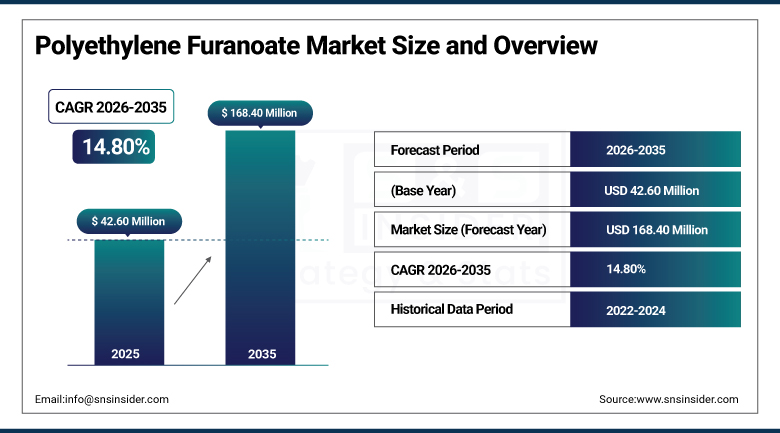
The Polyethylene Furanoate Market was valued at USD 42.60 Million in 2025 and is expected to reach USD 168.40 Million by 2035, growing at a CAGR of 14.80% from 2026 to 2035.
The Polyethylene Furanoate Market experiences a consistent and steady increase due to rising brand-owner efforts towards sustainability in their packaging, increasing regulatory pressure regarding reduced usage of oil-based plastics, and better gas and moisture barrier properties compared to traditional PET. Being a bio-based polyester made up of 2,5-furandicarboxylic acid and bio-based ethylene glycol, the polyethylene furanoate is increasingly used in various beverage bottles, packaging films, and technical fibers, being recyclable, drop-in compatible with PET processing equipment, and having a smaller carbon footprint. Furthermore, market development is being aided by an increase in industrial-scale FDCA production capacity, increased offtake deals with leading bottlers and brand owners in the beverages sector, and innovations in the production of high-barrier PEF resins for premium food, beverages, and personal care packaging.
Avantium N.V. and Origin Materials both advanced their industrial-scale FDCA and PEF production capacity in 2026 to meet growing brand-owner demand for bio-based, recyclable packaging polymers amid tightening plastic sustainability regulation across North America, Europe, and Asia Pacific beverage and packaging markets.
To Get more information On Polyethylene Furanoate Market - Request Free Sample Report
Polyethylene Furanoate Market Trends:
-
Rising brand-owner offtake agreements are accelerating commercial-scale PEF bottle and packaging adoption.
-
Growing investment in industrial-scale FDCA production capacity is easing raw material supply constraints.
-
Increasing development of high-barrier PEF grades is expanding premium food and beverage packaging applications.
-
Expanding interest in PEF-based technical fibers is opening new opportunities across apparel and textile markets.
-
Strategic partnerships between PEF technology developers and global packaging converters are accelerating commercialization timelines.
U.S. Polyethylene Furanoate Market Outlook:
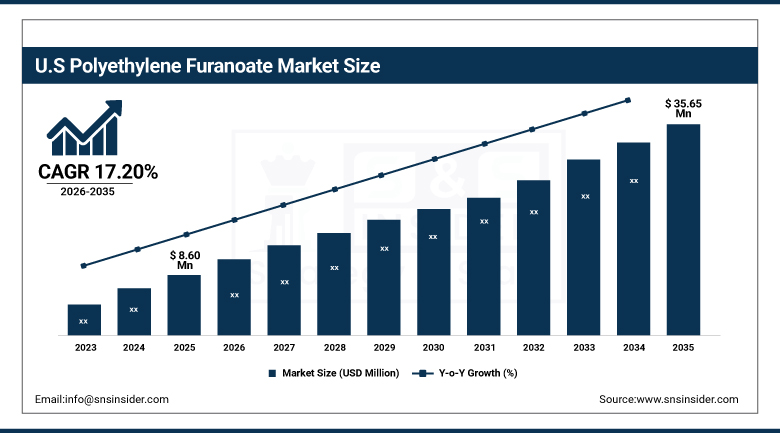
The U.S. Polyethylene Furanoate Market was valued at USD 8.60 Million in 2025 and is projected to reach USD 35.65 Million by 2035, growing at a CAGR of 17.20% during 2026-2035.
In the U.S. leading beverage brand owners, packaging converters, and specialty polymer developers continue to strengthen their sustainable packaging pipelines due to expanding corporate carbon-reduction commitments, growing consumer preference for recyclable and bio-based packaging materials, and increased investment in domestic FDCA and bio-based ethylene glycol production capacity. The growing emphasis on reducing dependence on imported bio-based polymer feedstocks, supported by abundant domestic corn stover and agricultural sugar resources, helps to ensure continued demand for domestically produced polyethylene furanoate. Rising private-sector investment in dedicated PEF polymerization and packaging conversion capacity further reinforces the country's position as a leading contributor to the North America Polyethylene Furanoate Market.
In 2026, Origin Materials advanced its U.S. FDCA production pathway from woody biomass feedstock through pilot-to-commercial scale-up, strengthening its ability to supply domestic PEF polymer producers and packaging converters seeking regionally sourced bio-based raw materials.
Polyethylene Furanoate Market Segment Analysis:
-
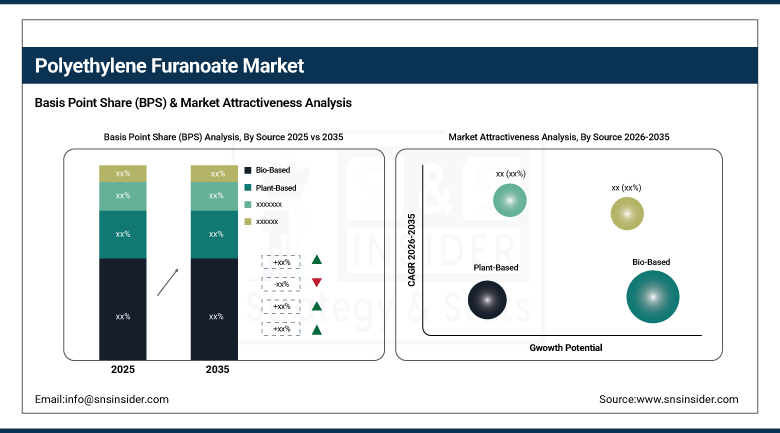
By Source, Bio-Based dominated the Polyethylene Furanoate Market with a 64.80% share in 2025, while Plant-Based is the fastest-growing source segment with a CAGR of 16.20% from 2026-2035.
-
By Grade, Standard Grade dominated the Polyethylene Furanoate Market with a 54.70% share in 2025, while High-Barrier Grade is the fastest-growing grade segment with a CAGR of 17.60% from 2026-2035.
-
By Application, Bottles dominated the Polyethylene Furanoate Market with a 67.40% share in 2025, while Fibers is the fastest-growing application segment with a CAGR of 19.80% from 2026-2035.
-
By End-Use, Beverage Packaging dominated the Polyethylene Furanoate Market with a 59.10% share in 2025, while Personal Care & Cosmetics is the fastest-growing end-use segment with a CAGR of 18.40% from 2026-2035.
By Source, Bio-Based dominated the market, while Plant-Based is the fastest-growing segment.
The Bio-Based segment was the leading contributor in the Polyethylene Furanoate Market. This source category accounts for being the largest segment due to its broader feedstock flexibility, encompassing plant sugars, lignocellulosic biomass, and agricultural residues that can be converted into 2,5-furandicarboxylic acid through established hydrothermal and oxidative processing routes. Its adaptability to different feedstock sources, along with the increasing number of collaborative production initiatives between the technology providers and chemical manufacturers, has made it possible for this biopolymer to maintain its supremacy over the other polymers in both existing and new packaging markets due to its superior properties as compared to other feedstock sources.
The Plant-Based segment is expected to witness the highest CAGR during the forecast period 2026-2035. Increasing importance of full traceability and sourcing of renewable feedstocks as single source is boosting demand for PEF that uses only sugars extracted from plants like corn, wheat, and sugar beet. Increasing marketing by brand owners highlighting the transparency and sustainability of the plants, along with increased plant-based FDCA manufacturing capacity, is also providing an impetus to the demand for this segment. Innovation in technology for converting sugar into FDCA is contributing towards higher-than-expected growth rate of this segment than overall polyethylene furanoate.
By Grade, Standard Grade dominated the market, while High-Barrier Grade is the fastest-growing segment.
The Standard Grade category held a market share of the Polyethylene Furanoate Market in 2025. Standard grade PEF continues to dominate supreme because it addresses the largest number of packaging needs through its broad applicability, processing know-how, and seamless ability to be used in existing PET production facilities without the requirement for higher barrier properties. The broad applicability of the material to high-volume commercial packaging conversion systems combined with existing supplier/converter relationships between the manufacturers of PEF and the world’s converters has ensured that it becomes the standard commercial grade obtained by the beverage and food packaging industry worldwide.
The High-Barrier Grade segment is anticipated to grow at the fastest rate during the forecast period 2026-2035. Increasing demand for enhanced oxygen and moisture barrier performance suitable for premium food, beverage, and personal care packaging applications requiring extended shelf life is driving adoption among specialty packaging converters. The increasing investments in innovative polymer formulations that enhance PEF’s already outstanding barrier performance compared to PET are helping in the faster growth of the segment within premium packaging applications.
By Application, Bottles dominated the market, while Fibers is the fastest-growing segment.
The Bottles segment dominated the Polyethylene Furanoate Market in 2025. Bottle applications remain the largest category owing to PEF's superior gas and moisture barrier properties compared to conventional PET, which make it particularly well-suited for carbonated beverages, alcoholic drinks, and water packaging requiring extended shelf life and product freshness, driving sustained procurement of PEF resin by major beverage bottlers and brand owners pursuing sustainable packaging commitments across major beverage-producing regions including North America, Europe, and Asia Pacific.
The Fibers segment is expected to register the fastest CAGR during the forecast period 2026-2035. Increased demand for technical yarns made from PEF that can enhance the drapability of the fabric, offer better UV protection, and have anti-microbial properties as compared to traditional synthetic materials is encouraging their adoption in the early stages by textile and apparel companies. Increased spending on pilot PEF fiber spinning technologies along with increased brand interest in sustainable technical wear and performance textiles is further contributing to the growth of the segment.
By End-Use, Beverage Packaging dominated the market, while Personal Care & Cosmetics is the fastest-growing segment.
The Beverage Packaging segment dominated the Polyethylene Furanoate Market in 2025. Beverage packaging applications remain the largest category owing to high-profile offtake commitments from major bottlers and brand owners seeking to reduce plastic packaging carbon footprint while maintaining product freshness and shelf stability, driving sustained procurement of PEF resin by beverage companies pursuing sustainability commitments across carbonated soft drinks, water, and alcoholic beverage categories spanning major consumer markets worldwide.
The Personal Care & Cosmetics segment is expected to register the fastest CAGR during the forecast period 2026-2035. Growing consumer demand for sustainable, recyclable packaging across premium cosmetics and personal care product lines, combined with brand-owner interest in differentiated, eco-conscious packaging aesthetics, is driving strong demand for PEF-based containers and packaging components, as personal care brands seek to align product packaging with broader corporate sustainability positioning across expanding premium and eco-conscious consumer segments.
Regional Insights
|
Region |
Major Country |
Share within Region, 2025 (%) |
|---|---|---|
|
North America |
United States |
88.60% |
|
Europe |
Netherlands |
26.40% |
|
Asia Pacific |
China |
34.80% |
|
Middle East & Africa |
Saudi Arabia |
27.60% |
|
Latin America |
Brazil |
36.20% |
Asia Pacific Polyethylene Furanoate Market Insights
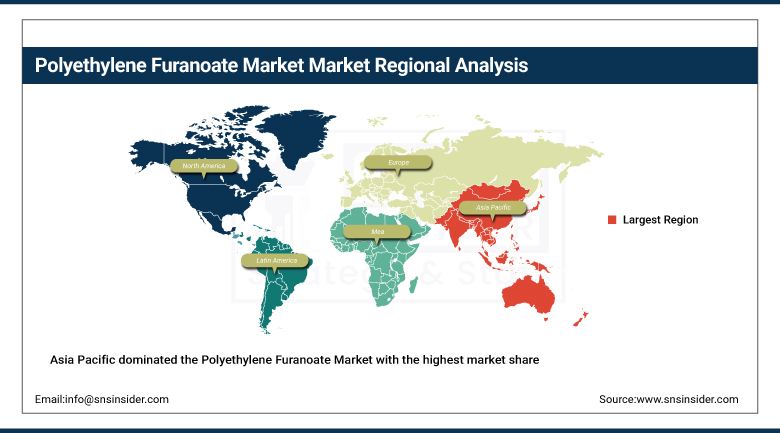
Asia Pacific dominated the Polyethylene Furanoate Market with the highest market share of about 38.60% in 2025, owing to the region's rapidly expanding beverage packaging industry, growing manufacturing base for sustainable polymer production, and increasing brand-owner investment in bio-based packaging solutions across China, Japan, and Southeast Asia. Polyethylene furanoate has continued to be consumed in high volumes due to the existence of a cost-effective polymer manufacturing setup in the region and significant investment in packaging conversion facilities.
China was the leading country within the Asia Pacific Polyethylene Furanoate Market in 2025 of the regional market, motivated by its burgeoning base of beverages and foods packaging production, polymer conversion facilities, and increasing number of domestic sustainability programs. Japan is contributing to regional growth through its own established relationships between PEF technology developers and major beverage and distribution companies, supporting early commercial adoption of bio-based packaging polymers.
Get Customized Report as per Your Business Requirement - Enquiry Now
North America Polyethylene Furanoate Market Insights
The North America Polyethylene Furanoate Market is expected to witness the fastest growth rate during the forecast period 2026-2035, registering a CAGR of 17.20%. The market growth is driven by strong corporate sustainability commitments among major beverage brand owners, growing regulatory support for renewable packaging materials, and increasing domestic investment in FDCA and bio-based ethylene glycol production capacity as the region's manufacturers pursue supply chain independence and abundant agricultural feedstock utilization to support expanding bio-based polymer production.
The United States is one of the main growth drivers in the North America Polyethylene Furanoate Market, owing to its abundant corn stover and agricultural sugar resources and rapidly growing domestic bio-based polymer production capability supporting both established and newly developed packaging applications. Canada is also contributing to regional growth through rising investment in sustainable packaging infrastructure and growing adoption of bio-based polymers across its expanding beverage and food packaging sectors.
Europe Polyethylene Furanoate Market Insights
The Europe region was a major contributor to the Polyethylene Furanoate Market in 2025, expected to register strong demand for sustainable packaging polymers during the forecast period. This is attributed to the region's stringent environmental regulations governing single-use plastics, strong consumer shift toward sustainable products, and presence of leading PEF technology developers pursuing industrial-scale commercialization across member states focused on circular economy and plastic waste reduction objectives.
The Netherlands is one of the major markets in Europe owing to its position as home to Avantium N.V., the global leader in PEF technology development and commercialization, along with the country's advanced flagship FDCA production facility. Other countries such as Germany, Finland, and Switzerland, home to significant chemical and polymer manufacturing infrastructure, are also contributing to market growth through continued investment in PEF process technology and packaging conversion capacity.
Middle East & Africa and Latin America Polyethylene Furanoate Market Insights
Middle East & Africa and Latin American regions are gradually expanding polyethylene furanoate adoption as sustainable packaging investment and brand-owner sustainability commitments grow across both regions, supported by increasing beverage industry activity and growing government focus on strengthening domestic bio-based material manufacturing capability.
Brazil is set to be a prominent Latin American market fueled by its substantial sugarcane-based agricultural feedstock base offering potential for domestic bio-based ethylene glycol and FDCA production and growing beverage industry sustainability investment. The Middle East & Africa region has Saudi Arabia investing in its industrial sector's recognition of sustainable material benefits, positioning the country as an emerging contributor to regional polyethylene furanoate demand.
Market Dynamics
Growth Drivers: Sustainable packaging commitments and superior barrier performance driving market growth
The increased commitment of the corporate world towards sustainability among brand owners of beverages and packaging products around the world, the increasing pressure due to regulation to cut back on the usage of petroleum based plastics, and the superior barrier properties of the material compared to traditional PET material form some of the main factors driving the market for Polyethylene Furanoate. Polyethylene furanoate offers the packaging and brand owners with a completely biobased, recyclable plastic material that helps in extending the shelf-life of their products while simultaneously lowering their carbon footprint.
Technological advancements in FDCA production efficiency have significantly increased commercial viability, with recent innovations improving conversion yields and reducing production costs across industrial-scale manufacturing operations. Rising private-sector investment in dedicated PEF polymerization capacity, growing integration of PEF into existing PET processing infrastructure through drop-in compatible technology, and continued expansion of brand-owner offtake agreements are further supporting demand across the forecast period, as technology developers and packaging converters continue strengthening capability against increasingly ambitious corporate sustainability targets.
Restraints: High production costs and limited manufacturing infrastructure limiting market expansion
One of the most critical obstacles in terms of market growth comes in the form of the high cost of large-scale FDCA production, which involves complex multi-step polymerization processes and limited commercial-scale manufacturing capability as compared to well-established petrochemical-based PET production. This comes down to the fact that PEF remains substantially more expensive than conventional plastics, which limits smaller packaging converters and brand owners from adopting the material without premium pricing acceptance or dedicated sustainability budget allocation.
Moreover, insufficient global manufacturing infrastructure for FDCA and bio-based ethylene glycol production across different regions directly impacts supply availability and causes capacity-constrained delays for both polymer producers and downstream packaging converters. Besides, the high technical requirements in terms of scaling polymerization processes while maintaining consistent product quality across varying feedstock sources require considerable ongoing capital investment from PEF technology developers and manufacturers.
Opportunities: Expansion of industrial-scale production and technical fiber innovation creating new growth avenues
The increasing need for fully bio-based, recyclable packaging polymers across expanding beverage and personal care packaging operations, the rise of brand-owner offtake agreements supporting industrial-scale production investment, and greater emphasis on technical fiber innovation due to increased interest in sustainable apparel will provide ample growth opportunities in the Polyethylene Furanoate Market. The need for compliance-driven, low-carbon packaging capability across beverage, food, and personal care operations will ensure future growth due to strict plastic sustainability regulations worldwide.
The field of alternative feedstock has enormous scope for future growth in terms of cost reduction and availability of feedstock for industries from different regions. The rising investments made by the beverage and packaging industry in the developing regions of Asia-Pacific and Latin America, coupled with the efforts made by technology developers in scaling up the production capacity of industrial FDCA, will propel the demand for advanced polyethylene furanoate products.
Recent Developments:
-
2025: Avantium N.V. signed a joint development agreement with Amcor Rigid Packaging to explore its Releaf-branded PEF in rigid containers for beverage, food, medical, and personal care applications.
-
2025: GS Biomats launched its FURIX branded high-performance furan-based polymer platform, introducing PEF fibers with natural antibacterial and UV-protective properties for technical apparel applications.
-
2026: Sulzer Ltd. expanded its PEF polymerization process technology licensing agreements with regional converters across Europe and Asia Pacific to accelerate industrial-scale commercialization.
Polyethylene Furanoate Key Players are:
-
Avantium N.V.
-
Sulzer Ltd.
-
AVA Biochem AG
-
Swicofil AG
-
ALPLA Group
-
Origin Materials, Inc.
-
Danone S.A.
-
Mitsui & Co., Ltd.
-
Eastman Chemical Company
-
The Coca-Cola Company
-
BASF SE
-
Amcor plc
-
Stora Enso Oyj
-
PepsiCo, Inc.
-
Suntory Holdings Limited
-
GS Biomats
-
Zhejiang Sugar Energy Technology Co., Ltd.
-
Carlsberg A/S
Polyethylene Furanoate Market Report Scope:
| Report Attributes | Details |
|---|---|
| Market Size in 2025 | USD 42.60 Million |
| Market Size by 2035 | USD 168.40 Million |
| CAGR | CAGR of 14.80% From 2026 to 2035 |
| Base Year | 2025 |
| Forecast Period | 2026-2035 |
| Historical Data | 2022-2024 |
| Report Scope & Coverage | Market Size, Segments Analysis, Competitive Landscape, Regional Analysis, DROC & SWOT Analysis, Forecast Outlook |
| Key Segments | • By Source (Bio-Based, Plant-Based) • By Grade (Standard Grade, High-Barrier Grade) • By Application (Bottles, Films, Fibers & Others) • By End-Use (Beverage Packaging, Food Packaging, Personal Care & Cosmetics, Textiles & Apparel & Industrial) |
| Regional Analysis/Coverage | North America (US, Canada), Europe (Germany, UK, France, Italy, Spain, Russia, Poland, Rest of Europe), Asia Pacific (China, India, Japan, South Korea, Australia, ASEAN Countries, Rest of Asia Pacific), Middle East & Africa (UAE, Saudi Arabia, Qatar, South Africa, Rest of Middle East & Africa), Latin America (Brazil, Argentina, Mexico, Colombia, Rest of Latin America). |
| Company Profiles | Avantium N.V., Sulzer Ltd., AVA Biochem AG, Swicofil AG, TOYOBO CO., LTD., ALPLA Group, Origin Materials, Inc., Danone S.A., Mitsui & Co., Ltd., Eastman Chemical Company, The Coca-Cola Company, BASF SE, Amcor plc, Stora Enso Oyj, Corbion N.V., PepsiCo, Inc., Suntory Holdings Limited, GS Biomats, Zhejiang Sugar Energy Technology Co., Ltd., Carlsberg A/S. |

Frequently Asked Questions
The market is driven by intensifying brand-owner sustainable packaging commitments, tightening plastic sustainability regulation, and PEF's superior gas and moisture barrier performance compared to conventional PET.
The Bottles segment dominated the Polyethylene Furanoate Market in 2025, accounting for approximately 67.40% market share.
The Asia Pacific region dominated the Polyethylene Furanoate Market in 2025, holding a market share of 38.60%, driven by its rapidly expanding beverage packaging industry and growing sustainable polymer manufacturing base.
