
Satellite Amplifier Market Report Scope and Overview:
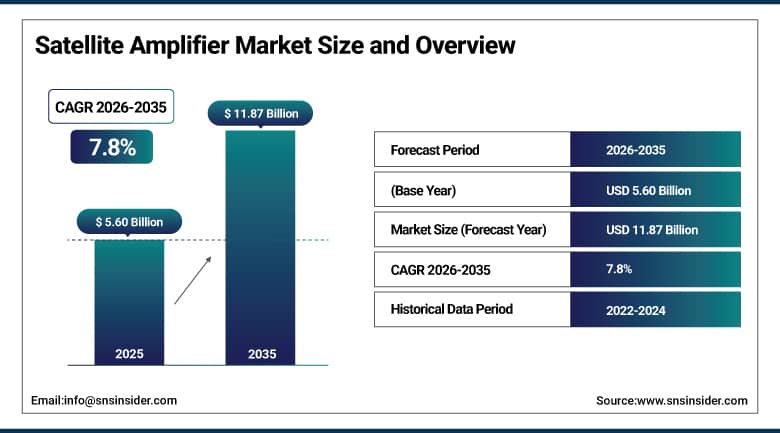
The Satellite Amplifier Market was valued at USD 5.60 Billion in 2025 and is projected to reach USD 11.87 Billion by 2035, registering a CAGR of 7.8% from 2026 to 2035.
Satellite Amplifier Market is driving the development of satellite communication infrastructure with the help of growing adoption of solid-state power amplifiers, traveling wave tube amplifiers, low noise amplifiers and gallium nitride RF architectures in ground stations as well as satellite payloads. The demand is driven by growing LEO/MEO constellation, high throughput satellites, SATCOM system modernization, inflight connectivity, maritime communications, remote communication, earth observation and growing Ku/Ka band networks.
Advances in GaN-on-SiC semiconductors, digital linearization, thermal management, electronically steered antenna systems, and compact size-weight-and-power architectures are increasing amplifier efficiency and reliability. These developments are particularly important as satellite operators seek higher throughput while reducing payload mass, electrical consumption, cooling requirements, and lifecycle operating costs.
To Get More Information On Satellite Amplifier Market - Request Free Sample Report
Satellite Amplifier Market Trends
-
Growing adoption of GaN-on-SiC power amplifiers continues improving satellite RF power density, thermal performance, and overall energy efficiency.
-
Rising deployment of LEO and multi-orbit satellite networks continues increasing demand for compact, lightweight, and scalable amplifier architectures.
-
Increasing migration toward Ka-band and higher-frequency SATCOM continues driving demand for broadband power amplifiers with improved linearity.
-
Growing integration of digital predistortion and adaptive RF control continues improving amplifier efficiency under high peak-to-average power waveforms.
-
Expanding inflight connectivity, maritime broadband, and defense SATCOM networks continues supporting ruggedized high-power amplifier deployment.
U.S. Satellite Amplifier Market Size Outlook
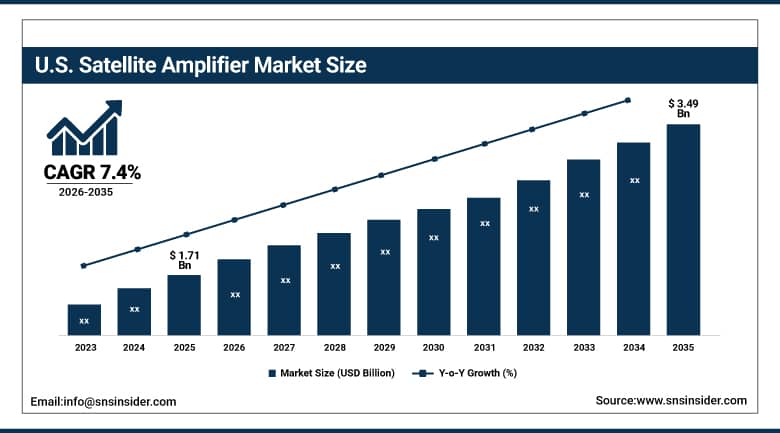
The U.S. Satellite Amplifier Market was valued at approximately USD 1.71 Billion in 2025 and is projected to reach approximately USD 3.49 Billion by 2035, registering a CAGR of approximately 7.4% from 2026 to 2035.
US demand is driven by the presence of robust military and government satellite communications infrastructure, commercial low Earth orbit (LEO) constellation launch programs, satellite broadband, high throughput satellite gateways, inflight connectivity, and advanced US production capability for RF and microwave products. Increased spending on space communications that are resilient and proliferated satellite architecture is driving increased demand for SSPAs, TWTAs, LNAs, gallium nitride MMICs, and block upconverters.
The presence of Comtech, Qorvo, Analog Devices, Mission Microwave, MACOM, Kratos, CPI, and many more RF device manufacturers provides a boost to domestic supply and engineering capacity. The U.S. adoption trend favors GaN-based power amplifiers, Ka band transmission, miniaturized electronically steered terminals, multi-orbit SATCOM systems, and military SATCOM applications requiring reduced size, weight, and power. This can be seen from Qorvo's continued development of K and Ka band GaN-based devices and Comtech's multi-orbit SATCOM solutions.
Satellite Amplifier Market Segment Analysis
-
By Amplifier Type, Solid-State Power Amplifiers segment dominated the Market in 2025 with 49% share; GaN RF Amplifier Modules segment is the fastest growing segment.
-
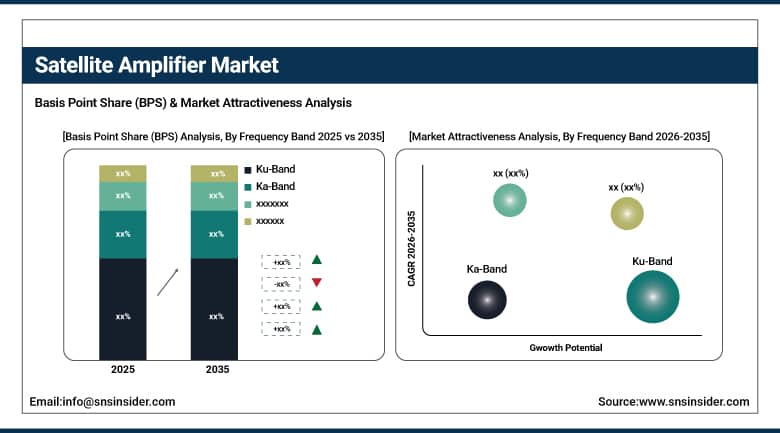
By Frequency Band, Ku-Band segment dominated the Market in 2025 with 32% share; Ka-Band segment is the fastest growing segment.
-
By Platform, Ground Systems segment dominated the Market in 2025 with 56% share; Space-Based Platforms segment is the fastest growing segment.
-
By Application, Communication & Broadcasting segment dominated the Market in 2025 with 42% share; Defense & Military segment is the fastest growing segment.
-
By End-User, Commercial Satellite Operators segment dominated the Market in 2025 with 34% share; Aerospace & Space Organizations segment is the fastest growing segment.
By Frequency Band Ku-Band Leads, Ka-Band Expands at the Fastest Pace
The Ku-Band held approximately 32% share in the Satellite Amplifier market in 2025 due to the wide application of the band in VSAT terminals, television broadcast, maritime communication, aircraft communication, enterprise network, portable SATCOM and defense communications. The band offers a good balance of the antenna size, available bandwidth, resilience from atmospheric conditions and available satellite capability. The band has a well-established infrastructure of ground equipment and amplifiers to meet the replacement and expansion demand. The range of products by Comtech Xicom includes the Ku Band and multi band products, while other companies such as Norsat, Spacepath and CPI have the Ku Band SSPA, TWTA and BUC products.
The Ka-Band is forecasted to have the highest growth as more and more high-capacity satellites and broadband constellations require higher frequency bands to offer better bandwidth capabilities. The usage of Ka-band amplifiers is especially essential in satellite gateway systems, airborne terminals, military communications, electronically steered arrays, and future LEO satellite constellations. The recent advancements in the area of GaN power amplifier design, heat dissipation, linearity enhancement, and smaller BUC design eliminate many efficiency and reliability problems from the past. Currently, Mission Microwave provides BUC and SSPA amplifiers in the Ka-band from compact terminal units to powerful 400 W amplifiers.
By Amplifier Type, Solid-State Power Amplifiers Lead, GaN RF Amplifier Modules Grow Fastest
Solid-State Power Amplifiers dominated the Satellite Amplifier Market in 2025 with approximately 49% share owing to their high reliability, lower maintenance requirements, compact form factor, rapid startup capability, and suitability for both fixed and mobile SATCOM terminals. SSPAs are increasingly deployed across satellite gateways, transportable terminals, airborne systems, maritime platforms, and defense communication networks. Their ability to support redundant architectures and provide improved lifecycle economics compared with conventional vacuum-tube systems has strengthened adoption. Current commercial portfolios from Norsat, Advantech Wireless, Mission Microwave, Comtech, and SpacePath include extensive SSPA and block-upconverter configurations across C-, Ku-, Ka-, X-, and other satellite bands.
GaN RF Amplifier Modules are expected to register the fastest growth throughout the forecast period due to their high breakdown voltage, superior power density, improved thermal performance, and ability to deliver substantial RF output from smaller footprints. These advantages are increasingly important for electronically steered terminals and spaceborne payloads constrained by power consumption and thermal dissipation. Qorvo's QPA1722 K-band amplifier, launched for LEO satellite payloads, demonstrates this trend by combining greater instantaneous bandwidth with reduced device footprint and higher efficiency. RFHIC and Analog Devices are also expanding GaN-based RF products suitable for SATCOM and aerospace applications, supporting broader commercialization of this technology.
By Platform Ground Systems Lead, Space-Based Platforms Grow Fastest
The Ground Systems Segment accounted for roughly 56% of the Satellite Amplifier Market’s revenues in 2025 since the teleports, satellite gateways, command and control centers, VSAT networks, broadcast uplinks, military terminals, tracking stations, and mobile communications systems all require large amounts of amplification equipment. The ground systems use an array of high-powered transmitters and low-noise receivers, resulting in repeated demand for both. In addition, the ground segment has more power and mass allowances than space-based segments, allowing for the deployment of highly powerful SSPAs and TWTAs.
Space-based Platforms will have the fastest growth rate by 2035 as there will be an increase in the number of satellites for commercial, governmental, and defense purposes. The payloads in satellites will also be defined more by software and will have increased capabilities. The Low Earth Orbit constellations will require small amplifiers which are efficient, radiation resistant, thermally stable, and light as their performance is critical to power budget of payload and longevity of satellites. Development of amplifiers using K-, Ka-, Q-, and V-bands is opening new areas for high capacity payloads and inter-satellite links.
By Application Communication & Broadcasting Lead, Defense & Military Grows Fastest
Communication and Broadcast were the main application areas for this market and had around 42% share in 2025 due to the implementation of satellite broadband services, direct-to-home broadcasting, enterprise VSAT services, rural connectivity, backhaul connectivity, maritime communication, and inflight communications. Amplification is crucial in ensuring that the link margin is maintained between the uplinks and downlinks especially when atmospheric attenuation, long distance transmissions, and high data rates increase the performance criteria of RF. Increased broadband capabilities and the use of hybrid terrestrial and satellite networks have led to increased demand for amplifiers.
Defense & Military applications are projected to show the highest growth rates due to the upgrading of the protected SATCOMs, tactical communications, intelligence, and surveillance systems, communications for air, naval, mobile command, and robust space systems. The military needs amplifiers with high output power, spectral purity, secure remote monitoring, redundancy, robustness, and environmental resistance. Comtech specializes in the development of high-power amplifiers from the Xicom range for military communications. Advantech Wireless provides amplifiers with high output for the S and X-bands based on GaN technology for satellite TT&C and military infrastructure.
By End-User Commercial Satellite Operators Lead, Aerospace & Space Organizations Gain Fastest Traction
The Commercial Satellite Operators were responsible for contributing to about 34% of the Satellite Amplifier Market’s revenue in 2025 since the operators run huge networks of geosynchronous (GEO), medium earth orbit (MEO), and low earth orbit (LEO) satellites where the use of amplifiers is required in gateways, teleports, feeder links, satellite payload, and customer end terminals. The increase in broadband subscriptions from satellites, upgrading of capacity, fleet renewal, and demand for multi-orbit connectivity have resulted in more investment in high-performance and high-efficient RF infrastructure.
Aerospace & Space organizations are expected to post the highest growth due to the expanding satellite applications among government bodies, space vehicle makers, commercial launch service providers, defense firms, and constellation developers. Smaller satellites have led to the greater use of small-size and radiation-resistant amplifier components, whereas scientific and deep-space missions have resulted in high-reliability amplifiers with high performance stability requirements. In addition, amplifier makers are developing space payload SWaP-constrained and high-frequency amplifiers, presenting growth opportunities in Telemetry, Tracking & Command payloads, communication payloads, Earth observation payloads, and exploration missions.
Regional Analysis:
|
Region |
Major Country |
Share within Region, 2025 |
|---|---|---|
|
North America |
United States |
82.00% |
|
Europe |
Germany |
26.00% |
|
Asia Pacific |
China |
42.00% |
|
Middle East and Africa |
Saudi Arabia |
27.00% |
|
Latin America |
Brazil |
46.00% |
North America Satellite Amplifier Market Insights
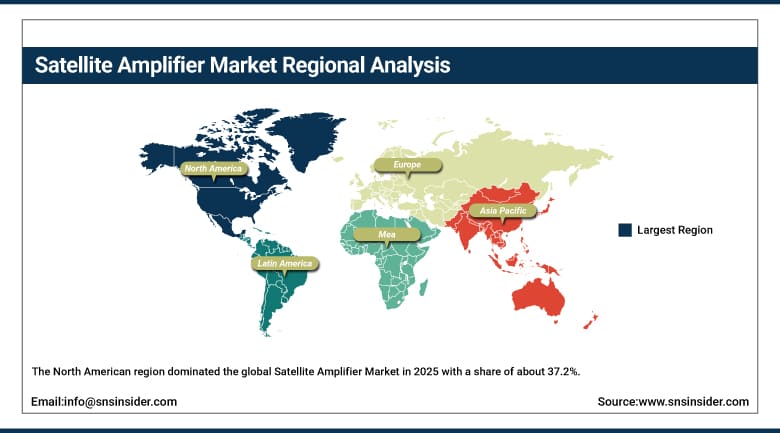
The North American region dominated the global Satellite Amplifier Market in 2025 with a share of about 37.2%. This was driven by several factors including strong satellite infrastructure, high spending on defense communications, a big commercial satellite fleet, advanced gateway networks, and the presence of an experienced RF and microwave components industry. Additionally, there are various satellite amplifiers and semiconductor providers in the US which makes it easier for satellite manufacturers and integrators in the region to benefit from state-of-the-art GaN, GaAs, SSPA, TWTA, and low-noise amplification solutions.
The United States was responsible for about 82% of North American revenues in 2025 due to the high levels of military SATCOM acquisitions, commercial space sector, LEO constellations, inflight connectivity services, and developments in space communication payloads. Examples of companies which contribute to the satellite RF eco-system in the country include Comtech, Mission Microwave, Qorvo, Analog Devices, CPI, MACOM, and Kratos. There are also other organizations from Canada that cater to the region by means of satellite components (Norsat) and communications services. Investment in protected SATCOMs, gateway upgrades, and resilient multi-orbit ground systems is likely to ensure North American demand over the forecast period.
Get Customized Report as Per Your Business Requirement - Enquiry Now
Europe Satellite Amplifier Market Insights
Europe held a significant position in the Satellite Amplifier Market in 2025 due to the presence of commercial satellite companies, defense modernization initiatives, satellite production, European space programs, broadcasting systems, and rising demand for secure sovereign communication. Development of regional broadband constellations and high-throughput satellite systems is increasing demand for GaN amplifiers, SSPAs, TWTAs, and low-noise RF chains. Europe also benefits from strong aerospace engineering expertise and a well-established supplier base serving commercial telecommunication, navigation, scientific, earth observation, defense, and institutional space programs.
Germany accounted for around 26% of the revenue generated by the European market in 2025 on account of its capabilities in aerospace manufacturing, telecommunication, defense electronics, and contribution to European satellite missions. Other countries like the United Kingdom, France, Italy, and Spain also hold a major share in the European market because of satellite manufacturing, military SATCOM, presence of commercial operators, and space research. There is a growing inclination among European operators towards efficient payloads, satellite architectures, secure communications, and high frequency band spectrum usage.
Asia Pacific Satellite Amplifier Market Insights
The Asia Pacific region is expected to exhibit the highest CAGR of around 9.4% during 2026-2035 due to increasing satellite launches, government-funded broadband programs, military space expenditure, manufacturing of satellites in-house, rural connectivity projects, and growing space program activity in China, India, Japan, South Korea, and Australia. There will be high demand for efficient ground station SSPAs, GaN RF modules, low noise amplifiers, tracking and telemetry technology, and Ka band systems. The independent research on the market also shows that the Asia Pacific region is the fastest-growing regional market for satellite amplifiers.
The China market contributed about 42% of the Asia-Pacific business in 2025 as a result of its well-established satellite manufacturing industry, communications satellites, BeiDou navigation system, Earth observation capabilities, broadband satellites, and defense space investments. India is developing fast due to increasing national satellite capability, commercial launch service business, military communications improvements, and increased need for indigenous SATCOM terminals. The markets of Japan and South Korea also contribute due to their advanced semiconductors, RF electronics, aerospace, and satellite manufacturing industries. The increasing regional demand for indigenous communication and high bandwidth will make the Asia Pacific region more significant for global amplifiers suppliers.
MEA and Latin America Satellite Amplifier Market Insights
The Satellite Amplifier Market in the Middle East, Africa, and Latin America is expanding steadily as governments and telecommunications providers increase investment in satellite broadband, remote connectivity, broadcast networks, defense communications, offshore operations, aviation connectivity, and disaster-response infrastructure. Satellite communication remains particularly valuable in countries where terrestrial fiber and mobile coverage are geographically constrained. Growing adoption of VSAT systems, high-throughput satellite capacity, and mobile SATCOM terminals is consequently increasing demand for reliable C-, Ku-, and Ka-band power amplifiers and low-noise receive chains.
The Saudi Arabia was estimated to generate around 27% of ME&A’s revenue for the year 2025 due to defense upgrades, national digital infrastructure initiatives, airline growth, and investments in communications via satellites. The UAE and Qatar also help generate revenue by satellite operations, aerospace investments, and secure government communications initiatives. Brazil contributed around 46% of Latin American region's revenue due to the huge geography, remote communications, broadcasting infrastructure, and enterprise communications via satellites. The countries contributing to the demand in the region include Mexico, Argentina, and Colombia.
Market Dynamics:
Growth Drivers: Expanding Satellite Constellations and Demand for High-Throughput Connectivity
The market is mainly being fueled by the fast growth of satellite broadband networks, low earth orbit (LEO) and medium earth orbit (MEO) constellations, HTS capacity, inflight connectivity services, maritime broadband networks, military SATCOM, and remote enterprise communication. With each new satellite network, there is a need for amplifiers in terms of the payloads, gateways, feeder links, tracking systems, user terminals, and mobile communications systems. High data throughput is also contributing to the move towards Ku-, Ka-, and other higher frequency systems which require high-linearity power amplifiers that are also power efficient.
The increasing adoption of electronically scanned antennas and software-defined satellite systems is also contributing to the use of small SSPAs and GaN-based RF modules. This makes it possible for manufacturers of terminals to cut down the size, weight, power and thermal requirements while making the systems more scalable. The combination of high output power, thermal capacity and efficiency that comes with GaN is ideal for use in satellite communication systems, where there are limited electrical and thermal resources available.
Restraints: High Development Costs and Stringent Thermal and Linearity Requirements
High development and qualification costs remain an important restraint because satellite amplifiers must satisfy demanding requirements for output power, linearity, efficiency, thermal performance, electromagnetic compatibility, reliability, and, in spaceborne applications, radiation tolerance. Advanced Ka-, Q-, and V-band systems require sophisticated semiconductor fabrication and packaging, while high-power ground amplifiers need extensive cooling, redundancy, monitoring, and protection circuitry. Long qualification cycles can increase product development expense and limit smaller companies' ability to compete in defense and spaceborne applications where failure tolerance is extremely low.
Thermal dissipation presents an additional constraint as manufacturers increase output power while shrinking amplifier footprints. GaN improves power density but does not eliminate system-level heat-management requirements. High-frequency signals are also more susceptible to atmospheric attenuation, while modern high-order modulation requires excellent amplifier linearity to prevent signal distortion. Designers must therefore balance efficiency, back-off, output power, linearity, cooling, and cost. These engineering tradeoffs can raise terminal prices and delay the transition from mature Ku- and C-band hardware to newer high-frequency amplifier architectures.
Opportunities: GaN Amplification and Multi-Orbit SATCOM Infrastructure Expansion
Growing adoption of GaN-on-SiC technology provides a major opportunity as satellite system manufacturers seek greater RF output, higher power-added efficiency, improved thermal handling, and reduced equipment footprint. Next-generation SSPAs using GaN can increasingly replace vacuum-tube amplifiers in applications where solid-state reliability and modularity are preferred. The opportunity extends from semiconductor dies and MMICs to complete BUCs, SSPAs, active antenna modules, and redundant gateway systems. Qorvo, RFHIC, Analog Devices, Norsat, Advantech Wireless, and Mission Microwave are already supporting this transition with commercially available GaN-based products.
Multi-orbit satellite connectivity represents another major opportunity because terminals and gateways increasingly need to communicate dynamically across GEO, MEO, and LEO networks. Amplifier suppliers that deliver broadband frequency coverage, software monitoring, remote diagnostics, high-efficiency operation, and flexible redundancy can benefit as operators consolidate ground infrastructure. Commercial aviation, maritime connectivity, military mobility, disaster recovery, and remote industrial networks create additional opportunities for ruggedized low-SWaP amplifiers. Expansion into higher-frequency K-, Ka-, Q-, and V-band architectures is expected to further increase the addressable market for advanced RF semiconductor and amplifier suppliers.
Recent Developments:
-
2026: MACOM Technology Solutions introduced and demonstrated new SATCOM amplifier technologies for IMS 2026, including K-/Ka-Band uplink and downlink amplifier chains, a linearized Q-Band GaN MMIC power amplifier, and a 24 dBm W-Band power amplifier operating from 80–100 GHz, targeting next-generation high-capacity satellite communications.
-
2026: RFHIC expanded its GaN SATCOM portfolio with the RWP2540200-53, a 200 W GaN-on-SiC wideband amplifier covering 2.5–4.0 GHz and offering 53 dB gain for SATCOM, radar, electronic warfare, and communications applications.
-
2025: Qorvo launched the QPA1722 K-Band Power Amplifier for LEO satellite payloads, providing three times greater instantaneous bandwidth, a 38% smaller footprint, and approximately 10% higher efficiency than competing devices according to the company.
-
2025: Qorvo advanced its SATCOM GaN portfolio with the QPA1724D, a 17.3–21.2 GHz, 20 W GaN-on-SiC K-band MMIC power amplifier designed for satellite communications, delivering up to 25 dB small-signal gain and 30% power-added efficiency.
Satellite Amplifier Companies are:
-
Communications & Power Industries LLC
-
Mission Microwave Technologies, LLC
-
Qorvo, Inc.
-
MACOM Technology Solutions Holdings, Inc.
-
Analog Devices, Inc.
-
Advantech Wireless Technologies Inc.
-
SpacePath Communications Ltd.
-
Kratos Defense & Security Solutions, Inc.
-
ND SATCOM GmbH
-
RFHIC Corporation
-
Teledyne Technologies Incorporated
-
Thales Group
-
L3Harris Technologies, Inc.
-
Mercury Systems, Inc.
-
Jersey Microwave
-
Terrasat Communications, Inc.
-
Amplus Communication Pte Ltd.
-
Rohde & Schwarz GmbH & Co. KG
Satellite Amplifier Market Report Scope:
| Report Attributes | Details |
|---|---|
| Market Size in 2025 | USD 5.60 Billion |
| Market Size by 2035 | USD 11.87 Billion |
| CAGR | 11.6% from 2026 to 2035 |
| Base Year | 2025 |
| Forecast Period | 2026-2035 |
| Historical Data | 2022-2024 |
| Report Scope & Coverage | Market Size, Segments Analysis, Competitive Landscape, Regional Analysis, DROC & SWOT Analysis, Forecast Outlook |
| Key Segments | • By Amplifier Type (Solid-State Power Amplifiers, Traveling Wave Tube Amplifiers, Low Noise Amplifiers, and GaN RF Amplifier Modules) • By Frequency Band (C-Band, Ku-Band, Ka-Band, X-Band, and Others) • By Platform (Ground Systems, Space-Based Platforms, Airborne Platforms, and Maritime Platforms) • By Application (Communication & Broadcasting, Defense & Military, Navigation & Earth Observation, and Space Exploration) • By End-User (Commercial Satellite Operators, Defense Agencies, Telecom Service Providers, Aerospace & Space Organizations, Maritime Operators, and Aviation Connectivity Providers) |
| Regional Analysis/Coverage | North America (US, Canada), Europe (Germany, UK, France, Italy, Spain, Russia, Poland, Rest of Europe), Asia Pacific (China, India, Japan, South Korea, Australia, ASEAN Countries, Rest of Asia Pacific), Middle East & Africa (UAE, Saudi Arabia, Qatar, South Africa, Rest of Middle East & Africa), Latin America (Brazil, Argentina, Mexico, Colombia, Rest of Latin America). |
| Company Profiles | Comtech Telecommunications Corp., Communications & Power Industries LLC, Mission Microwave Technologies, LLC, Qorvo, Inc., MACOM Technology Solutions Holdings, Inc., Analog Devices, Inc., Norsat International Inc., Advantech Wireless Technologies Inc., SpacePath Communications Ltd., Kratos Defense & Security Solutions, Inc., ND SATCOM GmbH, RFHIC Corporation, Teledyne Technologies Incorporated, Thales Group, L3Harris Technologies, Inc., Mercury Systems, Inc., Jersey Microwave, Terrasat Communications, Inc., Amplus Communication Pte Ltd., Rohde & Schwarz GmbH & Co. KG |

Frequently Asked Questions
Key players in the Satellite Amplifier Market include Comtech Telecommunications Corp., Communications & Power Industries LLC, Mission Microwave Technologies, Qorvo, MACOM Technology Solutions, and Analog Devices, among others.
Key opportunities in the Satellite Amplifier Market include increasing adoption of GaN-based SSPAs, expansion of multi-orbit SATCOM networks, Ka-band infrastructure deployment, spaceborne payload amplification, and growing inflight and maritime connectivity demand.
The market is driven by expanding LEO and high-throughput satellite networks, increasing demand for satellite broadband, military communication modernization, and growing adoption of efficient high-frequency RF amplification technologies.
The Solid-State Power Amplifiers segment dominated the Satellite Amplifier Market, accounting for approximately 49% market share in 2025.
North America dominated the Satellite Amplifier Market in 2025, driven by strong satellite infrastructure, military SATCOM demand, commercial space investment, and advanced RF technologies.
