
Vitreoretinal Surgery Devices Market Report Scope & Overview:
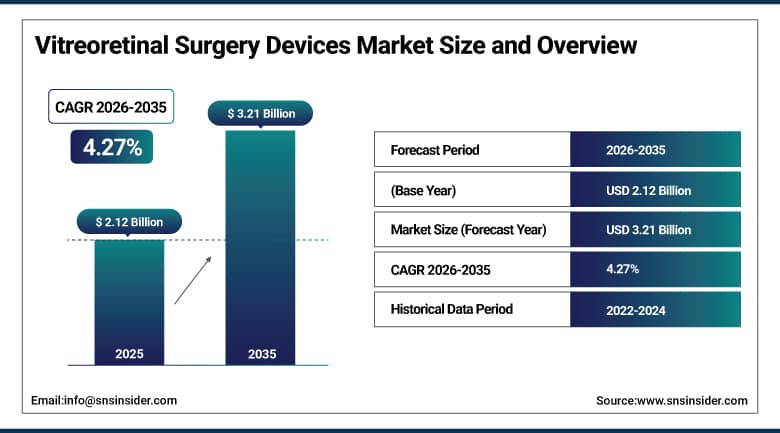
Vitreoretinal Surgery Devices Market was valued at USD 2.12 billion in 2025 and is expected to reach USD 3.21 billion by 2035, growing at a CAGR of 4.27% from 2026–2035.
The Vitreoretinal Surgery Devices Market are respond to proceed with extension driven by the elevating predominance of retinal scatters, upswing mature grown-up populace, and improvement in progressed ophthalmic careful measures. This has led to an increasing preference for treatments guaranteeing greater accuracy, better visual outcomes, and minimal recovery times among patients and healthcare professionals. Ongoing improvements in micro-incision vitrectomy systems (MIVS), high-resolution visualization technologies, intraoperative optical coherence tomography (OCT) and newer generation retinal laser treatment platforms are facilitating precise advances across sub-disciplines of ophthalmology to ensure surgical efficacy & safety.The growing global burden of vision-threatening conditions such as Diabetic Retinopathy, Retinal Detachment, and Macular Degeneration is a key factor fueling market demand. The increasing incidence of diabetes and age-related eye disorders is particularly contributing to the rising number of vitreoretinal procedures worldwide.
In Feb 2026 Supporting this trend, the World Health Organization estimates that more than 2.2 billion people worldwide live with vision impairment or blind and many of these are due to retinal disease.
To Get More Information On Vitreoretinal Surgery Devices Market - Request Free Sample Report
Vitreoretinal Surgery Devices Market Trends
-
Rise in use of miniaturized systems like 25G, and 27G micro-incision vitrectomy systems (MIVS) increasing accuracy, limits trauma, and better recovery time.
-
Integration of advanced imaging (intraoperative OCT & 3D visualization) for real-time surgical decision making
-
Ambulatory Surgical Center (ASC) expansion shift to outpatient procedure of more instances, new advance in cost efficiency and quickness and effectiveness.
-
Demand is driven by increasing number of retinal disorders (Diabetic Retinopathy, Retinal Detachment, AMD) caused due to aging and diabetes.
-
Faster cutter speeds and improved fluidics of novel vitrectomy machines are producing a safer, more controllable and quicker technique.
-
Increasing amount of heads-up and digital surgery systems is enhancing optics and reducing potential for surgeon fatigue.
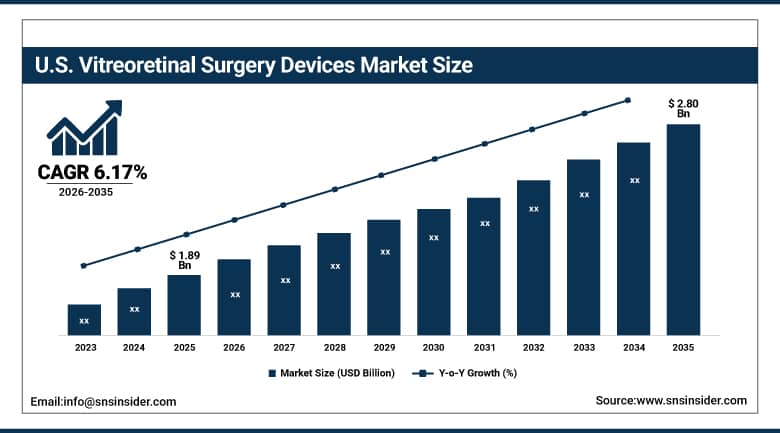
United States Vitreoretinal Surgery Devices Market was valued at USD 1.89 billion in 2025 and is expected to reach USD 2.80 billion by 2035, growing at a CAGR of 6.17% from 2026–2035.
The U.S. Vitreoretinal Surgery Devices Market stands as the world's largest, underpinned by a sophisticated healthcare infrastructure, robust reimbursement frameworks, and a concentration of leading ophthalmic device developers including Alcon, Bausch + Lomb, Carl Zeiss Meditec, and Topcon Corporation. Favorable Centers for Medicare & Medicaid Services (CMS) reimbursement policies for advanced retinal procedures continue to drive adoption across hospital systems and ambulatory surgery centers.
Jan 21, 2026: The National Diabetes Statistics Report highlights a major public health burden, with approximately 40.1 million people in the United States affected by diabetes, including both diagnosed and undiagnosed cases.
Vitreoretinal Surgery Devices Market Segment Highlights
-
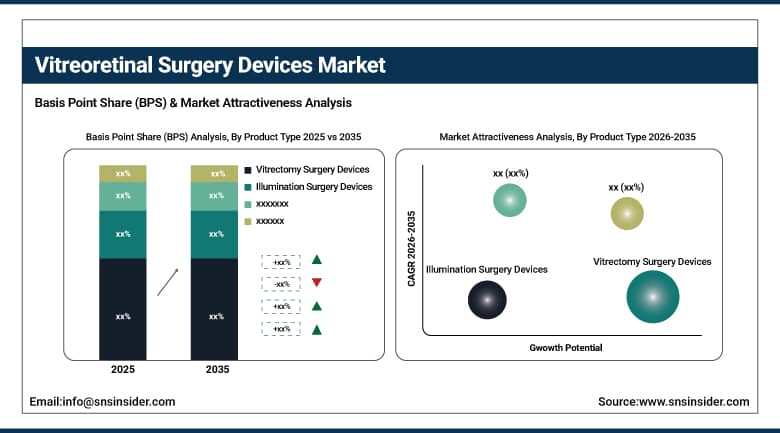
By Product Type, Vitrectomy Surgery Devices dominated the Vitreoretinal Surgery Devices Market with 34.81% share in 2025; Illumination Surgery Devices fastest growing (CAGR).
-
By Application, Diabetic Retinopathy dominated the Vitreoretinal Surgery Devices Market with 31.40% share in 2025; Epiretinal Membrane Removal fastest growing (CAGR).
-
By Surgery Type, Vitreoretinal Surgery Devices dominated the Vitreoretinal Surgery Devices Market with 46.35% share in 2025; Vitreoretinal Surgery Devices fastest growing (CAGR).
-
By End User, Hospitals dominated the Vitreoretinal Surgery Devices Market with 48.60% share in 2025; Ambulatory Surgical Centers fastest growing (CAGR).
By Product Type, Vitrectomy Surgery Devices segment dominates the Vitreoretinal Surgery Devices Market, Illumination Surgery Devices segment expected to grow fastest
The Vitrectomy Surgery Devices segment retained its leading position in the Vitreoretinal Surgery Devices Market, due to the importance of large number of vitrectomy devices since almost all retinal surgery are combined with vitrectomies by 2025. As emphasized in clinical literature from the American Academy of Ophthalmology, vitrectomy systems, cutters and fluidics platforms form an essential backbone for surgical interventions related to retinal detachment repair and macular hole surgery. Micro-incision vitrectomy systems (MIVS) and high-speed cutters have been continuously improved to enhance surgical precision and outcome.
The Illumination Surgery Devices segment is expected to be the fastest-growing segment during 2026-2035. Intraoperative visualization can be enhanced owing to the rising use of advanced visualization technologies such as inclusion of fiber optic and LED based illumination with 3D surgical systems. Research and device innovation: Carl Zeiss Meditec is among the companies assisting in advancing visual enhancement platforms.
By Application, Diabetic Retinopathy segment dominates the Vitreoretinal Surgery Devices Market, Epiretinal Membrane Removal segment expected to grow fastest
The Diabetic Retinopathy segment dominates the market due to the rapidly increasing global burden of diabetes. According to the World Health Organization, diabetes is a leading cause of vision impairment worldwide, significantly increasing demand for retinal interventions. Large-scale screening and early diagnosis programs are also contributing to higher procedural volumes.
Considering the regional segments, the removal of Epiretinal Membrane segment is projected to achieve growth at a faster pace during the forecast period The implementation of diagnostic technologies like optical coherence tomography (OCT), a commonly recommended form of imaging by the National Eye Institute — has enabled better detection rates. Secondly, epiretinal membrane disease is presenting more worldwide in association with our aging populations.
By Surgery Type, Vitreoretinal Surgery Devices segment dominates the Vitreoretinal Surgery Devices Market, Vitreoretinal Surgery Devices segment expected to grow fastest
The Vitreoretinal Surgery Devices segment dominates the Vitreoretinal Surgery Devices Market, driven by widespread adoption of micro-incision techniques. Clinical studies and surgical guidelines from the American Society of Retina Specialists emphasize that minimally invasive vitrectomy reduces complications, improves recovery time, and enhances patient outcomes.
During the forecast, from 2026 to 2035, high growth is also projected for this segment. This global adoption is proliferating due to continued advancements in related technologies specific to instrumentation, imaging, and digital surgery platforms; the growing preference for less invasive procedures by surgeons; and increased patient awareness.
By End User, Hospitals segment dominates the Vitreoretinal Surgery Devices Market, Ambulatory Surgical Centers segment expected to grow fastest
The Hospitals segment dominates the market, as complex retinal surgeries require advanced infrastructure, specialized surgical teams, and high-end imaging systems. According to healthcare delivery data from the Centers for Disease Control and Prevention, hospitals remain the primary setting for high-acuity surgical procedures in the United States and globally.
The fastest growing segment is Expected to be the Ambulatory Surgical Centers (ASCs) The trend toward outpatient care is accelerating across the globe, due to cost-effectiveness of an ambulatory approach and patients' preference for same-day procedures. The Centers for Medicare & Medicaid Services also has provided policy assistance, including increased reimbursement for outpatient procedures that is propelling this shift.
Vitreoretinal Surgery Devices Market Regional Analysis
|
Region |
Major Country |
Share within Region (%) |
|---|---|---|
|
North America |
United States |
39.18% |
|
Europe |
Germany |
27.96% |
|
Asia Pacific |
China |
22.94% |
|
Middle East & Africa |
UAE |
2.07% |
|
Latin America |
Brazil |
5.05% |
North America Vitreoretinal Surgery Devices Market Insights
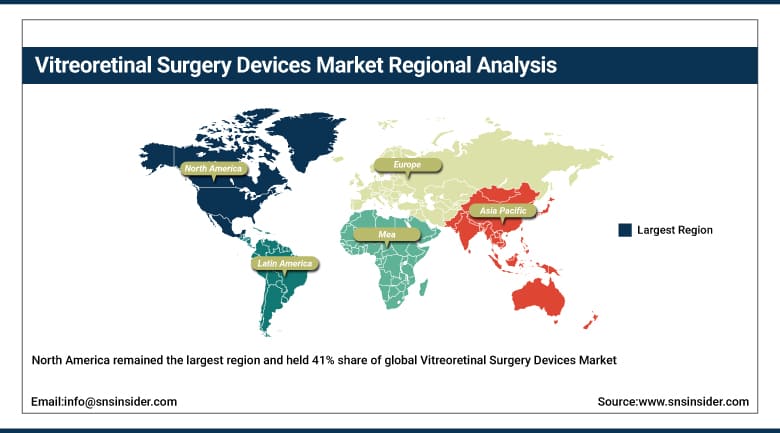
North America remained the largest region and held 41% share of global Vitreoretinal Surgery Devices Market revenue at its peak due to its advanced ophthalmic healthcare infrastructure, higher socioeconomic status of the people in that region, high prevalence of retinal disorders, larger number of leading medical device companies are basic tools for surgery in North America (such as vitrectomy systems), competent and budget-friendly modes of treatments capability to adopt cutting-edge technologies early on. The US accounts for the largest regional performance at 85% intra-regional share owing to broad adoption across hospital networks and specialty eye clinics of high-end vitrectomy platforms, laser-assisted retinal systems, and micro-incision surgical techniques.
Supporting this dominance, the U.S. Centers for Medicare & Medicaid Services (CMS) continues to provide reimbursement coverage for complex retinal surgeries, including vitrectomy procedures for diabetic retinopathy and retinal detachment, encouraging higher surgical volumes.
The American Academy of Ophthalmology (AAO) reports a steady increase in vitreoretinal procedures in the U.S., driven by rising diabetic eye disease cases and expanding use of minimally invasive retinal surgery technologies across ambulatory surgical centers and hospitals.
Get Customized Report as Per Your Business Requirement - Enquiry Now
Asia Pacific Vitreoretinal Surgery Devices Market Insights
The Asia Pacific region is forecasted to sustain the highest CAGR of 16.80% during the forecast period (2026 - 2035) owing to fast-improving ophthalmic healthcare infrastructure, increasing prevalence of diabetes-related eye diseases, rising awareness regarding various retinal treatment options, and substantial government investment in healthcare modernization. Regional revenue: China, India, Japan, South Korea, and Australia are key growth markets; China alone represents 55% of regional revenue. The rising prevalence of eye disorders, supportive government initiatives for reducing the burden of blindness and enhancing patient accessibility to eye care services are among key factors contributing towards a higher demand for advanced and reasonably-priced vitreoretinal surgical devices in this region.Supporting this growth, China’s National Medical Products Administration (NMPA) has accelerated approvals for advanced ophthalmic surgical devices, supporting faster commercialization of vitreoretinal systems.Japan’s Ministry of Health, Labour and Welfare (MHLW) continues to expand reimbursement coverage for retinal procedures, including treatments for diabetic retinopathy and macular degeneration, further increasing adoption of advanced vitreoretinal surgical technologies across hospitals and eye care centers.
Europe Vitreoretinal Surgery Devices Market Insights
The Europe region held the second-largest revenue share in the global Vitreoretinal Surgery Devices Market, accounting for 26% in 2025, driven by a well-established healthcare system, strong adoption of advanced ophthalmic surgical technologies, and increasing geriatric population prone to retinal disorders. Countries such as Germany, the United Kingdom, France, Italy, and Spain are major contributors, with high penetration of micro-incision vitrectomy systems and advanced visualization platforms in specialized eye hospitals. Supporting this position, the European Commission’s Horizon Europe program continues to fund research in ophthalmic imaging, robotic-assisted surgery, and digital visualization technologies, strengthening innovation in retinal care. In addition, the EU Medical Device Regulation (MDR 2017/745) has reinforced strict safety and performance standards for ophthalmic surgical devices, improving clinical confidence and accelerating adoption of advanced vitreoretinal technologies across European healthcare systems.
Middle East & Africa and Latin America Vitreoretinal Surgery Devices Market Insights
The Middle East & Africa (MEA) and Latin America regions are witnessing steady growth in the Vitreoretinal Surgery Devices Market, supported by improving healthcare infrastructure, increasing awareness of retinal diseases, and rising investments in advanced ophthalmic care facilities. In the MEA region, countries such as UAE, Saudi Arabia, and South Africa are leading adoption, driven by government initiatives to modernize healthcare systems and expand access to specialized eye care services. The UAE is emerging as a regional hub for advanced ophthalmic surgeries with increasing deployment of high-end vitreoretinal surgical systems in tertiary hospitals.Supporting development in these regions, Saudi Arabia’s Ministry of Health continues to invest in hospital modernization programs under Vision 2030, including procurement of advanced ophthalmic surgical equipment. In Latin America, Brazil is the regional leader for adoption in Latin America with fewer regulatory hurdles, as ANVISA has streamlined its approach to granting marketing approval for new medical devices driving timely commercial introduction of vitreoretinal surgical technologies within both public and private healthcare segments contributing to greater accessibility to retinal care products.
Vitreoretinal Surgery Devices Market Growth Drivers:
Rising Disease Burden and Demographic Shifts Driving Vitreoretinal Surgery Market Growth
The vitreoretinal surgery market is being strongly driven by the increasing prevalence of retinal disorders such as diabetic retinopathy, age-related macular degeneration (AMD), and retinal detachment, largely fueled by aging populations and rising lifestyle diseases like diabetes. Growing awareness and early diagnosis of eye conditions are also contributing to higher surgical intervention rates. Additionally, advancements in minimally invasive surgical techniques, improved vitrectomy devices, and enhanced visualization systems are increasing procedure efficiency and safety, encouraging wider adoption. Expanding healthcare infrastructure, particularly in emerging economies, along with greater access to specialized ophthalmic care, is further accelerating market growth globally..
Oct 6, 2025: 2025 Retina Report highlights a rising global burden of retinal diseases despite medical advances, with increasing cases of age-related macular degeneration (AMD), diabetic retinal disease, and inherited retinal disorders driven by aging populations and growing diabetes prevalence.
Vitreoretinal Surgery Devices Market Restraints:
High cost of advanced vitreoretinal surgical systems limiting adoption in developing healthcare markets
High-cost vitreoretinal surgery instruments and their associated surgical setups severely limit adoption, particularly in low- and middle-income economies. Many small hospitals and eye care centers are unable to afford advanced systems, for example high-end vitrectomy machines, laser units and visualization platforms requiring significant capital investment. Moreover, India spends more on maintenance, consumables and training than the purchase price of military hardware. Few reimbursement policies across different regions further disincentivize healthcare providers from making investments in such technologies. Consequently, the uptake of advanced vitreoretinal surgical solutions is still limited to developed markets, slowing global overall market growth.
Vitreoretinal Surgery Devices Market Opportunities:
Robotic and AI-Driven Precision Unlocking Next-Gen Vitreoretinal Surgery Opportunities
The emergence of robotic-assisted and AI-integrated vitreoretinal surgical systems is creating significant opportunities for advancement in ophthalmic care. These technologies enhance surgical precision, stability, and reproducibility, enabling surgeons to perform highly delicate procedures such as subretinal injections and membrane peeling with improved control. By minimizing human tremors and supporting microscale movements, robotic platforms increase safety and reduce procedural errors. AI-based imaging and decision-support systems further improve intraoperative guidance and diagnostic accuracy. This shift is expected to expand the scope of treatable retinal conditions while reducing the learning curve for surgeons. Additionally, integration with advanced visualization tools and minimally invasive techniques is driving demand for next-generation surgical platforms. Overall, these innovations are paving the way for more efficient, consistent, and patient-centric retinal surgery outcomes.
Jul 2025: Early first-in-human trial results of the Luca robotic system in vitreoretinal surgery show that robotic assistance can improve surgical precision and reproducibility while maintaining patient safety. The system demonstrates feasibility for highly delicate retinal procedures with enhanced stability and reduced human tremor impact.
Recent Developments:
-
2026: Bausch + Lomb receives FDA 510(k) clearance for the Bi-Blade + dual-port vitrectomy cutter (and also the Adaptive Fluidics upgrade for Stellaris Elite, which allows cutting speed of up to 25,000 cuts per minute and improved intraoperative fluidic stability in retinal surgery).
-
2025: Alcon launched limited global commercialization of its new state-of-the-art UNITY Vitreoretinal Cataract System (VCS), featuring next-generation elements such as 30,000 cuts-per-minute vitrectomy technology and Intelligent Fluidics to offer the greatest precision and efficiency across both vitreoretinal and cataract surgical procedures.
-
2024: Carl Zeiss Meditec bolstered its DORC-centric vitreoretinal operative ecosystem with improved EVA NEXUS platform technologies, high-speed cutters and high-end visualization systems to fine-tune surgical precision and intraop real-time monitoring.
Vitreoretinal Surgery Devices Market Key Players
Some of the Vitreoretinal Surgery Devices Market Companies
-
Johnson & Johnson Vision
-
Bausch + Lomb Incorporated
-
Carl Zeiss Meditec AG
-
Topcon Corporation
-
NIDEK Co., Ltd.
-
HOYA Corporation
-
DORC (Dutch Ophthalmic Research Center)
-
IRIDEX Corporation
-
Lumenis Ltd.
-
BVI Medical
-
GEUDER AG
-
OCULUS Optikgeräte GmbH
-
Optos plc
-
Ellex Medical Lasers Ltd.
-
Synergetics USA Inc.
-
Leica Microsystems GmbH
-
MedOne Surgical Inc.
-
Katalyst Surgical LLC
-
Peregrine Surgical Ltd.
Vitreoretinal Surgery Devices Market Report Scope:
| Report Attributes | Details |
|---|---|
| Market Size in 2025 | USD 2.12 Billion |
| Market Size by 2035 | USD 3.21 Billion |
| CAGR | CAGR of 4.27% From 2026 to 2035 |
| Base Year | 2025 |
| Forecast Period | 2026-2035 |
| Historical Data | 2022-2024 |
| Report Scope & Coverage | Market Size, Segments Analysis, Competitive Landscape, Regional Analysis, DROC & SWOT Analysis, Forecast Outlook |
| Key Segments | • By Product Type (Vitrectomy Surgery Devices, Photocoagulation Surgery Devices, Illumination Surgery Devices, Others, Total) • By Application Type (Diabetic Retinopathy, Retinal Detachment, Macular Hole Surgery, Epiretinal Membrane Removal, Other Vitreoretinal Disorders, Total) • By Surgery Type (Traditional Surgery, Minimally Invasive Surgery, Laser-Assisted Surgery, Total) • By End-User (Hospitals, Ambulatory Surgical Centers (ASCs), Specialty Ophthalmic Clinics, Research Institutes, Total) |
| Regional Analysis/Coverage | North America (US, Canada), Europe (Germany, UK, France, Italy, Spain, Russia, Poland, Rest of Europe), Asia Pacific (China, India, Japan, South Korea, Australia, ASEAN Countries, Rest of Asia Pacific), Middle East & Africa (UAE, Saudi Arabia, Qatar, South Africa, Rest of Middle East & Africa), Latin America (Brazil, Argentina, Mexico, Colombia, Rest of Latin America). |
| Company Profiles | Alcon Inc., Johnson & Johnson Vision, Bausch + Lomb Incorporated, Carl Zeiss Meditec AG, Topcon Corporation, NIDEK Co., Ltd., HOYA Corporation, DORC (Dutch Ophthalmic Research Center), IRIDEX Corporation, Lumenis Ltd., BVI Medical, GEUDER AG, OCULUS Optikgeräte GmbH, Optos plc, Ellex Medical Lasers Ltd., Synergetics USA Inc., Leica Microsystems GmbH, MedOne Surgical Inc., Katalyst Surgical LLC, Peregrine Surgical Ltd. |
Frequently Asked Questions
North America dominated the Vitreoretinal Surgery Devices Market in 2025.
The Vitrectomy Surgery Devices segment dominated the Vitreoretinal Surgery Devices Market in 2025.
Rising prevalence of retinal disorders such as diabetic retinopathy, retinal detachment, and age-related macular degeneration, along with increasing adoption of minimally invasive vitreoretinal surgical technologies, is the primary growth driver of the market.
The Vitreoretinal Surgery Devices Market was valued at USD 2.12 billion in 2025.
The Vitreoretinal Surgery Devices Market is expected to grow at a CAGR of 4.27% from 2026 to 2035.
