
Serial to Cellular Gateway Market Report Scope & Overview:
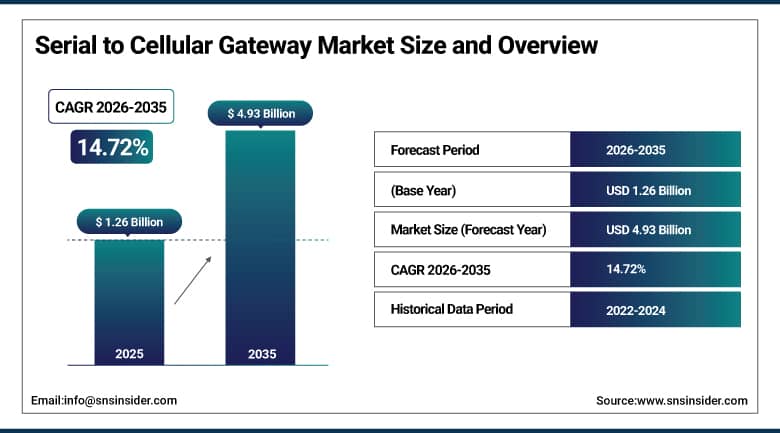
The Serial to Cellular Gateway Market was valued at USD 1.26 billion in 2025 and is expected to reach USD 4.93 billion by 2035, growing at a CAGR of 14.72% from 2026-2035.
The Serial to Cellular Gateway Market is witnessing strong growth due to increasing demand for reliable wireless connectivity for legacy serial devices across industrial and commercial environments. Increasing use of IoT, machine-to-machine communication, remote monitoring, and industrial automation is resulting in the requirement of connectivity between RS-232, RS-485, and other serial devices with the cellular network. The development of 4G and 5G networks is making it possible for communication to be faster and efficient. Moreover, the requirement for remote asset management, low-cost installation, and connectivity in places where there is no wired network is also driving the growth.
According to the GSMA, the number of IoT connections worldwide is expected to reach 29.5 billion by 2030, increasing demand for connected devices, gateways, and machine-to-machine communications.
To Get More Information On Serial to Cellular Gateway Market - Request Free Sample Report
Serial to Cellular Gateway Market Trends:
-
Rising adoption of industrial IoT and connected devices is driving demand for serial to cellular gateways enabling remote connectivity across legacy equipment.
-
Increasing deployment of 4G LTE and 5G networks is accelerating replacement of outdated communication technologies with reliable cellular connectivity solutions.
-
Growing demand for remote monitoring and equipment management is expanding gateway adoption across manufacturing, utilities, transportation, energy, and infrastructure applications.
-
Increasing modernization of legacy serial devices is encouraging organizations to integrate RS-232, RS-485, and RS-422 equipment with cellular networks.
-
Advancements in edge computing and industrial communication technologies are improving gateway processing capabilities, connectivity reliability, and real-time data transmission.
U.S. Serial to Cellular Gateway Market Outlook:
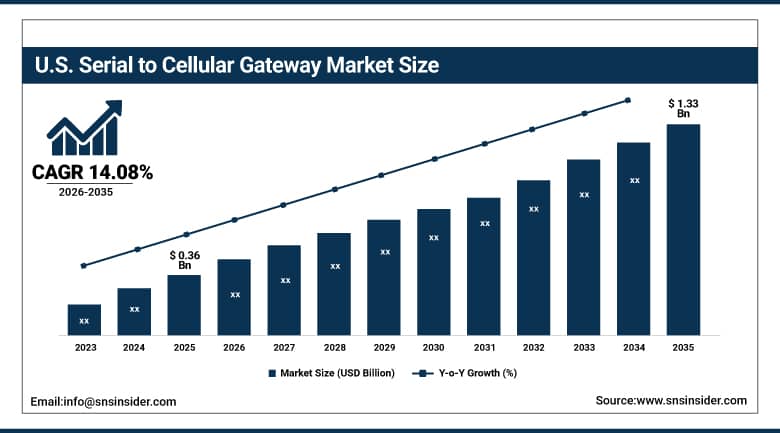
The U.S. Serial to Cellular Gateway Market was valued at USD 0.36 billion in 2025 and is expected to reach USD 1.33 billion by 2035, growing at a CAGR of 14.08% from 2026-2035.
The U.S. Serial to Cellular Gateway Market is witnessing strong growth due to increasing demand for reliable wireless connectivity for legacy serial equipment across industrial and commercial applications. The growing use of IoT, industrial automation, remote monitoring, and machine-to-machine communication is resulting in an increase in the need for cellular gateways that can link the serial devices to modern networks. The increasing development of 4G and 5G network is helping in improving the communication capabilities. Moreover, the need for remote asset management, low installation costs, and communications where there is no wired infrastructure is also leading to increased use. Development in cellular communication security, industrial IoT, and gateways is further aiding growth in the market.
According to the FCC's July 2026 document, U.S. wireless data usage increased by roughly 35% annually for the previous three years, increasing the requirement for network capacity and reliable cellular connectivity.
Serial to Cellular Gateway Market Segment Analysis:
-
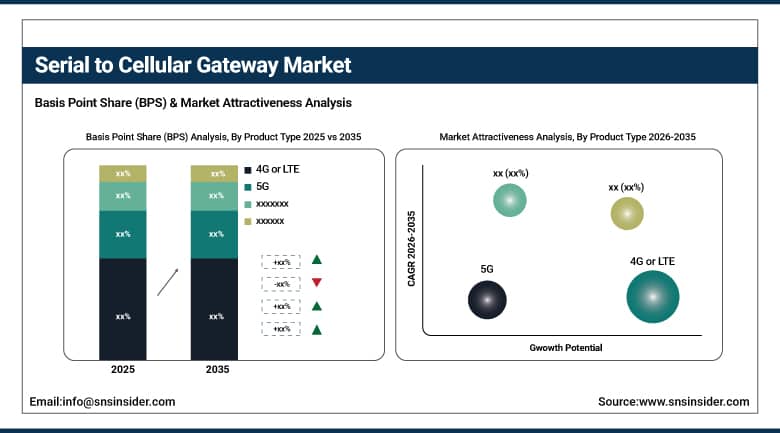
By Product Type, 4G or LTE dominated the Serial to Cellular Gateway Market with 62% share in 2025; 5G is expected to grow at the fastest CAGR of 16.01% from 2026–2035.
-
By Communication Protocol, RS485 dominated the Serial to Cellular Gateway Market with 49% share in 2025; RS485 is expected to grow at the fastest CAGR of 15.27% from 2026–2035.
-
By Distribution Channel, Direct Sales dominated the Serial to Cellular Gateway Market with 46% share in 2025; Online is expected to grow at the fastest CAGR of 16.26% from 2026–2035.
-
By Application, Industrial Automation dominated the Serial to Cellular Gateway Market with 32% share in 2025; Energy and Utilities is expected to grow at the fastest CAGR of 16.57% from 2026–2035.
-
By End-User, Manufacturing dominated the Serial to Cellular Gateway Market with 33% share in 2025; Smart Grid is expected to grow at the fastest CAGR of 16.35% from 2026–2035.
By Product Type, 4G or LTE dominates the serial to cellular gateway market, 5G grows fastest.
4G or LTE segment dominated the Serial to Cellular Gateway Market with the highest revenue share of about 62% in 2025 because of its extensive use in industrial systems, existing networking infrastructure, extensive coverage, and economical connectivity. 4G/LTE enables dependable data transfer for old-school serial hardware, remote surveillance, and industrial uses, whereas the presence of an established ecosystem facilitates its use in many industries around the world.
5G segment is expected to grow at the fastest CAGR of 16.01% from 2026-2035 Because of the rising need for ultra-low latency, fast data rates, improved reliability, and massive connectivity of devices. Increasing use of industrial IoT, smart manufacturing, remote monitoring, and critical missions has encouraged the shift towards 5G-capable gateways, while increased 5G infrastructure deployment hastens the process.
By Communication Protocol, RS485 dominates the serial to cellular gateway market and grows fastest.
RS485 segment dominated the Serial to Cellular Gateway Market with the highest revenue share of about 49% in 2025 because of its long distance communication capability, noise immunity, multi-point connection ability, and extensive use in industrial machinery. RS485 finds extensive application with PLCs, sensors, meters, and other automation devices, along with compatibility with industrial machinery and cost-effectiveness.
RS485 segment is expected to grow at the fastest CAGR of 15.27% from 2026-2035 As a result of increased industrial automation, integration of the Internet of Things (IoT), and need for communication between old and new machinery through cellular communication. The good performance of the RS485 gateways in electrical noise environments and its compatibility with many industrial protocols makes the RS485 gateways very appealing.
By Distribution Channel, Direct Sales dominates the serial to cellular gateway market, Online grows fastest.
Direct Sales segment dominated the Serial to Cellular Gateway Market with the highest revenue share of about 46% in 2025 as a result of the manufacturers' preference for personal contact, consultations, customizing, and follow-up services. Direct selling helps the suppliers to be aware of the needs and give the appropriate configuration. Industrial adoption and the need for customizing connectivity solutions have helped reinforce direct purchasing worldwide.
Online segment is expected to grow at the fastest CAGR of 16.26% from 2026-2035 because of the increase in digital buying, wider availability of products, clear pricing, and ease of comparing gateway requirements. Digital platforms make it easy for consumers to choose products from different brands and make it easier to purchase in smaller quantities. Increasing digitization and digital transformation will drive online purchases.
By Application, Industrial Automation dominates the serial to cellular gateway market, Energy and Utilities grows fastest.
Industrial Automation segment dominated the Serial to Cellular Gateway Market with the highest revenue share of about 32% in 2025 as a result of the increasing use of networked machines, remote monitoring, PLC communications, and automated production facilities. Serial gateways facilitate the connectivity of older industrial devices with cellular networks. Increasing number of Industry 4.0 projects also contribute to the rise in demand for these devices.
Energy and Utilities segment is expected to grow at the fastest CAGR of 16.57% from 2026-2035 This is attributed to the rising implementation of smart grids, asset monitoring, distributed generation sources, and reliable connectivity requirements among scattered facilities. Cellular gateways facilitate instant communication between the metering system, substations, and control centers, along with the adoption of renewable energy sources and grid modernization.
By End-User, Manufacturing dominates the serial to cellular gateway market, Smart Grid grows fastest.
Manufacturing segment dominated the Serial to Cellular Gateway Market with the highest revenue share of about 33% in 2025 This can be attributed to industrial automation, networking of machines, PLC systems, and monitoring of equipment remotely. Serial Gateways help in connecting old manufacturing equipment with cellular networks to facilitate real-time data communication and monitoring. The increased adoption of Industry 4.0 technology makes this more prevalent.
Smart Grid segment is expected to grow at the fastest CAGR of 16.35% from 2026-2035 because of rising grid modernization, use of smart meters, incorporation of renewable energy sources, and requirements for real-time monitoring of utilities. Cellular gateways offer an efficient mode of communication for dispersed grid resources by providing remote control capabilities and transferring data. Increasing investments in intelligent electricity networks fuel this trend further.
Regional Analysis:
|
Region |
Major Country |
Share within Region, 2025 (%) |
|---|---|---|
|
North America |
United States |
89.5% |
|
Europe |
Germany |
27.0% |
|
Asia Pacific |
China |
36.0% |
|
Middle East & Africa |
UAE |
22.5% |
|
Latin America |
Brazil |
40.0% |
North America Serial to Cellular Gateway Market Insights
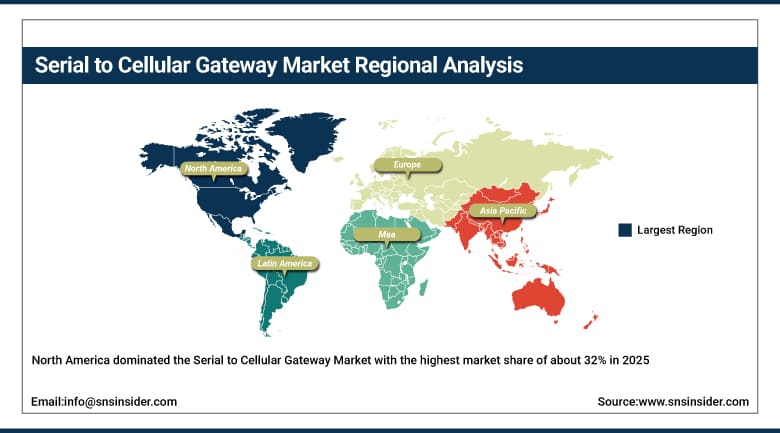
North America dominated the Serial to Cellular Gateway Market with the highest market share of about 32% in 2025, Fuelled by sophisticated industrial automation, broad implementation of Internet of Things (IoT) solutions, and increasing needs for remote communication. Modernization of old serial devices, development of intelligent infrastructure, and deployment of connected industrial systems are providing additional support to the gateways' deployment.
The U.S. Serial to Cellular Gateway Market accounted for a market share of 89.5%, Backed by industrial automation, IoT, and the need for remote access. Modernization of existing serial devices, development of smart infrastructures, and the growth of connected manufacturing, utilities, transportation, and energy systems is also fueling the adoption of serial to cellular gateways in the US.
Get Customized Report as Per Your Business Requirement - Enquiry Now
Europe Serial to Cellular Gateway Market Insights
Europe Serial to Cellular Gateway Market is witnessing steady growth, supported by industrial automation, IoT adoption, smart infrastructure, and modernization of legacy communication systems. Increasing needs for remote monitoring and reliable cellular connectivity are promoting installations within the manufacturing, utilities, transport, and energy industries. Efforts being made toward digital transformation and Industry 4.0 along with industrial communications will aid in the development of the regional market.
The Germany Serial to Cellular Gateway Market accounted for a market share of 27.0%, With the help of advanced automation, industry 4.0, and modernized legacy communication system, Germany’s IoT market is growing. Increasing demand for remote equipment monitoring along with dependable cellular connection is aiding in its growth in manufacturing, energy, utility, and transportation. Smart factories and digitalized industry are other factors contributing to market development.
Asia Pacific Serial to Cellular Gateway Market Insights
Asia Pacific is expected to grow at the fastest CAGR of about 15.53% from 2026–2035, backed by industrialization, Internet of Things implementation, smart cities, and increasing automation. Investment in connected infrastructure, modernization of manufacturing, remote monitoring, and communication systems is fueling demand. Increasing use of cellular connectivity in emerging nations is accelerating the uptake of serial to cellular gateway solutions.
The China Serial to Cellular Gateway Market accounted for a market share of 36.0%, driven by fast industrialization, IoT adoption, smart city development, and automation in manufacturing and infrastructure. Modernizing legacy infrastructure and remote monitoring requirements are behind the increasing adoption. Industrial connectivity, digital transformation, cellular technologies, and connected manufacturing are also enabling the proliferation of serial to cellular gateways in China.
Middle East & Africa and Latin America Serial to Cellular Gateway Market Insights
The Middle East & Africa and Latin America Serial to Cellular Gateway Market is gradually expanding, As a result of growing trends towards industrial automation, Internet of Things deployments, infrastructure modernization, and the need for remote connectivity, the usage of serial-to-cellular gateway technology is expected to increase. Usage of digital transformation, connected systems, cellular networks, and remote monitoring solutions is expected to contribute towards the adoption of serial-to-cellular gateway technology in these regions.
The UAE Serial to Cellular Gateway Market accounted for a market share of 22.5%, backed by fast-paced growth of smart cities, industrial digitization, IoT implementation, and increasing connected infrastructure. The rising need for remote monitoring and cellular connectivity in utility, transport, energy, and industrial sectors is fueling market growth. Digital transformation programs, infrastructure development, and connected systems implementation by the government are additional factors aiding serial to cellular gateway market growth in the UAE.
Growth Drivers: Growing industrial IoT adoption and modernization of legacy equipment are accelerating demand for serial cellular gateways globally
Increasing adoption of industrial IoT and the need to connect legacy equipment are significantly driving demand for serial to cellular gateways. A lot of machinery and automation equipment, meters, sensors, controls, and other devices still employ serial communication protocols such as RS232 and RS485. Meanwhile, in more contemporary processes, connectivity through cellular networks has become indispensable. Serial-to-cellular gateways are the most effective solution that enables connecting serial devices to cellular networks, not necessitating the need to completely change the existing equipment. Various industries, including manufacturing, utility, transport, energy, and intelligent infrastructure businesses, are increasingly utilizing serial to cellular technology. Increasing requirements for remote asset monitoring and predictive maintenance further contribute to the implementation of these technologies.
Restraints: Compatibility challenges with diverse legacy protocols and equipment can limit seamless deployment of serial cellular gateways
Compatibility with diverse legacy equipment and communication protocols remains a significant challenge for the Serial to Cellular Gateway Market. The industrial settings may include equipment from various vendors utilizing disparate serial interfaces, different baud rates, communication protocols, and data formats. The reliable transmission of information between such equipment and the cellular network may necessitate proper configuration, protocol transformation, or the development of special software. There may be additional complications in dealing with old equipment that may lack detailed documentation or use proprietary communication protocols. Special technical knowledge may be necessary to properly configure the gateways and ensure the stability of communication. Such problems may increase the time and expenses associated with the implementation of gateways. Thus, companies may be reluctant to install such devices due to possible compatibility problems.
Opportunities: Expansion of industrial IoT and smart infrastructure creates significant opportunities for advanced serial cellular gateway solutions globally
Rapid expansion of industrial IoT and smart infrastructure is creating substantial opportunities for serial to cellular gateway manufacturers. More often than not, industrial enterprises need connectivity for their legacy devices such as meters, sensors, controllers, and monitoring systems to facilitate centralized data gathering and remote control. Serial cellular gateways can offer an inexpensive way of connecting legacy hardware without replacing the already installed systems. Smart grid management, intelligent transport systems, water management, industrial automation, and remote energy assets can be some more applications for serial gateways. Serial gateways' connectivity with cloud platforms, IoT management platforms, and analytical applications can make them even more useful by allowing real-time monitoring and analytics. The market of manufacturers providing reliable, rugged, remotely configurable gateways working with different cellular standards and serial interfaces will see growing demand.
Recent Developments:
-
2026 – Digi launched Connect EZ 4 TS and 8 TS serial device servers, enabling secure modernization of legacy serial infrastructure through enhanced security, centralized management, and simplified deployment.
-
2026 – Moxa achieved IEC 62443-4-2 Security Level 2 certification for its NPort 6000-G2 Series, strengthening cybersecurity for serial device connectivity in increasingly connected industrial networks.
-
2026 – Lantronix launched its rugged NTC-550 5G industrial IoT gateways, integrating high-speed cellular connectivity with Wi-Fi 6, serial, and I/O interfaces for remote industrial applications.
-
2026 – Robustel’s EG5120 gateway received N3uron certification for energy, utilities, and distributed infrastructure applications, strengthening edge connectivity and industrial data-management capabilities.
Serial to Cellular Gateway Market Key Players are:
-
Digi International Inc.
-
Moxa Inc.
-
Lantronix, Inc.
-
Teltonika Networks
-
Robustel
-
Four-Faith Communication Technology Co., Ltd.
-
USR IOT Technology Limited
-
Antaira Technologies
-
ICP DAS Co., Ltd.
-
Axiomtek Co., Ltd.
-
Wlink Technology Co., Ltd.
-
Perle Systems
-
Westermo Network Technologies
-
Contemporary Controls
-
ATOP Technologies, Inc.
-
Sierra Wireless
-
InHand Networks
-
Innominate Security Technologies GmbH
Serial to Cellular Gateway Market Report Scope:
| Report Attributes | Details |
|---|---|
| Market Size in 2025 | USD 1.26 Billion |
| Market Size by 2035 | USD 4.93 Billion |
| CAGR | CAGR of 14.72% From 2026 to 2035 |
| Base Year | 2025 |
| Forecast Period | 2026-2035 |
| Historical Data | 2022-2024 |
| Report Scope & Coverage | Market Size, Segments Analysis, Competitive Landscape, Regional Analysis, DROC & SWOT Analysis, Forecast Outlook |
| Key Segments | • By Product Type (2G, 3G, 4G or LTE, 5G) • By Communication Protocol (RS232, RS485, RS422, Other Communication Protocols) • By Distribution Channel (Direct Sales, Distributors, Online) • By Application (Industrial Automation, Transportation, Energy and Utilities, Retail, Healthcare, Other Applications) • By End-User (Manufacturing, Oil and Gas, Smart Grid, Logistics, Other End-Users) |
| Regional Analysis/Coverage | North America (US, Canada), Europe (Germany, UK, France, Italy, Spain, Russia, Poland, Rest of Europe), Asia Pacific (China, India, Japan, South Korea, Australia, ASEAN Countries, Rest of Asia Pacific), Middle East & Africa (UAE, Saudi Arabia, Qatar, South Africa, Rest of Middle East & Africa), Latin America (Brazil, Argentina, Mexico, Colombia, Rest of Latin America). |
| Company Profiles | Digi International Inc., Moxa Inc., Advantech Co., Ltd., Lantronix, Inc., Teltonika Networks, Robustel, Four-Faith Communication Technology Co., Ltd., USR IOT Technology Limited, Antaira Technologies, Proxicast, LLC, ICP DAS Co., Ltd., Axiomtek Co., Ltd., Wlink Technology Co., Ltd., Perle Systems, Westermo Network Technologies, Contemporary Controls, ATOP Technologies, Inc., Sierra Wireless, InHand Networks, and Innominate Security Technologies GmbH. |

Frequently Asked Questions
The Serial to Cellular Gateway Market is expected to grow at a CAGR of 14.72% from 2026 to 2035.
The Serial to Cellular Gateway Market was valued at USD 1.26 billion in 2025.
The major growth factor is rising industrial automation, which increases demand for remote monitoring and control of legacy serial equipment through reliable cellular connectivity across manufacturing, utilities, transportation, and other industries.
The 4G or LTE segment dominated the Serial to Cellular Gateway Market in 2025.
North America dominated the Serial to Cellular Gateway Market in 2025.
