
Tumor Ablation Market Report Scope & Overview:
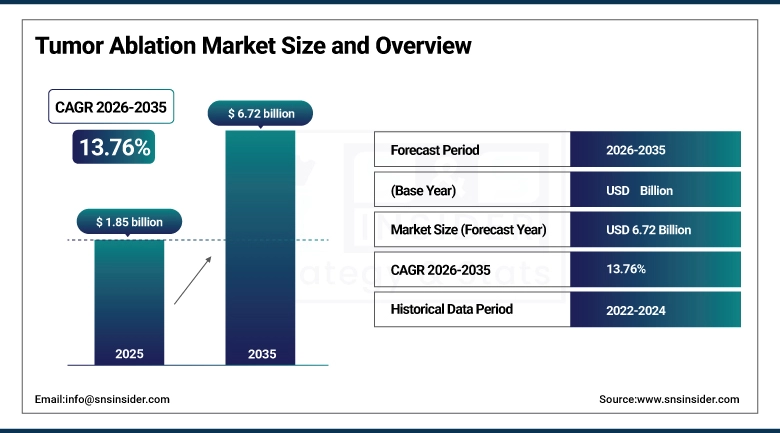
The Tumor Ablation Market size was valued at USD 1.85 Billion in 2025 and is expected to reach USD 6.72 Billion by 2035, growing at a CAGR of 13.76% over the forecast period of 2026-2035.
The global tumor ablation market is increasing and is primarily driven by the increasing incidence of cancer, which amounts to more than 19 million new cases every year and is rising. Tumor ablation is a minimally invasive, effective treatment option for patients who are unsuitable to undergo surgery, including the elderly or high-risk patients. Its wide application in common types of cancer including liver, lung, kidney, and breast cancer expands its clinical utility. With increasing screening and early diagnosis, smaller tumors, which are most suitable for ablation, are more common.
To Get more information On Tumor Ablation Market - Request Free Sample Report
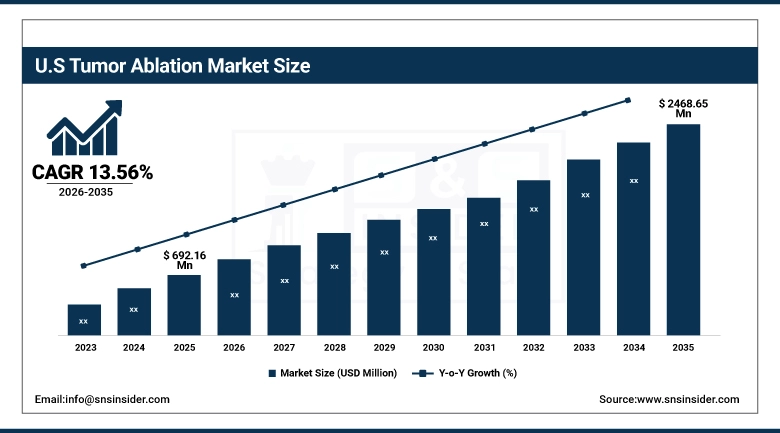
The U.S. Tumor Ablation Market was valued at USD 692.16 Million in 2025 and is expected to reach USD 2468.65 Million by 2035, growing at a CAGR of 13.56% from 2026-2035.
The U.S. leads the global tumor ablation owing to leadership in precision medicine, allowing for highly targeted, individualized cancer therapies. Powerful FDA frameworks, strong R&D investment, and advanced genomic testing facilitate the adoption of tumor ablation. Government initiatives, including the NIH’s Precision Medicine Initiative and high healthcare spending encourage innovation as well.
For instance, on May 8, 2025, the FDA approved the expanded use of FoundationOne CDx for solid tumors, enabling precise mutation detection to guide personalized treatments like tumor ablation in early-stage cancer patients.
Tumor Ablation Market Drivers:
-
Rising Incidence and Prevalence of Cancer, Driving the Tumor Ablation Market Growth
The tumor ablation market share is increasing quickly, driven by the increasing cancer rates across the world, particularly for liver, lung, and kidney cancers. The continuous development of minimally invasive technologies and imaging improves safety and precision, so ablation is becoming more popular than surgery. Increasing healthcare spending, an ageing population, and favorable reimbursement policies further propel the adoption. Better awareness, patient-centred care, and the use of AI result in better outcomes. Moreover, in developing markets, there is a massive potential driven by increasing infrastructure and affordability, resulting in a robust market
For instance, in March 2025, MedTech Dive reported that 47% of new tumor ablation systems launched in 2024–2025 include AI-based imaging and real-time navigation, enhancing procedural precision and accelerating global adoption.
Tumor Ablation Market Restraints:
-
Shortage of Trained Professionals Is Restraining the Tumor Ablation Market
A limited number of trained professionals seriously limits the tumor ablation market share, particularly in emerging economies. Restricted availability of accredited training, steep learning curves, and an imbalance in the number of trained experts impedes implementation. Incompetence results in procedural complications, inferior care quality, and loss of patient trust. Ablation use is further limited by infrastructure and personnel shortages. With high training expenses and restricted healthcare spending, this deficit serves as a significant impediment to market growth, especially in Asia-Pacific, Latin America, and low-income healthcare markets.
For instance, 10 April 2025 – WHO reported a global shortage of 6.4 million trained health professionals, with the most critical gaps in oncology and radiology fields, directly limiting tumor ablation adoption in developing regions.
Tumor Ablation Market Segmentation Analysis:
By Technology
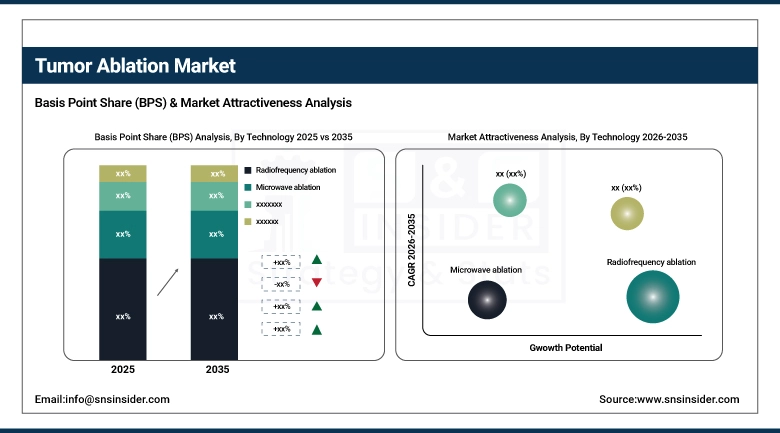
Radiofrequency ablation was the dominant segment in the tumor ablation market analysis, with a 34.70% market share in 2025, owing to its high safety, low cost, and extensive clinical applications, especially in liver, lung, and kidney tumors. It provides accurate, minimally invasive treatment with few complications and is broadly supported by regulatory clearances and reimbursement. These advantages show a great influence on its top position in the market of tumor ablation, especially in mature areas with upgraded interventional oncology infrastructure.
Microwave ablation is emerging as the fastest-growing segment in the tumor ablation market trend, with the highest CAGR of 14.51% over the forecast period 2026-2035, as it can raise higher temperatures, manage bigger tumors, and create less procedure time than other methods. It is also less affected by heat-sink effects and optimizes outcomes in technically challenging cryoablation (ablation in tumors that are difficult to reach or are in proximity to heat-sensitive structures). These technological benefits and uptake in outpatient settings are quickly growing its tumor ablation market share in developed and emerging healthcare systems.
By Treatment
In 2025, the Percutaneous ablation, controlled tumor ablation market had with 62.64% market share, because of the minimally invasive nature, enabling therapy under image guidance and avoiding open surgery. It provides for faster recovery, fewer complications, with reduced costs of stay at the hospital, making it suitable for outpatient practice. These advantages contribute to clinician and patient preference, with the net effect driving wider adoption and the greatest for the tumor ablation market share versus all other procedural approaches globally.
The Laparoscopic ablation is the fastest-growing segment in the global tumor ablation market, owing to the minimally invasive approach combined with direct visualization of tumors, and it may improve the accuracy, safety in difficult or deep-seated tumors. It is particularly valuable when percutaneous access is difficult. Increasing use in oncology centres and technological improvements in laparoscopic devices will support the industry demand and foster the growth of the tumor ablation market share in developed as well as developing countries.
By Application
The Other cancer segment controls the tumor ablation market analysis with a significant market share of 24.66%. The other segment includes various types of cancer, including bone metastasis and ENT cancer, owing to the increasing demand for palliative treatment and prevention of hard-to-reach lesions. These cancers are mostly present in elderly or inoperable patients, and, in such patients, minimally invasive ablation appears appropriate. Progress in imaging and ablation accuracy, increasing its utilization, has made it a major part of the overall tumor ablation market share growth across numerous clinical applications.
In the tumor ablation industry, the Lung cancer segment plays a vital role, registering the fastest growth during the forecast period, owing to the increasing global incidence and an increasing number of individuals not amenable to surgery. Tumor ablation provides a less invasive approach to the treatment of small or non-operable lung tumors, particularly in elderly or high-risk patients. Advanced image guidance and navigation technologies offer greater treatment precision, driving clinical acceptance and accounting for a substantial portion of the overall tumor ablation market growth in developed and emerging countries.
Tumor Ablation Market Regional Analysis:
North America, leading the Global Tumor Ablation Market With Strong Healthcare Infrastructure
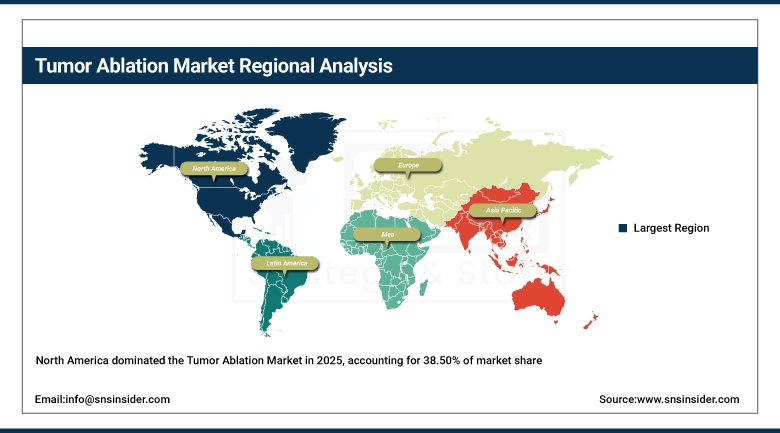
In 2025, the North American region dominated the tumor ablation industry and accounted for 38.50% of the overall revenue share. owing to its well-developed health-care system, high cancer incidence, and concentration on precision medicine. Extensive uptake of the minimally invasive treatments, as well as strong R&D investments and favorable reimbursement policies, also function to spur usage. The proximity of top medical device companies and the fast combination of AI and imaging technology make the procedure more effective. Collectively, these drivers are contributing to considerable expansion of the tumor ablation market growth in the U.S. and making it the world leader in ablation-based cancer therapies.
Get Customized Report as per Your Business Requirement - Enquiry Now
Europe, Second-Largest Market Driven by High Awareness and Advancements in Minimally Invasive Care
Europe is the second leading market for the tumor ablation industry, that dominated due to established health care systems and high awareness about the minimally invasive treatment options, and the rising load of cancer. The role of an ablative procedure in liver and lung cancer is increasingly utilized, with the support of government-funded screening programs and early detection. Promising technological advancements and robust existence of medical device manufacturers are also expected to support the tumor ablation market growth in most of the European countries, including Germany, France, and the U.K.
Asia Pacific, Fastest-Growing Region with a CAGR of 14.30% Fueled by Rising Cancer Burden and Expanding Healthcare Access
The Asia Pacific region is projected to grow with the fastest CAGR of 14.30% over the forecast period 2026-2035, owing to the increasing incidence of cancer, the rapidly developing medical system, and growing public awareness of minimally invasive treatments. Cancer screening and early diagnosis programs are expanding rapidly in countries, including China, India, and South Korea, with associated increased demand for efficacious local treatments, including tumor ablation. Growing government investments to make more people have access to advanced medical devices have led to the adoption of such devices.
Middle East & Africa, Steady Growth Supported by Oncology Investments and Expanding Healthcare Capabilities
The Middle East & Africa tumor ablation market is growing steadily in the tumor ablation industry, driven by rising cancer incidence and improving healthcare access in countries like the UAE, Saudi Arabia, and South Africa. While limited by infrastructure and skilled workforce shortages, increasing investments in oncology care, medical tourism, and public health initiatives are enhancing treatment availability. Partnerships with global device manufacturers are also helping introduce advanced ablation technologies, contributing to gradual market development
Latin America, moderate Growth Driven by Improving Oncology Infrastructure and Rising Cancer Prevalence
In Latin America, the ablation of the tumor market is growing at a moderate rate on the back of a rising number of cancer patients and improvement in healthcare infrastructure. The awareness and effort of the governments towards the modernization of oncology care are the driving factors for the minimally invasive cancer treatment market in countries like Brazil, Mexico, and Argentina. Yet, barriers including a lack of adequate access to sophisticated equipment, variable distribution of the specialists, and problems with reimbursement remain barriers to expansion. However, the area has potential for the future development of the tumor ablation industry.
Competitive Landscape for the Tumor Ablation Market:
Medtronic plc is a globally recognized leader in medical technology, offering a comprehensive range of tumor ablation solutions, including radiofrequency, microwave, and cryoablation systems. With decades of expertise in minimally invasive therapies, Medtronic designs devices that prioritize precision, safety, and compatibility with image-guided procedures. Its solutions support oncologists, radiologists, and surgical teams in treating liver, kidney, lung, and soft-tissue tumors. Medtronic’s role in the tumor ablation market is foundational, as the company continues to elevate treatment accuracy, streamline ablation workflows, and expand patient access to minimally invasive cancer care worldwide.
-
In 2025, Medtronic introduced enhanced microwave ablation system upgrades featuring improved thermal control algorithms and faster ablation cycles, enabling clinicians to treat tumors more efficiently with better real-time feedback.
Boston Scientific Corporation is a major global provider of minimally invasive cancer treatment technologies, offering advanced tumor ablation systems optimized for reliable energy delivery and precision targeting. The company focuses on designing user-friendly devices that support various ablation modalities, including RF, microwave, and cryoablation. Known for its engineering strength and broad oncology portfolio, Boston Scientific plays a strategic role in expanding access to image-guided, outpatient-friendly tumor ablation procedures. Its commitment to innovation helps clinicians achieve effective tumor destruction while preserving healthy tissue, improving treatment outcomes across multiple cancer types.
-
In 2025, Boston Scientific expanded its ablation product line with new applicators designed for deeper tumor penetration and enhanced compatibility with ultrasound and CT guidance platforms.
Johnson & Johnson MedTech is a global leader in surgical and interventional oncology technologies, offering a range of tumor ablation solutions under its extensive medical device portfolio. The company integrates advanced energy-based systems into cancer care pathways, supporting both hospital and outpatient settings. Its products emphasize surgical precision, procedural safety, and smooth integration with imaging modalities, making them valuable tools for treating solid tumors. Johnson & Johnson MedTech’s role in the tumor ablation market is significant, as it leverages its global clinical network, strong manufacturing capabilities, and innovation-driven approach to expand minimally invasive cancer treatment options.
-
In 2025, Johnson & Johnson MedTech introduced new ablation probes engineered for improved heat distribution and flexible navigation in anatomically complex tumor sites.
AngioDynamics, Inc. is a prominent U.S.-based developer of tumor ablation technologies, specializing in minimally invasive, energy-driven systems for oncology applications. The company is recognized for its portfolio of RF and microwave ablation products used extensively in interventional radiology and surgical oncology. AngioDynamics designs devices that prioritize rapid heating, controlled ablation zones, and precise applicator placement, enabling clinicians to target tumors with confidence. Its role in the tumor ablation market is highly impactful, as the company continues to focus on technological refinement, clinician-friendly design, and expanded access to effective ablative therapies.
-
In 2025, AngioDynamics launched updated microwave ablation applicators with improved shaft cooling and optimized energy delivery for more predictable ablation shapes in liver and kidney tumors.
Key Players in the Tumor Ablation Market:
-
Medtronic plc
-
Boston Scientific Corporation
-
Johnson & Johnson MedTech
-
AngioDynamics, Inc.
-
Stryker Corporation
-
Varian Medical Systems, Inc.
-
Olympus Corporation
-
Bioventus Inc. (Misonix Inc.)
-
EDAP TMS S.A.
-
Chongqing Haifu Medical Technology Co., Ltd.
-
Mermaid Medical
-
HealthTronics, Inc.
-
Galil Medical, Inc.
-
Neuwave Medical, Inc.
-
H.S. Hospital Service S.p.A.
-
Merit Medical Systems, Inc.
-
IceCure Medical Ltd.
-
Hologic, Inc.
-
Accuray Incorporated
-
BVM Medical Limited
| Report Attributes | Details |
|---|---|
| Market Size in 2025 | USD 1.85 Billion |
| Market Size by 2035 | USD 6.72 Billion |
| CAGR | CAGR of 13.76% From 2026 to 2035 |
| Base Year | 2025 |
| Forecast Period | 2026-2035 |
| Historical Data | 2022-2024 |
| Report Scope & Coverage | Market Size, Segments Analysis, Competitive Landscape, Regional Analysis, DROC & SWOT Analysis, Forecast Outlook |
| Key Segments | • By Technology (Radiofrequency ablation, Microwave ablation, Cryoablation, Irreversible electroporation ablation, HIFU, Other ablation technologies) • By Treatment (Surgical ablation, Laparoscopic ablation, Percutaneous ablation) • By Application (Kidney Cancer, Liver cancer, Breast cancer, Lung cancer, Prostate cancer, Other cancer) |
| Regional Analysis/Coverage | North America (US, Canada, Mexico), Europe (Germany, France, UK, Italy, Spain, Poland, Turkey, Rest of Europe), Asia Pacific (China, India, Japan, South Korea, Singapore, Australia, Rest of Asia Pacific), Middle East & Africa (UAE, Saudi Arabia, Qatar, South Africa, Rest of Middle East & Africa), Latin America (Brazil, Argentina, Rest of Latin America) |
| Company Profiles | Medtronic plc; Boston Scientific Corporation; Johnson & Johnson MedTech; AngioDynamics, Inc.; Stryker Corporation; Varian Medical Systems, Inc.; Olympus Corporation; Bioventus Inc. (Misonix Inc.); EDAP TMS S.A.; Chongqing Haifu Medical Technology Co., Ltd.; Mermaid Medical; HealthTronics, Inc.; Galil Medical, Inc.; Neuwave Medical, Inc.; H.S. Hospital Service S.p.A.; Merit Medical Systems, Inc.; IceCure Medical Ltd.; Hologic, Inc.; Accuray Incorporated; BVM Medical Limited. |
Frequently Asked Questions
The Tumor Ablation Market was valued at USD 1.85 billion in 2025.
The market is expected to reach USD 6.72 billion by 2035.
The market is projected to grow at a CAGR of 13.76% from 2026 to 2035.
Growth is primarily driven by the rising prevalence of cancer cases, increasing demand for minimally invasive treatment procedures, and technological advancements in ablation devices.
Common technologies include radiofrequency ablation, microwave ablation, cryoablation, laser ablation, and ultrasound ablation.
