
Vascular Guidewires Market Report Scope & Overview:
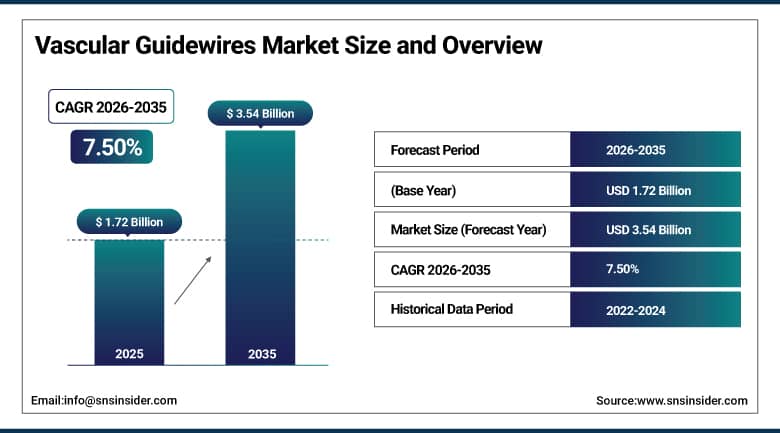
The Vascular Guidewires Market was valued at USD 1.72 Billion in 2025 and is expected to reach USD 3.54 Billion by 2035, growing at a CAGR of 7.50% from 2026 to 2035.
There is a consistent growth in the Vascular Guidewires Market, which is fueled by the increasing prevalence of cardiovascular and peripheral vascular disease throughout the world, increasing preference of minimally invasive endovascular surgeries over open surgeries, and advancements in the engineering of the guidewires to provide increased steerability, improved torque response, and enhanced flexibility of tips. This allows physicians to navigate the tortuous pathways of blood vessels more precisely, thus decreasing the time required to perform procedures. The vascular guidewires serve as the backbone for catheter procedures because of their basic nature as a tool of navigation.
⮞In 2026, Confluent Medical Technologies opened a new Nitinol Wire Center of Excellence in Hyderabad, India, doubling its nitinol wire output to strengthen upstream raw-material supply for guidewire manufacturers navigating tightening global feedstock availability and rising demand for medical-grade shape-memory alloys.
To Get More Information On Vascular Guidewires Market - Request Free Sample Report
Vascular Guidewires Market Trends:
-
Rising adoption of steerable, torque-enhanced hybrid guidewires is reducing procedure times and reliance on buddy-wire exchanges in complex lesions.
-
Expanding use of robotic-assisted endovascular platforms is driving demand for guidewires engineered for robotic interface compatibility.
-
Growing shift of percutaneous coronary and peripheral interventions toward ambulatory surgical centers is reshaping guidewire procurement patterns.
-
Increasing R&D investment in PFAS-free and fluorine-free hydrophilic coatings is responding to tightening environmental and regulatory scrutiny.
-
Supply-chain localization of medical-grade nitinol production is gaining momentum as manufacturers de-risk raw-material sourcing.
U.S. Vascular Guidewires Market Outlook:
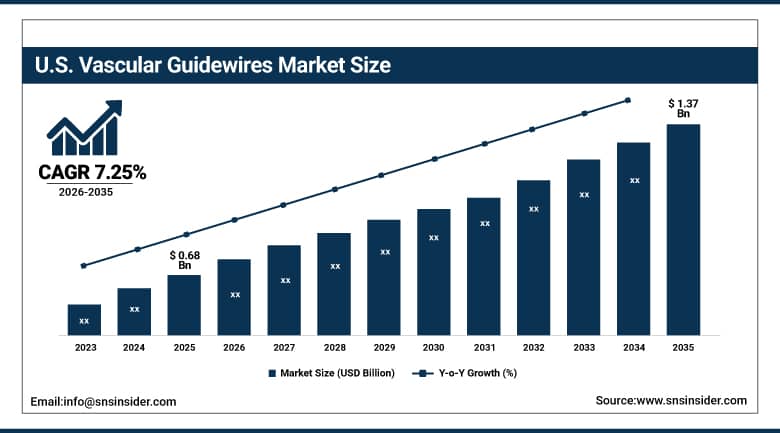
The U.S. Vascular Guidewires Market was valued at USD 0.68 Billion in 2025 and is projected to reach USD 1.37 Billion by 2035, growing at a CAGR of 7.25% during 2026–2035.
The leading interventional cardiology and neurovascular device manufacturers within the country continue to expand their guidewire portfolios owing to high catheterization lab throughput, broad commercial payer and Medicare reimbursement for coronary and peripheral procedures, and sustained investment in robotic-assisted endovascular suites. Growing outpatient migration of percutaneous coronary interventions toward ambulatory surgical centers, alongside expanding domestic nitinol processing and guidewire fabrication capacity among leading manufacturers, continues to ensure sustained demand for advanced, application-specific vascular guidewires across the country's hospital and outpatient care networks.
⮞In 2025, Medtronic entered an exclusive U.S. distribution agreement for Future Medical Design's F-14 and F-18 stainless-steel peripheral guidewires used in transradial access, strengthening its peripheral intervention portfolio and expanding its commercial reach among U.S. hospital and cath-lab customers.
Vascular Guidewires Market Segment Analysis:
-
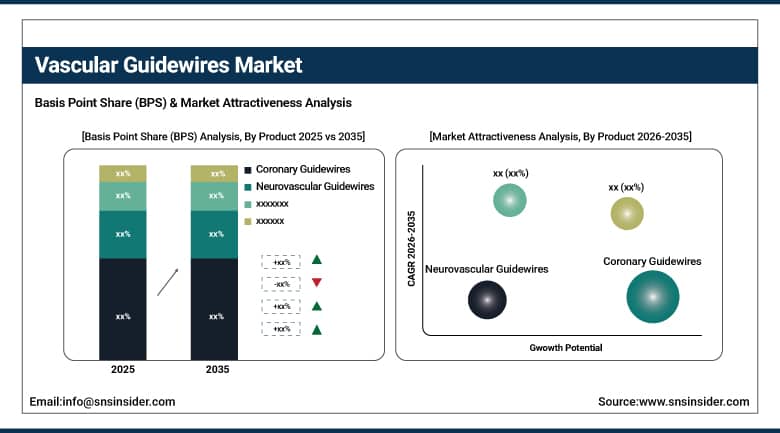
By Product, Coronary Guidewires dominated the Vascular Guidewires Market with a 46.02% share in 2025, while Neurovascular Guidewires is the fastest-growing product segment with a CAGR of 8.14% from 2026–2035.
-
By Coating, Coated dominated the Vascular Guidewires Market with a 62.48% share in 2025, while Non-Coated is the fastest-growing coating segment with a CAGR of 8.69% from 2026–2035.
-
By Raw Material, Nitinol dominated the Vascular Guidewires Market with a 54.20% share in 2025, while Stainless Steel is the fastest-growing raw material segment with a CAGR of 8.46% from 2026–2035.
-
By End User, Hospitals dominated the Vascular Guidewires Market with a 69.52% share in 2025, while Ambulatory Surgical Centers is the fastest-growing end-user segment with a CAGR of 8.17% from 2026–2035.
By Product, Coronary Guidewires dominated the market, while Neurovascular Guidewires is the fastest-growing segment.
The Coronary Guidewires segment was the leading contributor with a 46.02% revenue share in the Vascular Guidewires Market in 2025. Coronary guidewires retain their position as the largest product category due to the sheer global volume of percutaneous coronary interventions performed annually, the continuous refinement of core-to-tip transition designs that improve crossability across calcified and tortuous coronary lesions, and the deep clinical familiarity interventional cardiologists have built with established coronary wire platforms over decades of routine use. Their broad compatibility with balloon catheters, stent delivery systems, and imaging-guided workflows, combined with steady replacement demand tied to single-use sterility requirements, has reinforced coronary guidewires as the default access tool across both established cath labs in mature markets and newly commissioned interventional cardiology programs in emerging manufacturing economies.
The Neurovascular Guidewires market is set to exhibit the fastest growth CAGR of 8.14% from 2026 to 2035. The rising prevalence of stroke across the globe, increased number of cases of thrombectomy, and aneurysm coiling, and improvements in the field of microfabrication resulting in the production of ultra-low profile wires with enhanced distal support are some of the key factors responsible for the surge in demand. There has been an increased emphasis on the rapid recanalization process in ischemic stroke treatment coupled with increasing numbers of neurointerventional courses and hospitals investing in dedicated neurovascular labs which fuels the uptake of specially designed microguidewires capable of navigating even the tiniest vessels in the brain.
By Coating, Coated dominated the market, while Non-Coated is the fastest-growing segment.
The Coated type dominated the Vascular Guidewires Market and accounted for 62.48% market share in 2025. Hydrophilic and hydrophobic coating on guidewires have proven successful since they minimize friction between the wire and the vessel wall. This allows for better maneuverability and reduces any chance of vessel injury during the procedure. The success of coated products with respect to consistent lubricity in coronary, peripheral and neurovascular use has made them the preferred choice of interventionalists for navigating the complex lesion architecture, especially in light of constant improvements in coating technology.
The Non-Coated category is set to be the most rapidly growing during 2026-2035 with a CAGR of 8.69%. Increasing preference for tactile feel during precise lesion crossing by physicians along with growing sensitivity towards cost considerations in many health care settings and increased regulatory pressure related to PFAS in hydrophilic coatings of guidewires has been driving the adoption of non-coated guidewires in selected coronary and peripheral procedures.
⮞January 2026: The U.S. FDA granted 510(k) clearance for Merit Medical Ireland's Splashwire Hydrophilic Guide Wire, documenting continued regulatory activity in coated vascular guidewire technology. The clearance supports the relevance of lubricious surface technologies in peripheral vascular device development.
By Raw Material, Nitinol dominated the market, while Stainless Steel is the fastest-growing segment.
Nitinol captured the largest market share of 54.20% of revenue generation in the Vascular Guidewires Market. The guidewires made from nitinol are the most favored material because of the superelasticity and shape-memory effect possessed by nitinol. These features ensure the ability of the wire core to move around the tortuous vessel anatomy without failing to return to its original configuration. Hence, this ensures that the guidewire possesses the needed kink-resistant property. Continued investments by specialty material suppliers in the manufacturing of nitinol melting and drawing capabilities ensure that nitinol will continue to be the standard platform for the highest performing guidewire cores.
The Stainless Steel segment will show the fastest growth rate of 8.46% between 2026 and 2035. The rising need for guidewires that deliver efficient torque transmission and pushability in simple anatomy along with the current shortages and instability of the prices of the nitinol feedstock have increased the tendency of the manufacturers and health care organizations to opt for guidewires with stainless steel cores.
⮞August 2026: The U.S. FDA granted 510(k) clearance to Piraeus Medical's 35 Helix Guidewire. Regulatory documentation identifies a stainless-steel core, a hydrophilic distal coating and a PTFE-coated proximal section, demonstrating continued development of stainless-steel-based devices for neurovascular and peripheral applications.
By End User, Hospitals dominated the market, while Ambulatory Surgical Centers is the fastest-growing segment.
The Hospitals segment dominated the Vascular Guidewires Market with a revenue share of 69.52% in 2025. Hospitals remain the largest end-user category owing to their capacity to manage complex, high-acuity, and emergency vascular interventions, extensive catheterization and hybrid operating room infrastructure, and established relationships with device manufacturers that support bulk procurement and clinical training programs. The breadth of interventional cardiology, peripheral vascular, and neurointerventional specialties housed within hospital systems continues to drive sustained, diversified guidewire consumption across virtually every procedural category.
The Ambulatory Surgical Centers segment is witnessing rapid expansion at a CAGR of 8.17% through the forecast period. Favorable reimbursement policy shifts, growing clinical evidence supporting the safety of outpatient percutaneous coronary and peripheral interventions, and lower per-procedure cost structures compared with inpatient hospital settings are accelerating migration of routine vascular procedures to ambulatory surgical centers, creating a fast-growing, standardization-focused procurement channel for guidewire manufacturers.
Regional Analysis:
|
Region |
Major Country |
Share within Region, 2025 (%) |
|---|---|---|
|
North America |
United States |
88.00% |
|
Europe |
Germany |
24.50% |
|
Asia Pacific |
China |
40.50% |
|
Middle East & Africa |
Saudi Arabia |
27.50% |
|
Latin America |
Brazil |
36.50% |
North America Vascular Guidewires Market Insights
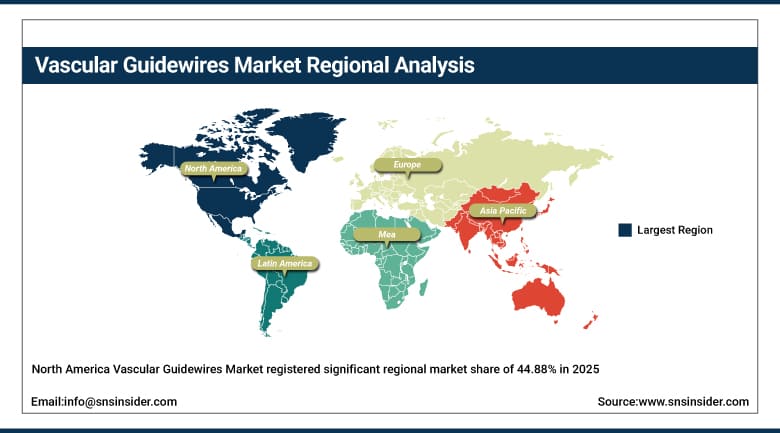
North America Vascular Guidewires Market registered significant regional market share of 44.88% in 2025, attributable to well-developed facilities of the catheterization labs, availability of widespread reimbursement for coronary, peripheral, and neurovascular procedures through both commercial as well as government insurers, and early adoption of robotic-assisted endovascular solutions in academic and community hospitals. Well-developed training programs for clinicians, presence of established guidewire manufacturers in North America, and significant presence of interventional cardiologists as well as neurointerventionalists ensures the high number of procedures performed both inpatient and outpatient setting. On the other hand, stringent FDA post-market regulations on devices are prolonging approval process.
Among countries included in the North America, in 2025, the United States had the largest market share of 88.00%. This position can be attributed to the significant cath-lab capacities within the country, high growth rate of percutaneous coronary interventions performed in ambulatory surgical centers, and investments made by device manufacturers in steerable, torque-enabled, and robotic-compliant guidewire technologies. Canada is supporting the growth of the North American market as well, due to the growth of cath-lab capacities in public hospitals and growth in utilization of minimally invasive endovascular procedures.
⮞April 2026: The U.S. FDA cleared Scientia Vascular's Aristotle 14, Aristotle 18, Aristotle 24 and Zoom Wire 14 guidewires under submission K253579. The regulatory decision reflects continued product development within the domestic neurovascular guidewire segment.
Get Customized Report as Per Your Business Requirement - Enquiry Now
Europe Vascular Guidewires Market Insights
The Europe region was a major contributor to the Vascular Guidewires Market in 2025 and is expected to register steady growth for advanced coated and hybrid guidewire solutions during the forecast period. This is attributed to the region's rigorous MDR regulatory framework favoring well-documented, clinically validated devices, an aging population sustaining high cardiovascular and peripheral intervention volumes, and growing national health-system emphasis on cost-effective, outcome-linked procurement of interventional devices across member states.
Germany is one of the major markets in Europe owing to its strong interventional cardiology infrastructure and presence of leading device manufacturers and component suppliers serving both domestic and export markets. Other countries such as the United Kingdom, France, Italy, and Spain, home to extensive public hospital catheterization networks, are also contributing to market growth through rising percutaneous intervention volumes and continued adoption of minimally invasive endovascular techniques.
⮞December 2025: Philips announced expanded commercial availability of its LumiGuide 3D Device Guidance solution across Europe and the United States, with broader availability beginning in January 2026. The technology uses light-based sensing to visualize compatible guidewires and catheters in real time during complex endovascular procedures.
Asia Pacific Vascular Guidewires Market Insights
The Asia Pacific Vascular Guidewires Market is expected to witness the fastest growth rate during the forecast period 2026–2035, registering a CAGR of 8.97%. The market growth is driven by rapidly expanding catheterization laboratory capacity, rising cardiovascular and peripheral artery disease prevalence linked to lifestyle and demographic shifts, and increasing government investment in cardiovascular centers of excellence across the region's major and emerging healthcare economies pursuing broader universal health-coverage objectives.
China is one of the main growth drivers in the Asia Pacific Vascular Guidewires Market, owing to its rapidly expanding domestic device manufacturing ecosystem, supportive localization policies favoring homegrown interventional device producers, and rising percutaneous coronary intervention volumes across both tier-one and lower-tier city hospital networks. India and Japan, both major regional healthcare markets, are also contributing to regional growth through expanding cath-lab infrastructure and increasing adoption of advanced coronary and neurovascular guidewire technologies.
⮞February 2026: Japan-based Asahi Intecc published its medium-term management strategy, identifying expansion of its cardiovascular guidewire portfolio and further development of peripheral and neurovascular products among its strategic priorities. The plan underscores continued investment in advanced interventional wire technologies.
Middle East & Africa and Latin America Vascular Guidewires Market Insights
Middle East & Africa and Latin American regions are gradually expanding vascular guidewire adoption as cardiovascular disease burden rises and government investment in interventional cardiology infrastructure grows across both regions, supported by increasing insurance coverage and expanding cath-lab networks in major urban centers.
Brazil is set to be a prominent Latin American market fueled by its expanding interventional cardiology capacity and growing government focus on reducing cardiovascular mortality through earlier percutaneous intervention. The Middle East & Africa region has Saudi Arabia and the UAE investing heavily in modern cardiovascular centers of excellence that are gradually increasing demand for vascular guidewires across coronary, peripheral, and neurovascular applications.
Market Dynamics:
Growth Drivers: Rising cardiovascular disease burden and minimally invasive procedure adoption driving market growth
Several factors are influencing the market for Vascular Guidewires: increasing burden of cardiovascular diseases, patient preference for minimally invasive endovascular procedures, as opposed to open surgeries, and engineering innovations in the form of steerable and enhanced torque guidewires. The global burden of hypertension is projected to grow from its present level of around 51% in 2020 to approximately 61% by 2050. Diabetes is likely to become increasingly prevalent in the coming decades. The growth in procedure volumes due to the rise in prevalence of such conditions is going to increase the need for guidewires, as they are indispensable for any catheter procedures done in modern cath labs.
Moreover, increased adoption of ambulatory surgical centers for percutaneous coronary interventions, growing adoption of robotic-assisted endovascular suites in hospitals, and advancements in nitinol processing and microfabrication capabilities of wires are likely to further boost their demand. Additionally, demographic trends towards aging populations with the need for rehospitalizations in those aged eighty years and older who have undergone coronary angiographies will make manufacturers develop guidewires with improved tactility and pushability.
⮞August 2025: The U.S. FDA granted 510(k) clearance for Imperative Care's X-Wire Guidewire, adding another regulatory-cleared device to the neurovascular intervention category. Continued clearance activity reflects manufacturers' efforts to broaden the range of tools available for minimally invasive vascular procedures.
Restraints: Product recalls and raw material price volatility limiting market expansion
One of the most critical obstacles to market growth is the rising incidence of Class I product recalls and FDA warning letters tied to coating separation and manufacturing quality issues, which have affected leading manufacturers and prompted healthcare providers to diversify supplier relationships. This heightened regulatory scrutiny is increasing compliance costs and lengthening approval timelines for new guidewire platforms entering the U.S. and European markets.
Furthermore, scarcity of global nitinol raw material and its subsequent price volatility impacts the economics of manufacturing operations for companies using shape memory alloy cores made from medical grade materials. These are compounded by the fact that group purchasing organizations are aggressively negotiating on the price of standard guidewire products in mature markets. In addition, regulatory constraints related to PFAS in relation to hydrophilic coating technology have prompted significant investments in R&D of alternative coatings.
Opportunities: Robotic-compatible platforms and neurovascular innovation creating new growth avenues
The increasing hospital adoption of robotic-assisted endovascular navigation systems, expanding stroke intervention volumes driving demand for specialty microfabricated neurovascular guidewires, and growing emphasis on nitinol supply-chain localization are creating substantial growth opportunities in the Vascular Guidewires Market. Rising outpatient migration of routine coronary and peripheral procedures toward ambulatory surgical centers is opening a fast-growing, standardization-focused procurement channel that favors manufacturers capable of delivering consistent, cost-competitive guidewire portfolios at scale.
There is immense potential for growth in PFAS-free hydrophilic coating chemistries that satisfy tightening environmental regulation while preserving lubricity performance, alongside expanding demand for guidewires engineered specifically for robotic interface compatibility. The continued build-out of cardiovascular centers of excellence and cath-lab capacity across emerging economies in Asia Pacific, Latin America, and the Middle East, combined with rising insurance penetration, will drive incremental demand growth for both standard and premium vascular guidewire platforms.
⮞August 2026: The U.S. FDA cleared Scientia Vascular's Aristotle Mini Guidewire under submission K260223. The decision illustrates ongoing development of specialized neurovascular guidewire platforms and potential opportunities for manufacturers serving increasingly complex catheter-based interventions.
Recent Developments:
-
2026: Confluent Medical Technologies opened a 26,000 sq. ft. Nitinol Wire Center of Excellence in Hyderabad, India, doubling its nitinol wire output to strengthen upstream supply for guidewire and broader interventional-device manufacturers.
-
2026: Peijia Medical received FDA 510(k) clearance for its DCwire Micro Guidewire, marking the company's first FDA-cleared product and its formal entry into the U.S. neurointerventional guidewire market.
-
2025: Medtronic announced an exclusive U.S. distribution agreement for Future Medical Design's F-14 and F-18 stainless-steel peripheral guidewires used in transradial access, expanding its peripheral intervention portfolio.
-
2024: Philips received FDA clearance for its enhanced LumiGuide guidewire featuring 3D device guidance technology and reported treating its 1,000th patient using the image-guided navigation system.
Vascular Guidewires Market Key Players are:
-
Medtronic plc
-
Stryker Corporation
-
B. Braun Melsungen AG
-
Teleflex Incorporated
-
Cardinal Health, Inc.
-
Cook Medical, Inc.
-
Asahi Intecc Co., Ltd.
-
AngioDynamics, Inc.
-
Integer Holdings Corporation
-
Merit Medical Systems, Inc.
-
Penumbra, Inc.
-
MicroPort Scientific Corporation
-
Nipro Corporation
-
Lepu Medical Technology (Beijing) Co., Ltd.
-
Scientia Vascular, LLC
-
Bentley InnoMed GmbH
-
Peijia Medical Limited
Vascular Guidewires Market Report Scope:
| Report Attributes | Details |
|---|---|
| Market Size in 2025 | USD 1.72 Billion |
| Market Size by 2035 | USD 3.54 Billion |
| CAGR | CAGR of 7.50% From 2026 to 2035 |
| Base Year | 2025 |
| Forecast Period | 2026-2035 |
| Historical Data | 2022-2024 |
| Report Scope & Coverage | Market Size, Segments Analysis, Competitive Landscape, Regional Analysis, DROC & SWOT Analysis, Forecast Outlook |
| Key Segments | • By Product (Coronary Guidewires, Peripheral Guidewires, Neurovascular Guidewires, Urology Guidewires) • By Coating (Coated, Non-Coated) • By Raw Material (Nitinol, Stainless Steel, Other Materials (PEEK, Polymer Hybrids)) • By End User (Hospitals, Ambulatory Surgical Centers, Specialty Clinics & Cath Labs) |
| Regional Analysis/Coverage | North America (US, Canada), Europe (Germany, UK, France, Italy, Spain, Russia, Poland, Rest of Europe), Asia Pacific (China, India, Japan, South Korea, Australia, ASEAN Countries, Rest of Asia Pacific), Middle East & Africa (UAE, Saudi Arabia, Qatar, South Africa, Rest of Middle East & Africa), Latin America (Brazil, Argentina, Mexico, Colombia, Rest of Latin America). |
| Company Profiles | Boston Scientific Corporation, Abbott Laboratories, Terumo Corporation, Medtronic plc, Stryker Corporation, B. Braun Melsungen AG, Teleflex Incorporated, Cardinal Health, Inc., Cook Medical, Inc., Asahi Intecc Co., Ltd., AngioDynamics, Inc., Integer Holdings Corporation, Merit Medical Systems, Inc., Penumbra, Inc., MicroPort Scientific Corporation, Nipro Corporation, Lepu Medical Technology (Beijing) Co., Ltd., Scientia Vascular, LLC, Bentley InnoMed GmbH, Peijia Medical Limited |

Frequently Asked Questions
Key players in the Vascular Guidewires Market include Boston Scientific Corporation, Abbott Laboratories, Terumo Corporation, Medtronic plc, Stryker Corporation, and B. Braun Melsungen AG, among others.
Key opportunities in the Vascular Guidewires Market include robotic-compatible platforms, neurovascular innovation, PFAS-free coating technologies, and localization of medical-grade nitinol supply chains.
The market is driven by the rising cardiovascular disease burden, increasing adoption of minimally invasive endovascular procedures, and advancements in steerable and torque-enhanced guidewire technologies.
The Coronary Guidewires segment dominated the Vascular Guidewires Market, accounting for approximately 46.02% market share in 2025.
The North America region dominated the Vascular Guidewires Market in 2025 with a 44.88% share, driven by developed catheterization infrastructure, broad reimbursement, and high adoption of advanced endovascular technologies.
