
Sensor Signal Conditioner (SSC) IC Market Report Scope & Overview:
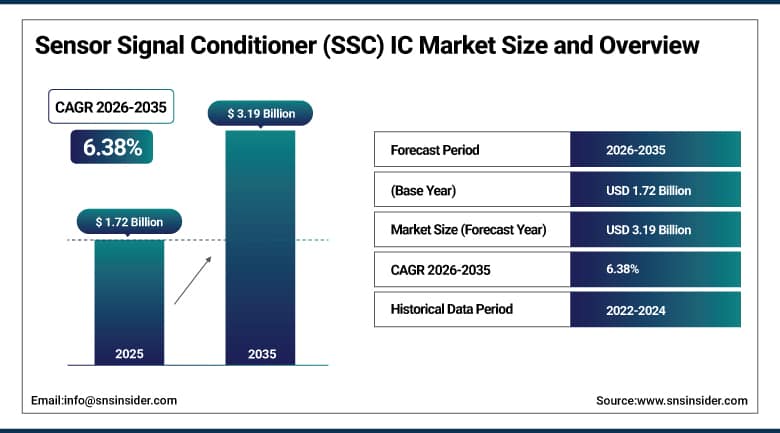
The Sensor Signal Conditioner (SSC) IC Market was valued at USD 1.72 Billion in 2025 and is expected to reach USD 3.19 Billion by 2035, growing at a CAGR of 6.38% from 2026-2035.
The Sensor Signal Conditioner (SSC) IC Market growth is being driven primarily by the expanding integration of precision sensing into automotive safety systems, industrial automation equipment, and consumer electronics that require amplification, filtering, and calibration of raw sensor output before it can be used by downstream control electronics. The growing application of advanced driver assistance systems has led to an increased deployment of pressure sensors, position sensors, and motion sensors per vehicle that require individual signal conditioners for converting the analog signal coming from each sensor into a noise-immune digital signal. Growing investments in industrial automation have increased the demand for signal conditioner ICs that are used in strain gauge-based and pressure sensor-based industrial process control systems. The shrinking size of analog and mixed-signal semiconductor technology processes has enabled the integration of signal conditioners in sensor packages to enable their use in wearable and consumer electronics applications.
In January 2024, Renesas Electronics agreed to acquire Transphorm, a gallium nitride power semiconductor developer, for approximately USD 339 million, with the transaction completing in June 2024. The acquisition strengthens Renesas's wide-bandgap semiconductor capabilities, which support the higher-precision analog front-end and signal conditioning designs increasingly required in automotive and industrial sensing applications, reflecting how signal-chain semiconductor suppliers are acquiring adjacent power and analog technology to broaden their sensing platform capabilities.
To Get More Information On Sensor Signal Conditioner (SSC) IC Market - Request Free Sample Report
Sensor Signal Conditioner (SSC) IC Market Trends
-
Rising integration of signal conditioner ICs directly into compact MEMS sensor modules for wearable and IoT devices.
-
Growing adoption of capacitive sensing architectures requiring specialized low-noise signal conditioning circuitry.
-
Expansion of automotive pressure and position sensor content per vehicle driving demand for automotive-grade conditioner ICs.
-
Increasing use of AI-enabled signal processing within conditioner ICs to improve sensor accuracy and reduce calibration time.
-
Consolidation among analog semiconductor suppliers through acquisitions of power and wide-bandgap technology developers.
-
Rising demand for energy-efficient, low-power signal conditioner ICs in battery-powered industrial and consumer applications.
U.S. Sensor Signal Conditioner (SSC) IC Market Size Outlook
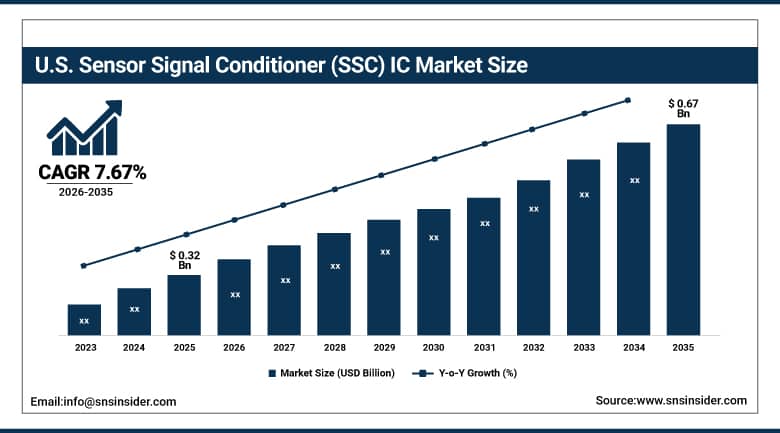
The U.S. Sensor Signal Conditioner (SSC) IC Market was valued at USD 0.32 Billion in 2025 and is expected to reach USD 0.67 Billion by 2035, growing at a CAGR of 7.67% from 2026-2035.
The U.S. Sensor Signal Conditioner (SSC) IC Market growth continues to be reinforced by the scale of the country's automotive and industrial automation manufacturing base, where domestic and foreign automakers are expanding sensor content per vehicle to support advanced driver-assistance and electrification programs. Federal semiconductor manufacturing incentives are supporting continued investment in domestic analog and mixed-signal fabrication capacity, strengthening the supply chain for signal conditioner ICs used in automotive, industrial, and aerospace applications. Growth is further reinforced by the country's large base of industrial automation equipment manufacturers, who continue to integrate strain-gauge and pressure-sensing signal conditioning into process control and manufacturing quality systems. Rising domestic demand for wearable health-monitoring devices is adding a further growth channel as signal conditioner ICs are increasingly integrated into compact biosensor modules.
In September 2024, Analog Devices, Inc. and India's Tata Group entered a partnership to explore semiconductor manufacturing opportunities in India, a move intended to diversify ADI's global supply chain and support long-term capacity for its analog and signal-chain product lines, including sensor signal conditioning circuitry. The partnership reflects how established U.S. analog semiconductor suppliers are pursuing international manufacturing diversification to support growing global demand for precision analog and signal conditioning products.
Sensor Signal Conditioner (SSC) IC Market Segment Analysis
-
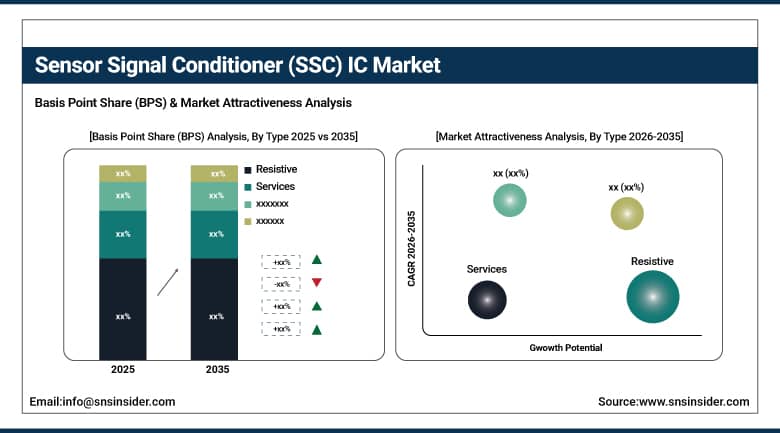
By Type, the Resistive segment dominated the Sensor Signal Conditioner (SSC) IC Market with approximately 58.40% share in 2025, while the Capacitive segment is the fastest growing with a CAGR of approximately 8.20%.
-
By Application, the Pressure Sensors segment dominated the Sensor Signal Conditioner (SSC) IC Market with approximately 29.70% share in 2025, while the Accelerometers segment is the fastest growing with a CAGR of approximately 8.90%.
-
By End-Use Industry, the Automotive segment dominated the Sensor Signal Conditioner (SSC) IC Market with approximately 41.30% share in 2025, while the Consumer Electronics segment is the fastest growing with a CAGR of approximately 9.40%.
By Type, Resistive Dominates the Sensor Signal Conditioner (SSC) IC Market and Capacitive Grows Fastest
Resistive signal conditioning dominates the market because bridge-based resistive sensors, including strain gauges and resistive pressure sensors, remain the established standard across automotive and industrial measurement applications where long-term stability and proven reliability are prioritized over cost. Semiconductor suppliers continue to expand resistive signal conditioner IC portfolios because the underlying sensor technology is well characterized, allowing conditioner ICs to be validated against decades of field performance data. This maturity keeps resistive conditioning the default specification for safety-critical automotive and industrial pressure-sensing applications.
Capacitive signal conditioning is the fastest-growing type, driven by the format's superior sensitivity and lower power consumption relative to resistive alternatives, which is expanding its use in MEMS-based motion, humidity, and proximity sensors across consumer electronics and wearable devices. Semiconductor suppliers are investing in low-noise capacitive front-end designs to support the tighter accuracy requirements of next-generation consumer and automotive sensing applications. This growth is reinforced by capacitive sensing's compatibility with the compact, low-power designs required in battery-powered wearable and IoT devices.
By Application, Pressure Sensors Dominates the Sensor Signal Conditioner (SSC) IC Market and Accelerometers Grows Fastest
Pressure sensor applications dominate the market because pressure measurement remains one of the most widely deployed sensing functions across automotive, industrial, and consumer applications, from tire-pressure monitoring to industrial process control. The breadth of pressure-sensing use cases, combined with decades of established design practice, sustains steady demand for dedicated pressure sensor signal conditioner ICs across a wide range of end markets. Semiconductor suppliers continue to expand pressure-sensing conditioner IC portfolios to serve both automotive safety-critical and industrial process-control applications.
Accelerometer applications constitute the fastest-growing segment due to the increasing use of advanced driver assistance systems in automobiles, fitness gadgets, and condition monitoring tools used in industries, among others. The increased incorporation of accelerometers in automotive stability control systems and occupant detection systems is fueling the need for automotive signal conditioning integrated circuits that can meet high levels of reliability and safety requirements. The increased adoption of consumer wearables is enhancing this trend as fitness and health monitoring tools incorporate motion sensing through accelerometers.
By End-Use Industry, Automotive Dominates the Sensor Signal Conditioner (SSC) IC Market and Consumer Electronics Grows Fastest
The automotive industry accounts for the majority of end-use consumption, which is attributed to the number of sensors embedded in today’s cars for use in enhancing safety, managing emissions and driver assistance features, all of which require signal conditioners for conversion of sensor input to useful control system data. In fact, the automotive industry continues to increase the number of sensors embedded in vehicles due to the introduction of more safety and electrification systems in cars, which ensures continued demand for automotive signal conditioner ICs.
Consumer electronics is the fastest-growing end-use industry as wearable health-monitoring devices, smartphones, and smart-home products expand their integration of compact, low-power sensing modules requiring specialized signal conditioning. Rising consumer demand for continuous health and fitness monitoring is accelerating adoption of accelerometer and biosensor-based devices that depend on precise, power-efficient signal conditioner ICs. Growth is further reinforced by the broader proliferation of IoT-connected consumer devices that integrate environmental and motion sensing as standard features.
Regional Analysis
|
Region |
Major Country |
Share within Region, 2025 (%) |
|
Asia Pacific |
China |
41.20% |
|
North America |
United States |
68.50% |
|
Europe |
Germany |
30.40% |
|
Middle East & Africa |
United Arab Emirates |
28.70% |
|
Latin America |
Mexico |
33.80% |
Asia Pacific Sensor Signal Conditioner (SSC) IC Market Insights
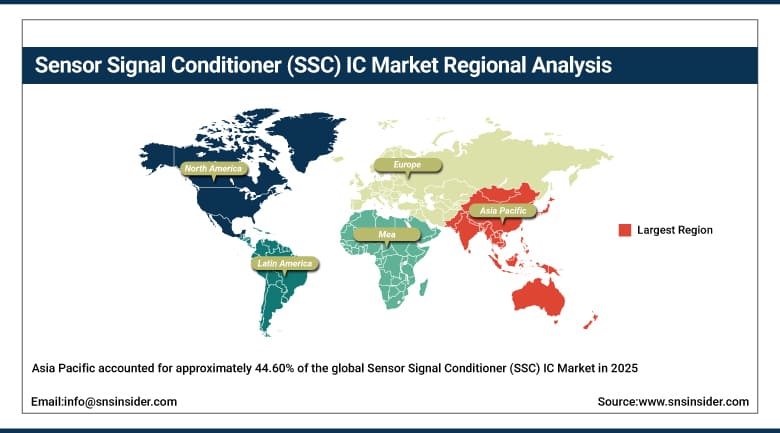
Asia Pacific accounted for approximately 44.60% of the global Sensor Signal Conditioner (SSC) IC Market in 2025, making it the largest regional market, supported by the concentration of semiconductor fabrication and electronics assembly capacity across China, Taiwan, and South Korea. As a result of China's substantial automobile and consumer electronics manufacturing industry, there is a robust demand for both resistive and capacitive signal conditioner ICs, while Taiwan's leading-edge manufacturing capacity continues to provide wafers with analog and mixed-signal circuits used in signal conditioner ICs for all designers worldwide. Additional demand comes from Japan and South Korea, due to well-developed automotive and consumer electronics production facilities that incorporate signal conditioner ICs into various sensors-based products.
Additional growth comes from India and Southeast Asian regions as the investment in electronics manufacturing provides for increasing assembly capacity in those regions for automotive and consumer sensor modules. Semiconductor suppliers in the region are continuously investing in the analog circuit design capabilities in order to minimize the import of signal conditioner ICs, ensuring the localization of the supply chain. The above-mentioned factors are supposed to secure the Asia Pacific position as the largest signal conditioner IC market during the forecast period.
Get Customized Report as Per Your Business Requirement - Enquiry Now
North America Sensor Signal Conditioner (SSC) IC Market Insights
North America is the fastest-growing regional market, expanding at a CAGR of approximately 7.80% from 2026 to 2035, driven by federal semiconductor manufacturing incentives and expanding automotive sensor content tied to advanced driver-assistance and electrification programs. The United States accounts for the large majority of regional demand, reflecting the scale of its automotive, industrial automation, and aerospace manufacturing sectors, while Canada is contributing incremental demand as regional automotive supply chains expand. Domestic semiconductor manufacturers are expanding analog and mixed-signal fabrication capacity to support growing demand for automotive-grade signal conditioner ICs.
Growth is further reinforced by rising consumer adoption of wearable health-monitoring devices, which is expanding demand for compact, low-power signal conditioner ICs integrated into biosensor modules manufactured or designed domestically. Continued investment in domestic semiconductor supply chain resilience is accelerating qualification of new signal conditioner IC designs for automotive and industrial customers. The region's combination of policy-driven manufacturing investment and expanding automotive sensor content underpins its position as the fastest-growing market over the forecast period.
Europe Sensor Signal Conditioner (SSC) IC Market Insights
Europe represents a significant share of the global Sensor Signal Conditioner (SSC) IC Market, anchored by Germany's large automotive manufacturing base and the region's established industrial automation equipment sector. European automotive safety regulations are driving continued expansion of sensor content per vehicle, sustaining demand for automotive-grade signal conditioner ICs across the region's extensive vehicle production base. Germany and the Nordic countries have been early adopters of industrial automation systems that rely on precision pressure and strain-gauge signal conditioning for process control.
France, the United Kingdom, and Italy are contributing steady demand growth as regional automotive suppliers extend sensor integration across a broader range of vehicle platforms and industrial equipment manufacturers modernize process control systems. Regional semiconductor design centers continue to develop specialized analog front-end capability to serve automotive safety-critical applications requiring rigorous qualification standards. The region's regulatory clarity around automotive safety systems is expected to sustain steady, compliance-driven growth through the forecast period.
MEA & Latin America Sensor Signal Conditioner (SSC) IC Market Insights
The Middle East & Africa market remains comparatively small but is expanding as industrial diversification programs in the United Arab Emirates and Saudi Arabia drive investment in process manufacturing and automation equipment that requires precision pressure and strain-gauge sensing. Limited local semiconductor design and fabrication capacity currently constrains faster adoption, with much of the region's signal conditioner IC supply imported from Asian, European, and North American manufacturers.
Latin America's market is led by Mexico, where nearshoring-driven investment in automotive and electronics manufacturing is expanding demand for both automotive and consumer-grade signal conditioner ICs. Brazil is contributing growth as its industrial automation and automotive sectors modernize process control and vehicle safety systems. Across the region, adoption remains concentrated among larger manufacturers with established relationships with global semiconductor suppliers, with broader mid-market uptake expected to follow as regional design and distribution support expands.
Market Dynamics
Growth Drivers: Automotive Sensor Proliferation and Industrial Automation Investment
Increasing number of sensors per vehicle is the main factor driving demand for signal conditioner ICs because car manufacturers are adding more pressure, position, and motion sensors to enable advanced driver-assistance systems, emission control systems, and programs of vehicle electrification. Every new sensor needs a signal conditioning path to convert an analog output to data usable by vehicle control systems; thus, there is a direct link between the number of sensors added and demand for signal conditioner ICs. In addition, stricter automotive safety rules increase demand because they require multiple signals and redundant sensing of vehicle systems.
Another important factor driving market growth is investment in industrial automation because factories are adding high-precision pressure and strain gauge sensors to their process control systems to enhance product quality and minimize downtime. With increasing popularity of industry 4.0 practices such as predictive maintenance and real-time process monitoring, signal conditioner ICs find application beyond measuring functions in more complex industrial data acquisition systems. Increased demand for measurement accuracy in regulated sectors of manufacturing such as pharmaceutical production and food processing industries fuels this trend.
Restraints: Design Complexity and Analog Semiconductor Talent Constraints
Design challenges associated with high precision signal conditioning circuits pose as a significant constraint for market growth since the design of low noise and temperature stable conditioning ICs demands specific analog design skills which are rarer in the semiconductor industry than digital design skills.
The challenge associated with the talent available in the analog/mixed-signal semiconductor industry exacerbates the above-mentioned constraint since analog signal conditioning design requires more time to develop skills compared to digital design skills, thus affecting the ability of suppliers to increase their design workforce in order to meet increased demands.
Increased input costs related to specialty semiconductors used in high precision analog processes further increase cost pressures on suppliers, especially small suppliers who lack purchasing power. As long as design constraints and cost pressures persist, certain suppliers may continue improving their existing products rather than designing new conditioner ICs.
Opportunities: AI-Enabled Signal Processing and Wearable Device Integration
Integration of AI-enabled signal processing capability within signal conditioner ICs represents a substantial opportunity, as suppliers develop conditioner ICs capable of adaptive calibration and noise filtering that reduce the need for manual sensor calibration during manufacturing. Suppliers that can embed intelligent signal processing directly into conditioner ICs are positioned to differentiate on both accuracy and total system cost, particularly in automotive and industrial applications where calibration labor represents a meaningful share of total sensor system cost.
The continued expansion of wearable health-monitoring devices offers a further avenue for growth, as suppliers develop increasingly compact, low-power signal conditioner ICs suited to battery-constrained consumer devices. Suppliers that can pair low-power analog design with the miniaturized packaging required for wearable integration are well positioned to capture demand from the growing consumer health-monitoring device category, particularly as continuous biosensor monitoring becomes more prevalent across fitness and clinical applications.
Recent Developments:
-
In April 2025, Texas Instruments launched a new portfolio of automotive LiDAR, radar, and clock chips designed to enhance advanced driver-assistance system performance and vehicle safety, expanding its signal-chain product line for automotive sensing applications.
-
In January 2025, Onsemi completed the acquisition of Qorvo's Silicon Carbide JFET technology portfolio, including the United Silicon Carbide brand, for approximately USD 115 million, strengthening its position in high and mid-voltage power semiconductors used alongside sensor signal conditioning in industrial and automotive applications.
-
In March 2025, NXP Semiconductors introduced its S32K5 microcontroller family, the first automotive microcontrollers built on 16-nanometer FinFET process technology with embedded MRAM, extending its CoreRide platform for next-generation vehicle electrification and sensing architectures.
-
In November 2024, STMicroelectronics opened a new design and industrialization center in Italy featuring a dedicated testing laboratory, expanding its regional capability to develop and qualify analog and sensor-interface semiconductor products.
-
In January 2025, OKI achieved three-dimensional integration of thin-film analog integrated circuits using Crystal Film Bonding technology, in collaboration with Nisshinbo Micro Devices, enabling mixed integration of analog ICs with other semiconductor device types on a single platform.
Sensor Signal Conditioner (SSC) IC Companies are:
-
OMEGA Engineering (Spectris plc)
-
iC-Haus GmbH
-
Schneider Electric SE
-
Suzhou Novosense Microelectronics Co., Ltd.
-
Rockwell Automation, Inc.
-
Texas Instruments Incorporated
-
Analog Devices, Inc.
-
NXP Semiconductors N.V.
-
Renesas Electronics Corporation
-
Xi'an Aerosemi Technology Co., Ltd.
-
Infineon Technologies AG
-
STMicroelectronics N.V.
-
Microchip Technology Inc.
-
onsemi
-
Honeywell International Inc.
-
TE Connectivity Ltd.
-
Sensata Technologies Holding plc
-
Melexis NV
-
ams-OSRAM AG
-
Bosch Sensortec GmbH
Sensor Signal Conditioner (SSC) IC Market Report Scope:
| Report Attributes | Details |
|---|---|
| Market Size in 2025 | USD 1.72 Billion |
| Market Size by 2035 | USD 3.19 Billion |
| CAGR | CAGR of 6.38% From 2026 to 2035 |
| Base Year | 2025 |
| Forecast Period | 2026-2035 |
| Historical Data | 2022-2024 |
| Report Scope & Coverage | Market Size, Segments Analysis, Competitive Landscape, Regional Analysis, DROC & SWOT Analysis, Forecast Outlook |
| Key Segments | • By Type (Resistive, Capacitive) • By Application (Pressure Sensors, Accelerometers, Motor Drive Controllers, Strain Gauges, and Others) • By End-Use Industry (Automotive, Industrial, Consumer Electronics, and Others) |
| Regional Analysis/Coverage | North America (US, Canada), Europe (Germany, UK, France, Italy, Spain, Russia, Poland, Rest of Europe), Asia Pacific (China, India, Japan, South Korea, Australia, ASEAN Countries, Rest of Asia Pacific), Middle East & Africa (UAE, Saudi Arabia, Qatar, South Africa, Rest of Middle East & Africa), Latin America (Brazil, Argentina, Mexico, Colombia, Rest of Latin America). |
| Company Profiles | OMEGA Engineering (Spectris plc), iC-Haus GmbH, Schneider Electric SE, Suzhou Novosense Microelectronics Co., Ltd., Rockwell Automation, Inc., Texas Instruments Incorporated, Analog Devices, Inc., NXP Semiconductors N.V., Renesas Electronics Corporation, Xi'an Aerosemi Technology Co., Ltd., Infineon Technologies AG, STMicroelectronics N.V., Microchip Technology Inc., onsemi, Honeywell International Inc., TE Connectivity Ltd., Sensata Technologies Holding plc, Melexis NV, ams-OSRAM AG, Bosch Sensortec GmbH. |
Frequently Asked Questions
Key players include Texas Instruments Incorporated, Analog Devices Inc., NXP Semiconductors N.V., Renesas Electronics Corporation, Infineon Technologies AG, STMicroelectronics N.V., and Schneider Electric SE, among other analog and sensor semiconductor suppliers.
Integration of AI-enabled adaptive calibration within conditioner ICs and expansion into compact, low-power wearable health-monitoring device applications represent the primary opportunities.
Growth is primarily driven by the proliferation of sensors per vehicle in advanced driver-assistance systems combined with expanding industrial automation investment requiring precision pressure and strain-gauge sensing.
By Type, Resistive dominated the market with approximately 58.40% share in 2025, reflecting its established role in automotive and industrial bridge-based pressure and strain-gauge sensing.
Asia Pacific dominated the market with approximately 44.60% share in 2025, supported by the concentration of semiconductor fabrication and electronics assembly capacity across China, Taiwan, and South Korea.
