
Serial NOR Flash Market Report Scope and Overview:
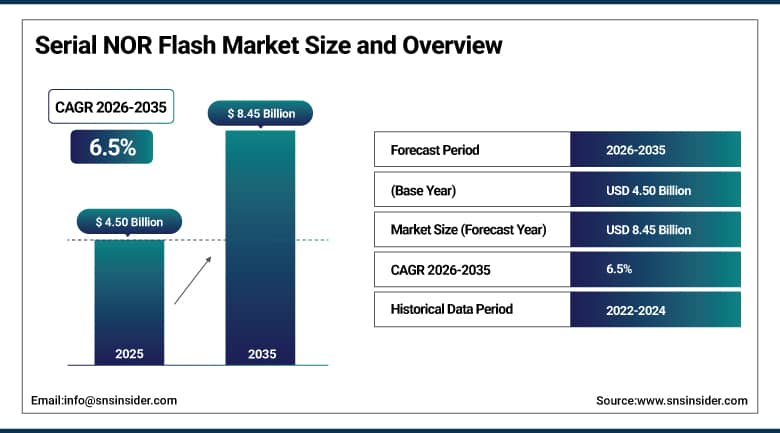
The Serial NOR Flash Market size was valued at USD 4.50 Billion in 2025 and is projected to reach USD 8.45 Billion by 2035, registering a CAGR of 6.5% from 2026 to 2035.
The Serial NOR Flash Memory Market ensures reliable code storage and firmware execution within billions of embedded systems through fast reads, low-pin integration, and data retention via execute-in-place capability. The Serial NOR Flash Memory Market is known for increasing demand for automotive-qualified, high-temperature rated memories, the usage of Quad SPI and Octal SPI interface for higher throughput, and increased presence in IoT, 5G infrastructure, and industrial automation devices within more connected device types. Important trends within the market include increased demand for advanced driver assistance system (ADAS), smart appliances, and networking devices since automakers and industrial equipment makers are making large investments in highly durable memories to support complex electronic systems.
The W25Q family ultra-low power Serial NOR Flash devices from Winbond Electronics were announced across 2025, offering up to 30% reduced standby power consumption in battery-operated edge, wearable, and IoT devices.
To Get More Information On Serial NOR Flash Market - Request Free Sample Report
Serial NOR Flash Market Trends
-
Growing adoption of Quad SPI and Octal SPI interfaces continues raising throughput for increasingly firmware-intensive embedded systems.
-
Rising demand for automotive-grade, high-temperature qualified memory continues expanding Serial NOR Flash adoption in powertrain and under-hood electronics.
-
Increasing integration into IoT and wearable devices continues driving demand for ultra-low-power, standby-optimized memory variants.
-
Expanding 5G infrastructure and industrial automation deployment continues broadening Serial NOR Flash use beyond traditional consumer electronics.
-
Growing shift toward higher-density memory tiers continues supporting increasingly complex firmware and secure boot code requirements.
U.S. Serial NOR Flash Market Size Outlook
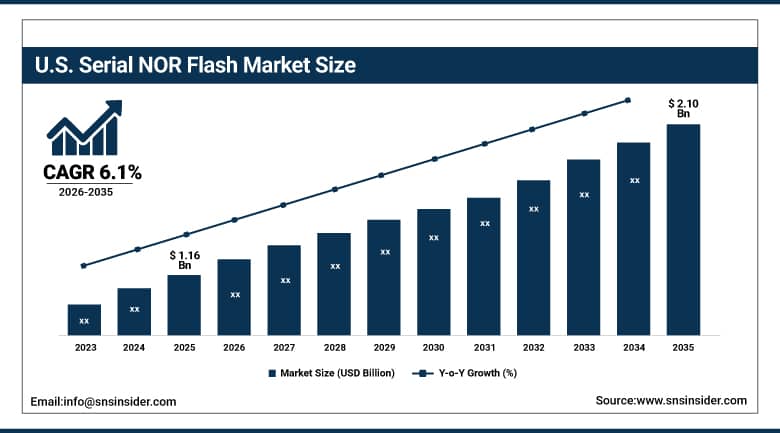
The U.S. Serial NOR Flash Market was valued at approximately USD 1.16 Billion in 2025 and is projected to reach approximately USD 2.10 Billion by 2035, registering a CAGR of approximately 6.1% from 2026 to 2035.
The United States demand continued to be shaped by strong automotive electronics and industrial automation spending, a deep concentration of leading memory suppliers and design engineering talent, and rising demand for reliable, high-endurance firmware storage across defense and aerospace applications. Rising deployment of automotive-qualified, high-temperature Serial NOR Flash by domestic automotive OEMs continued reinforcing the country's position as both a premium-quality hub and a genuine innovation leader for embedded memory technology. Growing adoption across advanced driver assistance systems, networking equipment, and industrial IoT gateways added further layers of sustained domestic demand well beyond the technology's traditional consumer electronics use case.
Macronix introduced automotive-grade Serial NOR Flash packaging throughout 2025, rated for junction temperatures up to 150 degrees Celsius and targeting powertrain and under-hood automotive electronics applications across North American customers.
Serial NOR Flash Market Segment Analysis
-
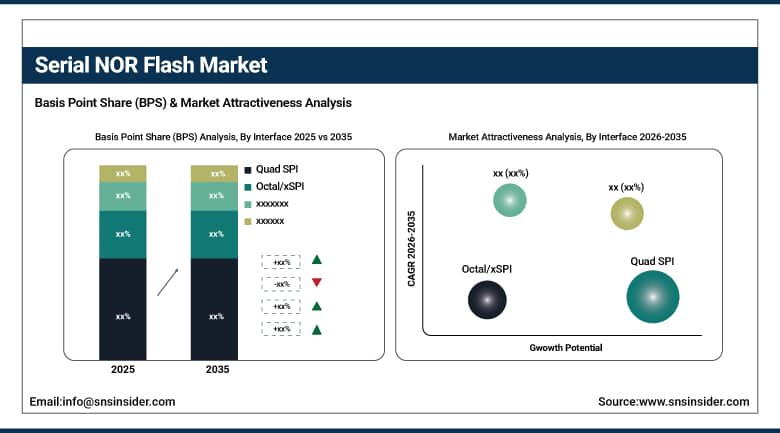
By Interface, Quad SPI dominated the Serial NOR Flash Market with a 39.00% share in 2025, while Octal/xSPI is the fastest-growing interface segment with a CAGR of 8.20% from 2026–2035.
-
By Density, 32 Mb to 128 Mb dominated the market with a 24.00% share in 2025, while 256 Mb and Above is the fastest-growing density segment with a CAGR of 9.10% from 2026–2035.
-
By Application, Consumer Electronics dominated the market with a 38.00% share in 2025, while Automotive is the fastest-growing application segment with a CAGR of 8.70% from 2026–2035.
-
By End-User, OEMs dominated the market with an 82.00% share in 2025, while Aftermarket is the fastest-growing end-user segment with a CAGR of 7.40% from 2026–2035.
By Interface, Quad SPI Leads While Octal/xSPI Grows Fastest
The Quad SPI segment dominated the Serial NOR Flash Market in 2025 owing to its favorable balance of throughput, pin count, and broad compatibility with established microcontroller and embedded processor ecosystems. Designers continue favoring Quad SPI for its proven reliability and widespread tooling support across consumer, industrial, and communication applications. Continued refinement of Quad SPI controller integration has kept this interface the largest single revenue contributor within the interface landscape tracked in this report.
The Octal/xSPI segment is the fastest growing in the Serial NOR Flash Market owing to rising demand for higher throughput in bandwidth-intensive applications such as automotive advanced driver assistance systems and edge AI inference devices. Designers increasingly favor Octal SPI interfaces to reduce code execution latency in increasingly firmware-intensive embedded architectures. Growing adoption of high-performance embedded processors continues accelerating demand for Octal/xSPI-compatible Serial NOR Flash devices across the industry.
By Density, 32 Mb to 128 Mb Dominates While 256 Mb and Above Records Fastest Growth
The 32 Mb to 128 Mb density segment dominated the Serial NOR Flash Market in 2025 due to its favorable balance of cost and capacity for mainstream consumer electronics, industrial controllers, and communication equipment firmware storage requirements. Designers continue relying on this density tier for its broad compatibility with established code storage and configuration requirements. Sustained mainstream embedded system production has kept this density tier the largest overall contributor to market revenue.
The 256 Mb and Above segment is the fastest growing in the Serial NOR Flash Market owing to rising firmware complexity in automotive, networking, and industrial applications requiring larger code storage capacity for increasingly sophisticated software stacks. Designers increasingly favor higher-density devices to accommodate over-the-air update capability and expanded feature sets. Growing software complexity across connected devices continues driving sustained growth in higher-density Serial NOR Flash demand.
By Application, Consumer Electronics Leads While Automotive Grows Fastest
The Consumer Electronics segment dominated the Serial NOR Flash Market in 2025 due to sustained global demand for smartphones, smart appliances, and wearable devices requiring compact, reliable firmware storage. Device manufacturers continue prioritizing Serial NOR Flash integration given the segment’s scale and recurring product refresh cycles. Sustained global consumer electronics shipment volumes have kept this application the largest overall revenue contributor across the market.
The Automotive segment is the fastest growing in the Serial NOR Flash Market owing to rapid growth in advanced driver assistance systems, electric vehicle power electronics, and infotainment platforms requiring reliable, high-temperature qualified firmware storage. Automakers and tier-one suppliers increasingly demand automotive-grade Serial NOR Flash capable of withstanding harsh operating environments. Accelerating global vehicle electrification and ADAS adoption continues driving sustained growth in automotive Serial NOR Flash demand.
By End-User, OEMs Lead While Aftermarket Grows Fastest
The OEMs segment dominated the Serial NOR Flash Market in 2025 due to sustained original equipment manufacturer demand for embedded firmware storage integrated directly into new consumer, automotive, and industrial products. OEMs continue driving the majority of Serial NOR Flash procurement given their central role in electronic product development. Continued global electronics production growth has kept this end-user segment the largest overall contributor to market revenue.
The Aftermarket segment is the fastest growing in the Serial NOR Flash Market owing to rising demand for firmware storage replacement and upgrade components in repair, refurbishment, and retrofit applications across industrial and automotive electronics. Repair service providers increasingly source compatible Serial NOR Flash components to extend equipment service life. Growing focus on electronics repairability and component-level servicing continues driving accelerated growth in aftermarket Serial NOR Flash demand.
Regional Analysis
|
Region |
Major Country |
Share within Region, 2025 (%) |
|---|---|---|
|
North America |
United States |
76.00% |
|
Europe |
Germany |
20.85% |
|
Asia Pacific |
China |
40.00% |
|
Middle East and Africa |
UAE |
26.50% |
|
Latin America |
Brazil |
32.00% |
North America Serial NOR Flash Market Insights
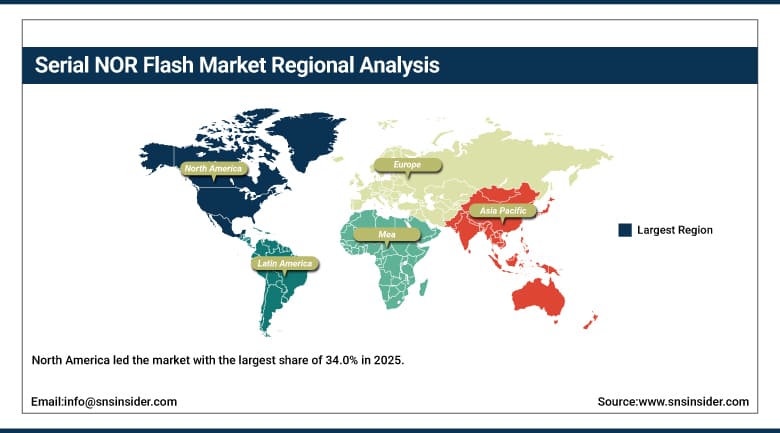
North America led the market with the largest share of 34.0% in 2025. Strong automotive electronics and industrial automation spending, a deep concentration of leading memory suppliers and design engineering talent, and rising demand for reliable, high-endurance firmware storage across defense and aerospace applications continued reinforcing the region’s dominant position. Growing deployment of automotive-qualified, high-temperature Serial NOR Flash across advanced driver assistance and industrial IoT applications further strengthened North America’s standing as both the largest and a genuinely innovation-driven market tracked in this report, with continued automotive electrification investment expected to sustain regional demand through the forecast period.
The United States anchored by its deep concentration of leading memory suppliers and substantial automotive and industrial electronics demand. Canada and Mexico added further regional demand through growing manufacturing and near-shoring activity, and that combined strength kept the continent the largest addressable market for Serial NOR Flash vendors through the forecast period, with continued automotive and industrial electronics investment expected to sustain regional demand.
Get Customized Report as Per Your Business Requirement - Enquiry Now
Europe Serial NOR Flash Market Insights
Europe held a meaningful share of global revenue, supported by strong automotive and industrial semiconductor demand and continued expansion of domestic chip design capability across the region’s major economies. Regulatory momentum around European Chips Act-backed semiconductor investment continued shaping regional development priorities without meaningfully slowing commercialization across the continent, while sustained automotive electrification investment kept the region among the more resilient Serial NOR Flash markets tracked in this report.
Germany led demand of European revenue, supported by its substantial automotive and industrial manufacturing base. The UK and France contributed additional demand, and continued European investment in automotive electrification and industrial automation should keep regional demand for Serial NOR Flash technology climbing steadily through the forecast period.
Asia Pacific Serial NOR Flash Market Insights
Asia Pacific is advancing at the fastest pace among all regions tracked in this report, registering a CAGR of 8.2% from 2026 to 2035, driven by concentrated electronics manufacturing capacity, expanding consumer electronics and automotive production, and growing government-backed investment in domestic semiconductor capability across the region’s largest economies. That combination of manufacturing scale and sustained downstream demand across smartphones, consumer electronics, and automotive electronics kept the region’s growth trajectory well ahead of every other region tracked in this report, with 5G infrastructure buildout adding a further, sustained layer of demand.
China led the pack, supported by its substantial domestic electronics manufacturing base and rapid expansion of consumer electronics and automotive production. South Korea and Taiwan contributed meaningful additional demand, with China’s expanding domestic memory ecosystem and Japan’s advanced electronics manufacturing capability both reinforcing the region’s position as the fastest-growing Serial NOR Flash market tracked in this report.
MEA and Latin America Serial NOR Flash Market Insights
The Middle East and Africa and Latin America both showed steady growth, driven by expanding electronics manufacturing investment, growing government focus on technology sector diversification, and rising demand for domestic assembly and firmware storage capability across both regions. As these markets continued building out modern electronics manufacturing infrastructure, Serial NOR Flash technology proved a genuinely valuable enabler of increasingly capable, locally assembled consumer and industrial electronics.
The UAE led Middle East and Africa demand, supported by the country’s growing electronics manufacturing investment and diversification initiatives. Saudi Arabia contributed further demand through its own industrial diversification programs. In Latin America, Brazil accounted for the largest share of regional revenue, with growing near-shoring and domestic electronics manufacturing investment continuing to anchor regional demand for Serial NOR Flash technology.
Market Dynamics
Growth Drivers: Rising Automotive Electronics Content and IoT Device Proliferation
The industry is driven by rising demand for automotive-grade, high-temperature qualified memory, growing adoption of Quad SPI and Octal SPI interfaces for higher throughput, expanding integration into IoT and 5G infrastructure equipment, and increasing firmware complexity across connected consumer and industrial devices. As electronic systems continue growing more feature-rich while requiring reliable, low-latency code execution, the need for dependable Serial NOR Flash storage continues driving sustained adoption across virtually every major embedded system category.
Rising vehicle electrification and ADAS adoption continues reinforcing this driver, as automotive electronic control units require increasingly reliable, high-temperature qualified firmware storage far beyond traditional automotive electronics content. Growing industrial automation investment continues defining a further layer of sustained demand, and that combination of automotive electrification and industrial IoT deployment is exactly what keeps overall demand climbing at such a steady, sustained pace.
Restraints: Higher Per-Bit Cost Relative to NAND Flash Alternatives
The higher cost per bit of Serial NOR Flash relative to NAND flash alternatives continues posing a genuine restraint on faster market-wide expansion, particularly for high-density data storage applications where NAND flash offers superior cost efficiency despite slower random access performance. That cost differential has kept Serial NOR Flash adoption concentrated primarily in code storage and firmware execution applications rather than bulk data storage scenarios.
Ongoing pricing pressure from established Asian memory manufacturers continues posing a further restraint, as intensifying competition among a growing number of regional suppliers compresses margins for established Serial NOR Flash vendors. Supply chain concentration risk in certain manufacturing regions keeps some customer sourcing strategies more administratively complicated than diversified component sourcing would otherwise require.
Opportunities: Automotive High-Temperature Qualification and Edge AI Firmware Storage
Rising automotive electronics content represents a genuinely significant opportunity, as vehicles increasingly integrate advanced driver assistance systems, centralized compute domains, and electric powertrain electronics requiring reliable, high-temperature qualified firmware storage. Vendors positioned early in automotive-grade Serial NOR Flash qualification stand to capture meaningful share as this capability continues expanding from traditional automotive electronics into broader autonomous driving and electrification applications.
Expanding edge AI device adoption offers a second substantial opportunity, as increasingly sophisticated edge inference devices require reliable, higher-density firmware storage to support complex on-device software stacks. Vendors with proven, low-power Serial NOR Flash technology stand to capture meaningful share as global edge AI and IoT device deployment continues scaling across established and emerging application markets alike.
Recent Developments:
-
2026: Infineon’s SEMPER NOR Flash was qualified for ASPEED’s AST2700 Baseboard Management Controller, strengthening its use in secure and reliable data-center server management applications.
-
2026: GigaDevice expanded its GD25UF 1.2 V ultra-low-power SPI NOR Flash family, extending available densities from 8 Mb to 256 Mb for low-power embedded applications.
-
2024: GigaDevice expanded its GD25 Quad SPI Serial NOR Flash product line with higher-density variants designed for 5G infrastructure and industrial automation firmware storage applications.
Serial NOR Flash Companies are:
-
Macronix International Co., Ltd.
-
Micron Technology, Inc.
-
Infineon Technologies AG
-
GigaDevice Semiconductor Inc.
-
STMicroelectronics N.V.
-
Renesas Electronics Corporation
-
XTX Technology Inc.
-
Puya Semiconductor Co., Ltd.
-
Integrated Silicon Solution, Inc. (ISSI)
-
Eon Silicon Solution Inc. (EON)
-
Zbit Semiconductor Inc.
-
Boya Microelectronics Inc.
-
Fudan Microelectronics Group Co., Ltd.
-
Samsung Electronics Co., Ltd.
-
Kioxia Holdings Corporation
-
Dosilicon Co., Ltd.
-
Elite Semiconductor Memory Technology Inc. (ESMT)
-
Toshiba Electronic Devices & Storage Corporation
Serial NOR Flash Market Report Scope:
| Report Attributes | Details |
|---|---|
| Market Size in 2025 | USD 4.50 Billion |
| Market Size by 2035 | USD 8.45 Billion |
| CAGR | CAGR of 6.5% From 2026 to 2035 |
| Base Year | 2025 |
| Forecast Period | 2026-2035 |
| Historical Data | 2022-2024 |
| Report Scope & Coverage | Market Size, Segments Analysis, Competitive Landscape, Regional Analysis, DROC & SWOT Analysis, Forecast Outlook |
| Key Segments | • By Interface (SPI Single/Dual, Quad SPI, Octal/xSPI) • By Density (2 Mb and Less, 4 Mb to 16 Mb, 32 Mb to 128 Mb, 256 Mb and Above) • By Application (Consumer Electronics, Automotive, Industrial, Communication & Networking, Others) • By End-User (OEMs, Aftermarket) |
| Regional Analysis/Coverage | North America (US, Canada), Europe (Germany, UK, France, Italy, Spain, Russia, Poland, Rest of Europe), Asia Pacific (China, India, Japan, South Korea, Australia, ASEAN Countries, Rest of Asia Pacific), Middle East & Africa (UAE, Saudi Arabia, Qatar, South Africa, Rest of Middle East & Africa), Latin America (Brazil, Argentina, Mexico, Colombia, Rest of Latin America). |
| Company Profiles | Winbond Electronics Corporation, Macronix International Co., Ltd., Micron Technology, Inc., Infineon Technologies AG, GigaDevice Semiconductor Inc., Microchip Technology Incorporated, STMicroelectronics N.V., Renesas Electronics Corporation, XTX Technology Inc., Puya Semiconductor Co., Ltd., Integrated Silicon Solution, Inc. (ISSI), Eon Silicon Solution Inc. (EON), Zbit Semiconductor Inc., Boya Microelectronics Inc., Fudan Microelectronics Group Co., Ltd., Samsung Electronics Co., Ltd., Kioxia Holdings Corporation, Dosilicon Co., Ltd., Elite Semiconductor Memory Technology Inc. (ESMT), Toshiba Electronic Devices & Storage Corporation. |

Frequently Asked Questions
The major growth factor is rising automotive electronics content, growing adoption of Quad SPI and Octal SPI interfaces, and expanding IoT and 5G infrastructure integration.
The Quad SPI segment dominated the Serial NOR Flash Market by interface, representing the largest share of revenue in 2025.
North America dominated the Serial NOR Flash Market in 2025, holding an estimated 34.0% share of total global market revenue.
Key opportunities include automotive electronics, connected devices, edge computing, secure boot applications, and high-density embedded memory.
