
Smart Module Market Report Scope & Overview:
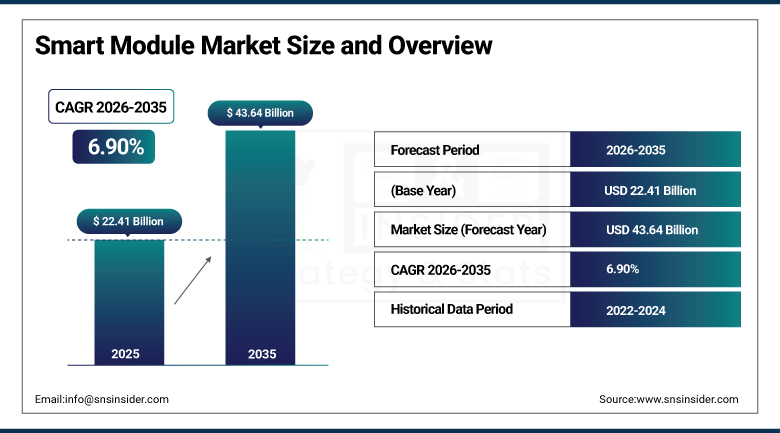
The Smart Module Market size was valued at USD 22.41 Billion in 2025 and is expected to reach USD 43.64 Billion by 2035, growing at a CAGR of 6.90% from 2026 to 2035.
The Smart Module Market is currently seeing considerable growth due to the rise in the use of connecting and intelligent technologies in consumer electronics, automotive, industrial automation, healthcare, and smart infrastructure industries. Smart modules come as a combination of sensing, processing, communicating, and controlling features in one compact module that enables companies to speed up their product development process and make the systems simpler. Rising requirements for the devices that can be used for the Internet of Things (IoT), edge computing, wireless connectivity, and automated systems are driving the market forward. Development of semiconductor technology, miniaturization, and energy-efficient designs are making smart modules perform better. At the same time, rising installations of smart home devices, connected cars, and industrial IoT solutions create many possibilities for smart modules producers.
Quectel Wireless Solutions and u-blox have extended their ranges of 5G and short range intelligent modules in 2026 through the release of RedCap, GNSS, and Wi-Fi 6E modules to cater to the increasing OEM needs for compact and power efficient modules in different IoT use cases.
To Get more information On Smart Module Market - Request Free Sample Report
Smart Module Market Trends:
-
Rapid adoption of 5G RedCap technology is bridging the performance-cost gap between legacy LTE and full 5G IoT modules.
-
Growing integration of AI-enabled edge processing within smart modules is accelerating on-device intelligence across industrial and consumer applications.
-
Rising demand for multi-constellation GNSS-enabled modules is strengthening precision positioning in automotive and agricultural applications.
-
Expanding use of satellite non-terrestrial network connectivity is extending smart module coverage to remote and off-grid regions.
-
Increasing OEM preference for pin-to-pin compatible module families is simplifying design migration across successive technology generations.
U.S. Smart Module Market Size Outlook:
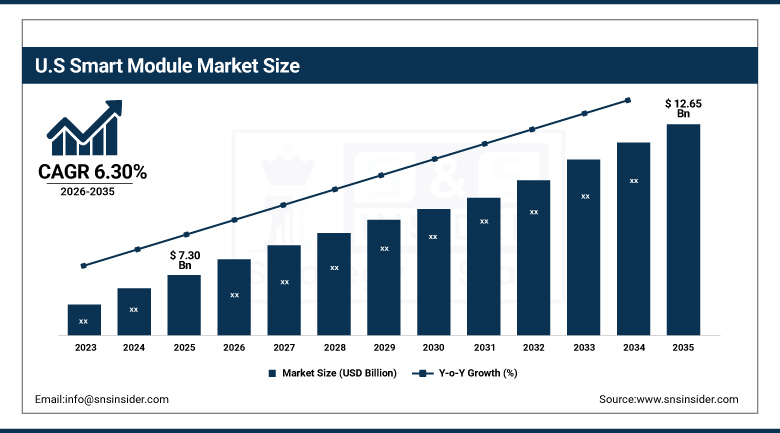
The U.S. Smart Module Market was valued at USD 7.30 Billion in 2025 and is projected to reach USD 12.65 Billion by 2035, growing at a CAGR of 6.30% during 2026–2035.
The U.S. Smart Module Market is on track to witness healthy growth backed by rising penetration in connected cars, industrial equipment, consumer electronics, healthcare and telecom applications. Domestic developments in semiconductor and radio frequency technology are improving the capability of connectivity solutions through embedded smart modules, whereas high-level security and certification standards are fostering the use of reliable smart modules. Rising application scope in energy sensing, fixed wireless broadband and healthcare telemetry applications will continue to support market growth. Furthermore, rising domestic capabilities in 5G and GNSS module design, carrier certification and fabless semiconductor design among others will ensure continued adoption of smart modules across different end-user verticals.
The company Telit Cinterion based in Irvine, California, launched in 2026 FRMCS-ready versions of its 5G RedCap modules for use by rail and industrial organizations in America and improving on its capability of deploying its solutions domestically.
Smart Module Market Segment Analysis:
-
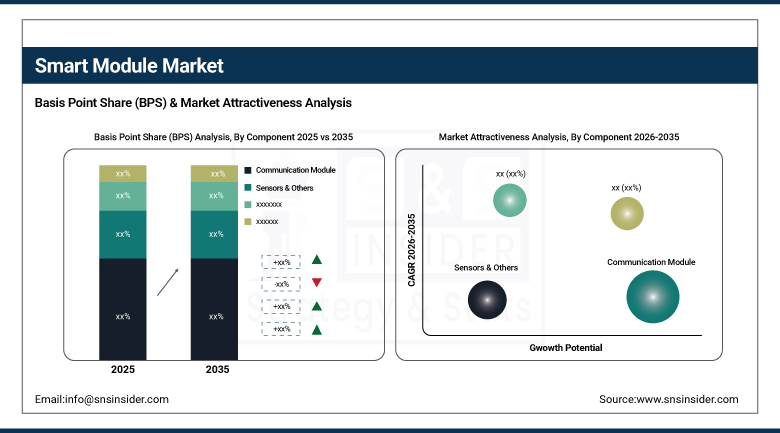
By Component, Communication Module dominated the Smart Module Market with a 36.80% share in 2025, while Sensors & Others is the fastest-growing component segment with a CAGR of 8.30% from 2026–2035.
-
By Connectivity, Cellular dominated the Smart Module Market with a 47.20% share in 2025, while LPWAN is the fastest-growing connectivity segment with a CAGR of 9.10% from 2026–2035.
-
By Application, Consumer Electronics dominated the Smart Module Market with a 29.80% share in 2025, while Automotive & Transportation is the fastest-growing application segment with a CAGR of 8.60% from 2026–2035.
-
By End User, Enterprises dominated the Smart Module Market with a 54.20% share in 2025, while Government & Public Sector is the fastest-growing end-user segment with a CAGR of 8.90% from 2026–2035.
By Component, Communication Module led the market, while Sensors & Others is the fastest-growing segment.
The Communication Module segment was the leading contributor with a 36.80% revenue share in the Smart Module Market in 2025. Communication modules, which integrate the RF transceiver, baseband, and antenna interface that define a smart module's connectivity capability, account for the largest component share because they form the technical core around which processor, memory, and sensor elements are built, and because sustained 5G, Wi-Fi 6E, and GNSS rollouts continue to drive design refreshes across automotive, industrial, and consumer OEM platforms. Their established fabrication ecosystems, extensive carrier and regulatory certification libraries, and broad compatibility with existing host-processor architectures across smartphone, router, and industrial gateway designs have reinforced this segment's dominance across both mature and emerging manufacturing regions.
The Sensors & Others segment is expected to register the highest CAGR of 8.30% during the forecast period 2026–2035. Growing integration of environmental, motion, and biometric sensing capability directly into smart modules is being driven by rising demand for context-aware IoT devices in healthcare monitoring, industrial predictive maintenance, and smart building automation, where combining sensing and connectivity in a single certified unit reduces integration risk and shortens time to market for device manufacturers. Continued miniaturization of MEMS-based sensor components and falling integration costs are further accelerating adoption of sensor-embedded smart modules across cost-sensitive consumer and industrial applications.
By Connectivity, Cellular led the market, while LPWAN is the fastest-growing segment.
The Cellular segment held a market share of 47.20% of the Smart Module Market in 2025. Cellular connectivity, spanning 4G LTE and expanding 5G and 5G RedCap technology, continues to dominate as it offers the wide-area coverage, carrier-grade reliability, and mobility support required by automotive telematics, fixed wireless access, and enterprise asset-tracking applications, while ongoing 3GPP standard evolution and RedCap commercialization are steadily lowering the cost of entry for mid-tier IoT use cases that previously relied on narrower-band alternatives.
The LPWAN segment is anticipated to grow at the fastest rate during the forecast period 2026–2035, at a CAGR of 9.10%. Rising deployment of battery-powered smart metering, agricultural monitoring, and asset-tracking devices that require multi-year battery life and low per-unit connectivity cost is driving strong adoption of NB-IoT and LoRa-based smart modules, particularly as utility and municipal infrastructure operators expand large-scale sensor networks across smart grid and smart city programs.
By Application, Consumer Electronics led the market, while Automotive & Transportation is the fastest-growing segment.
The Consumer Electronics segment dominated the Smart Module Market with a revenue share of 29.80% in 2025. Smartphones, wearables, smart speakers, and connected home devices remain the largest application category owing to high production volumes, frequent product refresh cycles, and continuous integration of new short-range and cellular connectivity standards, which sustains steady module replacement demand across leading consumer electronics brands and their contract manufacturing partners worldwide.
The Automotive & Transportation segment is expected to register the fastest CAGR of 8.60% during the forecast period 2026–2035. Increasing demand for telematics, ADAS, in-car infotainment, and V2X technologies along with other vehicle connectivity needs is fostering high demand for automotive smart modules that are designed according to the AEC-Q104 standards of qualification, while the increasing production and adoption of electric vehicles along with connected fleet management systems are adding another impetus to the already robust growth of this market segment.
By End User, Enterprises led the market, while Government & Public Sector is the fastest-growing segment.
The Enterprises segment held a market share of 54.20% in the Smart Module Market in 2025. End users in the Enterprises segment, which include industrial automation firms, logistics organizations, energy companies, and healthcare organizations, will continue to be the most prominent adopters of smart modules, since they are deploying smart modules in a large number of connected devices that depend on the reliability of certified connectivity solutions to achieve their goals.
Government & Public Sector is estimated to hold the fastest CAGR of 8.90% from 2026 to 2035. Increasing adoption of smart city projects, public utility upgrade projects, and infrastructure monitoring projects in municipalities is fueling the growth of smart modules for streetlighting, water metering, and public safety applications among others.
Regional Analysis:
|
Region |
Major Country |
Share within Region, 2025 (%) |
|
North America |
United States |
84.50% |
|
Europe |
Germany |
26.40% |
|
Asia Pacific |
China |
45.60% |
|
Middle East & Africa |
UAE |
24.80% |
|
Latin America |
Brazil |
36.50% |
North America Smart Module Market Insights
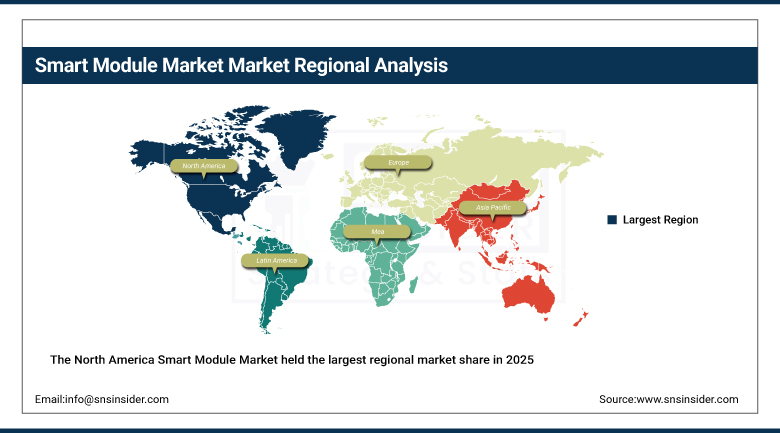
The North America Smart Module Market held the largest regional market share in 2025, accounting for 38.60% of global revenue, owing to the region's advanced semiconductor design ecosystem, extensive carrier certification infrastructure supporting rapid 5G and RedCap rollout, and strong presence of leading automotive, industrial automation, and hyperscale data infrastructure customers requiring certified embedded connectivity across a broad range of device categories. The region's highly developed fixed wireless access and enterprise Internet of Things implementation base, coupled with early implementations of AI-enabled edge processing modules, helps to drive smart module demand at the premium tier among consumer, automotive, and industrial applications.
North America Smart Module Market was led by the United States in 2025, accounting for 84.50% market share of the regional market, owing to extensive local design capabilities of modules and radio frequency engineering, as well as robust implementation of automotive telematics and fixed wireless access, along with ongoing growth of enterprise IoT and industrial automation projects among major domestic device makers. Canada is contributing to regional growth through its own expanding smart agriculture and utility metering deployments, supported by growing LPWAN network coverage across rural and remote regions.
Get Customized Report as per Your Business Requirement - Enquiry Now
Europe Smart Module Market Insights
Europe region was a major contributor to the Smart Module Market in 2025, expected to register comparatively higher growth for automotive-grade and industrial connectivity modules during the forecast period. It is due to the strict regulation of vehicle safety and emission control in this region that results in connected car implementation, the existing base of industrial automation and smart buildings, and the development of government-backed initiatives for the deployment of smart grids and smart meters.
Germany is one of the major markets in Europe owing to its strong automotive manufacturing base and presence of leading Tier 1 suppliers integrating smart connectivity and positioning modules into next-generation vehicle platforms. Other countries such as the United Kingdom, France, and Italy, home to expanding industrial IoT and smart city deployment programs, are also contributing to market growth through continued infrastructure modernization and enterprise connectivity investment.
Asia Pacific Smart Module Market Insights
Asia Pacific Smart Module Market is expected to witness the fastest growth rate during the forecast period 2026–2035, at a CAGR of 8.40%. The market growth is driven by the region's dominant semiconductor and module manufacturing ecosystem, rapidly expanding consumer electronics and electric vehicle production base, and increasing government investment in smart city, smart grid, and industrial automation infrastructure across the region's major and emerging manufacturing economies pursuing accelerated digital transformation strategies.
China is the main growth driver in the Asia Pacific Smart Module Market, owing to its massive module manufacturing ecosystem led by domestic suppliers and rapidly growing consumer electronics and automotive OEM demand supporting both local and export-oriented customers. India and South Korea, both expanding smart manufacturing and 5G infrastructure markets, are also contributing to regional growth through increasing adoption of connected consumer devices and industrial IoT deployment across their respective manufacturing sectors.
Middle East & Africa and Latin America Smart Module Market Insights
Middle East & Africa and Latin American regions are gradually expanding smart module adoption as digital infrastructure and industrial automation investment grows across both regions, supported by increasing government-backed smart city, utility metering, and connected vehicle programs alongside growing enterprise IoT deployment among regional telecom and industrial customers.
Brazil is set to be a prominent Latin American market fueled by its expanding connected vehicle telematics requirements and growing smart metering deployment among domestic utility operators. The Middle East & Africa region has the UAE and Saudi Arabia investing in smart city and digital infrastructure programs that are gradually increasing demand for smart modules across their expanding public safety, utility, and enterprise connectivity sectors.
Market Dynamics:
Growth Drivers: Accelerating 5G and edge-intelligent connectivity rollout driving market growth
The rising integration of processing, memory, and communication capability into compact certified units across automotive, industrial automation, consumer electronics, and healthcare industries, combined with accelerating global rollout of 5G, Wi-Fi 6E, and low-power wide-area network technologies, are among the primary drivers of the Smart Module Market. Smart modules provide device manufacturers with a faster, lower-risk path to certified connectivity than discrete component design, improving product development timelines and reliability across virtually every major application requiring embedded intelligence, from fixed wireless broadband and connected vehicles through industrial sensors and wearable devices.
Technological advancements in module engineering have significantly increased performance and power efficiency, with recent innovations improving RF integration, edge AI processing, and multi-constellation GNSS accuracy across commercial module platforms. Rising demand for automotive-grade connectivity as vehicle manufacturers expand telematics and ADAS deployment, growing integration of edge machine learning capability into short-range wireless modules, and continued semiconductor investment expanding module production capacity are further supporting demand across the forecast period, as smart modules continue displacing discrete radio and processing component designs across an increasingly broad range of device categories.
Restraints: Component supply constraints and design complexity limiting market expansion
One of the most critical obstacles to market growth comes in the form of ongoing volatility in semiconductor and RF component supply, which directly impacts module production lead times and pricing for both manufacturers and device OEM customers who depend on stable long-term component availability to plan large-scale product launches. This comes down to the fact that leading-edge chipsets used in high-performance 5G and Wi-Fi 6E modules remain concentrated among a limited number of foundries and platform suppliers, leaving module makers exposed to allocation constraints during periods of elevated global demand.
Moreover, the growing technical complexity involved in certifying multi-band cellular and GNSS modules across different regional carrier and regulatory requirements increases development cost and time to market for module suppliers, particularly for smaller vendors competing against established global players. Besides, the high engineering investment required to maintain pin-to-pin compatibility across successive module generations, while continuing to reduce form factor and power consumption, requires considerable sustained research and development spending that can constrain margins for mid-tier suppliers.
Opportunities: Expansion of edge AI and satellite connectivity applications creating new growth avenues
The increasing need for on-device intelligence in industrial and consumer applications, the rise of satellite non-terrestrial network integration within standard cellular modules, and greater emphasis on module-level edge AI processing due to increased funding in embedded computing will provide ample growth opportunities in the Smart Module Market. The demand for robust connectivity in remote and off-the-grid regions, which would be facilitated by hybrid designs using NB-NTN and satellite modules, would see future growth as applications such as agriculture, maritime, and utility monitoring become prevalent in previously unexplored territories.
Growth possibilities in automotive smart modules, which can support Level 3 and Level 4 autonomous driving architectures that would benefit from redundancy and functional safety qualified positioning and connectivity at premium costs as compared to normal consumer modules, are very high. The rising investment in smart city, smart grid, and industrial automation within the emerging markets of Asia Pacific and Latin America would provide for sustained growth in the future.
Recent Developments:
-
2026: Quectel Wireless Solutions launched the RG660QA and RG660QB 5G modules, built on Qualcomm's X85 and X82 5G Modem-RF Systems, targeting fixed wireless access, enterprise networking, and high-capacity mobile broadband customers.
-
2026: u-blox introduced the JODY-W6 tri-band Wi-Fi 6E and Bluetooth 5.4 module, built on the NXP IW623 chipset, offering secure high-throughput connectivity for industrial and healthcare IoT applications.
-
2026: Telit Cinterion launched the SE869eK2L GNSS module, built on the Airoha AG3352 platform, offering multiconstellation positioning support and a legacy-compatible footprint for OEMs upgrading aging L1 GNSS designs.
-
2026: Sierra Wireless, a Semtech company, unveiled the EM8695 5G RedCap module, based on Qualcomm's SDX35 baseband processor, targeting ultrabooks, notebooks, and FirstNet-ready M2M connectivity applications.
Smart Module Companies are:
-
u-blox Holding AG
-
Telit Cinterion (Telit IoT Solutions Holding Ltd.)
-
Fibocom Wireless Inc.
-
Thales Group
-
Espressif Systems (Shanghai) Co., Ltd.
-
SIMCom Wireless Solutions Co., Ltd.
-
Neoway Technology Co., Ltd.
-
Sunsea AIoT Technology (Wuxi) Co., Ltd.
-
Thundercomm Technology Co., Ltd.
-
Cavli Wireless Inc.
-
Semtech Corporation
-
Nordic Semiconductor ASA
-
MediaTek Inc.
-
Qualcomm Technologies, Inc.
-
Murata Manufacturing Co., Ltd.
-
Advantech Co., Ltd.
-
China Mobile IOT Company Limited
-
Longsung Technology (Baoding) Co., Ltd
Smart Module Market Report Scope
| Report Attributes | Details |
|---|---|
| Market Size in 2025 | USD 22.41 Billion |
| Market Size by 2035 | USD 43.64 Billion |
| CAGR | CAGR of 6.90% From 2026 to 2035 |
| Base Year | 2025 |
| Forecast Period | 2026-2035 |
| Historical Data | 2022-2024 |
| Report Scope & Coverage | Market Size, Segments Analysis, Competitive Landscape, Regional Analysis, DROC & SWOT Analysis, Forecast Outlook |
| Key Segments | • By Component (Processor & Microcontroller, Memory, Communication Module, Sensors & Others) • By Connectivity (Cellular, Wi-Fi & Bluetooth, LPWAN, Satellite & Others) • By Application (Consumer Electronics, Automotive & Transportation, Industrial Automation, Smart Home & Building Automation, Healthcare, Energy & Utilities) • By End User (Enterprises, Individual Consumers, Government & Public Sector) |
| Regional Analysis/Coverage | North America (US, Canada), Europe (Germany, UK, France, Italy, Spain, Russia, Poland, Rest of Europe), Asia Pacific (China, India, Japan, South Korea, Australia, ASEAN Countries, Rest of Asia Pacific), Middle East & Africa (UAE, Saudi Arabia, Qatar, South Africa, Rest of Middle East & Africa), Latin America (Brazil, Argentina, Mexico, Colombia, Rest of Latin America). |
| Company Profiles | Quectel Wireless Solutions Co., Ltd., u-blox Holding AG, Telit Cinterion (Telit IoT Solutions Holding Ltd.), Fibocom Wireless Inc., Thales Group, Espressif Systems (Shanghai) Co., Ltd., SIMCom Wireless Solutions Co., Ltd., MeiG Smart Technology Co., Ltd., Neoway Technology Co., Ltd., Sunsea AIoT Technology (Wuxi) Co., Ltd., Thundercomm Technology Co., Ltd., Cavli Wireless Inc., Semtech Corporation, Nordic Semiconductor ASA, MediaTek Inc., Qualcomm Technologies, Inc., Murata Manufacturing Co., Ltd., Advantech Co., Ltd., China Mobile IOT Company Limited, Longsung Technology (Baoding) Co., Ltd. |
Frequently Asked Questions
Key players include Quectel Wireless Solutions, Sierra Wireless, Telit Cinterion, Fibocom Wireless, and u-blox.
Key opportunities include 5G deployment, IoT expansion, edge computing, connected vehicles, smart healthcare, and industrial automation.
The market is driven by rising integration of processing, memory, and communication capability into single certified units, accelerating 5G and Wi-Fi 6E rollout, and continued module engineering advancement.
The Consumer Electronics segment dominated the Smart Module Market in 2025, accounting for approximately 29.80% market share.
The North America region dominated the Smart Module Market in 2025 with a market share of 38.60%, driven by the region's advanced semiconductor design ecosystem and extensive carrier certification infrastructure.
