
Optical Fiber Array Market Report Scope & Overview:
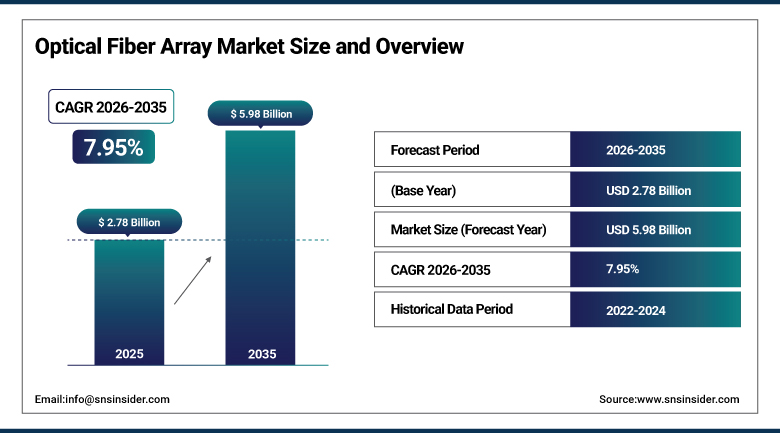
The Optical Fiber Array Market size was valued at USD 2.78 Billion in 2025 and is expected to reach USD 5.98 Billion by 2035, growing at a CAGR of 7.95% from 2026-2035.
Optical Fiber Array Market growth is being fueled largely by the fast-paced development of high-density optical interconnect structures in data centers, telecoms, and photonic instruments. Fiber arrays are an essential component that consists of multiple optical fibers aligned in a precisely defined manner, facilitating coupling with photonic integrated circuits, waveguides, and optical connectors; they have become a crucial part of data transmission as existing technologies of interconnects fail to cope with the ever-growing demands of transmission rate. Increased usage of co-packaged optics and pluggable transceivers in AI-based data center infrastructure increases the demand for more dense and lossless fiber arrays. Adoption of fiber array technology in medical imaging, industrial automation, and defense sensor systems is slowly widening the scope of potential customers beyond the telecommunications sphere, allowing the market to grow at a healthy pace for the next decade.
In March 2026, US Conec, Corning, Fujikura, and Sumitomo Electric Lightwave revealed separate deals outlining a multi-source strategy for the PRIZM TMT Expanded Beam Ferrules and accompanying MMC Connectors, expanding the Very Small Form Factor optical interconnects family to accommodate the needs of AI factory link designs.
To Get more information Optical Fiber Array Market - Request Free Sample Report
Optical Fiber Array Market Trends
-
Rapid adoption of co-packaged optics and pluggable transceiver architectures in AI-driven data centers.
-
Growing preference for 2D fiber array configurations to support compact, high-density connections.
-
Increasing use of very small form factor (VSFF) multi-fiber connectors to maximize interconnect density.
-
Rising adoption of fiber array technology in medical imaging and industrial automation applications.
-
Continued multi-sourcing agreements among leading suppliers to standardize high-density connector platforms.
U.S. Optical Fiber Array Market Size Outlook
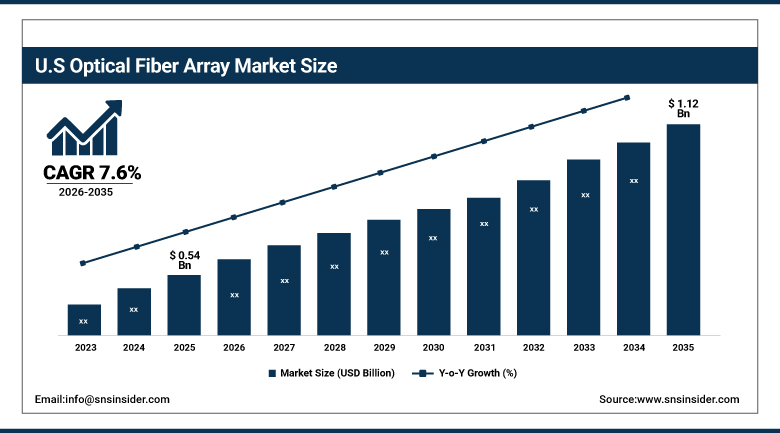
The U.S. Optical Fiber Array Market was valued at USD 0.54 Billion in 2025 and is projected to reach USD 1.12 Billion by 2035, expanding at a CAGR of 7.6% during 2026-2035.
The U.S. Optical Fiber Array Market growth continues to be reinforced by substantial hyperscale data center investment across major U.S. markets, sustained telecommunications network upgrades, and the country's concentration of leading optical connector and fiber array technology developers. Domestic demand also benefits from continued growth in AI-driven computing infrastructure, which increasingly relies on high-density optical interconnects to manage rapidly escalating data transmission requirements. Continued U.S. government and private investment in defense sensing and medical imaging technology further supports demand for precision fiber array components, even as core manufacturing capacity for the underlying optical components remains globally distributed.
For instance, in September 2024, US Conec and SANWA Technologies made an announcement concerning a licensing agreement that would help in developing MDC and MMC very small form factor connector solutions. These optical connectivity platforms play an important role in fiber array based interconnects.
Optical Fiber Array Market Segment Analysis
-
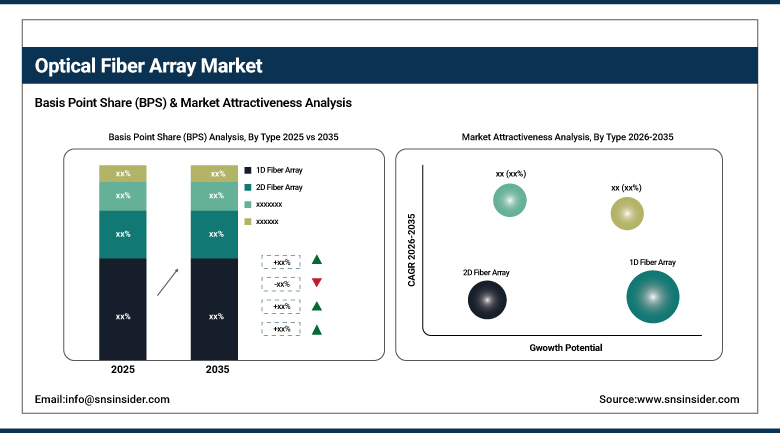
By Type, the 1D Fiber Array segment dominated the Optical Fiber Array Market with approximately 72.50% share in 2025, while the 2D Fiber Array segment is the fastest growing with a CAGR of approximately 10.80%.
-
By Application, the Telecommunications segment dominated the Optical Fiber Array Market with approximately 38.50% share in 2025, while the Data Centers segment is the fastest growing with a CAGR of approximately 9.80%.
By Type, 1D Fiber Array dominates and 2D Fiber Array grows fastest
1D Fiber Array type segments account for the largest share in the Optical Fiber Array Market, being defined by their relatively simpler linear alignment of fibers along with the proven technology that is based on V-grooves substrate material. Such a type segment takes advantage of a wide compatibility with planar lightwave circuit devices and array waveguide grating technology, where single row of the precisely placed fibers provides necessary coupling for most photonic chip and waveguide designs.
2D Fiber Array type segments are expected to exhibit the highest CAGR during the forecast period, which is largely due to the requirement of higher number of fiber channels per unit space in increasingly smaller photonic integrated circuits. It involves advanced multi-row alignment technology, which can offer significantly greater fiber channels in a similar amount of space compared to other types of fiber arrays.
By Application, Telecommunications dominates and Data Centers grows fastest
The telecommunications application continues to be the most prominent application in the Optical Fiber Array Market due to the technology's extensive history in ensuring fast data transmission over long-distance fiber-optic communications. The market segment is highly supported by years of accumulated deployment through the fiber arrays used as the main coupling device for transmission fiber and active optical components.
Data Centers are emerging as the fastest-growing application segment, driven by hyperscale operators' accelerating deployment of high-density optical interconnects to support AI-driven computing workloads and rising east-west data traffic within facilities. This segment focuses on ultra-low-loss, high-channel-count fiber array designs compatible with co-packaged optics and next-generation pluggable transceiver architectures, positioning data centers to capture a growing share of supplier investment as AI infrastructure buildout continues to accelerate globally.
Regional Analysis
|
Region |
Major Country |
Share within Region, 2025 (%) |
|---|---|---|
|
Asia Pacific |
Japan |
61.90% |
|
North America |
United States |
79.50% |
|
Europe |
Germany |
27.60% |
|
Latin America |
Brazil |
48.90% |
|
Middle East & Africa |
Israel |
29.60% |
Asia Pacific Optical Fiber Array Market Insights
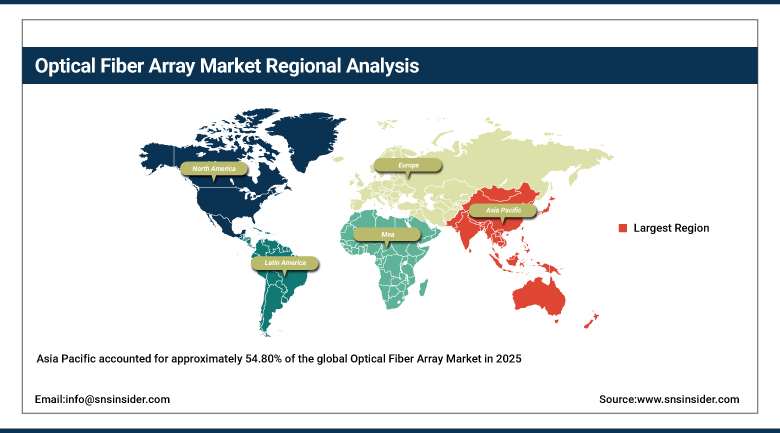
Asia Pacific accounted for approximately 54.80% of the global Optical Fiber Array Market in 2025 and is also projected to expand at the fastest CAGR of approximately 8.90% during the 2026-2035 forecast period, reflecting the region's concentration of precision optical component manufacturing capacity. Japan represents the largest single contributor within the region, anchored by its established precision manufacturing clusters and long-standing base of fiber-optic component engineering expertise built up over decades of telecommunications and photonics industry development.
China and South Korea contribute substantial additional regional volume, supported by rapid domestic data center construction and large-scale telecommunications network expansion. Taiwan's electronics manufacturing ecosystem further reinforces regional production capacity, positioning Asia Pacific as both the largest producer and the fastest-growing consuming market for optical fiber array technology as AI-driven data center investment continues to accelerate across the region.
Get Customized Report as per Your Business Requirement - Enquiry Now
North America Optical Fiber Array Market Insights
North America provides an important market region for optical fiber arrays, driven by extensive investments made in hyperscale data centers in the United States and the presence of the most advanced developers of fiber arrays and optical connection technologies in the country. The United States takes up a substantial part of the region's demand for optical fiber arrays, due to its advanced telecommunication infrastructure and the presence of fiber array and optical connectivity providers.
Both Canada and Mexico have lower percentages of the regional demand, but this demand is mainly due to the activity in the data center and telecoms infrastructure, which is related to the investments made in North American digital infrastructure. The further development of computing infrastructure driven by artificial intelligence in the large US data centers will bring stable demand for fiber array technology.
Europe Optical Fiber Array Market Insights
Europe represents a meaningful regional market for optical fiber arrays, anchored by Germany's strong telecommunications and industrial manufacturing base and its concentration of fiber-optic network infrastructure investment. Germany's share within the European market reflects both its telecommunications infrastructure scale and its home-market presence of optical component research and manufacturing activity.
The United Kingdom and France contribute additional regional demand, supported by ongoing fiber-to-the-home and 5G backhaul network deployment across the region. Continued European Union investment in digital infrastructure and rural fiber connectivity programs supports steady regional demand for fiber array-based interconnect components.
MEA & Latin America Optical Fiber Array Market Insights
Latin America's Optical Fiber Array Market is led by Brazil, which accounts for the majority of regional demand on the strength of its large telecommunications sector and its role as a regional hub for data center and network infrastructure investment. Gradual expansion of fiber-optic network coverage and rising data center construction across Brazil and Mexico continue to support steady regional demand growth.
The Middle East & Africa region is still considered a smaller player in terms of contribution to overall demand, with its research and development taking place in countries like Israel, which has a long history of technology and photonics research that can be related to the development of precision optical components. The overall demand in the region continues to be less than in Asia Pacific, North America, and Europe.
Market Dynamics
Growth Drivers: AI Data Center Infrastructure and High-Density Interconnect Demand
The rapid increase in AI-enabled data centers drives the growth of the Optical Fiber Array Market owing to the use of more dense optical interconnects that are being utilized to cater to increasing compute and transmission needs. This trend is being driven by the transition to co-packaged optics and pluggable transceiver technologies, which need optical fiber arrays that can facilitate higher channel counts compared to traditional interconnect systems.
Continuous upgrades in global telecommunications networks such as fiber-to-the-home and 5G backhaul systems are other sources of demand driving the Optical Fiber Array market, where service providers are continuously expanding their fiber-optic network capacity to cater to higher consumer bandwidth requirements. Increased usage of fiber array technology in the medical imaging and industrial automation markets boosts the market growth.
Restraints: Precision Manufacturing Complexity and Cost Pressure
The precision in manufacturing needed to make fiber arrays with submicron alignment tolerance levels acts as a key constraint in the Optical Fiber Array Market, given that such manufacturing processes are dependent on cleanrooms as well as high-quality labor skills that will limit the number of suppliers able to compete. Such constraints are especially common in 2D fiber arrays, which have much more stringent precision requirements than traditional 1D fiber arrays.
Moreover, the cost pressures that result from the hyperscale customers’ need to control the total infrastructure costs become another limitation because fiber array providers have to make trade-offs between investments in higher densities and price stability/decline per channel for their customers. Limitations on the availability of raw materials such as fused silica and adhesives should be taken into account as well.
Opportunities: Co-Packaged Optics and Photonic Integration Expansion
Further evolution of the industry towards the adoption of co-packaged optics will bring considerable growth prospects for the Optical Fiber Array Market, considering that this trend will demand advanced optical fiber arrays that can enable direct connections with photonic integrated circuits on-chip. Vendors who can offer reliable high-channel-count fiber arrays at a reasonable price point stand a good chance of gaining market share in the wake of the continuing move away from traditional pluggable optics.
Growing adoption of fiber array technology in emerging applications, including medical imaging, industrial sensing, and defense systems, presents a longer-term opportunity for suppliers to extend fiber array technology into new commercial categories beyond its traditional telecommunications and data center base. As these newer applications mature, suppliers with early development experience in precision fiber alignment technology are positioned to capture a disproportionate share of this emerging demand.
Recent Developments:
-
In 2026, Coherent introduced OptiAlign, a high-precision fiber array unit designed for co-packaged optics applications requiring precise pitch control and high fiber-channel counts.
-
In 2026, Arden Photonics upgraded its FGC Array Geometry Measurement System with 2D fiber array characterization, supporting multi-row arrays up to 22 mm wide and 0.8 mm tall.
-
In 2025, OZ Optics launched a new line of 2D-Fiber Array assemblies for high-density optical transmission, supporting applications such as optical cross-connection, biomedical imaging, spectroscopy, and astronomy.
-
In 2025, RAM Photonics Industrial launched its Medusa™ 2D Fiber Array family, using automated manufacturing and submicron precision for OCS and co-packaged optics applications.
Optical Fiber Array Companies are:
-
Corning Incorporated
-
US Conec Ltd.
-
Fujikura Ltd.
-
Sumitomo Electric Industries, Ltd.
-
Molex LLC
-
Senko Advanced Components, Inc.
-
OZ Optics Ltd.
-
Diamond SA
-
Kohoku Kogyo Co., Ltd.
-
Kawashima Manufacturing Co., Ltd.
-
Adamant Namiki Precision Jewel Co., Ltd.
-
IDIL Fibres Optiques
-
Broadex Technologies Co., Ltd.
-
HYC Co., Ltd.
-
Zhongshan Meisu Technology Co., Ltd.
-
SQS Vláknová Optika a.s.
-
Fibertech Optica Inc.
-
FiberBridge Photonics
-
Silicon Lightwave Technology
-
Vitex, Inc.
Optical Fiber Array Market Report Scope:
| Report Attributes | Details |
|---|---|
| Market Size in 2025 | USD 2.78 Billion |
| Market Size by 2035 | USD 5.98 Billion |
| CAGR | CAGR of 7.95% From 2026 to 2035 |
| Base Year | 2025 |
| Forecast Period | 2026-2035 |
| Historical Data | 2022-2024 |
| Report Scope & Coverage | Market Size, Segments Analysis, Competitive Landscape, Regional Analysis, DROC & SWOT Analysis, Forecast Outlook |
| Key Segments | • By Type (1D Fiber Array and 2D Fiber Array) • By Application (Telecommunications, Data Centers, Medical Imaging, Industrial Automation, Aerospace & Defense, and Others) |
| Regional Analysis/Coverage | North America (US, Canada), Europe (Germany, UK, France, Italy, Spain, Russia, Poland, Rest of Europe), Asia Pacific (China, India, Japan, South Korea, Australia, ASEAN Countries, Rest of Asia Pacific), Middle East & Africa (UAE, Saudi Arabia, Qatar, South Africa, Rest of Middle East & Africa), Latin America (Brazil, Argentina, Mexico, Colombia, Rest of Latin America). |
| Company Profiles | Corning Incorporated, US Conec Ltd., Fujikura Ltd., Sumitomo Electric Industries, Ltd., Molex LLC, Senko Advanced Components, Inc., OZ Optics Ltd., Diamond SA, Kohoku Kogyo Co., Ltd., Kawashima Manufacturing Co., Ltd., Adamant Namiki Precision Jewel Co., Ltd., IDIL Fibres Optiques, Broadex Technologies Co., Ltd., HYC Co., Ltd., Zhongshan Meisu Technology Co., Ltd., SQS Vláknová Optika a.s., Fibertech Optica Inc., FiberBridge Photonics, Silicon Lightwave Technology, Vitex, Inc. |
Frequently Asked Questions
Leading companies in the Optical Fiber Array Market include Corning, US Conec, Fujikura, Sumitomo Electric Industries, and Molex, among others.
Key opportunities include continued industry transition toward co-packaged optics architectures requiring chip-level fiber coupling, and growing adoption of fiber array technology in medical imaging, industrial sensing, and defense applications.
Rapid expansion of AI-driven data center infrastructure requiring increasingly dense optical interconnects, combined with continued global telecommunications network upgrades, is the major factor driving market growth.
The Telecommunications segment dominated the Optical Fiber Array Market with approximately 38.50% share in 2025.
Asia Pacific dominated the Optical Fiber Array Market in 2025 with approximately 54.80% share, reflecting the region's concentration of precision optical component manufacturing capacity, led by Japan.
