
Textile Coatings Market Report Scope & Overview:
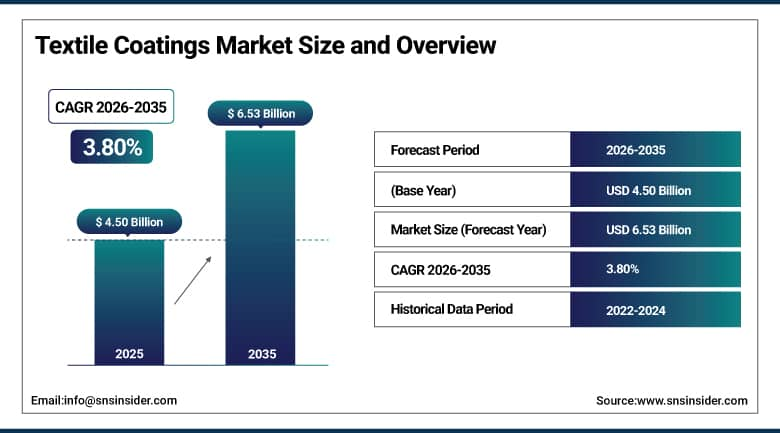
The Textile Coatings Market was valued at USD 4.50 Billion in 2025 and is expected to reach USD 6.53 Billion by 2035, growing at a CAGR of 3.80% from 2026-2035.
The Textile Coatings Market is growing steadily due to the increasing use of coated fabrics in protective apparel, automotive interiors, air bags, medical textiles, tents/tarpaulins, conveyor belts, filtration fabrics, and architectural membranes. The market growth is being driven by the need for certain properties, such as water repellence, fire resistance, abrasion resistance, and anti-microbial coatings, higher production of vehicles, and greater expenditure on protective apparel and medical textiles. Changes in legislation are changing the chemistry used by moving away from fluorinated water repellents and solvent-based systems towards PFAS-free, water-borne, and partially bio-based formulations. Efforts are being made to develop recyclable mono-material constructions through the cooperation of coating manufacturers, textile converters and machinery suppliers.
⮞On April 20, 2026, ahead of Techtextil 2026 in Frankfurt, Archroma presented PHOBOTEX NTR-50 LIQ, a non-PFAS and partly bio-based water repellent for outdoor and activewear, together with PHOBOTEX R-ACE for workwear and uniforms. The company also introduced APPRETAN formaldehyde-free binders for nonwovens and a High IQ lastingrepel programme that gives mills and brands third-party checks on water-repellent treatments, a sign of how verification is becoming part of the product offer.
To Get More Information On Textile Coatings Market - Request Free Sample Report
Textile Coatings Market Trends
-
Shift from fluorinated and solvent-based systems to PFAS-free and waterborne coatings
-
Growth of bio-based and mass-balanced polyurethane dispersions
-
Development of mono-material coated fabrics that support recycling
-
Demand for antimicrobial, flame-retardant and heat-resistant functional finishes
-
Third-party verification and testing programs for water-repellent treatments
-
Integration of electronics and smart surfaces with coated textiles in vehicles and wearables
U.S. Textile Coatings Market Outlook
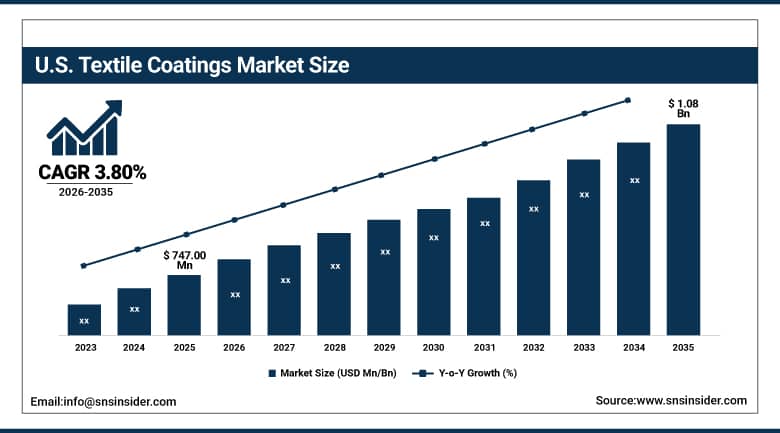
The U.S. Textile Coatings Market was valued at USD 747.00 Million in 2025 and is expected to reach USD 1.08 Billion by 2035, growing at a CAGR of 3.80% from 2026-2035.
The U.S. Textile Coatings Market is the largest market in North America, supported by demand for protective clothing, military and aerospace textiles, automotive interiors and airbags, medical fabrics, industrial belts and filtration media. Buyers emphasize performance certification, flame resistance and durability, and procurement by government agencies and large manufacturers favors suppliers with documented compliance. State laws restricting PFAS in apparel and textiles, along with federal scrutiny of these chemicals, are pushing outdoor brands, uniform makers and technical textile producers to qualify fluorine-free alternatives. Local production of dispersions and coated fabrics supports shorter supply chains for defense and automotive customers.
⮞Waterborne polyurethane capacity has been rebuilt on both sides of the Atlantic. On November 7, 2017, Covestro said it had started up a new aqueous polyurethane dispersions facility in Dormagen, Germany, was expanding production in Barcelona, building a new facility in China and resuming production in the United States while modernizing and expanding existing U.S. facilities. The company said the expansion responded to manufacturers replacing solvent-based products with waterborne systems and to rules on volatile organic compound emissions, trends that continue to shape American coated textile suppliers.
Textile Coatings Market Segment Analysis
-
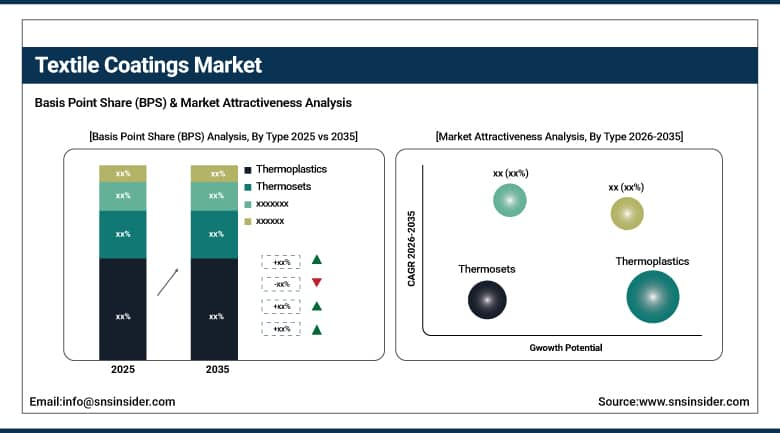
By Type, thermoplastics segment dominated the Textile Coatings Market in 2025 with an estimated 58% share; thermosets segment is the fastest-growing segment, with an estimated CAGR of 6.8% from 2026 to 2035.
-
By Material, polyurethane segment dominated the market in 2025 with an estimated 32% share; fluoropolymers segment is the fastest-growing segment, with an estimated CAGR of 7.5% from 2026 to 2035.
-
By Technology, full surface coating segment dominated the market in 2025 with an estimated 72% share; dot coating segment is the fastest-growing segment, with an estimated CAGR of 7.2% from 2026 to 2035.
-
By Coating Method, direct coating segment dominated the market in 2025 with an estimated 35% share; hot-melt extrusion coating segment is the fastest-growing segment, with an estimated CAGR of 7.8% from 2026 to 2035.
-
By End Use, protective clothing segment dominated the market in 2025 with an estimated 27% share; medical and healthcare textiles segment is the fastest-growing segment, with an estimated CAGR of 8.1% from 2026 to 2035.
By Type, Thermoplastics Dominate Textile Coatings Market; Thermosets to Register Fastest Growth.
The thermoplastics segment dominates the Textile Coatings Market on account of their versatility, easy processability, and suitability for a wide range of textile substrates. They have qualities like flexibility, durability, water repellency, and abrasion resistance which make them useful for applications like apparels, automotive textiles, industrial textiles, and other protective purposes. The capability to be reshaped after heating allows them to enable an effective manufacturing process and the possibility of recycling. Moreover, the well-developed technology and wide availability of these types of coatings drive the demand from textile producers as an economical choice.
The thermosets segment is expected to register the fastest growth, owing to the growing demand for the coatings having better resistance to chemicals, heat, and dimension stability. They can form cross-linked coatings that resist heat, solvents, and mechanical loads. This is useful in applications like industrial fabrics, automotive parts, construction textiles, and special protective applications. Increasing safety concerns in industrial sector and long-lasting performance of textile will drive the demand for such coatings.
⮞In May 2026, Eastex Products launched TEK AIR® SD/HT, a high-tenacity solution-dyed nylon fabric featuring a thermoplastic polyurethane coating, designed for RF-welded sealed seams, waterproof protection, abrasion resistance and UV durability in demanding applications.
By Material, Polyurethane Dominates Textile Coatings Market; Fluoropolymers to Register Fastest Growth.
The polyurethane segment dominates the Textile Coatings Market due to its optimal balance of flexibility, abrasion resistance, adhesion, and water repellency. Polyurethane coatings offer both protection and textile softness, making them well suited for the production of apparel, upholstery, automobile interiors, footwear, and technical textiles. Their flexibility, in terms of formulation, allows producing coatings that have custom-made durability, elasticity, and surface features. The availability of established manufacturing processes and wide commercial use also contribute to their popularity. The above mentioned factors favor polyurethane usage when there is a need to provide reliable protection without significantly reducing comfort and functionality of textiles.
The fluoropolymers segment is expected to register the fastest growth, due to rising demand for textiles with excellent chemical resistance, weathering capabilities, and water and oil repellence. Such coatings find application in filtration systems, protective clothing, outdoor materials, and technical textiles that operate in harsh environment. Durability against aggressive chemicals and extreme conditions of operation encourages adoption of such materials for critical applications. There are high demands for durable protection and longevity of surface coatings of textile materials. However, the use of some fluorine containing substances may be restricted due to environmental reasons.
⮞In October 2025, Stahl introduced PermaQure® EPU, an embossable polyurethane coating for synthetic leather and PU-coated textiles, designed to deliver durable grain definition and compatibility with existing PVC embossing lines.
By Technology, Full Surface Coating Dominates Textile Coatings Market; Dot Coating to Register Fastest Growth.
The full surface coating segment dominates the Textile Coatings Market due to the ability to coat the entire surface of textiles uniformly providing consistent protection and functionality. The technology enables the creation of products with resistance to moisture, chemicals, abrasion, and environmental conditions. It finds wide application in protective clothing, upholstery, automotive textiles, industrial textiles, and water-resistant textiles. Uniform coating enables manufacturers to ensure uniform product quality and effective barriers. Its applicability for mass manufacturing and various coating formulation options contribute to high adoption of the technology by industries to provide comprehensive textile protection and improved material durability.
The dot coating segment is expected to register the fastest growth owing to the growing preference of manufacturers for textile coatings maintaining breathability, flexibility, and fabric softness. Dot coating technology allows certain textile areas to receive functional properties whereas others remain unaffected. It has numerous applications in the apparel industry, footwear, medical textiles, and technical textiles. In addition, reduced use of coating material may be considered an important advantage for manufacturers. The increasing demand for lightweight and functional textiles is likely to drive adoption of the dot coating technology.
⮞In February 2026, researchers reported a polyacrylate-based surface coating combining thermo-expandable microspheres and ammonium polyphosphate flame retardants on polyester/cotton fabrics, improving thermal insulation and fire resistance for protective textile applications.
By Coating Method, Direct Coating Dominates Textile Coatings Market; Hot-Melt Extrusion Coating to Register Fastest Growth.
The direct coating segment dominates the Textile Coatings Market owing to the provision of an effective and flexible approach for direct application of functional coatings onto textile substrates. This technology allows the use of various polymer materials and fabrics, thus helping manufacturers develop their products with desired water resistance, durability, flexibility, and protection of surface. Compatibility of the technology with traditional textile finishing equipment allows using it for mass production of products in the apparel, upholstery, automotive fabrics, and other industrial segments.
The hot-melt extrusion coating segment is expected to register the fastest growth, due to growing popularity of efficient coating techniques that involve minimum use of solvents and drying. Hot-melt extrusion coating involves application of molten polymer materials onto textile substrates, allowing quick coating process and formation of durable protective films. Benefits of this approach are associated with high adhesion properties, efficient coating process, and manufacturing productivity. Growing demand for efficient process and low emissions are expected to prompt more companies to explore alternative solvent-free technologies. Increased consumption of technical textiles, protective materials, and fabric laminates is another driver of the growth of this technology.
⮞In March 2025, AGC Chemicals Americas and DRYFIBER announced the production launch of a non-fluorinated oil-and-water repellent coating for technical textiles, applicable through dipping or industrial spray-coating, with commercialisation planned for 2026.
By End Use, Protective Clothing Dominates Textile Coatings Market; Medical and Healthcare Textiles to Register Fastest Growth.
The protective clothing segment dominates the Textile Coatings Market since it provides protection from moisture, chemicals, heat, abrasions, and other occupational threats. Industrial workers, emergency response workers, healthcare providers, and service professionals require protective wear designed to meet their application-based safety requirements. The coating increases protection capabilities of textiles, improves their strength and, based on the composition, flexibility and comfort level. The increasing safety consciousness and workplace protection needs ensure stable demand for textile coatings in several industries. Regular use of textile coatings in protective workwear and personal protective equipment ensures leadership of the segment.
The medical and healthcare textiles segment is expected to register the fastest growth, driven by increasing demands for hygienic and protective textile coatings in healthcare settings increase usage of textile coatings. Medical gowns, surgical drapes, mattress covers, protection barriers, and other applications require the ability to provide protection from fluids and contamination. The growing medical infrastructure, increasing focus on infection prevention, and rising demands for disposable and reusable protection products help to increase the use of textile coatings in healthcare facilities.
⮞In November 2025, TEXTILCOLOR AG, Alpex Protection, Majocchi and Germany's Trans-Textil began a strategic collaboration to scale Pyroshell permanent flame-protection finishing for polyamide and polyester fabrics used in protective equipment.
Regional Insights
|
Region |
Major Country |
Share within Region, 2025 (%) |
|
Asia Pacific |
China |
45.60 |
|
North America |
United States |
83.00 |
|
Europe |
Germany |
28.40 |
|
Latin America |
Brazil |
47.00 |
|
Middle East & Africa |
Turkey |
26.50 |
Asia Pacific Textile Coatings Market Insights
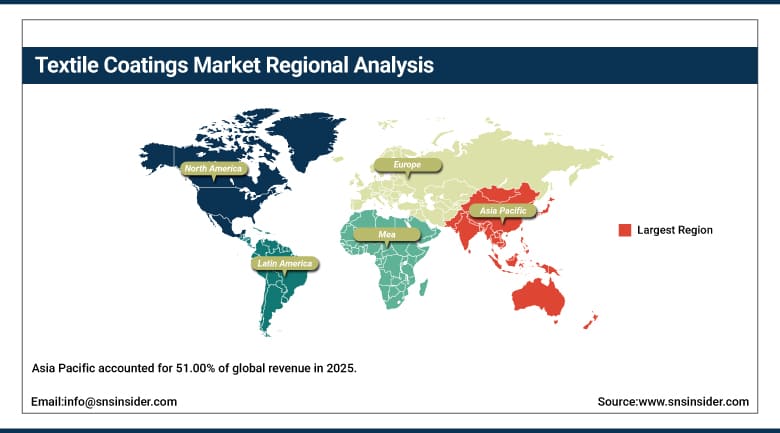
Asia Pacific accounted for 51.00% of global revenue in 2025, making it the largest regional market for textile coatings. China leads regional demand through its vast textile, apparel, synthetic leather and technical textile industries, followed by India, Japan, South Korea, Vietnam and Bangladesh. Industrialization, the concentration of garment and fabric manufacturing and growth of vehicle production support steady consumption. Chemical suppliers, coaters and machinery makers are heavily represented, and regional competition on price is strong.
Environmental rules in China and India are tightening, encouraging adoption of waterborne and lower-emission systems, and international brands push suppliers toward PFAS-free chemistry and chemical management programs. India is expanding technical textile capacity through government schemes, while Japan and South Korea focus on high-performance and medical fabrics. Textile mills are investing in modern coating lines, and global suppliers localize production of dispersions and additives to serve customers.
⮞In September 2026, Jiangsu Keqiang New Materials advanced a RMB 178.6 million coated-materials manufacturing project in Jiangsu, planned to produce 100,000 square metres annually of high-temperature flame-retardant silicone-rubber-coated fabrics for aerospace, medical and nuclear applications.
Get Customized Report as Per Your Business Requirement - Enquiry Now
North America Textile Coatings Market Insights
North America is projected to be the fastest-growing region, advancing at a CAGR of 4.60% from 2026-2035. The United States leads regional demand, with Canada and Mexico adding automotive and apparel production. Growth is driven by aerospace, defense, medical and industrial applications that need certified high-performance coated fabrics, as well as outdoor and workwear brands moving to fluorine-free finishes. Reshoring of strategic textile production and federal procurement preferences support local supply chains for protective gear.
State and federal action on PFAS is a defining factor, prompting brands and manufacturers to reformulate and qualify alternatives. Automotive makers require durable, low-emission coated textiles for interiors, while healthcare systems demand antimicrobial and barrier fabrics. Suppliers highlight technical service, rapid sampling and testing support. Investment in coating lines, dispersion plants and recycling initiatives for coated fabrics is expected to continue as customers prioritize resilience and compliance.
Europe Textile Coatings Market Insights
Europe is a technology-rich, regulation-driven market, with Germany, Italy, France and the United Kingdom leading consumption. Technical textile makers, automotive suppliers and sportswear brands drive demand for high-performance coated fabrics, and the region hosts major chemical companies and machinery builders. Techtextil in Frankfurt is a central venue where suppliers present new coatings, flame-retardant finishes and recyclable constructions to a global audience.
Chemical regulation under REACH, restrictions on PFAS and the European Union's textile sustainability strategy push the industry toward safer chemistries, mono-material fabrics and extended producer responsibility. Back coatings for carpets and artificial turf are being redesigned for single-material recycling. High energy costs and competition from imports challenge producers, so many focus on specialty products, circularity and verified environmental performance.
⮞In April 2026, German-made TIDURA entered the market as a premium TPU-coated technical-fabric brand, offering waterproof and hydrolysis-protected coated textiles developed through advanced manufacturing processes and specialised high-bonding TPU lamination.
MEA & Latin America Textile Coatings Market Insights
In the Middle East and Africa, demand is concentrated in Turkey, Egypt, Saudi Arabia, the United Arab Emirates and South Africa, where textile and technical fabric industries serve regional and export markets. Turkey is a major producer of coated fabrics for automotive, furniture and apparel customers, and Gulf states import protective and shade fabrics for construction and energy projects. Investment in local manufacturing is expanding under industrial diversification plans.
In Latin America, Brazil and Mexico lead consumption, supported by automotive production, apparel manufacturing and agriculture-related textiles. Regional coaters serve tarpaulins, footwear and furniture upholstery, and imports of specialty dispersions are common. Currency swings and uneven regulation affect adoption of advanced chemistries, but multinational brands operating in the region are encouraging cleaner formulations. Both regions are expected to add steadily to global revenue from a smaller base.
Market Dynamics
Growth Drivers: Functional Performance, Vehicle Output and Protective Demand
The rising demand for textile coatings is fueled by the need to manufacture fabrics that have higher resistance against water, fire, heat, abrasion, chemicals and microbial attacks. Such coatings make fabrics more durable and functional in applications in automobiles, health care, construction, industry and apparels. The automotive industry drives the demand for coated fabrics, which are used in seats, airbags, headliners, doors and interior trimmings. In addition, electric vehicles drive the development of light weight and environmentally friendly materials.
Safety demands in work environments and increasing industrial activities are boosting demand for protective clothes and technical textiles. Health care facilities need coated materials with hygienic, liquid resistance and durable qualities. Applications in construction, like architectural membranes and coated façade systems, benefit from their ability to withstand weather conditions. Furthermore, innovations in aqueous formulations, antimicrobial finishes and intelligent textile surfaces help manufacturers to create unique products.
⮞In June 2025, East Providence, Rhode Island, became the first U.S. city to equip its fire department department-wide with non-PFAS turnout gear, purchasing 170 sets through a USD 658,000 procurement covering 125 full-time firefighters.
Restraints: PFAS Regulation, Raw Material Costs and Recycling Challenges
Regulations governing per- and polyfluoroalkyl chemicals are posing issues to producers of textile coatings, especially producers of water- and oil-resistant coatings based on fluorinated chemicals. Product reformulation will involve research, testing, certification, and customer requalification. Non-fluorinated chemicals may not offer similar resistance to water, oil, and chemical degradation in some instances.
Fluctuating costs of raw materials will impact the economics of production, as polyurethane, acrylic and silicone coatings use various chemicals and energy. Disruptions in supply may result in higher costs and delivery delays. Recycling is another constraint since the coatings and laminates use multiple materials, making recycling difficult.
Increasing concern over the management of textile waste and chemical safety will also complicate matters. At the same time, competition from low-cost competitors makes it difficult to change prices in the case of standardized coatings and textiles.
Opportunities: Bio-Based Chemistry, Mono-Material Fabrics and Smart Textiles
Sustainability programs open possibilities for the development of bio-based polyurethane dispersions and waterborne products as well as binder systems containing recycled materials. These technologies help reduce reliance on traditional petrochemical feedstocks and contribute to meeting customers’ environmental goals. Enhanced chemical information and independent third-party certification may facilitate product differentiation and purchases. Textile structures made from mono-materials can serve as an opportunity because of their simpler recyclability.
Water-based products for use with polyester or polyolefin fabrics can serve as a source of solutions for carpets, artificial grasses, automotive interiors, and technical textiles. Smart textiles can also become an attractive business opportunity owing to coatings providing sensors, heaters, lighting and temperature control. These technologies are gaining importance in connection with automotive, healthcare monitoring, sportswear and wearables industries. Other value-added applications include microencapsulated coatings with odor, insect repellent and temperature control properties, allowing to focus on special customer groups.
⮞In September 2026, IIT Delhi-incubated startup Medicfibers, collaborating with AIIMS New Delhi, developed Viroclog®, an antimicrobial solution applied as a textile coating to reduce the survival of viruses, bacteria and fungi associated with hospital-acquired infections.
Recent Developments
-
In March 2026, Covestro announced that it would exhibit at Techtextil 2026 in Frankfurt, presenting waterborne, partially bio-based and mass-balanced polyurethane technologies for coated textiles. Examples included a concept car door panel with a PU-coated surface and antimicrobial PU coatings for textiles. The company also showed thermoplastic adhesive films following its acquisition of Pontacol.
-
In March 2026, Zschimmer and Schwarz presented FASALOOP at Techtextil 2026, a polyester- or polyolefin-based back coating that replaces latex or polyurethane in artificial turf and carpets. The product supports single-material recycling, reflecting the industry's push toward mono-material constructions.
-
In September 2025, Trelleborg Sealing Solutions reported progress on PFAS-free coatings, including FlexCoat NG and Seal-Glide, designed to reduce friction and extend seal life while meeting emerging standards. The company said its Turcon PTFE range is free of PFAS surfactants and called for a risk-based regulatory approach.
-
In November 2023, Covestro launched Impranil CQ DLU, a bio-based polyurethane dispersion with 34% plant-derived carbon, aimed at sports, automotive and technical textiles. The launch added to the company's portfolio of lower-carbon textile coating binders.
Textile Coatings Companies are:
-
Covestro AG
-
Huntsman Corporation
-
BASF SE
-
The Lubrizol Corporation
-
Solvay S.A.
-
LANXESS AG
-
Archroma
-
Tanatex Chemicals B.V.
-
Michelman, Inc.
-
Daikin Industries, Ltd.
-
H.B. Fuller Company
-
Shin-Etsu Chemical Co., Ltd.
-
Momentive Performance Materials Inc.
-
The Dow Chemical Company
-
Henkel AG & Co. KGaA
-
DSM-Firmenich
-
CHT Group
-
Trelleborg AB
Textile Coatings Market Report Scope:
| Report Attributes | Details |
|---|---|
| Market Size in 2025 | USD 4.50 Billion |
| Market Size by 2035 | USD 6.53 Billion |
| CAGR | CAGR of 3.80% From 2026 to 2035 |
| Base Year | 2025 |
| Forecast Period | 2026-2035 |
| Historical Data | 2022-2024 |
| Report Scope & Coverage | Market Size, Segments Analysis, Competitive Landscape, Regional Analysis, DROC & SWOT Analysis, Forecast Outlook |
| Key Segments | • By Type (Thermoplastics, Thermosets, Others) • By Material (Polyurethane, Polyvinyl Chloride (PVC), Acrylic, Silicone, Rubber, Fluoropolymers, Others) • By Technology (Full Surface Coating, Dot Coating) • By Coating Method (Direct Coating, Direct Roll Coating, Pad-Dry-Cure Coating, Foam Coating, Hot-Melt Extrusion Coating, Calender Coating, Others) • By End Use (Protective Clothing, Transportation and Automotive Textiles, Building and Construction Textiles, Medical and Healthcare Textiles, Industrial Textiles, Home Furnishing Textiles, Others) |
| Regional Analysis/Coverage | North America (US, Canada), Europe (Germany, UK, France, Italy, Spain, Russia, Poland, Rest of Europe), Asia Pacific (China, India, Japan, South Korea, Australia, ASEAN Countries, Rest of Asia Pacific), Middle East & Africa (UAE, Saudi Arabia, Qatar, South Africa, Rest of Middle East & Africa), Latin America (Brazil, Argentina, Mexico, Colombia, Rest of Latin America). |
| Company Profiles | Covestro AG, Huntsman Corporation, BASF SE, The Lubrizol Corporation, Solvay S.A., Clariant AG, LANXESS AG, Archroma, Tanatex Chemicals B.V., Michelman, Inc., Daikin Industries, Ltd., H.B. Fuller Company, Shin-Etsu Chemical Co., Ltd., Wacker Chemie AG, Momentive Performance Materials Inc., The Dow Chemical Company, Henkel AG & Co. KGaA, DSM-Firmenich, CHT Group, Trelleborg AB |

Frequently Asked Questions
Key players include Covestro AG, Huntsman Corporation, BASF SE, The Lubrizol Corporation, Solvay S.A., Clariant AG, LANXESS AG, Archroma, Henkel AG & Co. KGaA, DSM-Firmenich, CHT Group and Trelleborg AB.
Key opportunities include bio-based and mass-balanced polyurethane chemistry, PFAS-free water repellents, mono-material coated fabrics that support recycling, and smart or functional textiles for automotive, medical and wearable products.
The major growth factor is demand for functional fabrics that offer waterproofing, flame retardancy, abrasion resistance and antimicrobial protection in protective, automotive and medical uses.
By Type, the Thermoplastics segment dominated the market 2025, owing to economical application, flexibility and compatibility with many fabrics.
Asia Pacific dominated the market with a share of 51.00% in 2025, supported by its large textile, apparel, synthetic leather and technical textile industries in China, India and Southeast Asia.
